
Last updated: February 2026
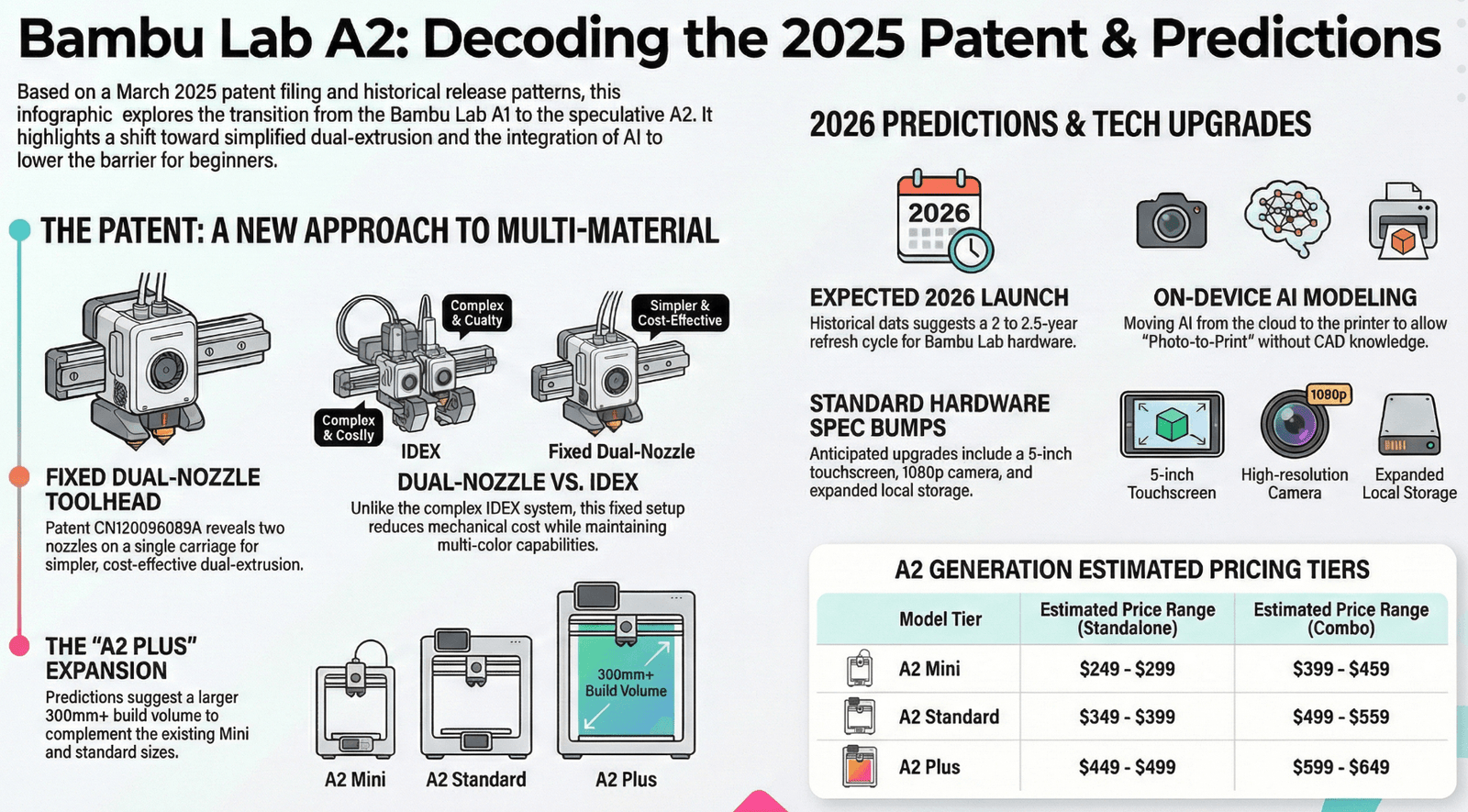
A patent filed in March 2025 might be the clearest signal yet that Bambu Lab’s A series is getting a serious upgrade.
China’s patent database recently published a filing from Bambu Lab (Publication No. CN120096089A) titled “Tool Head Offset Determination Method and 3D Printer.” Buried in the diagrams: a version of the A1 fitted with a fixed dual-nozzle toolhead. Bambu hasn’t said anything officially. But this is worth unpacking.
A quick look at Bambu Lab’s release pattern
Bambu launched the A1 Mini in September 2023. The full-size A1 followed about three months later in December 2023. That’s a tight cadence — Mini first, bigger sibling shortly after.

The P series followed a similar pattern. P1S launched and ran strong for nearly two years before the P2S arrived in late 2025 as a refined evolution of the same core architecture.
If Bambu sticks to that formula, an A2 refresh in 2026 — roughly two to two-and-a-half years after the A1 — fits perfectly. The A series hasn’t seen a hardware update since launch. It’s overdue.
What the patent actually shows
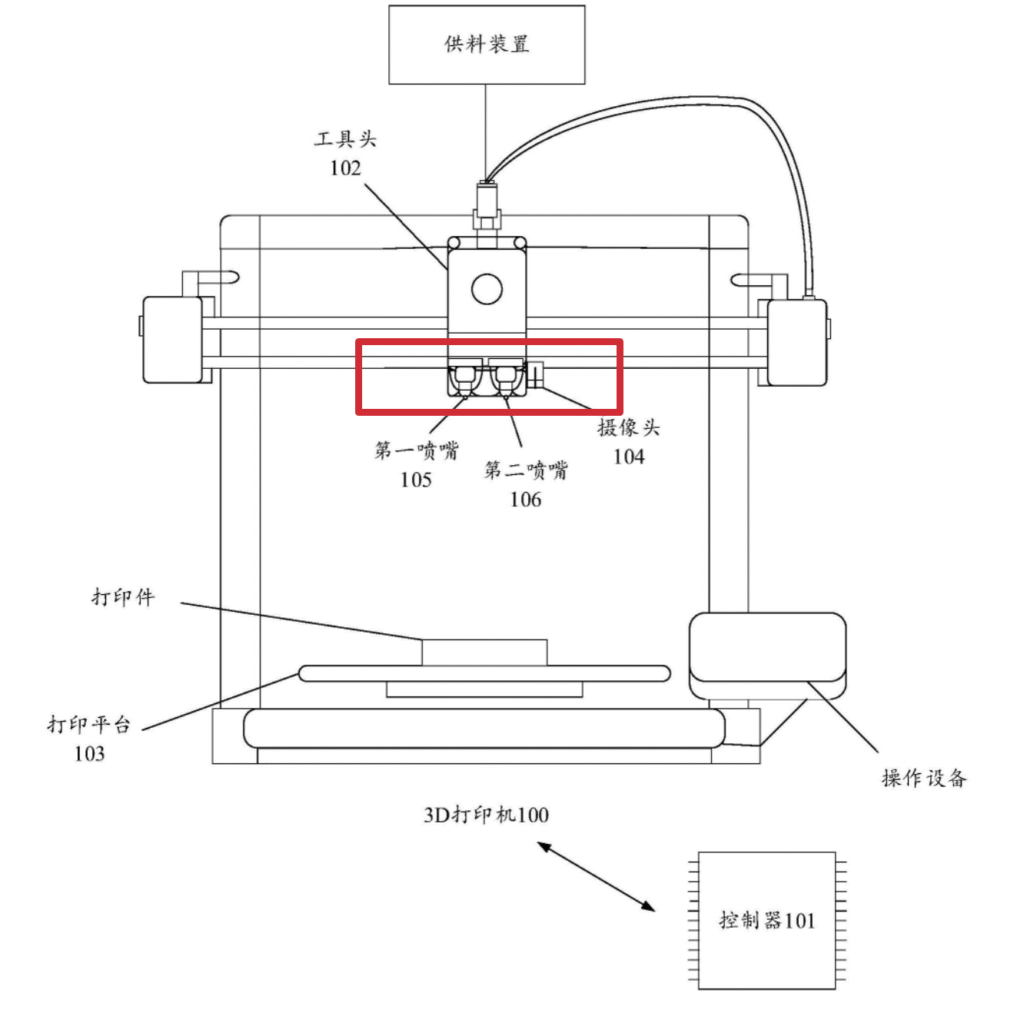
The filing shows a fixed dual-nozzle configuration on an A1-style body. Two nozzles, one toolhead, no independent carriage movement.
This matters because it’s fundamentally different from what Bambu already does with dual extrusion on the H2D. That machine runs full IDEX — two completely independent print heads on separate carriages. Impressive engineering, but expensive and complex to manufacture.
A fixed dual-nozzle setup is simpler. Both nozzles live on one toolhead. You lose some of the flexibility of true IDEX, but the mechanical complexity drops significantly. For a printer positioned as entry-level, that’s the trade-off that actually makes sense.
The other route Bambu could take is something closer to the H2C’s Vortek hotend swap system — a tool-changer approach that lets you switch between different hotend types mid-print.
Better on paper. But mechanically involved and harder to price competitively. I don’t see that landing in the A series. That’s P-series territory.


Or it’s just a spec bump — and that might not be enough
Bambu could take the safe road. The P1S-to-P2S transition is the template: same core architecture, upgraded hardware. Better camera (the P2S moved to 1080p), bigger touchscreen (5-inch), expanded local storage, HF hotend support, updated AMS interface.
An A2 could do the same. Improve the A1’s small 2.4-inch screen, add 1080p timelapse camera, upgrade storage, maybe add a USB-C port. These are all reasonable, useful upgrades.
But here’s the problem: the budget 3D printer market in 2026 is brutal. Creality, Anycubic, and Elegoo are all pushing capable machines at aggressive prices.
A spec refresh alone won’t move the needle. Over on the Bambu Lab community forum, users are already asking: “With the P2S and H2C ticking off the main wishlist items, what’s actually left?” The A series is the obvious answer — but only if it brings something genuinely new.
The AI angle is real
This is the one I keep coming back to. Bambu already has AI modeling tools on MakerWorld. If they move that capability onto the device itself — so a complete beginner can describe an object or take a photo and get a finished print without touching any CAD software — that changes everything about the A series pitch.
Right now, even “easy” 3D printing has friction. You still need a model file. You still need to slice it. For someone who just wants to print something, that’s a wall.
On-device AI that handles the full loop — idea to print, no CAD knowledge required — would be a genuine differentiator. Not a gimmick. The actual reason a non-maker buys a printer.
Will there be an A2 Plus?
Probably. People have been asking for a larger-format A1 since the A1 launched. The A1’s 256×256×256mm build volume is solid, but there’s clearly appetite for something bigger. An A2 Plus with a 300mm or larger bed wouldn’t surprise anyone — and it gives Bambu a clean three-tier lineup: A2 Mini, A2, A2 Plus.
On pricing
The A1 Mini currently runs $299 on Bambu’s US site, with the AMS Lite combo at $459. The A1 is $399 standalone, $559 with the combo kit.
Given that the P2S came in at $699 and didn’t dramatically reposition Bambu’s pricing philosophy, I’d expect the A2 lineup to stay in the same ballpark as the A1. Maybe a slight bump at the top end if dual-nozzle hardware adds cost, but the A series lives and dies by value positioning. Bambu won’t blow that up.
Read: Is the Bambu Lab A1 Mini Worth It for Beginners in 2026? (Honest Review)
Frequently Asked Questions
When is the Bambu Lab A2 release date?
No official date yet. Based on Bambu’s historical release cadence — A1 launched late 2023, A series hasn’t had a hardware update since — a 2026 announcement is likely. Second half of 2026 is a reasonable guess, but I have no confirmed date.
Will the Bambu A2 have dual extrusion?
A March 2025 patent shows a dual-nozzle A1-style printer, suggesting Bambu is at least exploring it. This is speculation based on a patent filing, not a confirmed feature. Patents often don’t become products.
What’s the difference between dual nozzle and IDEX?
IDEX (Independent Dual Extrusion) uses two completely separate print heads on independent carriages. Dual nozzle puts two nozzles on one toolhead. IDEX is more flexible; dual nozzle is simpler and cheaper to build.
How much will the Bambu A2 cost?
No official pricing. Based on current A1 pricing ($299–$559 depending on config) and Bambu’s value positioning, expect the A2 to stay in a similar range.
Should I wait for the A2 or buy the A1 now?
If you need a printer today, the A1 is excellent and has dropped in price. If you’re not in a rush and want to see what the A2 brings — especially if the dual-nozzle patent becomes real — waiting makes sense.
What do you actually want from the A2 — dual nozzle, bigger build volume, on-device AI, or just a cleaner version of what already exists? Drop it in the comments.

Leave a Reply