Introduction
Bambu Lab has once again shaken up the 3D printing industry with an unexpected announcement.
Through its official forum and video channels, the company revealed its upcoming Vortek multi-color system along with a brand-new flagship printer, the H2C, scheduled for release in Q4 2025.
In a surprisingly candid statement, Bambu Lab admitted that disclosing the H2C so early could hurt the sales of its existing models, the H2D and H2S.
At the same time, keeping silent might lead to customers regretting their purchase decisions later on.
This unusual level of transparency not only highlights a classic business dilemma, but also demonstrates Bambu Lab’s absolute confidence in the disruptive potential of the Vortek system.
Industry observers see this announcement as more than just a product teaser. It is better understood as a strategic declaration about the future direction of multi-color FDM printing.
The Core Challenge of Multi-Color 3D Printing
To understand the importance of Vortek, we need to revisit a fundamental question:
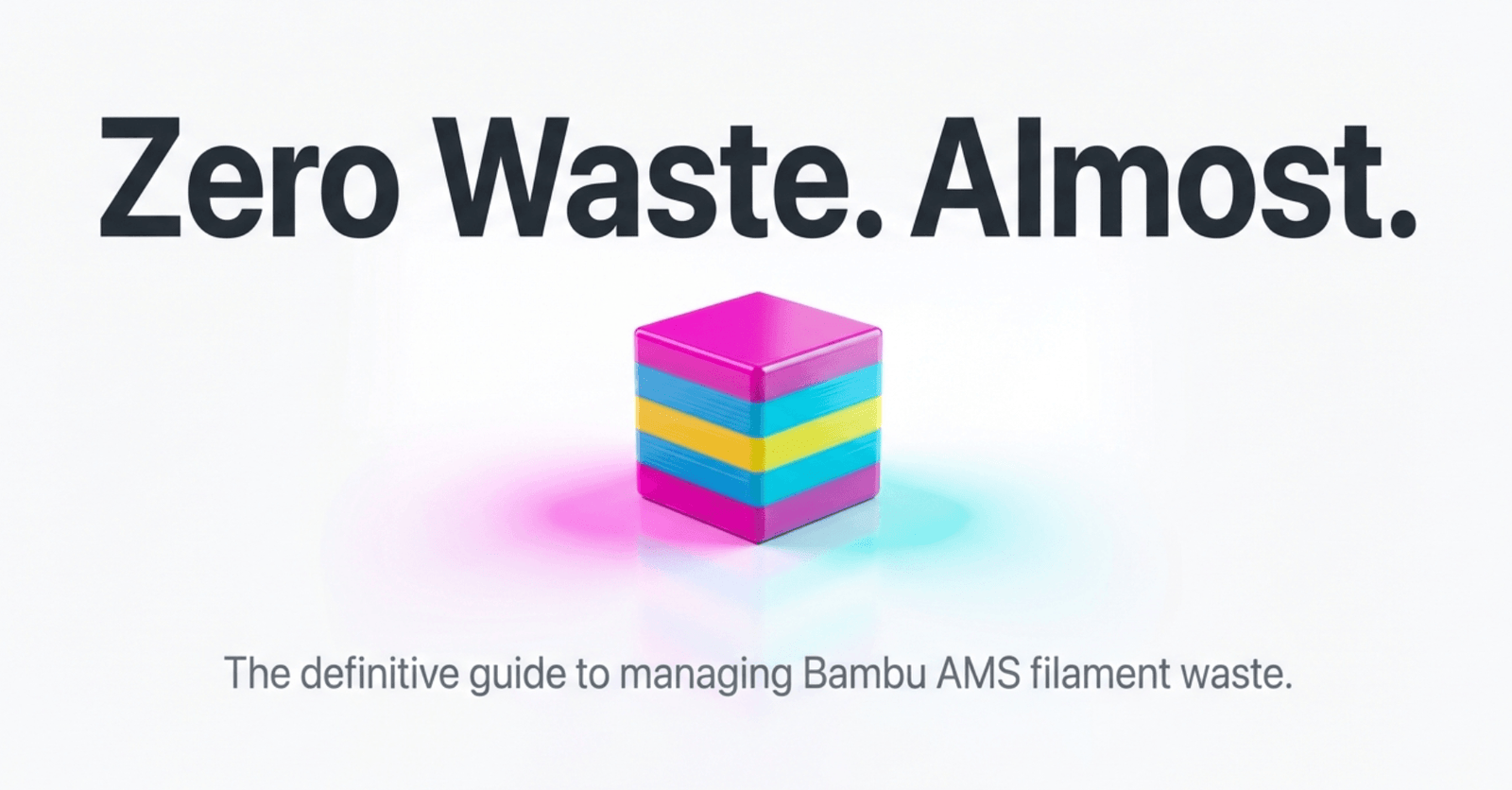
Why do multi-color 3D printers generate purge waste in the first place?
The answer is simple—to clean residual filament from the nozzle before switching to a new color.
As Bambu Lab explained in its video, printing multiple colors with a single nozzle is like painting with a brush. Every time you change colors, you need to clean the brush so that the old pigment doesn’t contaminate the new one.
This analogy reveals the heart of the problem:
- Every multi-color 3D printer today must either waste filament during purging or sacrifice speed with long cleaning cycles.
- For the past three years, this trade-off has been a constant bottleneck across the entire FDM industry.
The promise of the Vortek system lies in its ambition to eliminate or drastically reduce this compromise, paving the way for faster, cleaner, and more efficient multi-color printing.
Five Technical Pathways to Multi-Color Printing
In its official forum post, Bambu Lab openly shared the five different engineering routes it considered before finalizing the Vortek system. Each reflects a unique design philosophy and trade-off:
Option A: Full Gantry Switching
- Swap out the entire gantry for each nozzle.
- Pros: Simple, avoids connector issues.
- Cons: Extremely expensive and bulky; usually limited to dual-nozzle IDEX designs.
Option B: Toolhead Switching
- Only the toolhead is swapped, while the motion system is shared.
- Pros: Saves space and reduces cost compared to full gantry.
- Cons: Requires complex connectors between gantry and toolhead; toolheads remain heavy, limiting scalability.
Option C: Hotend Module Switching
- Replace just the hotend module, keeping the motion system, extruder, and cooling shared.
- Pros: More compact and cost-effective.
- Cons: Electrical and thermal connections (heating, sensors) are prone to reliability issues over long cycles.
Option D: Bare Nozzle Switching
- The simplest idea: swap only the nozzle and heatsink, while heating and temperature sensing are handled externally (similar to the Bambu A1 nozzle).
- Challenge: Maintaining consistent thermal conductivity during thousands of swaps is extremely difficult.
Final Choice: Vortek Wireless Hotend Switching
Bambu Lab ultimately chose Option C, but with a critical innovation: wireless power and data transfer.
- Instead of fragile spring pins or mechanical connectors, the hotend uses induction heating and a custom microchip.
- The chip not only receives power but also measures temperature, transmits material information, and communicates wirelessly with the printer.
- According to official claims, the nozzle can heat up to printing temperature in just eight seconds.
This approach eliminates one of the biggest barriers to reliable hotend switching and positions Vortek as a true breakthrough in multi-color FDM technology.
Key Technical Highlights of H2C
The H2C is more than just a printer with a new hotend system. It integrates Vortek into a carefully engineered architecture:
Build Volume
From screenshots in the official video, the H2C appears to have a build size of 330 × 320 × 325 mm, slightly different from both the H2D and H2S.
Dual-Nozzle Architecture
- Left nozzle: A liftable fixed nozzle, designed to move up and down to avoid dragging during prints.
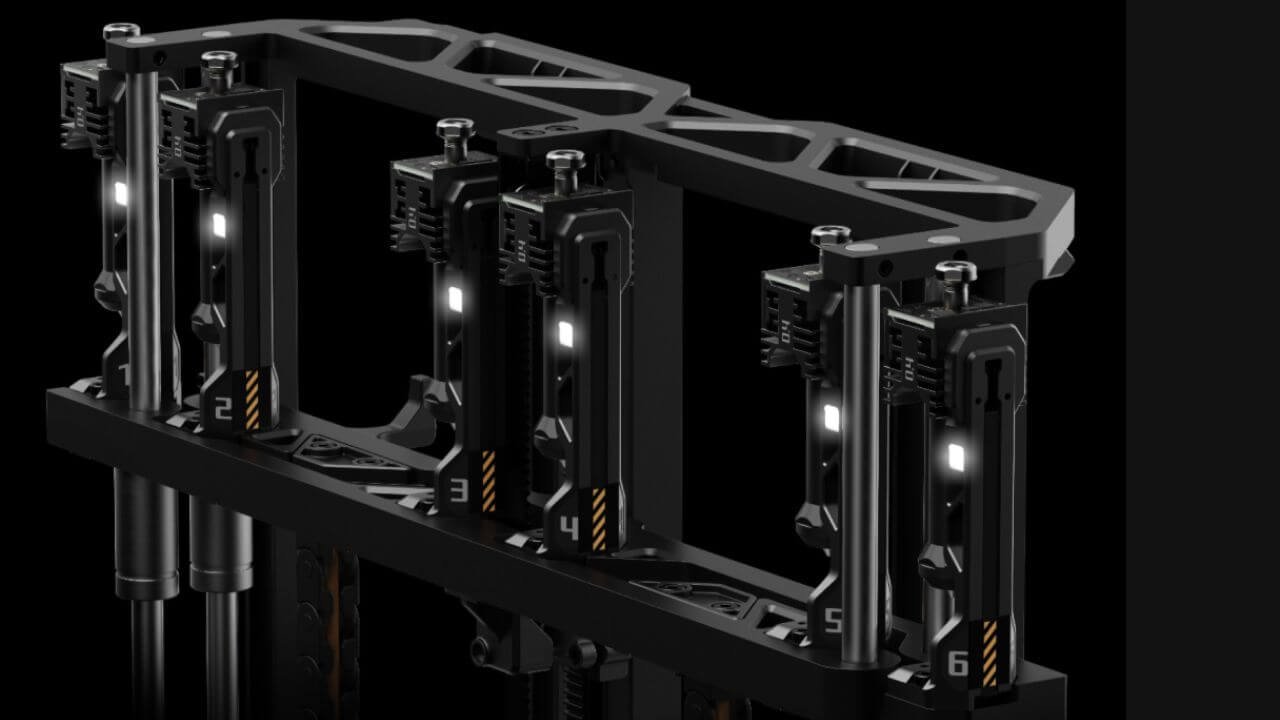
- Right nozzle: Equipped with the Vortek hotend switching system, capable of selecting from six different hotends stored in a side-mounted exchange bay.
- In total, users gain access to seven hotends (one fixed + six swappable).
Multi-Color Capacity
Bambu Lab suggests that the system may support up to 24 filament inputs, likely through multiple AMS units. While the math isn’t fully disclosed (some speculate 6 hotends × 4 AMS channels = 24 colors), official confirmation is still pending.
Wireless Induction Heating and Communication
- No cables, no spring-pin connectors.
- Each hotend carries a microcircuit that enables induction heating, real-time temperature sensing, and wireless data transfer.
- The system claims a heat-up time of just eight seconds, minimizing downtime between color changes.
Precision Alignment and Calibration
Swapping hotends thousands of times requires micron-level consistency. The H2C appears to use vision-assisted alignment to ensure repeatable accuracy.
Software Complexity
Bambu Lab emphasized that the software layer is often underestimated. Even though the hardware was finalized months ago, software development continues to be the main factor delaying the product launch. This reflects the critical role of algorithms and firmware in managing such a complex multi-color system.
Upgrade Possibilities from H2D to H2C
For current H2D owners, one of the most pressing questions is whether their printers can be upgraded to support the Vortek system.
Bambu Lab has confirmed that H2D units can indeed be upgraded to H2C, but with important caveats:
- The process is technically feasible, but requires significant skill and patience.
- Users must carefully follow detailed instructions and be prepared to spend several hours completing the conversion.
- The company openly admits this procedure is more complicated than replacing a clogged nozzle, and therefore does not recommend it for beginner-level users.
In short, while the upgrade path exists, it is clearly targeted at advanced makers and technically confident users, not the average hobbyist.
Market Strategy and Timing
The Vortek system will debut as a standard feature of the H2C flagship printer, officially scheduled for Q4 2025.
This launch window is not accidental—it aligns with several strategic considerations:
- Global shopping season: The release coincides with major year-end sales events, including Singles’ Day (11.11) in China, as well as Black Friday and Christmas in Western markets.
- Competitive positioning: By revealing H2C now but shipping later in the year, Bambu Lab both reassures potential buyers of its technology roadmap and limits the reaction time available to competitors.
- Market timing: The multi-color FDM printing segment is still a largely untapped “blue ocean.” Capturing user attention and wallet share during this critical period could lock in long-term market leadership.
From a business perspective, Q4 2025 is the perfect stage for Bambu Lab to maximize visibility, leverage seasonal demand, and strengthen its position in the growing multi-color 3D printing race.
Conclusion
The Vortek system represents more than just another incremental upgrade—it signals a major technological leap for multi-color FDM printing.
By eliminating fragile connectors through wireless hotend switching, enabling seven hotends and potentially 24 colors, and tightly integrating hardware with advanced software, Bambu Lab has set a new benchmark for what desktop 3D printers can achieve.
For users, the implications are clear:
- Faster and cleaner multi-color printing.
- Reduced waste and downtime.
- Expanded creative possibilities across functional and aesthetic applications.
For the industry, Vortek may mark the start of a new cycle of competition, pushing manufacturers to rethink their approaches to multi-material and multi-color solutions.
Interestingly, Bambu Lab described this as their “First Attempt” at solving purge waste, hinting at future iterations and even more ambitious systems down the road.
With H2C slated for Q4 2025, the stage is set for a new era in desktop 3D printing—where multi-color is not just an add-on, but a defining standard.
FAQ
Q1: How does the H2C differ from the H2D and H2S?
The H2C is the first printer to feature the Vortek wireless hotend switching system, allowing up to 24 colors. The H2D and H2S remain traditional dual-nozzle machines without this capability.
Q2: How fast can the H2C switch nozzles?
Bambu Lab claims that each hotend can reach printing temperature in just eight seconds, significantly reducing the downtime during color changes.
Q3: Can existing H2D owners upgrade to H2C?
Yes, but the process is complex and time-consuming. Bambu Lab does not recommend it for beginners, as it requires advanced technical skills and several hours of careful work.
Q4: Will the Vortek system reduce filament waste?
That is its core purpose. While the full details of waste reduction are not yet disclosed, the system is designed to minimize purging material and improve overall efficiency.
Q5: When will the H2C be released?
The H2C is officially scheduled for launch in Q4 2025, strategically aligned with major global shopping seasons.