
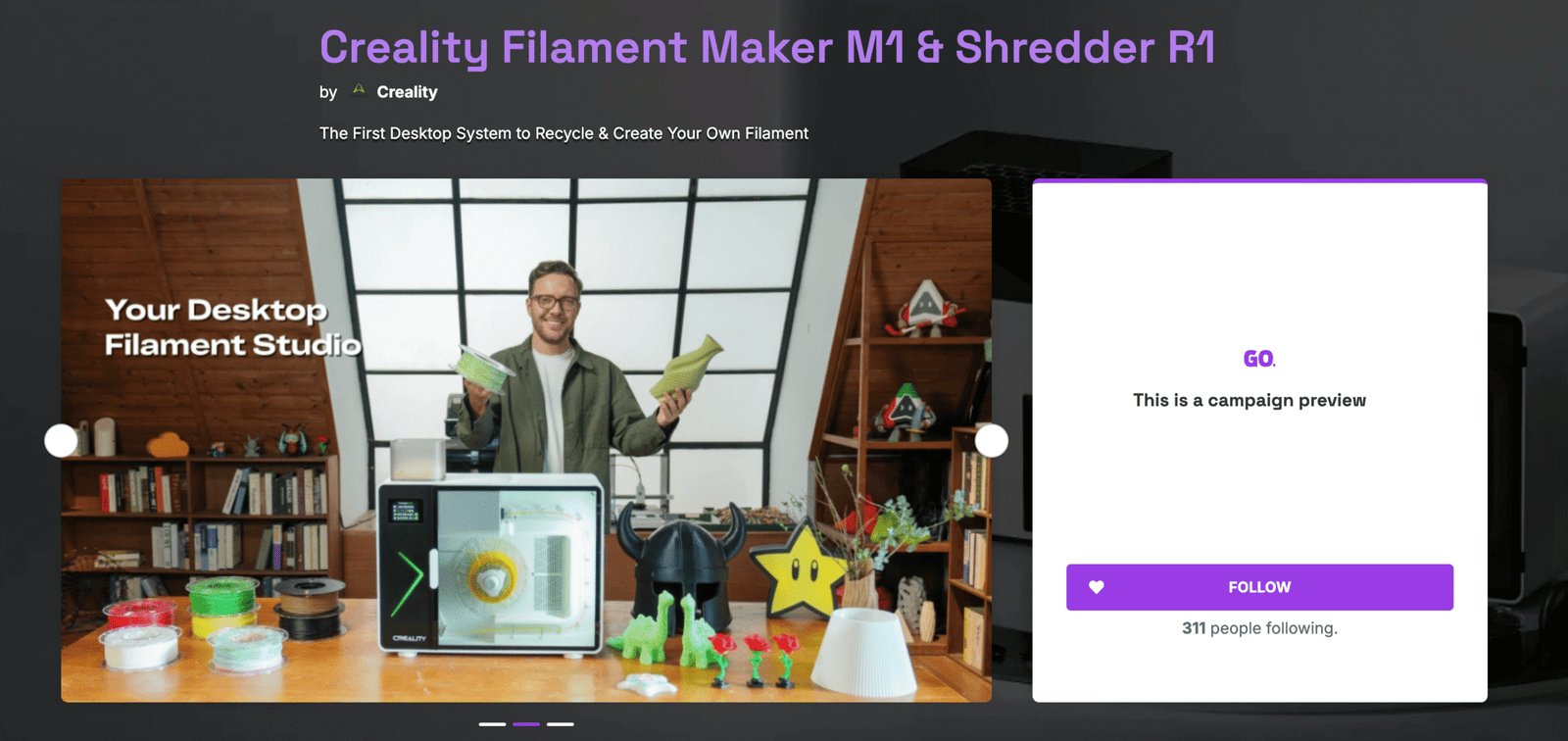
Should You Back the Creality M1 & R1 on Indiegogo? (Quick Answer)
✅ Back it now — if you run a Bambu AMS and generate serious filament poo, or if you print high-waste jobs regularly and already know your monthly scrap volume.
⏳ Wait for retail — if you’re on a single printer, generate less than 1-2kg of waste per month, or hate dealing with early-access hardware.
❌ Skip it entirely — if you want drop-in commercial filament quality from recycled scraps. The ±0.1mm tolerance on recycled output is real, and it matters.
The Creality M1 & R1 Indiegogo campaign is live right now.
Not “coming soon.” Not “deposit phase.” Live.
I’ve been tracking this since the deposit page launched in February. Now that the campaign is actually up, I can give you a real answer — not speculation.
Here’s what you need to know before you click that back button.
Creality M1 Pricing, Specs & Deposit Terms: What’s Now Confirmed
When I first covered this in February, half the important questions had no answers.
That’s changed.
Here’s what Creality has now confirmed:
Pricing is locked. VIP price (deposit holders): M1 at $649, R1 at $349, Bundle at $899. If you missed the deposit phase, Super Early Bird on Indiegogo is $799 / $499 / $1,199. MSRP sits at $1,149 / $649 / $1,699 — so the crowdfunding discount is real, not manufactured.
The deposit is 100% refundable. If you placed a $50 deposit and don’t back the campaign, Creality refunds it within 14 business days after the campaign ends. No catch in the fine print that I can find.
Shipping terms are clear for most regions. Free shipping to the US (contiguous), UK, and all EU countries. VAT and customs fees are included in the listed price. Other regions are still being finalized — contact crowdfunding@creality.com if you’re outside those areas.
Materials support is confirmed. Eight materials: PLA, ABS, PETG, ASA, PA, PC, TPU, PET.
What’s still not confirmed: Real-world output consistency. Noise levels. Dust containment in a real home environment. Wear-part replacement costs. Nobody outside Creality has run this thing for 30 days straight.
That last part matters more than anything on the spec sheet.
Creality M1 for Bambu Lab AMS Users: Is It Worth It for Filament Poo?
If you run a Bambu printer with AMS, you already know what filament poo is.

Every color change produces a purge block. Every multi-color print leaves a pile of mixed-color waste on your build plate. If you’re printing multi-material jobs regularly, that waste adds up faster than most people track.
Here’s a rough reality check.
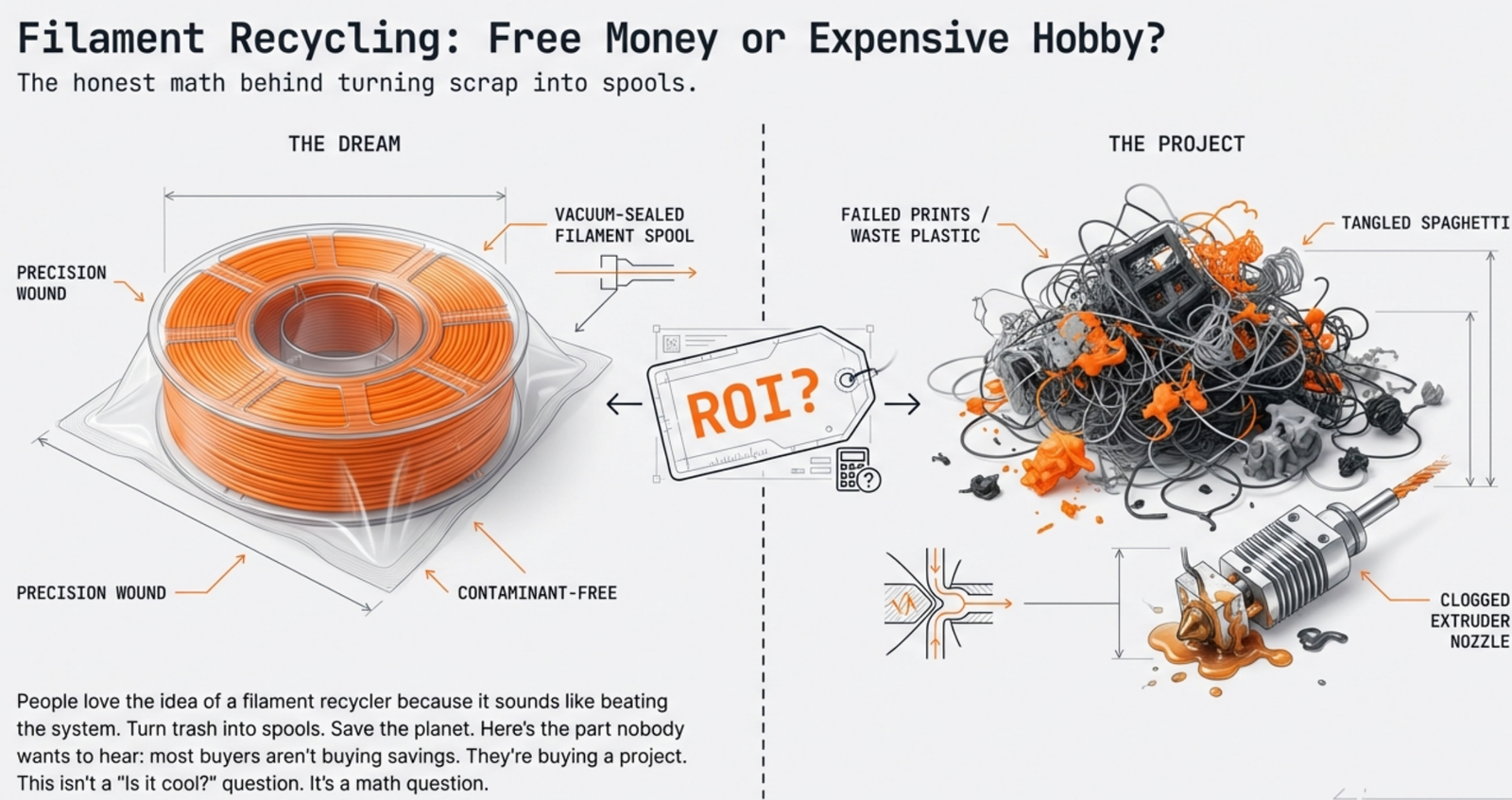
A typical AMS multi-color print wastes somewhere between 50-150g of filament per job depending on color changes and purge settings. Run two or three of those jobs a week, and you’re looking at 400-600g of waste monthly. That’s roughly 5-7kg of wasted filament per year — at $20-25 per kg, somewhere around $100-175 in annual waste.
That’s the number that matters.
The M1 + R1 Bundle at VIP price is $899. At $150 in annual savings, your payback period is roughly 6 years — before accounting for electricity, wear parts, and failed runs.
That sounds bad. But it’s not the whole picture.
The Bambu AMS case isn’t purely about ROI. It’s about what you do with the recycled output. If you’re using recycled filament for draft prints, test pieces, jigs, and functional prototypes — not finished parts — then ±0.1mm tolerance is acceptable. You’re not wasting $25/kg filament on throwaway prints anymore.
That changes the math.
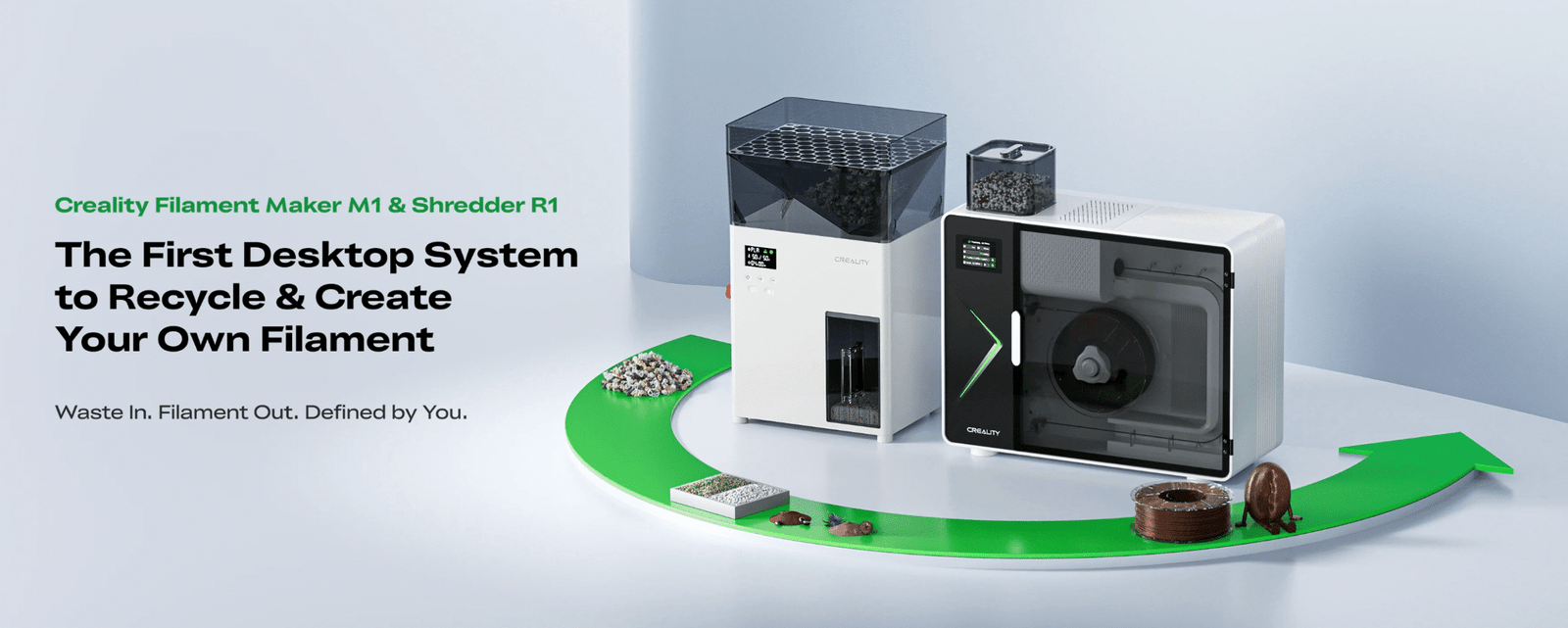
If that’s your workflow, the Bundle makes more sense than buying the M1 alone. The R1 is what turns your AMS purge blocks into usable feedstock. Without it, you’re buying virgin pellets and the recycling loop doesn’t close.
Run your own numbers here first: ROI Calculator →


Creality M1 for Ender & K1 Users: Does the ROI Actually Work?
Single-printer users have a different problem.
You generate waste — failed prints, support structures, skirts, test cubes — but nowhere near the volume of an AMS setup. A typical Ender or K1 user running regular jobs produces maybe 200-400g of scrap per month. That’s 2-5kg per year.
At $20/kg filament, you’re looking at $40-100 in annual waste.
The math here is brutal. At $649 for the M1 alone — not even counting the R1 — your payback period on filament savings alone is 7-15 years. That’s not a recycling system, that’s a hobby project with a very long tail.
So why would an Ender or K1 user consider this at all?


One reason: virgin pellets are cheaper than commercial filament spools.
The M1 isn’t just a recycler. It’s a filament extruder. You can feed it brand-new PLA pellets — which cost around $3-5/kg in bulk — and extrude your own spools instead of buying them at $20-25/kg. That’s a completely different ROI calculation.
If you’re printing at high volume on a single machine — we’re talking 2-3kg per month minimum — the cost-per-kg savings on virgin pellets alone could justify the M1 without ever touching your scrap pile.
But here’s the honest part: most Ender and K1 users aren’t printing 2-3kg a month. If you’re printing casually, a few prints a week, this doesn’t pencil out. The upfront cost is too high and the payback period is too long for the crowdfunding risk to make sense.
My read for this group: wait for retail unless you’re already printing at high volume and buying filament in bulk is already on your radar.
Creality M1 Recycled Filament Tolerance: What ±0.1mm Means for Your Printer
This is the number nobody in the marketing materials wants to talk about.
Creality claims ±0.05mm diameter tolerance when using virgin pellets. That’s competitive with decent commercial filament. Not the best on the market, but workable for most printers.
But when you feed recycled material from the R1 into the M1, that tolerance doubles to ±0.1mm.
That doesn’t sound like much. It is.
Here’s why it matters in practice.
Commercial filament from brands like Bambu or eSUN holds ±0.02-0.03mm. Your printer’s flow rate calibration, pressure advance settings, and extrusion multiplier are all tuned around that consistency.
When diameter swings by ±0.1mm across a spool, your printer sees it as inconsistent flow — even if you’ve calibrated perfectly.
For a 0.4mm nozzle, ±0.1mm variance means you’re feeding anywhere from 1.6mm to 1.8mm filament through a path designed for 1.75mm. That’s a 3% swing on the low end, 3% on the high. Some printers handle this fine.
Others — especially ones with tight PTFE tolerances or bowden setups — will clog or underextrude unpredictably.
Bambu AMS users have it worse. The AMS hub has tight filament path tolerances by design. Oversized filament causes feed jams. Undersized filament causes slipping.
Bambu’s system is optimized for consistent commercial spools — feeding it ±0.1mm recycled output is asking for trouble on anything critical.
This doesn’t mean recycled output is useless. It means you need to be honest about what you use it for.
Draft prints, functional prototypes, test fits, jigs — fine. Visible exterior surfaces, flexible parts, AMS multi-color jobs, anything going through a 0.2mm nozzle — don’t risk it.
Creality’s own page quietly acknowledges this with a small note: “A higher ratio of virgin pellets improves precision and production stability.” That’s not a feature. That’s a warning buried in the specs.
Crowdfunding Risk: What’s Real vs. What’s Noise
Every time a hardware product launches on Indiegogo, the same two camps appear.
One side says “it’s a scam, never back crowdfunding hardware.” The other side says “Creality is a huge company, it’s fine.” Both are overreacting.
Here’s how I actually think about the risk on this one.
What’s not a real risk:
Creality disappearing. This isn’t a three-person startup running their first campaign. Creality ships millions of printers. They have manufacturing infrastructure, supply chains, and a global customer base. The “company vanishes with your money” crowdfunding horror story doesn’t apply here.
Your $50 deposit disappearing. It’s confirmed refundable. If you back and regret it before shipping, the worst case is waiting for a refund process — not losing the money.
What is a real risk:
Shipping slipping past Q2 2026. “Starts shipping Q2 2026” is Creality’s wording. That’s a window, not a date. Hardware products — especially first-generation ones — slip. If Q2 becomes Q3 or Q4, that’s not a catastrophe, but it’s worth knowing you might wait longer than expected.
First-generation hardware being rough around the edges. Creality confirmed this is a functional prototype that isn’t ready for external reviewers yet. That’s honest, but it means nobody outside Creality has stress-tested this in a real home environment for months on end. The first batch of backers are effectively beta testers. That’s normal for crowdfunding. Just don’t pretend it isn’t true.
The recycled output quality gap being wider than the spec sheet suggests. ±0.1mm is a claimed best-case number under controlled conditions. Real-world mixed scrap — different materials, different colors, contamination from supports and purge blocks — could perform worse. Nobody knows yet because nobody has tested it publicly.
The honest risk summary: this isn’t a financial risk. It’s a hardware maturity risk. You’re betting that Creality’s first desktop filament recycling system ships on time and works as advertised. That’s a reasonable bet given their track record — but it’s still a bet.
Creality M1 & R1 Price Breakdown: VIP vs. Early Bird vs. MSRP
Let’s put all the pricing in one place and be honest about what you’re actually paying.
| Product | VIP Price (deposit holders) | Indiegogo Super Early Bird | MSRP |
|---|---|---|---|
| Filament Maker M1 | $649 | $799 | $1,149 |
| Shredder R1 | $349 | $499 | $649 |
| M1 + R1 Bundle | $899 | $1,199 | $1,699 |
The bundle discount is real. Buying M1 + R1 separately at VIP price costs $998. The bundle is $899. That’s $99 saved on top of an already discounted price. If you want both machines, the bundle is the only version that makes financial sense.
The M1 alone at $649 is the interesting case. You skip the recycling loop entirely and use it purely as a filament extruder fed by virgin pellets. Here’s what that math actually looks like:
| Variable | Number |
|---|---|
| Virgin pellet cost | $3–5/kg |
| Commercial spool cost | $20–25/kg |
| Savings per kg extruded | ~$15–20 |
| M1 VIP price | $649 |
| Filament needed to break even | ~35–40kg |
| Run time to break even (at 1kg/hr) | ~35–40 hours |
High-volume users get there. Casual users don’t.
One thing worth noting: every M1 purchase includes a Starter Kit — 2kg of PLA pellets and five 50g packs of coloring masterbatch. That’s enough to produce your first spool immediately without sourcing pellets separately. It removes one barrier to getting started on day one.
The retail price of $1,149 for the M1 is the number that makes the crowdfunding price look attractive. Whether that MSRP holds at retail or drops — I have no clue. Creality has been known to adjust pricing after launch. If you’re thinking “I’ll just wait and buy at retail for cheaper,” that’s a reasonable thought, but not a guaranteed outcome.
Who Should Back the Creality M1 on Indiegogo Right Now
I’m not going to summarize everything I just wrote. You read it. Here’s the short version.
Back it now if: You run a Bambu AMS and you’re drowning in filament poo. You print at high volume — 2kg+ per month minimum. You’ve already run the ROI calculator and the numbers work for your specific situation. You’re comfortable being a first-generation user and you’re not expecting commercial filament quality from recycled output.
Wait for retail if: You want independent reviews before committing. You’re on a single printer with moderate waste output. You hate the idea of waiting on a shipping window that might slip. You need ±0.05mm or better consistency for your actual print workflow.
Skip it entirely if: Your monthly scrap volume is under 1kg. You’re expecting recycled filament to perform like Bambu’s house brand. You’ve never dealt with first-gen hardware headaches and don’t want to start now.
The deposit is refundable. The Indiegogo campaign is live. The pricing is the best it’s going to be before retail.
Those are the facts. The decision is yours.
→ Track the full M1 & R1 specs, pricing history, and updates here


Leave a Reply