
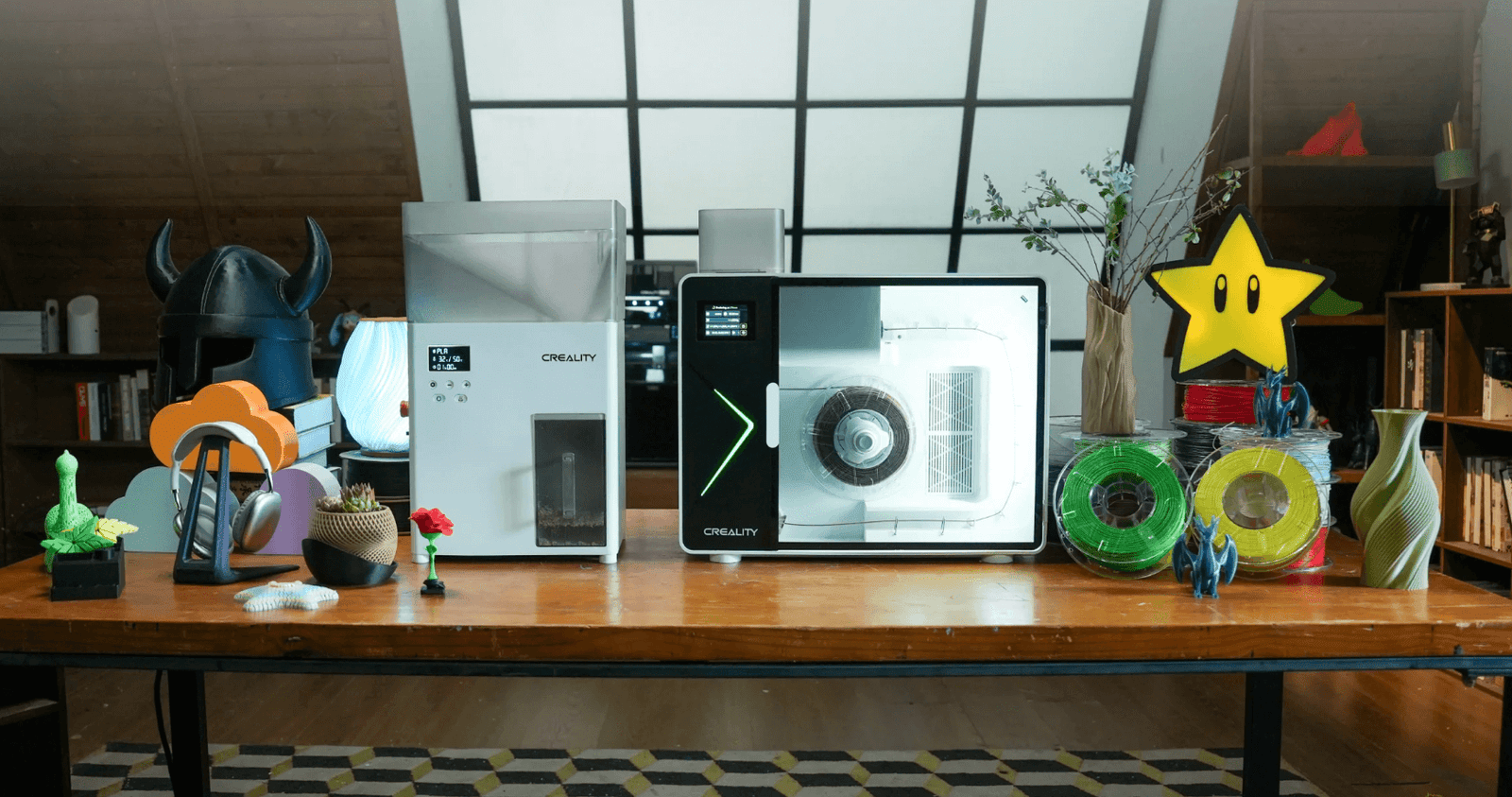
Before you read: Everything in this article is based on Creality’s claimed specifications and official documentation. The M1 & R1 doesn’t ship until Q2 2026. No independent reviewer has tested production units yet.
The ±0.1mm recycled tolerance is Creality’s best-case claim under controlled conditions — real-world results with mixed scraps may be worse. We’ll update this article when independent test data exists.
Table of Contents
Can You Use Creality M1 & R1 Output in Your Printer?
By input route:
| Input Route | Tolerance | Bambu AMS | Bambu (no AMS) | Ender / K1 |
|---|---|---|---|---|
| Virgin Pellets only | ±0.05mm | ⚠️ Likely workable, unverified | ✅ Yes | ✅ Yes |
| 50/50 Mix (Creality’s recommended route) | Not published yet | ⚠️ Unknown — needs real-world testing | ✅ Likely fine | ✅ Yes |
| Recycled scraps only | ±0.1mm | ❌ High risk | ✅ Workable | ✅ With calibration |
Virgin pellet output at ±0.05mm has not been independently tested in Bambu AMS. It performs significantly better than recycled output, but still falls short of Bambu’s own ±0.02mm spec. Proceed with caution.
By printer setup (recycled-only output specifically):
| Your Setup | Verdict |
|---|---|
| Bambu AMS (P1S / X1C) | ⚠️ High risk. Don’t run recycled output through AMS. Use an external spool holder instead, or save recycled filament for draft prints only. |
| Bambu without AMS | ✅ Workable. Expect occasional under-extrusion. Not for finished parts or fine details. |
| Ender, K1, or other single-extruder printers | ✅ Most forgiving. Calibrate your flow rate first and you’ll get usable results on low-stakes prints. |
The Creality M1 & R1 are designed for two things: recycling waste plastic into filament, and creating custom filament from virgin pellets. This article focuses specifically on the output quality of each path — and the tolerance numbers that determine where you can actually use that filament.
It works. But “works” and “works like commercial filament” are two very different things.
The gap between those two is a number: ±0.1mm.
That’s the diameter tolerance Creality states for recycled-only output from the M1 & R1 system. It sounds small. It isn’t. And depending on your printer setup and which input route you use, it changes everything about how you can actually use this filament.
Here’s the full breakdown.
What Is Filament Tolerance?
Your printer is designed around one assumption: the filament going in is consistently 1.75mm thick.
Every setting you calibrate — flow rate, pressure advance, extrusion multiplier — is built on that assumption. Your printer doesn’t measure the filament as it feeds in. It just trusts the number.
Tolerance is how far reality drifts from that number.
A tolerance of ±0.05mm means your filament runs between 1.70mm and 1.80mm. That’s a 0.10mm total swing. Most printers handle this without noticing.
A tolerance of ±0.1mm means your filament runs between 1.65mm and 1.85mm. That’s a 0.20mm total swing — double the range, on the same 1.75mm path.
Think of it like a garden hose. Your sprinkler system is calibrated for a hose that’s consistently the same width. A hose that randomly gets wider and narrower along its length doesn’t deliver water at a consistent rate — even if the average width is correct.
Your printer has the same problem with inconsistent filament. It pushes at a fixed rate. The filament diameter varies. The output becomes unpredictable.
That’s tolerance. That’s why it matters.
Creality Filament Tolerance: Virgin Pellets vs. 50/50 Mix vs. Recycled Output
The M1 & R1 isn’t a single-output machine. What you put in determines what you get out — and those outputs are not the same.
| Commercial Filament (e.g. Bambu) | Virgin Pellets Only | 50/50 Mix (recommended) | Recycled Only | |
|---|---|---|---|---|
| Tolerance | ±0.02mm | ±0.05mm | Not published | ±0.1mm |
| Actual range | 1.73–1.77mm | 1.70–1.80mm | Unknown | 1.65–1.85mm |
| Total swing | 0.04mm | 0.10mm | Unknown | 0.20mm |
| Suitable for AMS | ✅ Yes | ⚠️ Likely workable, unverified | ⚠️ Unknown | ❌ High risk |
| Suitable for single extruder | ✅ Yes | ✅ Yes | ✅ Likely yes | ✅ With calibration |
A few things jump out of this table.
Virgin pellets output is actually decent. ±0.05mm sits at the low end of what most third-party filament brands deliver. Not Bambu-grade, but workable for most printers.
The 50/50 mix is the gap nobody can fill yet. Creality recommends it as the standard recycling route — but they haven’t published a tolerance number for it. We don’t know whether it’s closer to ±0.05mm or ±0.1mm. That data doesn’t exist until real units ship and get tested.
Recycled-only output is a different story entirely. That 1.65–1.85mm range is a 0.20mm total swing across a single spool. One section might feed perfectly. The next might jam your AMS hub or starve your nozzle.
One more thing worth stating clearly: ±0.1mm is Creality’s best-case number under controlled conditions. Real-world recycled output — mixed colors, different print jobs, supports, purge blocks — could perform worse. Nobody has independent test data yet because the machine isn’t shipping until Q2 2026.
The 50/50 Mix: Creality’s Actual Recommended Route
This is the part most articles miss entirely.
Creality doesn’t position pure recycled scrap as the primary input route. Their recommended recycling workflow uses virgin pellets as the base. The official documentation frames it as:
Virgin Pellets + Purges/Plastic bottles + Additives
Waste is an additive. Virgin pellets are the base.
The official recommended ratio for the recycling workflow is 50% recycled scrap + 50% virgin PLA pellets. That’s how Creality expects most users to run this system.
Their product page repeats this signal five separate times:
“A higher ratio of virgin pellets improves precision and production stability.”
That’s not a footnote buried in the specs. That’s a deliberate, repeated warning.
What this means in practice:
If you’re a Bambu AMS user who wants to recycle filament poo, you’re not just dumping purge blocks into the R1 and getting clean filament out the other side. You’re grinding those purge blocks and mixing them with fresh PLA pellets in roughly equal proportion, then extruding.
That changes the cost calculation. It changes the workflow. And it means you need to keep virgin PLA pellets on hand as a permanent part of the recycling loop — not as a one-time starter.
What we still don’t know:
Creality hasn’t published a tolerance number for 50/50 mixed output. Until independent reviewers run actual tests on production units, we can’t say whether 50/50 output is AMS-safe or not. We’ll update this article when that data exists.
Why ±0.1mm Recycled Filament Clogs Bambu AMS
The Bambu AMS isn’t just a spool holder. It’s an active feeding system with multiple pinch points between the spool and your nozzle.
Here’s what recycled filament has to survive before it even reaches the hotend:
AMS intake rollers — grip the filament and push it forward. Designed for consistent 1.75mm. Too thin (1.65mm) and the rollers slip. Too thick (1.85mm) and the filament jams at entry.
PTFE tube inside the AMS — tight tolerance by design. Oversized filament creates friction here. Over a long print, that friction builds into a feed failure.
AMS hub — where all four channels merge into one path. This is the tightest point in the entire system. Diameter spikes here cause hard jams that stop the print completely.
Extruder on the print head — by the time filament reaches here, it’s already traveled through three potential failure points. If it made it this far with a diameter spike, the extruder gear will grind it.
Any single one of these points can fail with ±0.1mm filament. All four in sequence is a recipe for a ruined print and a frustrating 20-minute jam-clearing session.
This isn’t a flaw in Bambu’s design. The AMS is engineered for consistent commercial filament. Feeding it recycled output with five times the diameter variance of Bambu’s own filament (Bambu spec: ±0.02mm; M1 recycled: ±0.1mm) is asking it to do something it wasn’t built for.
Two options that actually work:
Option 1: External spool holder, bypass AMS entirely. Feed recycled filament directly into the print head, skipping the AMS completely. The extruder on the print head is more forgiving than the AMS path. You lose multi-color capability for that print, but you avoid the jam risk entirely.
Option 2: Use recycled filament only for single-material draft prints. Run recycled spools on a separate non-AMS printer if you have one, or save them specifically for prints where you don’t need the AMS at all. Draft parts, test fits, jigs, functional prototypes — anything where a surface defect or slight under-extrusion doesn’t matter.
What you shouldn’t do: load recycled-only output into the AMS and expect it to run like Bambu Basic PLA. It won’t.
Using Creality M1 & R1 Output on Ender or K1: Better Odds, But Not Risk-Free
Single-extruder printers have one big advantage over the Bambu AMS setup: the filament path is short and simple.
On an Ender 3, K1, or most standard FDM printers, filament goes from the spool directly into the extruder. No hub. No multi-channel switching. No tight PTFE runs through an automated system. Just one path, one set of gears, one hotend.
That shorter path means more forgiveness for diameter variance.
A 1.85mm spike that would jam an AMS hub might squeeze through a direct-drive extruder with nothing more than a brief pressure spike. A 1.65mm thin spot that would slip through AMS rollers might still get grabbed by a well-tensioned extruder gear.
That said, “more forgiving” isn’t the same as “no problem.”
What you’ll actually see on a single-extruder printer with ±0.1mm recycled filament:
Occasional under-extrusion on thin spots — visible as gaps or weak layer bonding. Slight over-extrusion on thick spots — visible as blobs or rough surface texture. Higher clog risk compared to commercial filament, especially on 0.2mm nozzles.
The fix before you print anything:
Grab a pair of digital calipers. Measure the recycled filament at 10 points along the first meter. Take the average — that’s your actual diameter. Enter that number into your slicer instead of the default 1.75mm.
This single step compensates for a significant chunk of the variance. It won’t fix every spike, but it brings your flow rate calibration into the real world instead of assuming a number that might be off.
The Ender and K1 are also cheaper to fix if something does go wrong. A clogged nozzle on an Ender costs you a $2 replacement and 10 minutes. A jammed AMS mid-print costs you a ruined multi-color job and significantly more frustration.
Lower stakes printer, lower stakes experiment.
What Recycled Filament Is Safe For vs. What You Should Never Risk
The honest answer isn’t “recycled filament is bad.” It’s “recycled filament has a specific lane, and staying in that lane matters.”
| ✅ Safe — Recycled Only | ⚠️ Possible — 50/50 Mix (unverified) | ❌ Don’t Risk Either |
|---|---|---|
| Draft prints and test fits | Low-detail functional parts | Final presentation parts |
| Functional prototypes (appearance doesn’t matter) | Single-color prints with moderate detail | Anything going through Bambu AMS |
| Jigs, fixtures, and shop tools | Structural parts with thick walls | 0.2mm nozzle prints |
| Calibration objects and test cubes | Ender/K1 prints under 3 hours | Flexible parts (TPU) |
| Single-color prints on Ender / K1 | Multi-color AMS prints | |
| Infill-heavy structural parts | Thin walls or fine surface details | |
| Prints over 6 hours |
The 50/50 column is based on reasonable inference from better tolerance — not confirmed test data. Update pending real-world results post Q2 2026.
TPU specifically: flexible filament is already the hardest material to feed consistently. Add ±0.1mm variance on top of TPU’s natural tendency to buckle under feed pressure and you’re asking for trouble. Don’t recycle TPU through the M1 & R1 and expect it to print well. Use virgin TPU pellets if you want to extrude flexible filament.
Long prints: a diameter spike at hour 1 of a 10-hour print is a minor annoyance. The same spike at hour 8 is a ruined print. Keep recycled filament for shorter jobs until you’ve dialed in your specific batch.
Mixed material scraps: Creality explicitly states mixed materials (e.g. PLA + TPU together) must not be processed — risk of unstable extrusion or machine damage. Sort your waste by material before it goes into the R1. This isn’t optional.
Makers101’s Take
There are three ways to use this machine, and they’re not the same product.
Virgin pellets only: you’re essentially buying a desktop filament extruder. ±0.05mm output, lowest risk, most consistent results. The recycling angle disappears entirely — you’re just making custom filament cheaper than buying spools.
50/50 mix (Creality’s recommended route): this is the actual recycling use case Creality designed for. You dilute your waste scraps with fresh pellets to get better output quality than recycled-only. The tolerance number for this path isn’t published yet. We’ll update when it is.
Recycled scraps only: highest risk, lowest cost per kg, most unpredictable output. ±0.1mm is the best case. Real-world mixed scrap will probably be worse. Fine for draft prints and throwaway jobs. Not fine for anything you care about.
If you’re a Bambu AMS user, recycled-only output isn’t your AMS filament. It’s your draft filament. Run it externally, use it for throwaway prints, and keep your AMS fed with commercial spools or M1 virgin pellet output.
If you’re on an Ender or K1, follow the 50/50 mix route first. Measure your filament. Adjust your slicer diameter. Start with short, low-stakes prints before you commit a full spool to anything important.
Neither answer is “don’t bother.” The M1 & R1 has a real use case — it just isn’t a drop-in replacement for commercial filament. Know the lane, stay in the lane.
FAQ
Q: What is the filament tolerance of Creality M1 recycled output?
Creality states ±0.1mm for recycled pellet output. That means filament diameter runs anywhere from 1.65mm to 1.85mm — a 0.20mm total swing. For virgin pellets, the stated tolerance is ±0.05mm (1.70–1.80mm range).
Q: Can I use Creality M1 recycled filament in Bambu AMS?
No — not reliably. The Bambu AMS has four tight pinch points between spool and nozzle, all calibrated for consistent 1.75mm commercial filament. Recycled output at ±0.1mm carries high jam risk at the AMS intake rollers, PTFE tube, AMS hub, and extruder. Use recycled filament through an external spool holder instead, bypassing AMS entirely.
Q: What does Creality actually recommend — pure recycled or mixed pellets?
Creality recommends a 50/50 mix of recycled scrap and virgin PLA pellets as the standard recycling route. Their product page states five times that “a higher ratio of virgin pellets improves precision and production stability.” Pure recycled-only output is supported but produces lower quality results at ±0.1mm tolerance.
Q: Does ±0.1mm tolerance cause clogs?
It depends on your printer. On Bambu AMS: high clog risk due to tight tolerances throughout the feeding system. On single-extruder printers (Ender, K1): more forgiving, but expect occasional under-extrusion on thin spots and slight over-extrusion on thick spots. Measuring actual filament diameter with calipers and entering it into your slicer reduces the risk significantly.
Q: When will independent test data be available for the M1 & R1?
The M1 & R1 is scheduled to begin shipping Q2 2026. No production units have been tested by independent reviewers yet. All tolerance figures in this article are based on Creality’s official specifications. This article will be updated when real-world test data exists.
→ Still deciding whether to back the Creality M1 & R1 on Indiegogo? Read the full Indiegogo breakdown here.
→ Track confirmed specs, pricing, and updates on the M1 & R1 Live Tracker.


Leave a Reply