
Heads up — some of the links below are affiliate links. If you buy through them, I earn a small commission (at no extra cost to you), which helps cover the gear I test. Thanks!
Here’s a thing that doesn’t happen very often in patent court: a company gets beaten with its own words.
That’s exactly what occurred on April 24, 2026, when the Unified Patent Court (UPC) in The Hague dismissed Stratasys’ emergency bid to block the Bambu Lab H2C from European shelves. The judges didn’t just rule against Stratasys — they reached back to a statement Stratasys itself made to patent examiners in 2017 and used it to dismantle the company’s argument.
The patent Stratasys claimed Bambu Lab was violating? Under the court’s reading, it doesn’t cover the H2C’s design. Not even close.
For Bambu Lab, it’s the first legal win in a cross-continental war that now spans the US, Europe, and China. For the 3D printing community, it is believed to be the first time the UPC — a relatively new European court with jurisdiction across 18 EU member states — has ruled on core consumer FDM technology. The interpretation it set down will matter for years. It may not be the last front. Bambu is now hiring for UV inkjet work, which opens a whole new patent surface.
Quick Answer (TL;DR)
- What happened: The UPC Hague Local Division dismissed Stratasys’ provisional injunction against the Bambu Lab H2C (case UPC-CFI-305/2026) on April 24, 2026.
- The patent at stake: EP2964450 — Stratasys’ European patent on multi-material purge tower technology.
- The decisive issue: What “layer by layer printing” actually means — and Stratasys’ own 2017 filing proved its patent means something narrower than it argued in court.
- The result: H2C ships freely in Europe. The invalidation case in Paris continues. The US litigation is still live.
Why Stratasys Went After Bambu Lab in the First Place
To understand this ruling, you need to understand the business logic behind it.
Stratasys built its dominance in the 2000s and 2010s by patenting core FDM technology and using those patents as a legal moat. Competitors couldn’t build affordable printers without running into Stratasys’ IP.
The strategy worked — until the patents started expiring, and suddenly a generation of fast-moving manufacturers could compete on equal technical footing.
Bambu Lab is the most dramatic example of what happened next. Founded in 2020 by a team of ex-DJI engineers in Shenzhen, the company burst onto the scene with its first printer in 2022 and grew at a pace the industry had never seen — reportedly posting a 3,000% increase in printer shipments in a single year (2023, per market intelligence firm CONTEXT).
Its machines offered near-industrial speed and multi-material capability at prices consumers could actually afford. Stratasys watched its own sales decline in parallel.
In August 2024, Stratasys filed two patent infringement lawsuits in the US District Court for the Eastern District of Texas — targeting Bambu Lab’s entire lineup. The complaints alleged infringement of ten patents covering purge towers, heated build platforms, tool head force detection, and networked printing.
The message was unmistakable: you built something that looks like ours, and we’re coming for you.
How the H2C Became the European Flashpoint
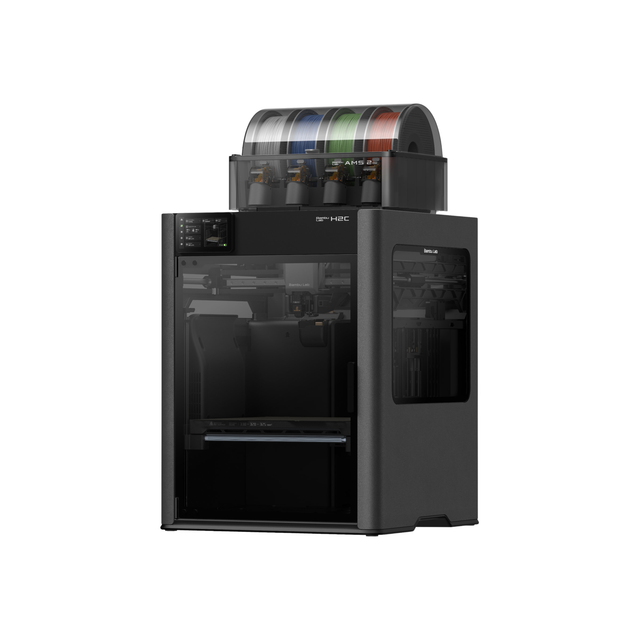
- Bambu Lab H2C 3D Printer revolutionizes printing with multiple colors
- With 6 different nozzles and a versatile 7th nozzle for support, this 3D printer enables fast multi-color printing, minimizes purge time, and reduces filament waste
- Using different nozzles, this printer can print different types of filament at the same time, expanding the limits of your creations
- Ultimate Starter Kit includes additional: -> 1x AMS 2 Pro, 1x AMS HT -> 3x Induction Hotend 0
- 4mm -> 1x Regular Hotend 0
- 2mm -> 1x Regular Hotend 0
On August 26, 2025, Bambu Lab launched the H2S and — in an unusual move — simultaneously teased the upcoming H2C in a blog post, revealing its existence before the product had even reached their warehouse.
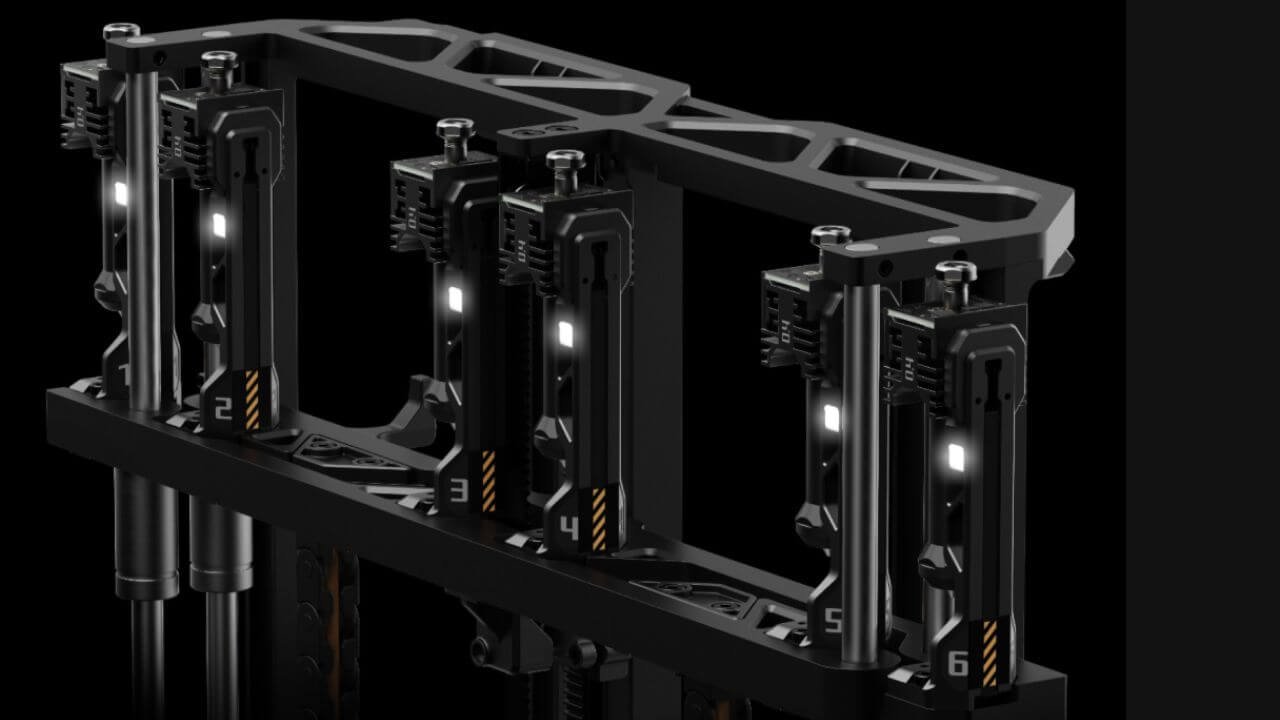
The H2C is Bambu Lab’s first hotend-changer printer, built around the proprietary Vortek system: instead of switching entire toolheads, it swaps just the hotend, enabling up to seven different materials in a single print while dramatically reducing — and in many configurations eliminating — the purge waste that plagues conventional multi-material printing.
The full product reveal came on November 18, 2025, at Formnext in Frankfurt — one of the world’s largest additive manufacturing trade shows — where Bambu opened European pre-orders alongside a live demonstration of the machine.
Stratasys was watching. Between November 2025 and January 2026, the company obtained sample units and ran technical tests. What it found — or believed it found — was a new infringement of European patent EP2964450, which covers multi-material printing with purge towers.
On January 28, 2026, Stratasys filed for a provisional injunction at the UPC Hague Local Division. In plain terms: it asked the court to immediately block the H2C from being sold anywhere in the 18 EU member states that fall under UPC jurisdiction, before a full trial even began.
But Bambu Lab had already moved first.
On December 16, 2025 — six weeks before Stratasys filed for the injunction — Bambu Lab had preemptively filed a patent invalidation action (UPC-CFI-0001952/2025) at the UPC Paris Local Division, challenging the very patent Stratasys was planning to use as a weapon. It was a calculated signal: we know what’s coming, and we’re not waiting. The same discipline shows up in its own filings. The rack behind Vortek was locked down 12 days before the H2C went on sale.
What the Court Actually Decided — and the Moment That Settled It
The legal dispute came down to three questions. One went to Stratasys. Two went to Bambu Lab. And the second question was the one that ended the case.
Question 1: Is the H2C’s prime tower a purge tower?
Bambu Lab argued its “prime tower” — the sacrificial structure the H2C prints to purge filament between material switches — was fundamentally different from the “purge tower” described in Stratasys’ patent. The court didn’t buy it. Functionally, it said, a prime tower is part of a purge operation.
Stratasys wins this point. But it turned out not to matter.
Question 2: What does “layer by layer” actually mean?
This is where the case turned — and where Stratasys’ own history became its undoing.
Stratasys argued “in a layer by layer manner” should be read broadly: the printer builds up a 3D object layer by layer, full stop. Under that reading, the H2C’s behavior — printing two different materials within a single layer — would still fall inside the patent’s scope.
Bambu Lab argued the phrase means something more specific: each layer contains only one material, stacked vertically. Mixing red PLA and blue PETG side by side within a single layer is structurally different from anything the patent describes.
The judges opened Stratasys’ own prosecution history and found a statement the company submitted to patent examiners in 2017, when it was trying to get EP2964450 granted. Stratasys had written, explicitly, that each layer of the purge tower is printed with either model material or support material.
One or the other. Not both.
That statement — made a decade earlier to convince examiners that the patent deserved to be granted — now demonstrated that Stratasys’ patent protects only single-material-per-layer purge towers. The H2C, which combines two materials in the same horizontal layer, falls outside that scope.
Bambu Lab wins the decisive point.
Question 3: Does the H2C’s dual-material layer structure fall within the patent?
Given the court’s answer to Question 2, this was straightforward. The H2C’s same-layer, two-material structure — red PLA for the model, blue PETG for support — is not what EP2964450 covers.
The H2C does not infringe.
The Final Ruling
To issue a provisional injunction under UPC rules, a court must find a “high probability of infringement.” The panel concluded Stratasys hadn’t come close to meeting that threshold. Case dismissed — without the court even needing to examine whether the patent itself is valid, or whether the situation was genuinely urgent.
If You Own a Bambu Lab Printer, Here’s What This Means for You
You ordered an H2C in Europe? It ships. No court-imposed hold, no customs headache, no waiting for a secondary ruling. The provisional injunction — the only thing that could have blocked the printer immediately — is gone.
You own an X1C, P1S, or any current Bambu Lab model? This ruling doesn’t directly protect you. The European case was specifically about the H2C and EP2964450. The US litigation — which covers your printer — is a separate proceeding with different patents, and it’s still very much active in Texas.
You’re considering buying a Bambu Lab printer? The European legal risk just got meaningfully smaller. The US risk is unchanged.
Why This Ruling Is Bigger Than One Case
It’s the First UPC Ruling on Consumer 3D Printing — Ever
The Unified Patent Court only became fully operational in June 2023. According to IP law reporters covering the UPC, this is believed to be the first UPC interim ruling on core consumer FDM 3D printing technology.
The legal reasoning the judges applied — particularly their interpretation of what “layer by layer” means in the context of multi-material printing — now becomes a reference point for future disputes across all 18 participating EU member states. This isn’t just Bambu Lab vs. Stratasys. It’s a precedent.
Stratasys Got Trapped by Its Own Patent History
The most remarkable moment in the ruling wasn’t a dramatic courtroom argument — it was three judges reading a document from 2017 and concluding that Stratasys had defined its own patent more narrowly than it was now claiming.
Under UPC rules, courts can use a patent’s prosecution history — the record of communications between the applicant and patent examiners — as an aid to interpreting what a patent actually covers.
What Stratasys told examiners in 2017 to get the patent granted became evidence of what the patent was always meant to protect. The court found that interpretation worked against Stratasys, not for it.
Bambu Lab Is No Longer Playing Defense
A company that files an invalidation action against your patent before you even file for an injunction is not scrambling to survive.
That December 16, 2025 filing in Paris was strategic — it forced Stratasys to respond on two fronts simultaneously and put the patent’s validity on the table before the injunction fight even started. For a company less than six years old, this is sophisticated legal maneuvering.
What’s Still Unresolved
This is a win, not a conclusion. Here’s where things stand:
| Front | What’s Happening |
|---|---|
| UPC Paris | Bambu Lab’s invalidation action against EP2964450 is ongoing. If successful, it could void the patent across the entire UPC jurisdiction — eliminating it as a future weapon entirely. |
| US — Eastern District of Texas | The consolidated case (No. 2:25-cv-00465-JRG) covers Bambu Lab’s full product lineup across ten patents. Jury trial expected. This is the highest-stakes arena. |
The US case deserves a separate article — it involves different patents, a different legal standard, and a jury rather than a panel of judges. A Stratasys win in Texas could result in an injunction blocking Bambu Lab from selling any of its current printers in the United States. That possibility hasn’t changed.
Full Timeline
| Date | Event |
|---|---|
| August 8, 2024 | Stratasys files two patent infringement lawsuits in Eastern District of Texas |
| October 2024 | Charges against Tiertime defendants dropped; Bambu Lab remains sole defendant |
| February 2025 | Bambu Lab moves to dismiss US cases, arguing wrong entity named |
| June 2025 | US cases consolidated into single action (No. 2:25-cv-00465-JRG) |
| August 26, 2025 | Bambu Lab launches H2S; simultaneously teases upcoming H2C in blog post |
| November 18, 2025 | H2C full reveal at Formnext Frankfurt; European pre-orders open; Stratasys begins evidence collection |
| December 16, 2025 | Bambu Lab files preemptive invalidation at UPC Paris — six weeks before Stratasys acts |
| January 28, 2026 | Stratasys files provisional injunction request at UPC Hague |
| April 24, 2026 | UPC Hague dismisses injunction. Bambu Lab wins. |
Frequently Asked Questions
Is the Bambu Lab H2C banned in Europe?
No. The April 24, 2026 ruling dismissed Stratasys’ injunction request. The H2C can be sold and shipped across Europe freely. For that to change, Stratasys would need to succeed in a full trial on the merits — a much longer, harder road.
What is the UPC?
The Unified Patent Court is a European court system for patent disputes, fully operational since June 2023. A single UPC ruling applies across all 18 participating EU member states simultaneously — making it a powerful venue for both enforcement and invalidation. Think of it as a pan-European patent court that didn’t exist a few years ago.
What’s a purge tower, and why does it matter legally?
When a multi-material 3D printer switches filaments mid-print, it needs to clear residual material from the nozzle before resuming — otherwise colors or materials bleed into each other. A purge tower is a small sacrificial structure where this clearing happens. Because purge towers are central to how multi-color printing works, the patents covering them affect nearly every serious FDM printer on the market. That’s why this case has implications beyond just Bambu Lab and Stratasys.
Does this ruling protect my X1C or P1S?
Not directly. This ruling specifically addressed the H2C and European patent EP2964450. The US lawsuits targeting the X1C, P1S, and other current models involve different patents under US law and are still pending.
Could Stratasys still win?
Yes. The April 24 ruling only addressed the provisional injunction — a preliminary measure with its own specific legal standard. It is not a final ruling on infringement or patent validity. The US consolidated case in Texas is still pending with a jury trial expected, the Paris invalidation proceeding hasn’t concluded, and Stratasys could pursue further actions in other jurisdictions. This ruling is a significant win for Bambu Lab, but it does not determine the outcome of the broader dispute.
The Bottom Line
Something shifted on April 24, 2026 — and it wasn’t just a court docket.
Patent litigation has long been a tool that established players use to protect their market position against fast-moving newcomers. Whether those patents reflect genuine innovation or simply describe technologies that have become industry-standard is often the core question — and the answer frequently gets decided in court, not in a lab.
Bambu Lab’s approach here was notable: it moved first, chose its legal battleground carefully, and when the moment came, let Stratasys’ own decade-old words make the argument.
The H2C ships. The patent that was supposed to stop it now has its own validity under challenge in Paris. And a court that will set precedent across the European Union has put down a marker: write your patent to mean one thing, and don’t come back ten years later claiming it means something else.
One case. One court. One ruling. The war continues — but Bambu Lab just proved it knows how to fight it.
Sources: UPC Hague order UPC-CFI-305/2026 (April 24, 2026); PRIP Substack (April 25, 2026); 3D Printing Industry; TCT Magazine; All3DP; Tom’s Hardware; 3Dnatives
Editorial note: This article represents the editorial opinion of makers101.com based on publicly available court records and industry reporting. It does not constitute legal advice. The litigation described is ongoing and outcomes may change. Readers with legal questions about 3D printing IP should consult a qualified patent attorney.
Watching the Stratasys vs. Bambu Lab cases? We’ll update this article as the US litigation and Paris invalidation proceed. Subscribe for alerts.