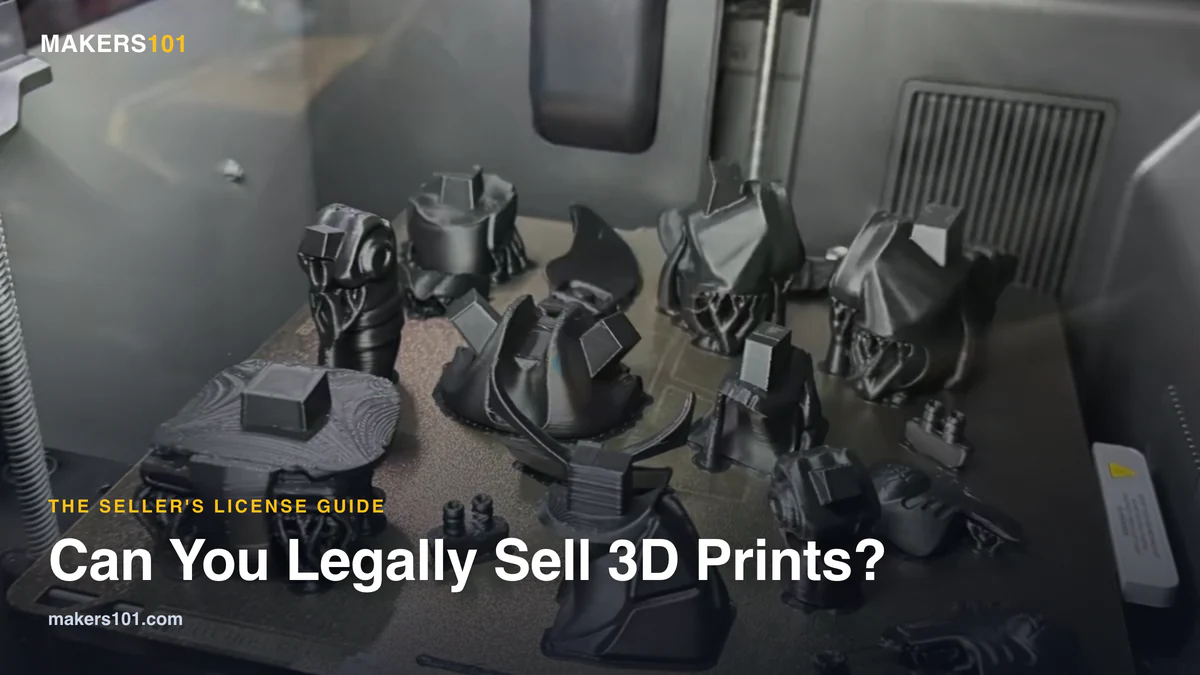

- Quick answer: You can sell 3D prints legally, but only if you own the rights or hold a commercial license to sell 3D prints made from that model. Your own designs and most functional parts are fine. Selling someone else’s model, or any Disney, Marvel, or Pokémon character, without permission is copyright infringement. In the US, statutory damages run up to $150,000 per item.
- A free model is not automatically a sellable model. Check the Creative Commons license first. Any “NC” tag means no selling.
- You can buy commercial rights from MakerWorld, Patreon merchant tiers, Cults3D, STL Flix, or Cubee3D. Often it costs just $3 to $5 per designer.
- Screenshot every license the day you download it. Terms change, and your screenshot is your proof.
- The real trap is not getting a license. It is a license quietly expiring while your listings stay live.
You’ve seen them at every craft fair and all over Etsy. Articulated dragons. Pokémon figures. Baby Yoda planters. At some point you wondered if you could sell prints too.
Here’s what most guides skip: a lot of what you see being sold isn’t actually legal. And “everyone else is doing it” isn’t a defense that holds up in court.
This guide shows you exactly what a commercial license to sell 3D prints is, when you need one, where to get one, and how to sell without risking a takedown or a lawsuit.
Can You Legally Sell 3D Prints? The Short Answer
Yes, you can sell 3D prints, as long as one of three things is true: it’s your own design, it’s a functional part that copyright doesn’t protect, or you hold a commercial license for the model.
That middle category trips people up. A phone stand, a replacement knob, a cable clip: these are functional objects. Copyright generally doesn’t cover the function of a part. A sculpted character is different. That’s creative work, and someone owns it.
So the question is never “can I sell 3D prints.” It’s “do I have the right to sell this model.”
One myth needs to die first. Plenty of sellers tell themselves they’re “just a small fish” and nobody cares. Not getting caught isn’t the same as being legal. The rights holder decides if and when to act, and the math doesn’t favor you. If you want a sense of how seriously courts treat 3D printing intellectual property, look at the legal side of 3D printing and how patent fights are already playing out.
The Real Risk: What Happens If You Sell Without a License
The downside is bigger than most sellers think. In the US, copyright infringement carries statutory damages of up to $150,000 per infringing item, and that’s before court costs and attorney fees.
It gets worse. Those proud “look what I sold” posts on social media can be used as evidence against you. You’re documenting the infringement for them.
Platforms are tightening up too. Etsy rolled out stricter rules on 3D printed items in 2026, and DMCA takedowns can pull your listings, or your whole shop, with little warning.
But not every rights holder behaves the same way. This is the part nobody explains clearly.
Big game companies like Capcom or Nintendo rarely chase down small sellers, even though they could. Other rights holders are aggressive. Disney has a legal team. So do major sports clubs, and some run bots that scan marketplaces for their logos and players. The takeaway: the IP you choose decides your real risk.
| Rights holder type | Typical enforcement | Your real risk |
|---|---|---|
| Big game studios | Rarely pursue small sellers | Lower, still illegal |
| Disney, Marvel, Star Wars | Active legal teams | High |
| Sports clubs and leagues | Bots scanning marketplaces | High |
| Independent designers | Will DMCA, may license | Medium, easy to fix |
The fix for the last row is simple: get a license. The rest you should avoid unless you hold written permission.
Creative Commons Licenses: Which Ones Let You Sell
When a model is free, the Creative Commons license tells you whether you can sell prints of it. Four CC types allow commercial use. Anything marked “NC” doesn’t.
| License | Sell prints? | Condition |
|---|---|---|
| PD (Public Domain) | Yes | None |
| CC BY | Yes | Credit the designer |
| CC BY-SA | Yes | Credit, plus share-alike |
| CC BY-ND | Yes | Credit, no modifying the model |
| Any “NC” (CC BY-NC, etc.) | No | Non-commercial only |
One trap here. Even if a file is labeled public domain, that doesn’t automatically mean you can sell it legally. Read the attribution rules, and read them like your business depends on it. It might.
Then protect yourself. Screenshot the license page, the URL, and the date the day you download the file. If a designer changes the license later, that screenshot proves you got it under the old terms. That record is worth more than you’d think.
Where to Get a Commercial License to Sell 3D Prints
The safest way to sell is to source models from places that grant clear commercial rights. You’ve got more options than you might expect, and they suit different sellers.
| Source | How it works | Typical price | Best for |
|---|---|---|---|
| MakerWorld Commercial License | Per-creator membership | $3 to $300/mo | Bambu ecosystem buyers |
| Patreon merchant tier | Monthly sub to a designer | $5 to $10/mo | Miniatures and tabletop |
| Cults3D / MyMiniFactory | Per-model or tribe rules | Varies | One-off designs |
| STL Flix / Nico Industries | Subscription catalog | Flat monthly | High-volume sellers |
| Cubee3D (Hive) | Plans include a commercial license | Subscription | Starter sellers |
MakerWorld’s commercial license is worth understanding in detail, since many sellers live in the Bambu ecosystem. The designer sets the price. To offer one, a creator needs 200+ followers, 600+ prints, and 90 days with no violations. The platform takes a 10% cut, and there’s a License Helper tool to generate the terms. Personal-use downloads stay free.
Here’s the catch that sneaks up on people. Buy from three or four designers and you now have three or four renewal dates and three or four sets of terms to keep straight. That’s a real job once your shop grows.
How Much Does a Commercial License Cost? And Are Any Free?
For a single model’s commercial rights, expect to pay around $3 to $5 per designer. That’s the going rate, and it’s low enough that there’s no excuse to skip it.
Pricing comes in two shapes. Some platforms charge a monthly subscription that covers a whole catalog. Others sell a per-file license, sometimes capped (for example, “sell up to 25 units”). Read which one you’re buying.
And yes, free commercial-license models exist. MakerWorld has free models that still grant commercial rights, and CC BY models cost nothing to use. Starting there is smart. You learn the full workflow before you spend on original designs.
One pricing note, because it bites new sellers. Your price has to cover material, your time, and the license fee itself. If you want to nail the numbers, work out your real cost per print before you set a single listing price.
The Hidden Trap: Licenses Expire, and Your Listings Don’t
This is the mistake that turns a careful seller into an accidental infringer. Most Patreon and membership licenses are recurring. Cancel one, or simply forget to renew, and your right to sell ends that day. Your Etsy listing doesn’t. It stays live. Now you’re selling without a license and you don’t even know it.
Scale makes it worse. Sellers routinely juggle licenses from many designers, each with its own term and renewal date. One lapse hidden in a stack of twenty is easy to miss, and expensive to explain later.
You need one place that tracks every license and every expiry date, plus a quick way to check the rules before you buy. So I put together a free kit.
Grab my free 3D Print Selling Compliance Kit. It’s two parts. A license tracker that flags any license about to lapse, so a quiet expiry never costs you your shop. Plus a cheat sheet of where to legally buy commercial licenses (with prices), which Creative Commons types actually let you sell, and exactly which IP will get you a takedown. Drop your email below and it’s yours.
Your Pre-Sale Compliance Checklist
Run every model through this before it goes live. It takes two minutes and saves you a takedown.
- Is it your own design or a functional part? If yes, you’re clear to sell.
- Is it a licensed character or someone else’s model? Get written commercial rights first.
- Read the exact license, and watch for the “NC” tag.
- Save a screenshot of the license page and the model link.
- Log it in your tracker with the renewal date.
- Re-check before each restock or new listing.
Once you are cleared to sell and ready to scale, your printer matters as much as your paperwork. These best printers for Etsy and small-business sellers will keep up with real order volume.
Frequently Asked Questions
Do you need an LLC to sell 3D prints? No, an LLC isn’t legally required to start. It separates your personal assets from business liability, which many sellers want once they grow. But registering a business is separate from licensing. You still need the right to sell each model.
Is it legal to sell 3D printed items at markets and fairs? The same rules apply. A craft fair table doesn’t change copyright law. If you don’t own the design or hold a license, selling it in person is still infringement, just with a smaller audience.
How are people selling Pokémon or other trademarked figures “legally”? Mostly, they’re not. Some try to skirt it by “selling a service” or asking for tips instead of listing the product. It’s still risky, and trademark holders like Nintendo can act whenever they choose.
Are there free commercial licenses to sell 3D prints? Yes. CC BY models and certain free MakerWorld models grant commercial rights at no cost. Always confirm the license on the model page and screenshot it.
What is the difference between a personal and a commercial license?
| License | What it covers |
|---|---|
| Personal | Print the model for yourself, no selling |
| Commercial | Sell the printed object, subject to the terms |
Does this apply outside the US? Yes. Copyright protects designs in the EU, the UK, and most major markets, not just the US. Statutory damages differ by country, but selling someone’s model without a license is infringement nearly everywhere. The safe rule is the same worldwide: get the license regardless of where you sell.