
Heads up — some of the links below are affiliate links. If you buy through them, I earn a small commission (at no extra cost to you), which helps cover the gear I test. Thanks!
If you’ve ever pulled a TPU print off the bed expecting soft rubber and gotten something closer to a stiff phone case, you’re not alone. Flexible filament confuses more people than any other material. The labels say “soft,” the spools look identical, and half the brands jam on a printer that handles PLA all day.
Here’s what most guides skip: the best TPU filament for you depends less on the brand and more on two numbers (its Shore hardness) and one question (how your printer feeds it). Get those right and TPU stops being scary.
Below are seven TPU filaments worth buying in 2026, each matched to a real use case. We’ll also cover what Shore hardness actually feels like, how to print TPU without clogs, and how it compares to TPE and PEBA.
- For most people, Overture TPU 95A is the best starting point. It’s firm enough to feed reliably, cheap, and forgiving on almost any printer.
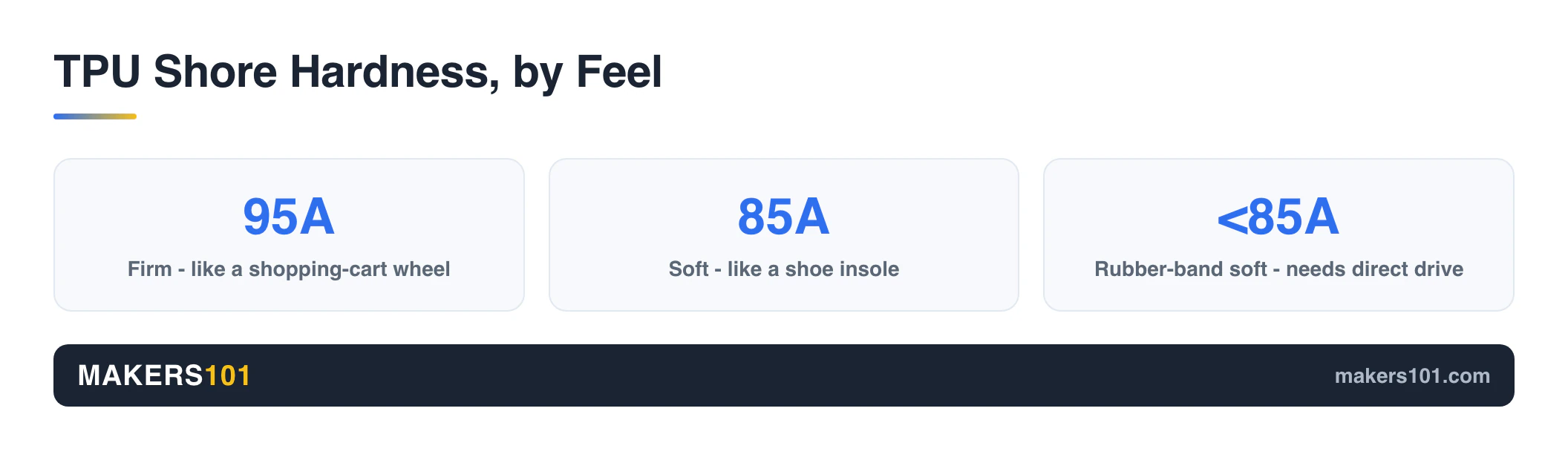
- Shore hardness is the spec that matters. 95A is firm like a shopping-cart wheel. 85A is soft like a shoe insole. Below 85A gets rubber-band soft and needs a direct-drive extruder.
- Best Budget: SUNLU TPU 95A. Best Soft: Siraya Tech Flex 85A. Best for Bambu: Bambu Lab TPU 95A HF. Best Specialty (footwear): Siraya Tech Roamr foaming TPU.
- Your extruder type decides what you can print. Bowden printers want 95A and slow speeds. Direct drive opens up the soft stuff.
- TPU soaks up moisture. Dry it before printing or expect stringing and weak layers.
TPU at a Glance: 2026’s Best Flexible Filaments Compared
Want the short version? Every pick below earns its spot for a specific job. Read each row on its own: the hardness tells you how soft it feels, and the feed note tells you whether your printer can handle it. Every pick here is standard 1.75mm filament.
| Filament | Shore | Best For | Feeding | Price (as of Jun 2026) |
|---|---|---|---|---|
| Overture TPU 95A | 95A (firm) | Best overall, beginners | Works on most printers | ~$22.99 / 1kg |
| SUNLU TPU 95A | 95A (firm) | Best budget, Bambu A1 | Works on most printers | ~$22.49 / 1kg |
| Polymaker PolyFlex TPU95 | 95A (firm) | Cleanest, most consistent prints | Works on most printers | ~$24.99 / 0.75kg |
| Bambu Lab TPU 95A HF | 95A (firm) | Best for Bambu/AMS | Bambu external spool | ~$25-30 / 1kg (Bambu Store) |
| Siraya Tech Flex 85A | 85A (soft) | Wearables, grips | Direct drive recommended | ~$32.79 / 1kg |
| SainSmart Matte TPU 95A | 95A (firm) | Matte look, functional parts | Works on most printers | ~$33.99 / 1kg |
| Siraya Tech Roamr TPU Air HR 80A | 80A foaming | Footwear, high rebound | Direct drive required | ~$50.83 / 1kg |
What Is TPU Filament (and Why “Soft” Doesn’t Mean What You Think)
TPU stands for thermoplastic polyurethane. Think of it as the rubber of 3D printing: bendable, grippy, and abrasion-resistant, but it still prints on a normal FDM machine. People reach for it when they want phone cases that bounce, gaskets that seal, RC tires that grip, or tool handles that don’t crack.
The part that trips up beginners is hardness. TPU is sold by its Shore A rating, and the number is less obvious than it sounds.
- 95A is the firm end. It flexes, but it feels closer to a shopping-cart wheel than a rubber band. This is the easy-to-print all-rounder.
- 85A is genuinely soft. Think shoe insole or a squishy grip. It feels great in the hand and prints noticeably harder.
- Below 85A (75A, 60A) gets rubber-band soft. The results are amazing, but the printing is finicky and demands the right hardware.
This is the single biggest source of disappointment with TPU. Plenty of new users buy an 88A or 95A spool expecting a silicone feel, then find it prints “like a very soft PLA,” still a little plasticky to the touch. That’s normal. If you want true squish, you have to go softer and accept a harder print. To see how TPU sits next to PLA, PETG, and ABS, our full 3D printing filament guide breaks down each material’s strengths.
How We Picked (What Actually Makes a TPU “Best”)

A “best” TPU isn’t the softest or the cheapest. It’s the one that matches your part and your printer. Here’s what we weighed.
Shore hardness vs. your use case. Soft is not automatically better. A gasket wants firm. A wristband wants soft. We picked across the range so you can match the spool to the job.
Your printer’s feed path. This is the one most guides bury. Flexible filament buckles like wet spaghetti in a long Bowden tube. Direct-drive extruders have a short, tight path that pushes soft TPU reliably. The softer the filament, the more this matters.
Brand consistency and tolerance. Cheap, inconsistent diameter is a top cause of jams. We leaned toward brands with tight tolerances and a track record, because a clog on a flexible filament is a special kind of misery.
Moisture handling. TPU is hygroscopic, meaning it pulls water from the air. Wet TPU strings, pops, and prints weak. Spools that ship sealed with desiccant get a nod. Not sure how to dry it? The filament drying guide tool gives you temps and times.
Price and availability. A great filament you can’t reorder isn’t great. We favored picks that are easy to find and restock. We ranked these the same way we ranked the best PETG filament: real use cases first, hype last.
1. Overture TPU 95A: Best Overall for Most People
If you’re buying your first roll of TPU, start here. Overture’s 95A is firm enough to feed on almost any printer, prints without drama, and costs about as little as TPU gets. It hits the sweet spot the community keeps asking for: not too stiff, not too squishy.
At 95A, it has the column strength to push through a standard Bowden setup if you slow down. On a direct-drive machine it’s nearly foolproof. That combination is why it lands as the default recommendation.
It’s also the safe roll for learning what TPU is good at. People use it for phone and controller cases, cable protectors, drone and RC bumpers, furniture feet, and snap-fit covers that need a little give. It comes in a wide range of colors, so you’re not stuck with black, and it’s stocked almost everywhere, which matters when you want to reorder the same spool. One handling tip: slow your first layer and dry the spool if it has been open a while, and you’ll rarely see a failed Overture print.
Specs: 95A Shore, 1kg spool. Prints around 220-240°C on a 30-60°C bed.
- Reliable feeding on most printers, Bowden included
- Budget price for a full 1kg spool
- Wide color selection and easy to restock
- Strong community track record for consistency
- 95A is firm, not the soft rubber some expect
- Like all TPU, needs drying before use
Best for: First-time TPU buyers, phone and controller cases, bumpers, cable management, general functional flex.
Nik’s Take: This is the roll I’d hand a friend who’s nervous about flexibles. It does the boring thing well, which is exactly what you want when you’re learning a new material. Reviewers consistently put it at the top of their “just works” lists, and that boring reliability is exactly why it leads this guide.

- 【High-Quality TPU Material】 Engineered for unparalleled flexibility and durability. Featuring Shore hardness of 95A, Overture TPU strikes the…
- 【Excellent Layer Adhesion】 Setting the standard for impeccable layer adhesion and delivering impressive results. Overture TPU features optimal…
- 【Clog-Free & Bubble-Free】 Designed and manufactured with our patented clog-free formula to guarantee a smooth and seamless printing experience…
- 【Wide Compatibility and Color Selection】 Overture filaments seamlessly integrates with most consumer and industrial 3D printers. Explore your…
- 【Supported & Smooth Printing】 Print with confidence. Overture filament comes with dedicated support and a 1-year shelf life for unopened spools…
2. SUNLU TPU 95A: Best Budget (and a Community Favorite for Bambu A1)
When people on Reddit ask which TPU to run on a Bambu A1, SUNLU comes up again and again. It’s a 95A firm filament at a rock-bottom price, with a tighter diameter tolerance than you’d expect for the money. SUNLU also sells a Silk TPU if you want a shinier finish.
The “High Speed” label isn’t just marketing fluff. It’s tuned to keep up on faster printers, which is part of why A1 and P1S owners gravitate to it. If you print a lot of flexible parts and don’t want to babysit cost, this is the roll that lets you experiment freely.
The two flavors are worth knowing. The standard matte-ish version is the everyday workhorse for cases, organizers, and tool grips. The Silk TPU trades a little practicality for a glossy, eye-catching finish that suits display pieces and gifts. Either way, give the extruder gear a quick tension check before a long print, since soft filament feeds best when the path is snug but not crushing.
Specs: 95A Shore, 1kg, ±0.03mm tolerance. Prints around 210-230°C.
- Lowest price per kilo on this list
- Tighter diameter tolerance than most budget rolls
- Standard and Silk versions for different looks
- Community-proven on Bambu A1 and P1S
- Bargain batches can occasionally vary
- Still 95A firm; soft grip means choosing 85A elsewhere
Best for: Budget builds, Bambu A1/P1S owners, high-volume functional prints, and anyone learning TPU.
Nik’s Take: Running SUNLU TPU through my Bambu A1 has become a no-stress habit. It’s cheap enough that a failed print doesn’t sting, and consistent enough that failures stay rare. When a part needs to look nicer, the Silk version is the one I reach for.

- 【TPU for Fast Printing】- SUNLU High Speed TPU Filament can print 3 times fast as ordinary TPU filaments, strikes the ideal balance between…
- 【TPU 3D Printing Filament】- TPU filament is made of flexible thermoplastic polyurethane, featuring Shore hardness of 95A, and items printed with…
- 【Excellent Layer Adhesion】- Setting the standard for impeccable layer adhesion and delivering impressive results. SUNLU TPU features optimal layer…
- 【Excellent Printed Results】- SUNLU TPU filament 1.75mm has excellent layer adhesion, very easy to print. TPU filament is wear-resistant…
- 【TPU Recommend Settings】- We recommend printing at a nozzle temperature of 210-230°C, bed temperature of 50-60°C, printing speed of 80-120mm/s…
3. Polymaker PolyFlex TPU95: Best for Consistency and Clean Prints
Polymaker built its name on tidy spools and predictable results, and PolyFlex TPU95 carries that reputation. If you care about clean surfaces and even winding (no tangles mid-print), this is the firm 95A to reach for.
One catch worth flagging up front: the spool is 0.75kg, not the usual 1kg. The sticker price looks low, but the effective cost per kilo is higher than Overture or SUNLU. You’re paying for quality control, not quantity.
The upside is fewer surprises. Polymaker’s winding is genuinely neat, which means fewer tangles and feed hiccups on long, detailed prints. That makes it a strong pick for parts people will actually see and handle: enclosure grommets, camera rigs, custom grips, and display models. And if you later want softer, the PolyFlex family extends down to TPU90 and TPU70, so you can stay on a brand you trust as your projects get more ambitious.
Specs: 95A Shore, 0.75kg spool, roughly 210-230°C.
- Excellent winding and dimensional consistency
- Clean print surfaces with minimal tuning
- Softer TPU90 and TPU70 grades available in the same line
- Backed by a well-regarded engineering brand
- 0.75kg spool, so more expensive per kilogram
- This grade tops out at the firm end (step to TPU90/70 for soft)
Best for: Visible or handled parts where print quality and reliability beat raw cost.
Nik’s Take: Reach for this when a print has to look right the first time. Just do the per-kilo math before you assume it’s the cheap option, because that 0.75kg spool quietly changes the value equation.

- 【Flexible TPU 95A Filament】 Polymaker TPU 95A is a flexible thermoplastic polyurethane filament designed for a balance of flexibility, resilience…
- 【Smooth Printing & Strong Layer Adhesion】 Polymaker TPU 95A is designed for smooth extrusion, consistent printing, and strong layer adhesion. Its…
- 【1.75mm TPU Filament | ±0.02mm Accuracy】 Polymaker TPU 95A features a standard 1.75mm filament diameter with dimensional accuracy of ±0.02mm…
- 【40mm-80mm/s Printing Speed | 210–230°C Nozzle】 Polymaker TPU 95A is recommended for printing at 40mm/s, with a nozzle temperature of…
- 【Flexible Material for Functional Applications】 Polymaker TPU 95A is suitable for a wide range of flexible 3D printed parts, including protective…
4. Bambu Lab TPU 95A HF: Best for the Bambu/AMS Ecosystem
If you’re deep in the Bambu ecosystem and want filament the company tuned for its own machines, the TPU 95A HF (High Flow) is the safe call. It’s built for Bambu’s fast feed paths, and recent firmware has steadily expanded what their printers can do with it. The H2D update even unlocked dual-color TPU by allowing the left hotend to run 90A and up. On a budget, Anycubic’s Kobra X officially supports 95A TPU in multicolor jobs, and that’s a big reason to pick it over the SparkX i8.
The “High Flow” part matters in practice. It’s formulated to push more material per second, so you can keep Bambu’s fast profiles instead of crawling. The payoff is TPU prints that finish in a reasonable time without the under-extrusion you’d get forcing a slow filament through a fast machine.
One honesty note: buy this from the Bambu Store, not Amazon. Search “Bambu TPU” on Amazon and you’ll mostly find third-party “Bamboo” knockoffs, not the real thing. For the steadiest results, feed it from an external holder rather than fighting the AMS, especially on multi-color jobs.
Specs: 95A Shore, High Flow formulation, runs from an external spool; AMS support varies by model and firmware.
- Tuned for Bambu’s high-speed feed system
- High Flow keeps print times reasonable
- Firmware keeps expanding TPU capability (dual-color on H2D)
- Predictable profiles inside Bambu Studio
- Not sold as genuine stock on Amazon; use the Bambu Store
- Pricier than generic 95A
- Softer grades still aren’t reliable through the AMS
Best for: Bambu owners who want first-party, profile-ready TPU with minimal setup.
Nik’s Take: On my own Bambu setup, the 95A HF gives the least trouble of any TPU I’ve run through it. An external spool has been more reliable for me than leaning on the AMS. If you do go the AMS route, read our Bambu filament runout guide first, because flexible filament behaves differently when a spool runs low. And on the TPU Feed Assist module: testing shows it boosts reliability on 95A but won’t save you with anything below 85A.
5. Siraya Tech Flex 85A: Best Soft TPU for Wearables and Grips
When you actually want squish, drop to 85A. Siraya Tech Flex 85A is the soft pick for watch bands, grips, insoles, and anything that touches skin (it carries ISO 10993 skin-contact certification). It feels genuinely rubbery in a way 95A never will.
The ISO 10993 certification is worth understanding: it’s the standard used for skin-contact safety testing, which is why this is a sensible choice for watch straps, prosthetic liners, ergonomic grips, and anything worn against the body. The trade-off is real, though. 85A wants a direct-drive extruder. In a Bowden tube it tends to buckle and jam. If your printer has a short, direct feed path, this is where TPU gets fun.
A couple of settings make the difference. Turn retraction down low or off entirely, slow your speed, and keep the spool dry, since soft TPU shows moisture problems faster than firm grades. If your printer is Bowden-only, Siraya’s 95A High Flow is the easier sibling to start with before you commit to soft.
Specs: 85A Shore, 1kg spool, ISO 10993 certified, moisture-resistant packaging, around 220°C.
- Truly soft, comfortable hand feel
- Skin-contact certified for wearables
- Moisture-resistant packaging out of the box
- High-flow formulation prints faster than older soft TPUs
- Needs a direct-drive extruder
- Higher difficulty for beginners
- Costs more than basic 95A
Best for: Watch straps, soft grips, insoles, wearables, and gaskets that need to compress.
Nik’s Take: Buy this when “flexible” finally has to mean soft. Just be honest with yourself about your extruder before you order. On a Bowden machine, 85A will test your patience.

- Superior Flexibility & Toughness: Siraya Tech’s Flex TPU 85A 3d printer filament excels in flexibility and elasticity, making it ideal for durable…
- ISO 10993 Tested: Our Flex TPU 85A has undergone testing according to ISO 10993-10, -5, and -23 protocols. These tests evaluate biological responses…
- High Flow, High Speed: Designed for high-flow, Flex TPU 85A filament enables quicker prints than typical TPU 95a, blending speed with stellar…
- Long-Lasting Quality with Special Packaging: Our Flex TPU 3d printer filament is sealed in moisture-resistant aluminum resealable bags, preventing…
- Versatile for Various Applications: From custom footwear to medical devices, this Flex TPU filament 1.75mm meets diverse needs in creative and…
6. SainSmart Matte TPU 95A: Best Matte Look and Functional Flex
Most TPU prints with a slight sheen. SainSmart’s Matte TPU 95A goes the other way with a flat, premium finish that hides layer lines and looks great on functional parts. It’s a firm 95A, so it feeds like the other all-rounders here.
The matte surface earns its keep on parts you actually look at: vibration dampers, appliance feet, camera and tripod accessories, and any cover where visible layer lines would cheapen the result. The flat finish also hides small extrusion inconsistencies that gloss would highlight. And because SainSmart is the US channel for NinjaTek, this is a natural jumping-off point if you later want engineering-grade flexibles like Cheetah or Armadillo. The one number to note is the ±0.05mm tolerance, which is a touch looser than budget rivals, so dial in your flow if you chase dimensional precision.
Specs: 95A Shore, 1kg spool, diameter accuracy ±0.05mm, matte finish, roughly 210-230°C.
- Distinctive matte surface that hides layer lines
- Firm 95A feeds on most printers
- Gateway to NinjaTek’s engineering line (Cheetah, Armadillo)
- ±0.05mm tolerance is looser than SUNLU’s ±0.03mm
- Priced above basic 95A
- Matte isn’t to everyone’s taste
Best for: Vibration dampers, feet, accessory parts, and any functional print where looks matter.
Nik’s Take: The matte finish is the reason to buy this one. It turns ordinary functional prints into something that looks deliberate. If you fall in love with TPU and want to go industrial, SainSmart’s shelf makes the next step easy.

- [Matte 95A TPU Filament] Made from resilient thermoplastic polyurethane, this Shore 95A filament provides softness, high elasticity, and resistance to…
- [Easy and Consistent Printing] The controlled 1.75 mm diameter and +/- 0.04 mm dimensional accuracy support steady feeding and consistent extrusion…
- [Recommended TPU Settings] For optimal results, use a nozzle temperature of 220–240°C (428–464°F), a bed temperature of 30–55°C…
- [Made for FDM Printers] Designed for FDM 3D printers and extrusion systems that support 1.75 mm flexible TPU. Check your printer specifications and…
- [Create Flexible Functional Parts]Suitable for seals, gaskets, grips, protective covers, phone cases, watch bands, insoles, robotics components, drone…
7. Siraya Tech Roamr TPU Air HR 80A: Best Specialty TPU for Footwear (Advanced)
This one is for a specific dream: printing shoes, insoles, and high-rebound cushioning. Roamr is a foaming TPU. As it extrudes, it expands and gets lighter, with a springy, high-rebound feel closer to PEBA than ordinary rubber. The 80A Air HR version claims 48-50% rebound.
It is not a beginner filament. Testing shows the foaming behavior is driven by temperature (roughly 230-260°C controls how soft and foamy it ends up), so the same spool can finish anywhere from firm to genuinely squishy depending on how you tune it. That temperature dial is the whole appeal: one roll, a range of densities for different parts of a sole.
To get there, you need the right setup. It wants a direct-drive extruder, a short PTFE path, and dry feeding, and reviewers found it prints best at around half speed with extrusion bumped up roughly 15%. Skip those and you get stringing and patchy foaming. If you want a softer classic alternative, Recreus Filaflex is the famous super-soft name, though it’s harder to source and just as picky.
Specs: nominal 80A (foams softer), 48-50% high rebound, 1kg spool, around 230-260°C.
- Light, springy, high-rebound foam feel
- Purpose-built for footwear and cushioning
- One spool covers a range of densities via temperature
- Expensive (roughly double a basic 95A)
- Demands direct drive and big speed reductions
- Overkill for everyday parts
Best for: Footwear projects, custom insoles, midsoles, and high-rebound cushioning.
Nik’s Take: Foaming TPU is the most exciting corner of flexible filament right now, but it’s a project, not a casual buy. If you’ve seen the wave of 3D printed shoes with TPU and want in, this is your material. Just come prepared to slow everything down and dial in temperature.
- FOOTWEAR-OPTIMIZED HIGH REBOUND(HR): Specifically engineered for shoes, Roamr TPU Air HR offers a rebound resilience of 48%–50%. This provides…
- ULTRALIGHT ACTIVE FOAMING: By utilizing active-foaming technology, this material can achieve up to a 50% weight reduction compared to standard TPU…
- VARIABLE HARDNESS CONTROL: Gain total control over the “squish” of your prints. By adjusting your printing temperature, you can dial in a surface…
- PREMIUM MATTE & SKIN-TOUCH COMFORT: Eliminate the cheap, shiny “plastic” look of traditional TPU. Roamr 80A prints with a sophisticated, non-tacky…
- TRUE FUNCTIONAL PROTOTYPING: Designed for the rigorous standards of footwear designers and engineers. Whether you are validating a new sneaker…
Best TPU Filament for Your Printer (Bambu, Creality, Ender, Prusa)
The right TPU depends on how your printer feeds filament. Here’s the quick version by setup.
Bambu (A1, P1S, X1): Stick to 95A and run it from an external spool for the most reliable feeding. The AMS is happiest with Bambu’s own TPU 95A HF. SUNLU and Overture 95A are the community-favorite third-party picks.
Creality, Ender 3, and other Bowden printers: Start with 95A, slow your speed, and turn retraction way down or off. Soft 85A filament will fight a long Bowden tube, so save it for after you upgrade to direct drive.
Direct-drive printers (Prusa, most modern machines): You’ve got the freedom to go soft. 85A and below feed cleanly when the path is short, so this is where wearables and foaming TPU become realistic.
TPU vs TPE vs PEBA: Which Flexible Filament Do You Actually Need?
Short answer: TPU is the versatile default, TPE is the broad family it belongs to, and PEBA is the springy newcomer for rebound. Pick by what the part needs to do.
TPU absorbs energy well, which makes it great for damping, bumpers, and shock. What it doesn’t do brilliantly is bounce back. That’s PEBA’s job. In testing, PEBA came out about 20% lighter than TPU with roughly 2.5 times the rebound energy and better fatigue resistance, which is why it’s showing up in running shoes and spring-like parts. The catch is PEBA needs smooth feeding and costs more.
TPE is the umbrella term for thermoplastic elastomers, and TPU is one type within it. For most makers, the choice is simply TPU for general flexible parts, and PEBA only when you specifically need high energy return. Still unsure which material fits your project? The filament picker tool helps you narrow it down in a couple of clicks.
| Material | Strength | Best use |
|---|---|---|
| TPU | Energy absorption, versatility | Bumpers, gaskets, grips, general flex |
| PEBA | High rebound, light weight | Athletic soles, springs, energy return |
| TPE | Broad family (includes TPU) | Catch-all term, varies by blend |
How to Print TPU Without the Headaches
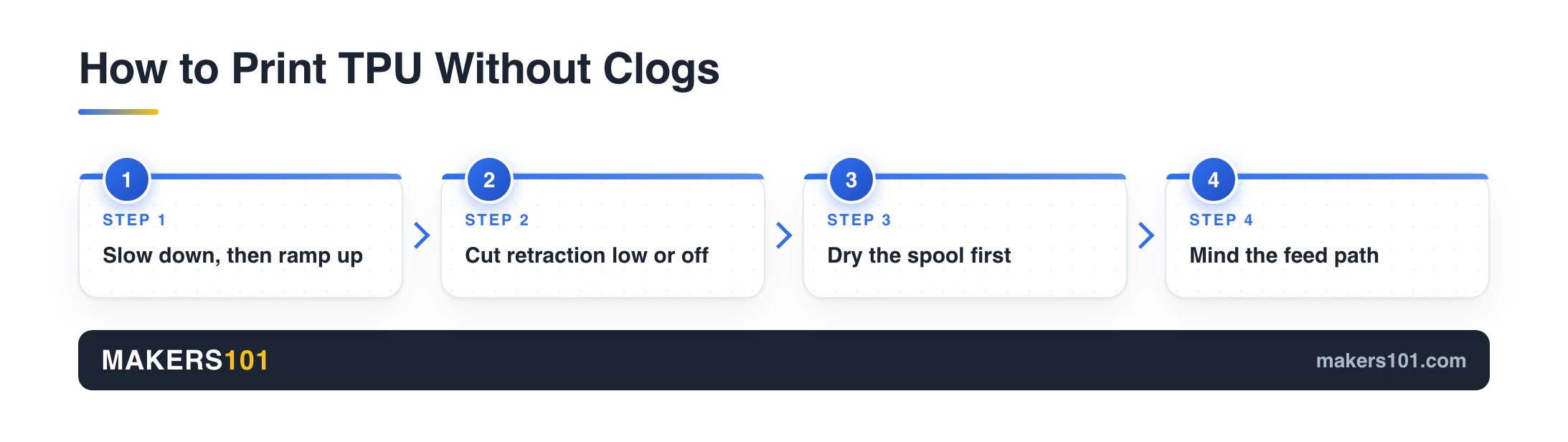
Most TPU failures trace back to three things: speed, moisture, and the feed path. Fix those and the rest is detail.
Slow down, but not as much as you think. Old advice said crawl at 20mm/s. Modern printers and slicers do far better. With proper calibration, makers now run TPU at 150mm/s on outer walls and 200mm/s elsewhere. Start conservative, then push speed up as you dial in.
Tame retraction. Long retractions stretch soft filament and cause jams. Keep retraction short, or turn it off entirely on soft grades. A little stringing is easier to clean than a clogged hotend.
Dry it first. This is non-negotiable. Wet TPU strings and prints weak. A dryer at around 70°C handles TPU fine; you don’t need the 85°C engineering settings. Active-airflow dryers pull moisture out faster. We break down which ones win in our filament dryer roundup.
Mind the feed path. Direct drive for soft TPU, short PTFE for everything. If you’re on Bowden, stay at 95A.
One bonus trick: a very light fuzzy skin (around 0.1mm) hides mild overhang flaws and extrusion inconsistencies on TPU, and it knocks down the sheen. Temperatures vary by brand, but most TPU lives in the 210-245°C range.
Don’t Buy TPU If… (Common Mistakes and Mismatches)
A few honest reasons to pause before you click buy.
- You expect a silicone feel from 95A. It won’t happen. Match the Shore rating to the softness you actually want.
- You run a Bowden printer and grabbed 60A. Super-soft filament will buckle and jam. Get a direct-drive setup first, or stick to 95A.
- You skip drying. Stringy, weak prints almost always trace back to wet filament. Dry it.
- You need a load-bearing structural part. TPU flexes by design. For rigid strength, PETG or a composite is the better call.
FAQ
What is the best TPU filament to start with? A firm 95A roll like Overture TPU is the right first buy for most people. At 95A it feeds well on nearly any printer, including Bowden setups, and it’s inexpensive. Beginners hit the fewest snags here before graduating to softer grades.
Which TPU filament is best for Bambu (A1 or P1S)? For first-party reliability, Bambu Lab TPU 95A HF is tuned for the company’s feed system. Among third-party rolls, SUNLU 95A is the community favorite for the A1 and P1S, with Overture close behind. An external spool gives the steadiest feed.
Is 95A or 85A TPU better? Neither wins outright; they suit different jobs. 95A is firmer and far easier to print, which makes it ideal for functional parts and beginners. 85A is genuinely soft and better for wearables and grips, but it usually requires a direct-drive extruder.
Which TPU is best for gaskets? A firm 95A like Overture or SUNLU works well for gaskets that need to hold their shape while sealing. If the gasket must compress and spring back a lot, step down to a soft 85A like Siraya Tech Flex for a tighter seal.
Which TPU works best for shoes? For footwear, a foaming roll like Siraya Tech Roamr TPU Air HR 80A gives the light, springy cushioning shoes need. It’s an advanced material that demands direct drive and slow printing, so tackle it once you’re comfortable with standard TPU.
Do I need a direct drive extruder for TPU? Not for firm 95A, which prints fine on Bowden printers if you slow down. For soft grades (85A and below), a direct-drive extruder is strongly recommended because the short feed path stops soft filament from buckling.
Does TPU need to be dried? Yes. TPU is hygroscopic and absorbs moisture from the air, which causes stringing, popping, and weak layers. Dry it at around 70°C before printing, and store it sealed with desiccant between uses.