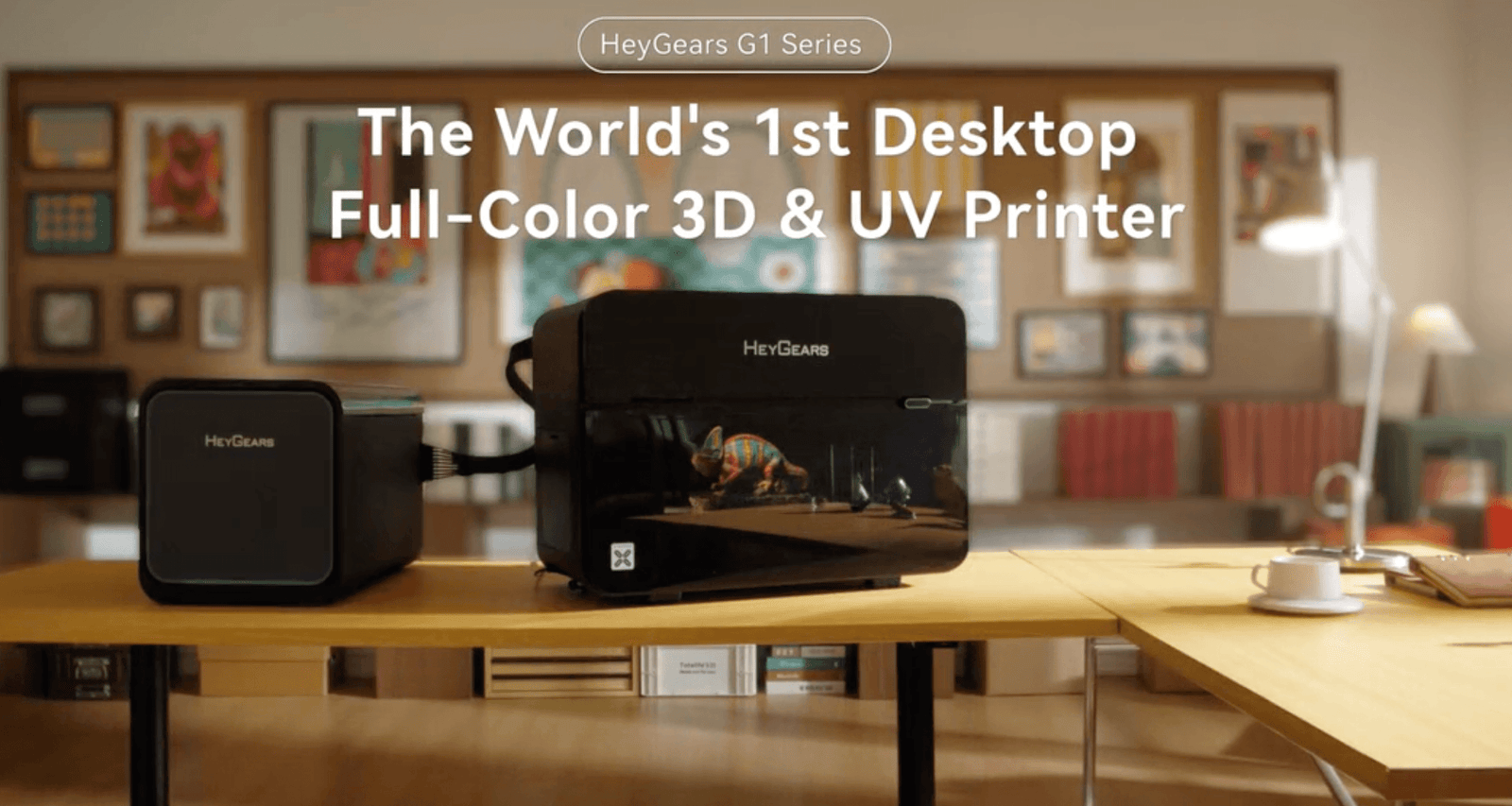

- The HeyGears G1 series has closed its Kickstarter on September 11, 2026 with $17,685,524 from 3,981 backers. That averages about $4,440 per backer, which says more about who is buying than any spec sheet does.
- Watch the tier names. The $1,999 model cannot print in full color 3D at all. The HeyGears G1X Full-3D Pack, at $3,599, is the one that can.
- Every payback estimate circulating right now, HeyGears’ included, is built on a single-figure demo print that occupied about 4% of the plate.
- Nesting a full plate clearly costs less per figure, but HeyGears has published no batch time, so the true per-unit economics are unknown. Ask for that number before you pledge.
- The campaign closed September 11, 2026, and Late Pledge is still open. Units are scheduled to ship December 2026.
Every few years desktop 3D printing runs out of an obvious problem. Speed got solved. Bed leveling got solved. Multi-material got solved well enough that people stopped complaining. What’s left is color, and color has been stuck in the same place for a decade. You either print in one color and paint it by hand, or you swap between a few spools of pre-dyed filament and accept that your model looks assembled from Lego bricks.
That gap is why a dental 3D printing company from Guangzhou is sitting on the second-largest 3D printer campaign in Kickstarter history.
Table of Contents
- What Happened With the HeyGears G1X Kickstarter
- Multicolor Is Not Full-Color 3D Printing
- What a Full-Color 3D Printer Costs: G1X vs CJ270 vs Industrial
- What the HeyGears G1X Actually Is
- HeyGears G1X Consumables Are Cheaper Than You’d Guess
- HeyGears G1X Payback Math, and the Number Nobody Published
- About the HeyGears G1X’s $5,499 MSRP
- Living With a Material Jetting Printer Like the G1X
- HeyGears G1X Competition: Flashforge, iNEW3D and Bambu Lab
- What the Community Thinks of the HeyGears G1X
- My Take: Who Should Back the HeyGears G1X
- HeyGears G1X FAQ
What Happened With the HeyGears G1X Kickstarter
HeyGears launched the G1 series on Kickstarter on July 23, 2026. It closed on September 11 with $17,685,524 from 3,981 backers, per the Kickstarter project page. Late Pledge is still open, and HeyGears says early-bird pricing applies there for a limited time.
Here’s where that sits against the category’s biggest campaigns:
| Campaign | Raised | Backers |
|---|---|---|
| Snapmaker U1 | $20,161,265 | 20,206 |
| HeyGears G1 series | $17,685,524 | 3,981 |
| AnkerMake M5 | ~$8.8M | — |
| Bambu Lab X1 | $7,047,538 | 5,575 |
The interesting column is on the right. Snapmaker reached $20M by selling a sub-$700 printer to twenty thousand people. HeyGears reached $17.7M by selling a machine five times that price to about four thousand. The average pledge works out to roughly $4,440.
That is not a hobbyist crowd. Those are small shops and miniature sellers who already run a print farm and did arithmetic before clicking. The same pattern showed up when we looked at whether the xTool O1 Omni is worth preordering. High-ticket maker hardware now funds on business cases. Enthusiasm alone stopped being enough a while ago.
One clarification, because the numbers get mixed up constantly. Kickstarter’s all-time record still belongs to eufyMake’s E1 at $46,762,258. The E1 is a texture UV printer. It decorates objects that already exist. It doesn’t build them. eufyMake’s chasing that same crowdfunding playbook again, this time with a fabric printer. We looked at what it means for Anker’s 3D printing retreat.
Multicolor Is Not Full-Color 3D Printing
Multicolor swaps between pre-dyed filaments and assembles a model from discrete blocks of color. Full color mixes pigment at the droplet level and blends it per voxel. The first gives you hard edges, the second gives you gradients, and the gap between them is why this category exists.
Multicolor is what an AMS does. The machine keeps several spools loaded, feeds red when it wants red, cuts to yellow when it wants yellow. You can get a lot of colors this way. You cannot get a gradient. Every boundary is a hard edge, and the result reads as pixel art.
Full color jets cyan, magenta, yellow, black, white, and clear resin through separate channels, blends them per voxel, then flash-cures with UV. Skin tones blend into each other. A chameleon can actually fade from green to orange.
The reason FDM can’t cross that line is physical. Filament melts, and molten plastic doesn’t premix in the hot end in any controllable way. To hit millions of colors through fusion you’d need thousands of independently metered nozzles, which is not a machine anyone puts on a desk.
Resin can do it because resin is a liquid you can jet. If you want the underlying mechanics, how a resin printer actually works covers the UV curing side all of this is built on. That explains a lot about where this machine came from. The first credible desktop full-color printer was always going to arrive from a resin company. The FDM giants were on the wrong side of the chemistry. One Shenzhen startup thinks there’s a way around that. The FA3D DIO X prints the part in filament and paints it with UV ink.
The ink channel lineup isn’t exotic either. Epson’s own SureColor V1070 UV printer ships white and varnish channels for texture and gloss. White plus clear alongside CMYK is standard equipment in UV printing. What’s new here is aiming that hardware at a build volume instead of a flatbed. Bambu’s own UV job ads name that same channel lineup, which is a big part of why we read them as a flatbed machine.
What a Full-Color 3D Printer Costs: G1X vs CJ270 vs Industrial
Before this campaign, full-color 3D printing came in two brackets: industrial machines priced in the six figures, and one $7,199 desktop machine.
| Machine | Category | Price | Status |
|---|---|---|---|
| Mimaki 3DUJ-553 | Industrial material jetting | $207,895 US list | Shipping |
| Stratasys J850 Prime | Industrial PolyJet | Quote only, six figures | Shipping |
| iNEW3D QC2A | Desktop material jetting | $7,199 crowdfunding / $9,999 MSRP | Funded, >$1.4M |
| Flashforge CJ270 | Desktop material jetting | $3,999 pre-order / $4,499 list | Pre-order, first units ship October 15 |
| HeyGears G1X Full-3D | Desktop material jetting | $3,599 crowdfunding / $5,499 MSRP | Funded, Late Pledge open, ships December 2026 |
The Mimaki number is the useful one because it’s public. At $207,895 list, it costs about 58 times what the G1X costs on Kickstarter. Stratasys doesn’t publish a J850 price at all and routes you to a sales rep, and full-color PolyJet systems have been reported above $100,000 for years.
The QC2A is the closest real comparison and it’s a genuine machine: 200 × 160 × 80mm build volume, 30µm layers, six channels, over 500,000 blended colors. Flashforge’s CJ270 spent more than a year at trade shows, including TCT Asia this March, before pre-orders opened on September 9. It has seven printheads, claims 7-micron layers, and prints on a 180 × 120 × 100mm plate. We covered the CJ270’s price, ship date and resin costs.
When the campaign launched, nothing sat below the G1X. That empty space is where its backers came from. It isn’t empty anymore. The CJ270’s $3,999 pre-order price is $400 above the G1X’s campaign price and $1,500 under its $5,499 MSRP.
What the HeyGears G1X Actually Is
The G1 and the G1X are different machines and the naming does not make that obvious. If you want full-color 3D printing, the $1,999 tier is not it.
The G1 is a flatbed machine. It prints 2D images and raised texture onto objects that already exist, which drops it into direct competition with the eufyMake E1 and xTool’s UV line, a crowded field where it has no particular advantage. Full-color 3D starts with the G1X Full-3D Pack, the tier that includes the resin station.
| G1 ($1,999) | G1X ($3,299–$3,599) | |
|---|---|---|
| Printhead | Epson F1080, 6 channels | Epson i3200, 8 channels, 3,200 nozzles |
| Resolution | 720 × 900 DPI | 1440 × 2400 DPI |
| Droplet size | — | 3.9 picoliter |
| Full-color 3D | No | Yes, with resin station |
| 3D texture height | Up to 5mm | Full |
| Rated printhead life | 6–12 months (~700 hrs) | 12–24 months (~2,100 hrs) |
The build area matters more than any other spec here, and it’s the one most coverage skips. HeyGears lists two plates for the Full-3D Pack: the Standard Flatbed at 420 × 330 × 130mm and the Mini Flatbed at 130 × 330 × 150mm. Height appears only in the Full-3D column of their spec table. The G1X and G1 columns list the same two plates with no Z dimension at all, which is how you can tell these are build volumes. Layer height runs 10–20µm. The machine measures 580 × 660 × 510mm and weighs 25kg, or 45kg with the resin station, and takes up to 6kg of load. Supports are water-soluble, so you soak them off instead of clipping them.
Post-campaign MSRPs are $2,699 for the G1 and $5,499 for the bigger machine. Delivery is scheduled for December.
HeyGears G1X Consumables Are Cheaper Than You’d Guess
Ink and resin run $25 to $35 a bottle with no chip-locked cartridges, which puts material cost at roughly $4.50 for an 8cm figurine. This is the part I expected to be ugly, and it isn’t.
Campaign pricing:
- UV ink, 300ml: white $25, color (C/M/Y/K/Lc/Lm) $29, varnish $35
- UV resin, 1L: white and support $25, color $29, transparent $35
Hackaday put the CMYK ink kit at a $189 suggested retail price and noted you aren’t locked into proprietary cartridges. Community coverage during the campaign added two details worth more than the sticker price. The ink tanks refill. The waste tank empties and goes back in, so it isn’t something you rebuy.
One lever most people miss. On UV flatbed work, reworking artwork to shrink heavy full-coverage areas can cut ink cost close to half. One documented job dropped from $6.23 to $3.32 of ink on the same cup after a design pass. Full-color 3D obeys the same physics: a model saturated across every surface consumes noticeably more than one with white or clear regions. Your consumable bill is partly a design decision.
HeyGears G1X Payback Math, and the Number Nobody Published
HeyGears’ business case is circulating everywhere and no one has checked it. An 8cm figurine weighing about 150g including support costs roughly $4.50 in resin, about $9 all-in with machine wear and a little labor, and sells for $69. Sell one or two a day and the machine pays for itself in two or three months.
Two of those claims hold up. The third rests on an assumption nobody has tested.
The material half checks out. Resin runs about 1.1g/ml, so 150g is roughly 136ml. At $25 to $35 per liter that’s $3.40 to $4.75. Their number is honest.
The margin half checks out. Take their $69 price, $4.50 of resin, and 15 minutes of hands-on labor at $20/hour, which is a realistic small-shop rate:
- Contribution margin per figure: $59.50
- Units to cover the machine: 61
The throughput half is where it comes apart. HeyGears’ own community account posted a print log: a 66.1 × 87.2 × 40mm figure, 176.7ml of material, 13.25 hours. Treat that with appropriate caution. It’s a single vendor-published demo on pre-production hardware, with no layer height, quality mode, or orientation disclosed, and no independent reproduction.
More importantly, it was one figure on a 420 × 330mm plate. That footprint uses about 4% of the available area.
Material jetting doesn’t scale like FDM. The carriage lays down each layer in passes and every part on the plate is built in the same passes, so adding a second figure costs far less than doubling. That much is settled physics for this process class, and HeyGears markets “Batch Printing” in Blueprint Studio on exactly that promise: more pieces “in less time.”
How much less, nobody outside the company knows. A single i3200 carriage still has to index across more of the plate to cover twelve figures than one, so a full plate will take longer than 13 hours. It just won’t take twelve times longer. Read the two columns below as bounds. The left is what a one-at-a-time workflow actually costs. The right is the floor you’d hit if nesting were free. The real number sits between them and HeyGears has not published it.
| One figure per job (measured) | Twelve nested (theoretical floor) | |
|---|---|---|
| Effective time per figure | 13.25 hrs | 1.1 hrs |
| Figures per printhead (2,100 hrs) | 158 | ~1,900 |
| Machine cost amortized per figure | $22.78 | $1.89 |
| Nonstop printing days to make 61 units | ~34 | ~3 |
Every per-unit number in every article about this machine, HeyGears’ own included, is quoting the left column. If the right column is even approximately right, the printhead stops being a frightening consumable and payback stops being about the machine at all.
Which flips the real risk. It was never whether this thing can produce enough. It’s whether you can sell 61 collectibles at $69, and then keep selling them. Compare that honestly against your current process, including what painting 3D prints actually costs you in time, and the case either holds or it doesn’t.
One caveat survives either column: nobody outside HeyGears knows what a replacement printhead costs. Ask.
About the HeyGears G1X’s $5,499 MSRP
A crowdfunded MSRP is a claim. Companies honor them unevenly, so treat the advertised discount as unverifiable until the machine reaches retail.
We have a documented case in our own coverage. When we tracked the Creality Pika scanner, the $979 MSRP never appeared anywhere; the street price settled at $699 against a $629 early bird. The real saving was $70. The headline implied $350, five times as much. The Procolored X One went up at $3,799 early bird against a claimed $7,999 retail, and that campaign’s actual post-launch pricing still hasn’t resolved.
HeyGears may hold $5,499 exactly. Plenty of companies do. You have no way to test that number today, which is the entire point. Decide whether the G1X is worth $3,599 on its own terms. If the answer only works because of the discount, it isn’t an answer.
Living With a Material Jetting Printer Like the G1X
Every machine using this process shares the same three trade-offs: parts that soften near 50°C, printheads that need regular use, and a room you’d be happy to ventilate.
Parts are weak and heat-sensitive. Jetted photopolymer has lower mechanical strength than FDM plastic and starts deforming around 50°C. These are display pieces and figurines. Don’t plan on functional parts, and definitely don’t leave one on a car dashboard.
Printheads want to be used. Inkjet heads clog when idle and wear when run hard. HeyGears addresses this with three cleaning modes: a quick jetting check, routine cleaning that runs automatically during long jobs, and a deep clean recommended when switching print modes or after two weeks idle. Call that a maintenance routine. Appliances don’t have deep clean cycles.
This isn’t a HeyGears-specific weakness. White ink pigment settles and clogs heads across the entire UV printing industry, which is why xTool built a dedicated white ink circulation system into the O1 Omni and marketed it on the promise that you can go on vacation and come back to a working machine. When two unrelated companies engineer around the same failure mode, that failure mode is telling you something.
You still need ventilation and IPA. HeyGears describes its inks as low-odor and skin-safe, and there’s in-machine filtration. Low-odor is not inert. Put this in a workshop. Bedrooms and classrooms deserve a harder look at fumes and waste handling first.
Give it a solid table. Sounds trivial. It isn’t. A wobbly surface has been enough to interrupt jobs on other UV printers mid-print, and this machine weighs 45kg loaded while moving a gantry across a 420mm bed.
Post-processing shrinks but doesn’t vanish. Water-soluble supports genuinely beat clipping and sanding, and skipping hand-painting is the real win. You still soak and rinse, and the same rules about cleaning resin prints without wasting IPA apply to the leftovers.
HeyGears G1X Competition: Flashforge, iNEW3D and Bambu Lab
HeyGears has a real structural head start, and the most-repeated threat to it is a rumor.
Confirmed: the company was founded in Guangzhou in 2015 by University of Illinois engineering graduates and has built resin systems for eleven years, developing its own optics, materials and software. Roughly 70% of its revenue now comes from materials, with hardware sales making up the rest. It raised a $44M Series C in May 2026 led by Legend Capital specifically to move beyond dental into consumer.
That matters for a reason that’s easy to miss. The most common way crowdfunded hardware fails is a company jumping into a technology stack it has never shipped in. Procolored drew exactly that criticism for bolting a laser onto a UV printer with no laser engineering history. HeyGears is doing the opposite, extending sideways within photopolymer, the one thing it has done for over a decade. That doesn’t guarantee delivery. It does change the risk profile.
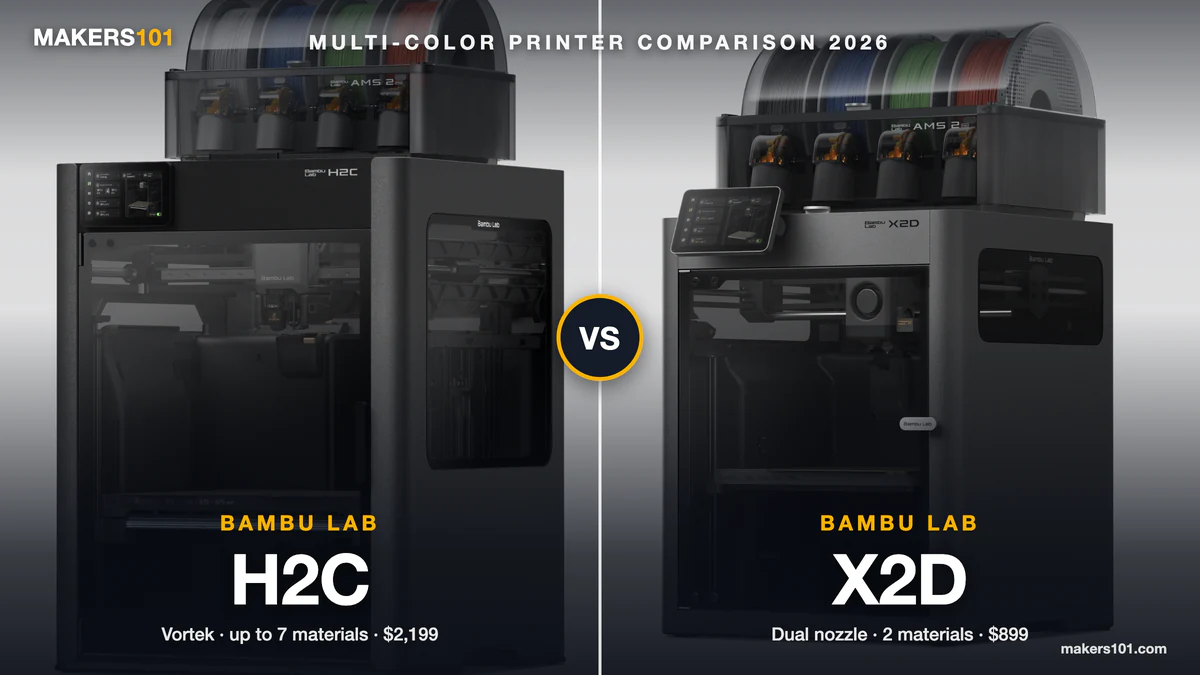
Not confirmed: Chinese trade press has reported, citing unnamed industry sources, that Bambu Lab has a full-color program in pre-development pairing UV inkjet with photopolymer curing. The same idea has circulated in Bambu’s own Reddit community since July 2025. Bambu has announced nothing as of late September 2026: no product page, no teaser, nothing carrying a date. Until that changes, it’s a report about a plan. You can’t buy it.
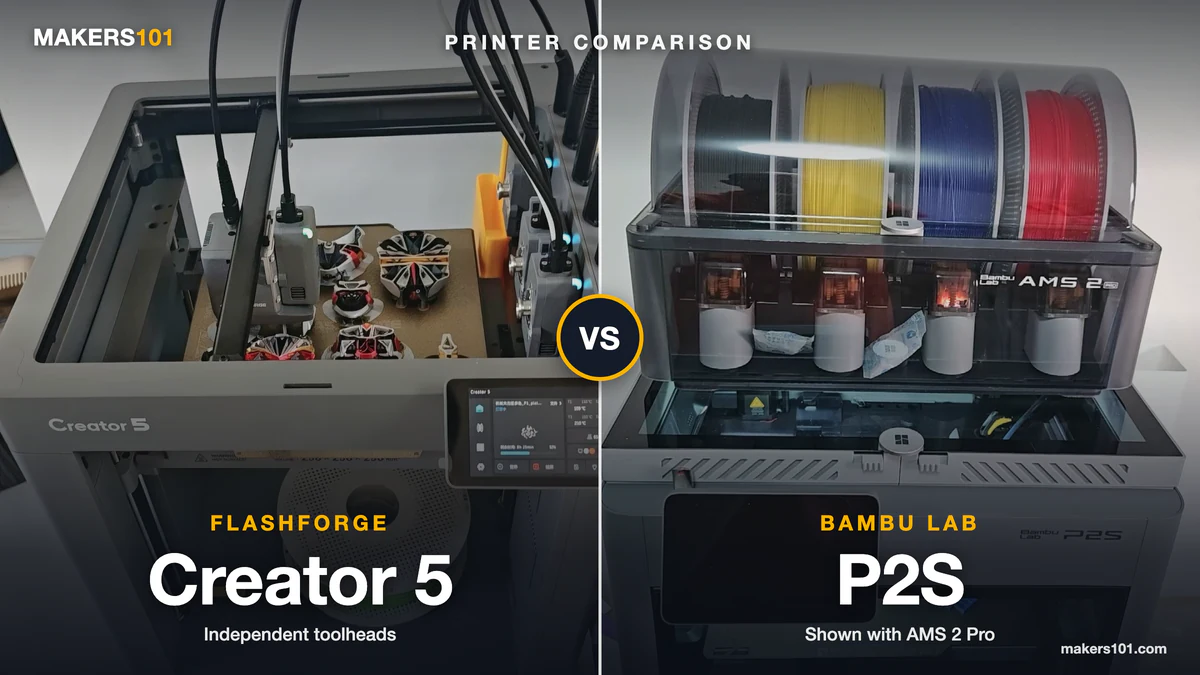
The real near-term pressure comes from Flashforge and iNEW3D. Flashforge has priced the CJ270 and says the first units ship October 15, about two months before the G1X. It’s a much smaller machine, and its Flashforge-only resin runs $49.90 to $69.90 per kilogram against HeyGears’ $25 to $35 per liter. The units differ, but the gap is real. iNEW3D’s QC2A is funded and costs about twice as much. Neither has shipped at volume yet. If the CJ270 lands on time, this price tier stops being a one-machine market.
What the Community Thinks of the HeyGears G1X
Demand for full-color printing is clearly real. The buzz specifically around this campaign is thinner than the post count suggests.
The demand signal is genuine and independent. A full-color 3D printing thread in r/FDMminiatures pulled 146 upvotes and 44 comments. On r/3dprinter, the question people are actually asking about this machine is whether it’s “too good to be true or actually good legit product,” which drew 13 upvotes and 14 comments. That’s an audience that wants this to exist and doesn’t yet believe it.
The buzz signal deserves more skepticism. Of the seven busiest threads about the G1 series, three come from a single content creator posting his own videos, and those three carry scores of 4, 0, and 0. A fourth is from HeyGears’ own account. So roughly half the visible conversation is the vendor plus one enthusiast, and Reddit is doing what Reddit does to self-promotion.
The most-commented post in the set, at 50 comments, came from a user who received a HeyGears survey about an unannounced printer, contacted support to confirm it was real, and asked whether anyone else had heard anything. That’s how this story actually broke.
Excitement is real. Consensus hasn’t formed, because nothing has shipped.
My Take: Who Should Back the HeyGears G1X
You aren’t buying a printer, you’re buying a small production line. Everything follows from that: the consumables math is favorable, the printhead is a scheduled expense, and the whole thing only works if you have somewhere to sell the output.
Before you pledge, get answers to these four. All are reasonable to ask on the campaign page, and none are currently published:
1. How long does a full bed take? Ask for a print log of ten or more figures nested on the 420 × 330mm Standard Flatbed. This single number moves your per-unit cost by more than 10×. 2. What does a replacement Epson i3200 printhead cost? The 2,100-hour rating is meaningless without it. 3. What layer height and quality mode produced the 13.25-hour demo print? Speed claims mean nothing without them. 4. Does Open Material Mode cover the 3D resin, or only UV ink? HeyGears runs an Open Material Mode page and the tanks are refillable, but the Full-3D resin side isn’t spelled out, and neither is what it does to your warranty.
Back it if you already sell painted miniatures or display models, hand-finishing is your bottleneck, and a delivery slip wouldn’t hurt you. You can still get in through Late Pledge. The margin structure holds. The CJ270 now costs only $400 more on pre-order, but it prints on a much smaller plate with pricier resin.
Wait if you want functional parts, you want an appliance, or your plan depends on throughput. HeyGears has told Chinese media it sees the home market as one or two product generations out, contingent on volume and a price near $1,400 around 2028. That’s a roadmap. Roadmaps move.
Skip the G1 entirely if full-color 3D is the reason you’re here. At that price you’re buying into a crowded flatbed field.
Six months from now the question will still be who can build one of these. A year from now it’ll be who can make one cheap enough, and boring enough to leave running unattended overnight.
HeyGears G1X FAQ
Can the $1,999 HeyGears G1 print in full color 3D?
No. That model decorates surfaces. It lays 2D images and raised texture up to 5mm onto objects you already have. Building a colored object from scratch requires the resin station, which arrives with the G1X Full-3D Pack at $3,599 on Kickstarter and $5,499 at retail.
How much does it cost to print a full-color figurine on the G1X?
Roughly $3.40 to $4.75 in resin for an 8cm figure weighing about 150g, using HeyGears’ published pricing of $25 to $35 per liter. Add labor and printhead wear and a realistic all-in figure sits near $10 per piece, before you account for the machine.
How long does a full-color 3D print take on the G1X?
A single 66 × 87 × 40mm figure ran just over 13 hours in HeyGears’ published print log. That figure occupied about 4% of the 420 × 330mm Standard Flatbed. Because every part on the plate is built in the same passes, nesting a dozen figures costs far less than twelve separate jobs, though a full plate still takes longer than one figure. HeyGears has published no batch benchmark, which makes it the most important unanswered question about this machine.
Is the HeyGears G1X strong enough for functional parts?
No. Material jetting produces parts weaker than FDM plastic that start to soften near 50°C. Use the G1X for display models and decorated objects, and use a filament printer for anything that has to bear load or sit somewhere hot.
When does the HeyGears G1X ship?
HeyGears lists December 2026. The Kickstarter campaign closed September 11, 2026. Late Pledge remains available. As with all crowdfunding hardware, treat that date as a plan. Dates like it slip routinely.
Is HeyGears a legitimate company or a crowdfunding risk?
HeyGears is an established manufacturer, founded in Guangzhou in 2015, with eleven years of shipping resin 3D printers into dental and industrial markets and a $44M Series C raised in May 2026. That substantially lowers the “will this company exist next year” risk. Normal crowdfunding risk around schedule slips and first-generation hardware issues still applies.
Final funding figures come from the Kickstarter project page after the campaign closed on September 11. Specifications and consumable pricing come from HeyGears’ campaign and store listings. Print time data is vendor-published and not independently verified. Crowdfunding is not preordering, and hardware delivery dates slip more often than they hold.