
Heads up — some of the links below are affiliate links. If you buy through them, I earn a small commission (at no extra cost to you), which helps cover the gear I test. Thanks!
- The Flashforge CJ270 is a desktop full-color 3D printer that sprays tiny drops of UV-cured resin, building color into every layer. It costs $3,999 on pre-order ($500 off list), it’s sold directly from Flashforge’s store instead of through crowdfunding, and the first 100 units go out by air on October 15, 2026.
- It uses seven printheads and six base resins (CMYK, white, clear) plus water-soluble support, with 7 μm layers and a 180 × 120 × 100 mm build volume.
- Resin costs $69.90 for a 1 kg pack, and three of its ten cartridges are support material.
- Flashforge’s own FAQ says prints are display models, not functional parts. Only Flashforge resin works, and there’s no Wi-Fi at launch.
- Other desktop full-color machines exist (HeyGears G1X, iNEW3D QC2A), but the CJ270 is one of the first sold as a plain retail pre-order that ships this October.
Last updated: September 29, 2026. All prices checked on Flashforge’s US store that day.
If you’ve followed desktop full-color 3D printing, you’ve seen plenty of teasers and very few shipping machines. Flashforge showed the CJ270 at trade shows for more than a year, and some fans on Reddit say they paid a $5 deposit just to hold an early-bird spot. Pre-orders for the Flashforge CJ270 are finally open.
The launch page is heavy on colors and microns. It says far less about what the resin costs, how tough the prints are, or how the CJ270 stacks up against the other full-color machines on the way. You’ll get all of that below, plus a straight answer on who should pre-order and who should wait.
Table of Contents
- What Flashforge Announced: CJ270 Pre-Orders, Price, and the October 15 Ship Date
- Flashforge CJ270 Specs at a Glance
- How the Flashforge CJ270 Prints in Full Color (MJP vs FDM vs UV Printers)
- The Flashforge CJ270 Workflow: ColorPrint, AI Image-to-3D, and Water-Soluble Supports
- What Flashforge CJ270 Resin Actually Costs
- Is the Flashforge CJ270 Really the First Desktop Full-Color 3D Printer?
- Flashforge CJ270 Limitations: Durability, Build Volume, and Locked-In Materials
- Why the Flashforge CJ270 Matters for Full-Color 3D Printing
- My Take: Who Should Pre-Order the Flashforge CJ270 and Who Should Wait
- What Happens Next for the Flashforge CJ270
- FAQ: Flashforge CJ270 Price, Shipping, and Resin
What Flashforge Announced: CJ270 Pre-Orders, Price, and the October 15 Ship Date
The Flashforge CJ270 went on pre-order on September 9, 2026, at just under $4,000. That’s $500 below its $4,499 regular price. The pre-order window runs until October 15 (Pacific Time).
The first 100 units ship by air on October 15. Later pre-orders also go by air, in the order they were placed. Flashforge estimates delivery at about one week in the United States and two weeks in Europe after a unit ships. In the UK, one buyer on Reddit reported an early-bird email offering the CJ270 for £3,499.
Flashforge is selling the CJ270 straight from its own store, with no crowdfunding campaign. For a brand that sells printers in more than 200 countries and regions, that’s a signal of confidence. It also skips the crowdfunding route that the HeyGears G1X and iNEW3D QC2A both took.
The road here was slow. The CJ270 appeared at trade shows repeatedly, including TCT Asia in March 2026, and a promised Kickstarter never launched. In a May 30 thread on r/FlashForge, one early-bird subscriber said the machine was starting to feel like vaporware. Talk of a June sale date had already slipped by then.
Two optional add-ons sit next to the printer:
- $49 Early Bird Package: one full-color sample printed from a model you submit, plus 24 kg of resin delivered as 2 kg a month for 12 months. It’s capped at 1,000 buyers, and the first resin shipments are expected around November.
- $999 Application Support Package: everything in the Early Bird Package, plus up to two model validations, direct access to Flashforge’s application team, one AI modeling session, and 12 months of expert support.
Flashforge CJ270 Specs at a Glance
The CJ270’s numbers all point at one job: small, detailed, colored objects that look finished when they come off the printer.
| Spec | Flashforge CJ270 |
|---|---|
| Technology | MJP (MultiJet Printing) with UV curing |
| Printheads | 7 industrial-grade inkjet heads |
| Materials | Cyan, magenta, yellow, black, white, clear, water-soluble support |
| Colors | 10 million+ |
| Layer thickness | 7 μm |
| Build volume | 180 × 120 × 100 mm |
| Machine size | 697 × 410 × 405 mm |
| Weight | 33.5 kg |
| Noise | 55 dB or lower |
| Air filtration | Built-in activated carbon filter |
| Leveling | Automatic |
| Connection | LAN from a connected computer, or USB (no Wi-Fi yet) |
| Slicer | Flashforge ColorPrint (Windows, macOS) |
| Warranty | 12 months |
| Price | $3,999 pre-order ($4,499 list) |
Flashforge says the CJ270 is less than 1/20 the size of traditional full-color 3D printers. It also says the 7 μm layer beats the 20 to 30 μm it lists for industrial full-color systems. Both are Flashforge’s own comparisons, so treat them as vendor claims until owners start measuring prints.
How the Flashforge CJ270 Prints in Full Color (MJP vs FDM vs UV Printers)
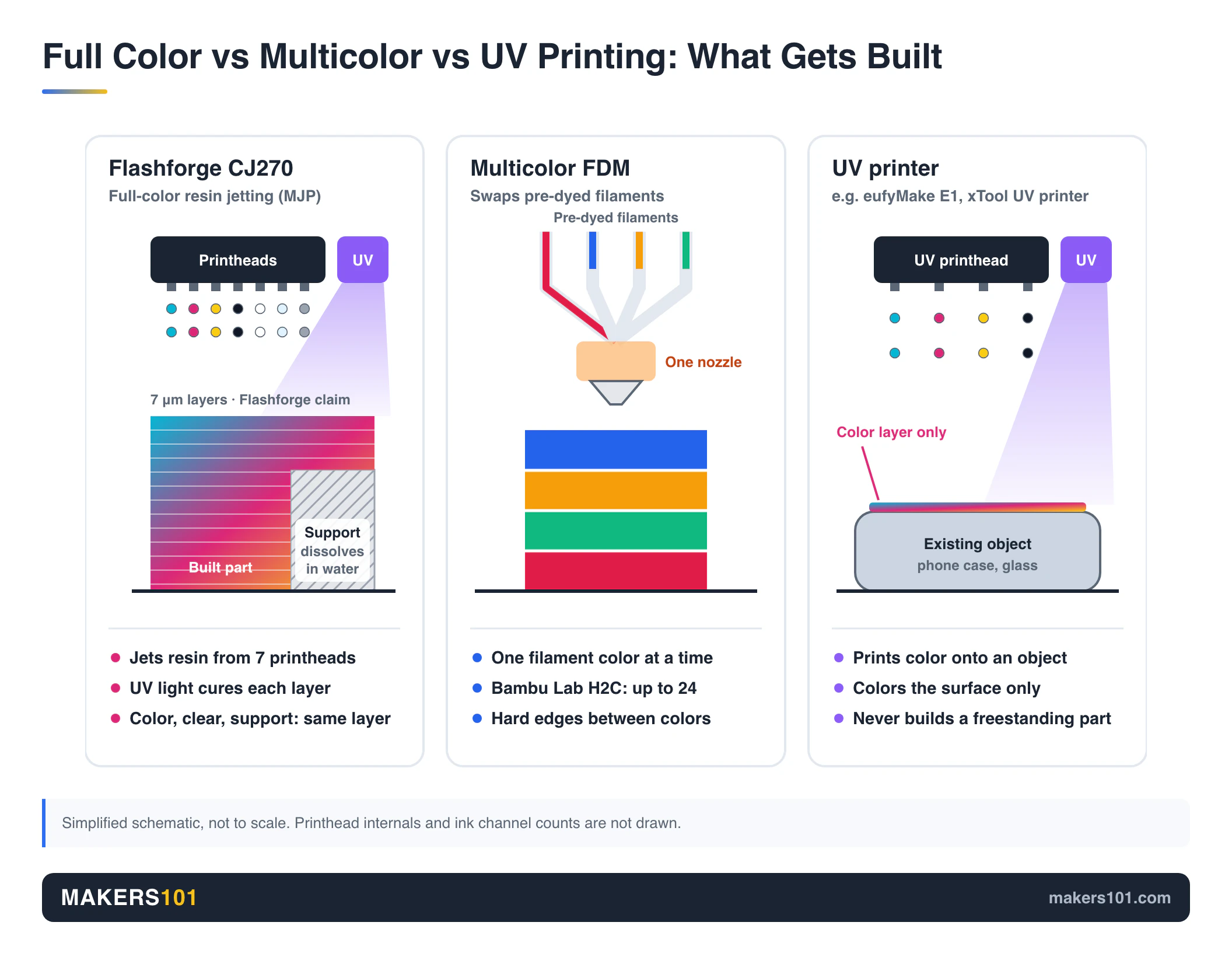
The CJ270 builds a part by jetting tiny droplets of photopolymer resin from seven printheads and curing each layer instantly with UV light. Color, clear resin, and support all go down together in the same layer. Nothing gets painted afterward.
Six base resins do the color work: CMYK plus white and clear. The printer mixes them on every layer, which is how Flashforge reaches its 10 million+ color figure. The payoff you’d actually see is smooth gradients and natural skin tones, with no hard edges between color blocks.
A multicolor FDM printer works differently. It switches between pre-dyed filaments, and even a Bambu Lab H2C tops out at 24 of them. Melted plastic can’t be premixed inside a nozzle, so reaching millions of colors with FDM would take thousands of nozzles.
One industry description of the split sticks. Multicolor printing looks like pixel art or a child’s crayon drawing. Full color looks more like a watercolor or a photo, where colors blend into each other.
It’s also a different animal from the resin printer you may already own. A DLP or LCD printer cures a whole layer at once with projected light, and it prints one resin at a time. If you want the basics of that process, start with our guide to how a resin printer works.
UV printers cause the most confusion. Machines like the eufyMake E1 and xTool’s UV printer print full color onto objects that already exist, such as phone cases or glass. xTool’s machine, for example, works over an A3 area with 150 mm of Z clearance.
Standard UV ink droplets can’t hold a shape on their own, so these machines color a surface and never build a freestanding part. We covered that split in our piece on the Bambu Lab UV printer.
The Flashforge CJ270 Workflow: ColorPrint, AI Image-to-3D, and Water-Soluble Supports
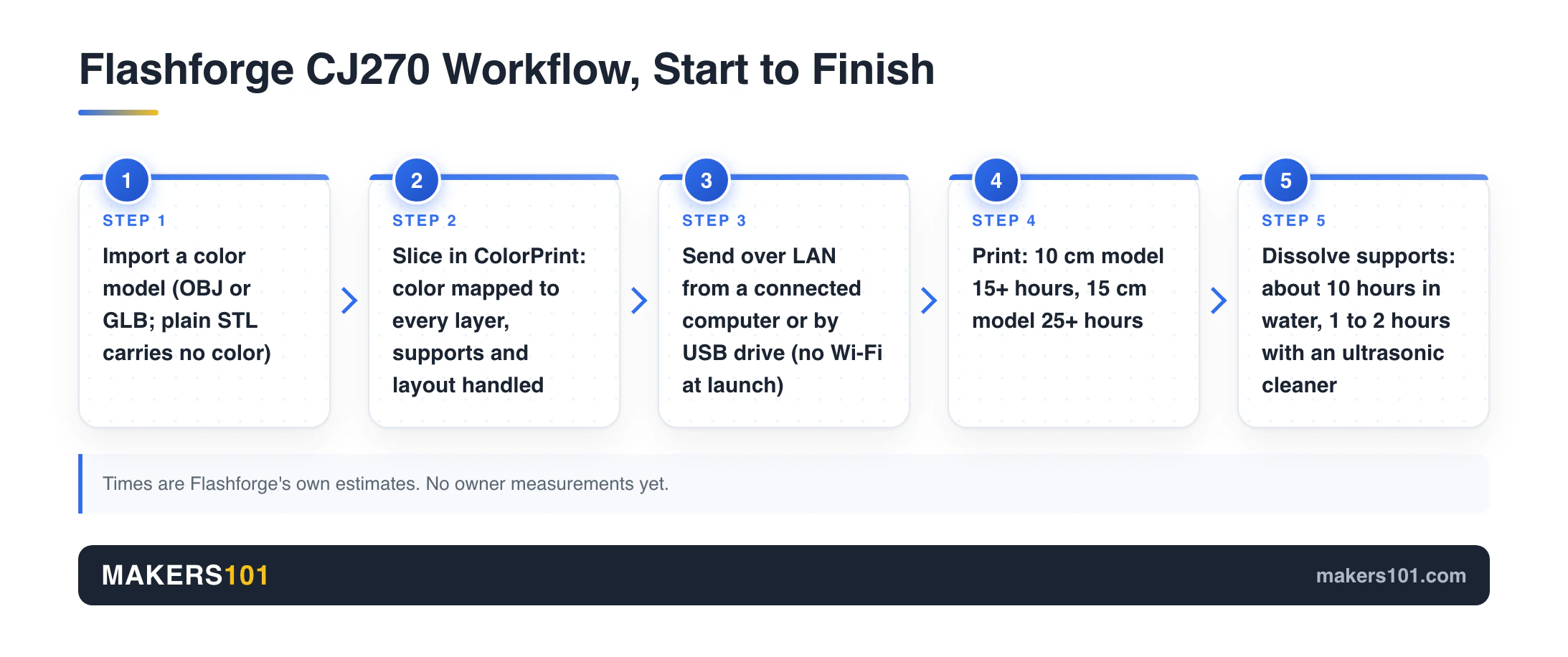
Flashforge pitches a one-app workflow: import a model, slice it in ColorPrint, send it to the printer, then dissolve the supports in water.
ColorPrint is the slicer built for the CJ270. It maps color onto every layer automatically and handles supports and layout. It runs on Windows and macOS and opens CJP, CJM, STL, OBJ, 3MF, STEP, STP, PLY, FBX, GLB, GLTF, and WRL files. For color models, Flashforge recommends OBJ or GLB, since a plain STL carries no color at all.
The software also includes an AI modeling tool that turns a single 2D image into a printable 3D file. That lowers the bar if you don’t model. How good those auto-generated models look in full color is something only owner prints will show.
A few details matter before you plan a production day:
- No Wi-Fi at launch. Files go over LAN from a connected computer or by USB drive. Flashforge says Wi-Fi is planned for later this year.
- Long print times. Flashforge’s own guide says models under 10 cm may take less than 10 hours, a 10 cm model needs 15+ hours, and a 15 cm one runs 25+ hours.
- Slow support removal. Soaking in water takes around 10 hours. An optional ultrasonic cleaner cuts that to 1 to 2 hours.
- One-time material cards. Each resin pack’s card loads its balance into the printer once and then becomes invalid.
Once the supports are gone, you can lightly sand, polish, or add a UV gloss coat for a more finished surface. Automatic leveling takes care of the first layers.
What Flashforge CJ270 Resin Actually Costs
Flashforge CJ270 resin costs $69.90 for a single-kilogram pack or $499 for a bulk pack of ten, which works out to $49.90 per kilogram. Those are the prices on Flashforge’s US store as of this update.
The resin page went live on September 11, two days after pre-orders opened. On launch day, a UK buyer on r/FlashForge said they asked Flashforge what resin would cost and were told the official site “will be launched soon.” Now there’s an answer, and the pack contents show where your money goes.
Each single pack holds ten 100 g cartridges:
| Cartridge | Count per pack | Share of pack |
|---|---|---|
| Support (water-soluble) | 3 | 30% |
| White | 2 | 20% |
| Cyan, magenta, yellow, black | 1 each | 10% each |
| Clear | 1 | 10% |
Three of every ten cartridges hold support that ends up dissolved in a tub of water. Your real ratio will depend on the model and its orientation. Still, the pack itself tells you Flashforge expects support to be the single biggest material you burn through.
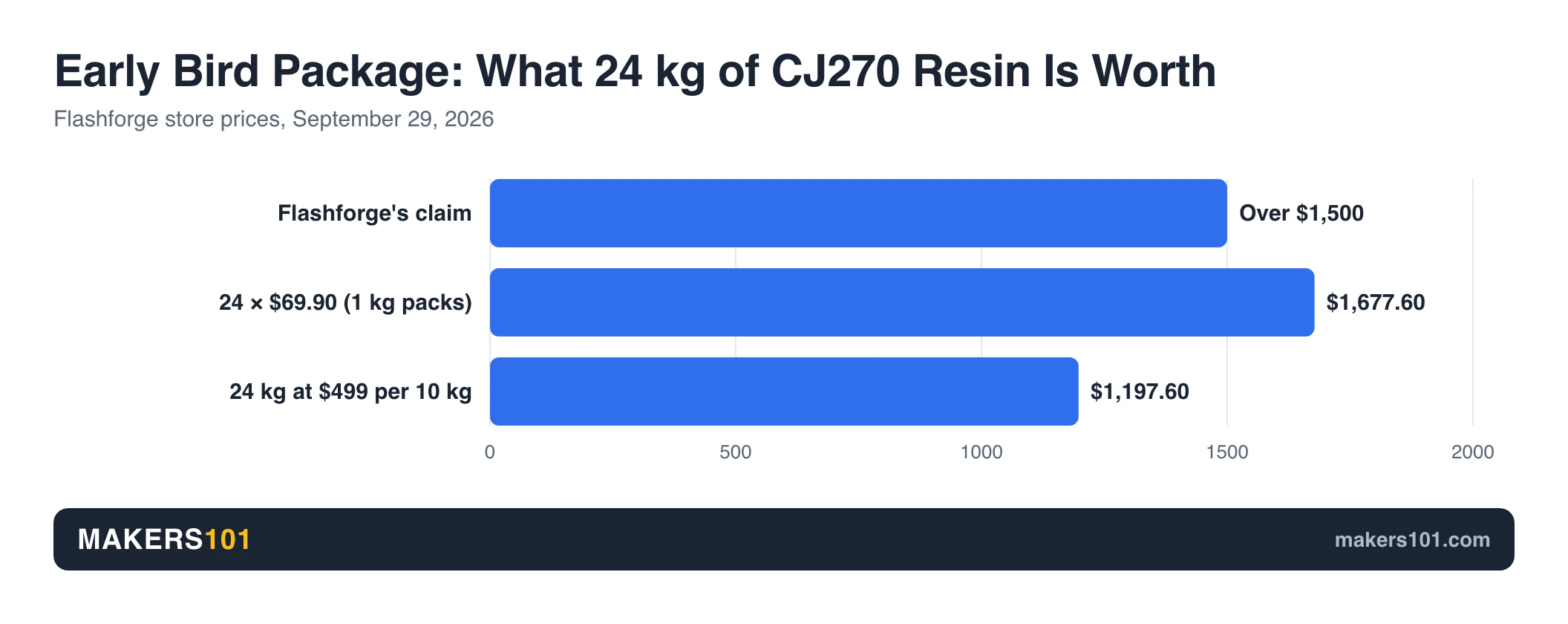
Now check the Early Bird claim. Flashforge says the resin benefit is “worth over $1,500.” At single-pack pricing, the full allotment comes to $1,677.60. At the bulk rate, it’s $1,197.60. So the claim only holds at small-pack pricing.
For an add-on that cheap, it’s still the best value in the launch in my view, as long as you’ll actually use 2 kg a month.
Shelf life is where that condition bites. Unopened resin lasts 18 months, but Flashforge recommends using opened cartridges within 2 months. If you print occasionally, some of what you pay for will age out before it reaches a print.
For comparison, HeyGears lists its G1X resin at $25 to $35 per liter in campaign pricing. Kilograms and liters aren’t the same unit, and photopolymer resin is a little denser than water, so treat this as a rough check.
Flashforge’s price also covers the support resin that makes up 30% of each pack, and it’s unclear whether HeyGears’ figure includes support. Even so, its bulk rate sits above the top of HeyGears’ range, and its single-pack price is about double. To price a specific model, plug your own numbers into our 3D print cost calculator.
Third-party resin is off the table. Flashforge says the CJ270 supports its dedicated materials only and that other resins may damage the printer.
Is the Flashforge CJ270 Really the First Desktop Full-Color 3D Printer?
No. “The World’s First Desktop Full-Color 3D Printer” is Flashforge’s marketing line, and other desktop full-color machines were announced earlier. What the CJ270 can claim is a straight retail pre-order from an established printer brand, backed by a published ship date.
| Machine | Type | Price | Build volume | Status (Sept 2026) |
|---|---|---|---|---|
| Flashforge CJ270 | Desktop MJP resin jetting | $3,999 pre-order ($4,499 list) | 180 × 120 × 100 mm | Pre-order, first units ship Oct 15 |
| HeyGears G1X Full-3D Pack | Desktop UV resin jetting | $3,599 Kickstarter ($5,499 MSRP) | 420 × 330 × 130 mm | Crowdfunded, ships Dec 2026 |
| iNEW3D QC2A | Desktop material jetting | $7,199 crowdfunding ($9,999 MSRP) | 200 × 160 × 80 mm | Funded on crowdfunding |
| Stratasys J850 Prime | Industrial PolyJet | Quote only, reported above $100,000 | n/a | Shipping |
| Mimaki 3DUJ-553 | Industrial material jetting | $207,895 US list | n/a | Shipping |
Reddit pushed back fast. On the r/FlashForge launch post, one commenter said there are already “like 20 models out right now.” Another replied that no desktop full-color resin printer was actually on the market yet, because every rival was still a pre-order. On r/3DDruck, the German thread’s author questioned the “first” claim too, pointed at the HeyGears G1X and eufyMake E1, and put the CJ270 at about €4,150 with tax.
The E1 is a UV printer, so it doesn’t build parts. The G1X does, and its plate is far bigger, but backers won’t see units until December.
If the CJ270 ships on October 15, it should reach owners about two months before the G1X. Our HeyGears G1X breakdown covers that machine’s numbers in detail.
There’s also a cheaper route to color that skips jetted resin for the body entirely. The FA3D DIO X builds the part in FDM plastic and sprays UV color onto the outer layer as it prints.
Flashforge CJ270 Limitations: Durability, Build Volume, and Locked-In Materials
The CJ270 makes display pieces, and Flashforge says so itself. Its resin FAQ calls the materials “designed primarily for high-quality full-color visual models rather than functional applications.” Prints may break if dropped or put under real stress, and Flashforge doesn’t recommend them for functional prototypes or load-bearing parts.
That lines up with a wider criticism of jetted resin. Coverage promoting FA3D’s competing FDM + UV machine claims material-jetted parts tend to be brittle and start softening around 50°C. It names no test and comes from a rival’s pitch, so weigh it lightly. Flashforge’s own warning is the one to plan around.
The other limits:
- Small build volume. At 180 × 120 × 100 mm, the CJ270 fits figures and miniatures, plus portraits and small collectibles. Cosplay helmets and big dioramas won’t fit.
- Locked materials. Only Flashforge resin works, loaded through one-time material cards. If supply or pricing changes, there’s no second source.
- Unknown printhead life. Flashforge hasn’t published it. The same FA3D-side coverage says early crowdfunding buyers of other UV machines complained about ink expiring after about six months and heads lasting three to six months. It names no brand, and none of it involves the CJ270.
- No independent reviews yet. Units haven’t shipped, so every published print sample comes from Flashforge.
Why the Flashforge CJ270 Matters for Full-Color 3D Printing
The CJ270 moves full-color resin jetting from a six-figure industrial purchase to a desktop price. Flashforge’s own chart puts traditional industrial full-color printers at about $150,000, and Stratasys’ full-color PolyJet machines have been reported above $100,000 for years.
That gap matters most to print shops. Europe and North America reportedly have close to 20,000 3D print farms, and many rely on industrial color machines for this kind of work. A desktop jetting printer won’t match a J850 on speed or size. It does change what a small shop can offer customers.
The market underneath is growing, too. One industry analysis puts 2025 consumer 3D printing GMV at about $6 billion, with 33.2% annual growth expected over the next five years.
Expect prices to keep falling. The same analysis argues that once these makers sort out mass delivery and get cost and maintenance under control, prices could drop quickly as they compete for the same studios and creators. One Reddit commenter already put a number on it: “once they get below say $3k the 40k players will be all over them.”
The locked-material approach isn’t unique to Flashforge, either. HeyGears’ founder has argued that full color only works when materials, process, software, and hardware are developed together, and that a simple assembly model can’t get there.
My Take: Who Should Pre-Order the Flashforge CJ270 and Who Should Wait
I haven’t printed on a CJ270, and nobody outside Flashforge has run a production unit yet. This take is built on the official specs, the store pages, and the cost math above.
Pre-order if you sell small, custom, colored objects. Pet figures, custom portraits, tabletop miniatures, and designer toys all fit the build volume and never need to survive a drop. For that kind of shop, the pre-order price plus the Early Bird Package is the cheapest way to buy jetted full color at retail, with no crowdfunding risk. The G1X’s regular price is $5,499, and the QC2A’s is $9,999.
Just run your own numbers first. HeyGears estimated about $4.50 in resin for an 8 cm figure weighing about 150 g with supports, sold at $69. That was HeyGears’ own estimate, unverified by users, and CJ270 resin costs more per kilogram. Our guide to making money with a 3D printer covers the costs people usually forget.
Wait if any of these describe you:
- You want functional parts, not display pieces.
- You need anything bigger than a small figure.
- You print a few times a month, so opened resin would expire before you use it.
- You want independent reviews before spending $4,000 on a brand-new category.
My read: the CJ270 is a small-business tool with a hobby-sized footprint. Buy it for the orders it can earn.
What Happens Next for the Flashforge CJ270
The next date to watch is October 15. That’s when the pre-order window closes (Pacific Time) and the first batch of 100 leaves the warehouse. Early Bird resin shipments should start around November, and Flashforge says Wi-Fi support arrives later this year.
Three things will tell you whether the CJ270 lives up to the launch page:
- Owner prints. Color accuracy, surface finish, and how visible those 7 μm layers really are.
- Real resin use per model. Especially how much support a typical figure eats.
- Printhead life. Flashforge hasn’t published it, and it decides the long-term cost.
The HeyGears G1X is scheduled to ship in December 2026. By early next year, you should be able to compare both machines on real owner prints.
FAQ: Flashforge CJ270 Price, Shipping, and Resin
How much does the Flashforge CJ270 3D printer cost?
The Flashforge CJ270 costs $3,999 during pre-order, down from a $4,499 regular price. An optional $49 Early Bird Package adds a sample print and 24 kg of resin over 12 months. Prices are from Flashforge’s US store as of September 29, 2026.
When does the Flashforge CJ270 ship?
Flashforge’s first 100 CJ270 units go out on October 15, 2026. Every other pre-order follows in purchase order, also by air. Once your unit leaves, expect roughly a week for US delivery and two weeks for Europe.
How does the Flashforge CJ270 work?
The CJ270 uses MJP (MultiJet Printing). Seven printheads jet droplets of photopolymer resin, and UV light cures each layer instantly. It blends the four CMYK colors with white and transparent resin on every layer and prints water-soluble support at the same time.
How much does Flashforge CJ270 resin cost?
A 10 kg bulk pack of CJ270 resin is $499, and a single kilogram runs about $70. Each single pack splits into ten 100 g cartridges, with three reserved for support. Once opened, a cartridge should be used within two months.
Can the Flashforge CJ270 use third-party resin?
No. Flashforge says the CJ270 supports only its dedicated materials and that third-party resin may damage the printer. Resin loads through one-time material cards.
What is the best full-color 3D printer right now?
None of the new desktop full-color printers has independent reviews yet, so there’s no tested best pick. The Flashforge CJ270 is set to ship on October 15, about two months ahead of the G1X, and claims 7 μm layers. The HeyGears G1X offers a much larger build plate and ships in December 2026.
Are Flashforge 3D printers any good?
Flashforge is an established brand with a global retail footprint, and FDM models like the AD5X and Creator 5 have large owner communities. The CJ270 is new technology for the company, though. Judge it on owner reviews after it ships.
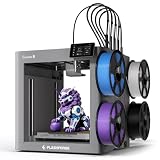
- A Smarter Approach to Multi-Material Printing: Every color change shouldn’t come with a pile of wasted filament. Creator 5 takes a smarter route…
- 7 Seconds Tool Changer System: Traditional filament changers can spend more time purging than printing. The FlashSwap system keeps four toolheads…
- Support Mixed-Material Printing: The Creator 5 allows you to combine model materials with PETG, PVA, and BVOH supports for improved print stability…
- High-Speed Printing Without the Artifacts: Combines high-speed motion with intelligent vibration cancellation to preserve print quality at every…
- Calibrated for Flawless Multi-Toolhead Printing: Advanced compensation algorithms keep every toolhead perfectly synchronized, suppress vibrations…

- Enjoy 4-Colors Printing: With Intelligent Filament System,FLAFORGE AD5X allows your printing in 4 colors,and will be about to achieve different types…
- Speedy and Stable: FLASHFORGE AD5X multicolor 3D printer can reach up to 600mm/s travel speed and 20m/s² acceleration, CoreXY all metal design…
- Multi-Filament Print:Equipped with 300°C High Temp nozzle andd 32mm³/s large flow hotend will greatly shorten the waiting time for printing.Easily…
- Excellent Printing Function: Multi color 3d printer machine AD5X integrates key features that one-click auto leveling,vibration compensation,4.3inch…
- Multi-Device Management: With Flash Maker and Orca-Flashforge,it allows users manage hundreds of printers remotely,real-time monitoring of print…