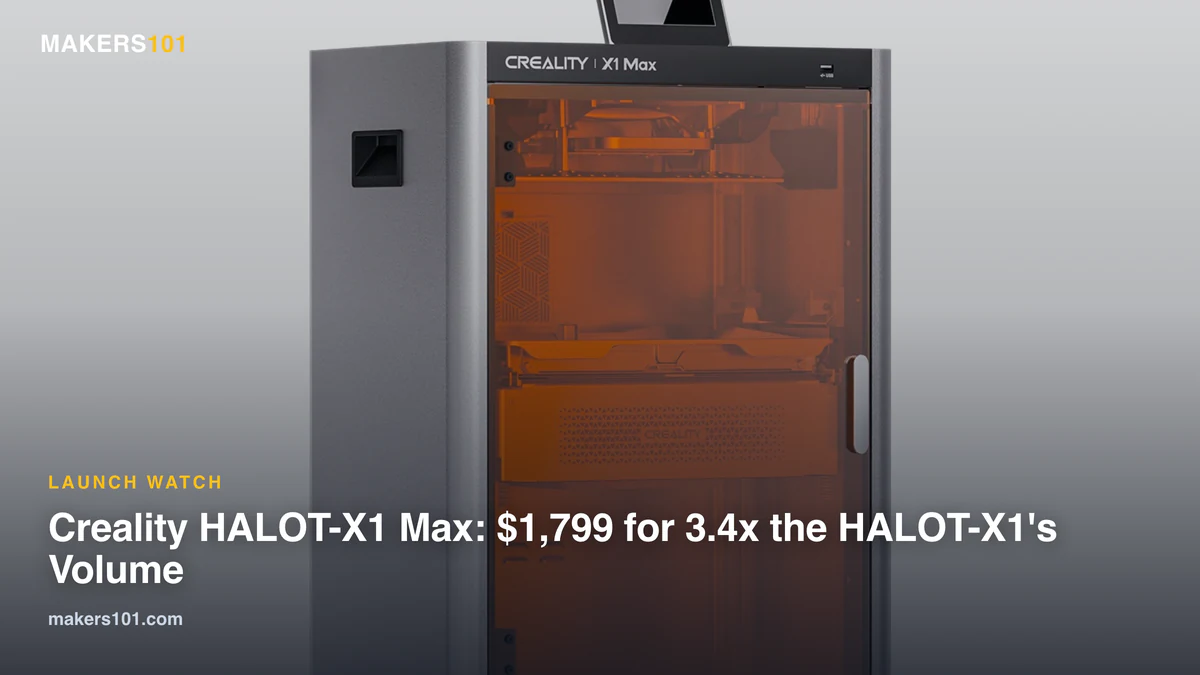
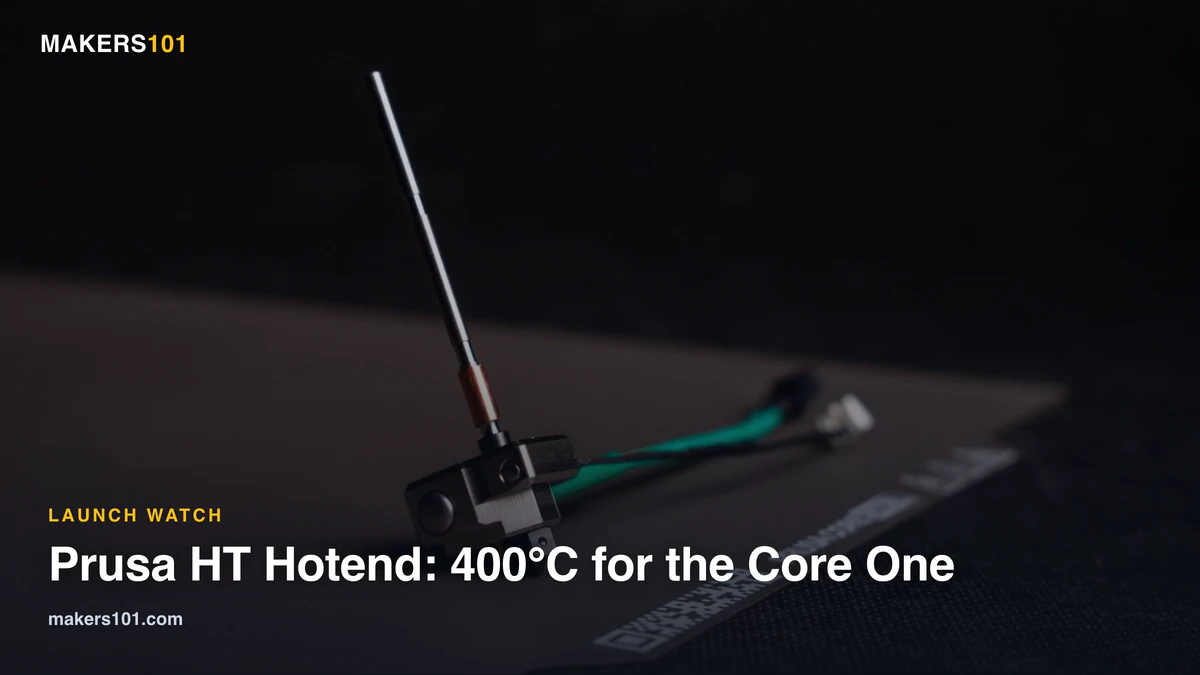

Prusa’s HT Hotend upgrade costs $199.99 and lifts the Core One family’s nozzle limit to 400°C. A new Core One L+ with the hotend factory-fitted sells for $2,169. That’s $170 more than the standard L+ at $1,999.
Prusa also released HighTemp print sheets and three filaments on Oct. 21: PPS-CF, PPS-GF and PPA-CF Core. The hotend itself isn’t new. It has been listed at roughly $200 since at least December 2025.
Table of Contents
- Prusa HT Hotend at a Glance (as of Oct. 28, 2026)
- Prusa HT Hotend Price: $199.99, or About $378 for the Full Kit
- What the HT Hotend Changes on a Core One, and What It Doesn’t
- Prusa HT Hotend vs Bambu H2D and X2D for High-Temp Printing
- What the HT Hotend Means for Core One and Bambu Buyers
- Prusa HT Hotend FAQ
- What We Still Don’t Know About the Prusa HT Hotend
Prusa HT Hotend at a Glance (as of Oct. 28, 2026)
| Prusa HT Hotend (as of Oct. 28, 2026) | Detail |
|---|---|
| Price | $199.99 (upgrade kit) |
| Factory-fitted option | Core One L+ (HighTemp Hotend), $2,169 |
| Lead time | About 3 weeks |
| Max nozzle temperature | 400°C |
| Stock nozzle | Hardened 0.4 mm ObXidian 500, standard flow |
| Fits | Core One, Core One+, Core One+ (Gen 2), Core One L, Core One L+ |
| Doesn’t fit | INDX, MMU, XL+, MK4S |
| In the box | Hotend, two idlers (standard and high-temp), new main plate, gloves, printed guide |
| Matching sheet | HighTemp sheet, $59.99 (Core One) or $61.99 (Core One L) |
Prusa HT Hotend Price: $199.99, or About $378 for the Full Kit
The hotend is the cheap part. Most high-temp materials “emit dangerous fumes,” so plan on extra gear around it.
For a Core One+ owner, that bundle comes to $377.96. On top of the hotend, it’s $59.99 for the sheet, $82.99 for Advanced Filtration and $34.99 for the USS Drybox. Skip the sheet for hotter PA11 or PC Blend, since standard materials stick poorly to it.
Per kilogram, PPS-CF10 works out to $169.98 and PPS-GF20 to $145.98, since both come in 500 g spools. PPA-CF Core is $114.99 for a full kilogram.
What the HT Hotend Changes on a Core One, and What It Doesn’t
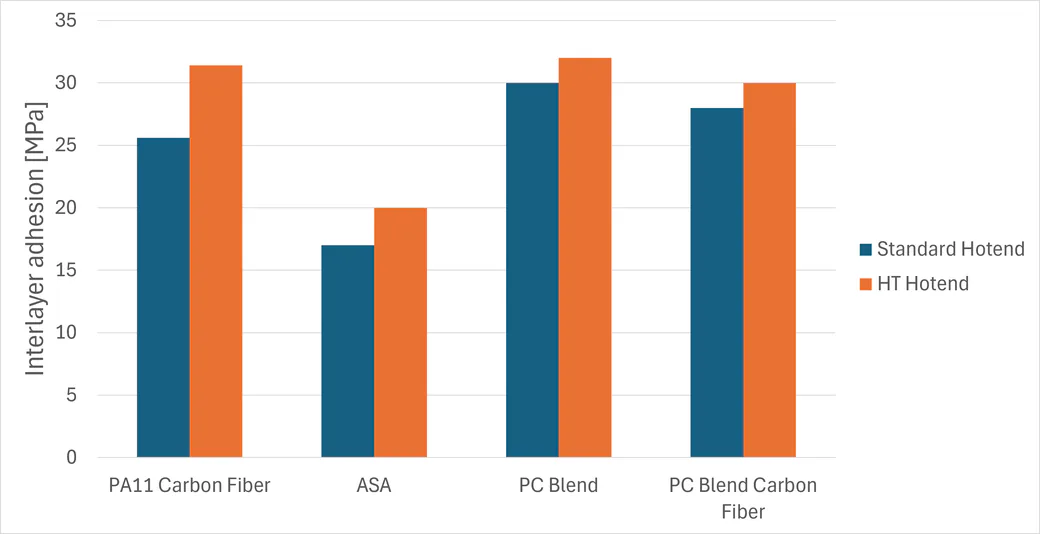
The main gain is stronger parts from materials you can already print. In Prusa’s own tests, interlayer adhesion rose 23% for PA11 Carbon Fiber, 18% for ASA and 7% each for PC Blend and PC Blend Carbon Fiber. If ASA is your main material, our ASA filament rankings compare brands on strength and warping.
The second gain is new materials. PPS-CF, PPS-GF and PPA-GF need the HT hotend and its high-temp “H” idler.
Prusa contradicts itself on the top tier. Its product FAQ calls PEEK, PEKK and PEI “not supported”: the nozzle and 120°C bed are “on the lower end but sufficient,” but a 60°C chamber is “too low.” Yet the same page promises PEKK-CF, and the launch post says small PEKK-CF parts “may be printed.”
On the Core One+ (Gen 2), high-temp materials are rated for “small-scale parts only.” That model’s chamber is passive and tops out at 55°C.
After a one-time install that replaces the main plate, swapping hotends takes under a minute, so you can keep a brass high-flow hotend for PLA. Don’t run PLA on the HT hotend at high heat, though. PLA degrades at 250°C and can ignite near the hotend’s top temperature.
Prusa HT Hotend vs Bambu H2D and X2D for High-Temp Printing
On paper, the upgraded Core One runs a hotter nozzle than Bambu’s H2D, H2C or X2D. The H2D and H2C top out at 350°C, and the X2D at 300°C.
Bambu wins on the chamber. All three heat it actively to 65°C. The L+ uses active convection a few degrees lower, while the Core One+ chamber is passive and cooler still at 55°C.
Our Bambu Lab X2D vs Prusa Core One comparison covers the Core One+’s passive chamber against Bambu’s active heating.
Bed heat is the other question. In Thomas Sanladerer’s January test, an early Core One L showed a 110°C bed that measured 96–98°C at the surface, with cold spots. It failed his polycarbonate print, which he blamed on dripping grease and uneven bed heat. He also found its chamber heat drops whenever the bed runs below 120°C. Prusa now claims under 2°C of variance across 99% of the L+ bed. No independent test has checked that yet.
My read: for PPS and PPA, the hotter nozzle is the real gain. For PEEK-class plastics, the Core One chamber is too cold, and Bambu’s 65°C is only slightly warmer. That’s the job of Prusa’s Pro HT90, with a 500°C nozzle and a 90°C chamber, listed at $11,380.
What the HT Hotend Means for Core One and Bambu Buyers
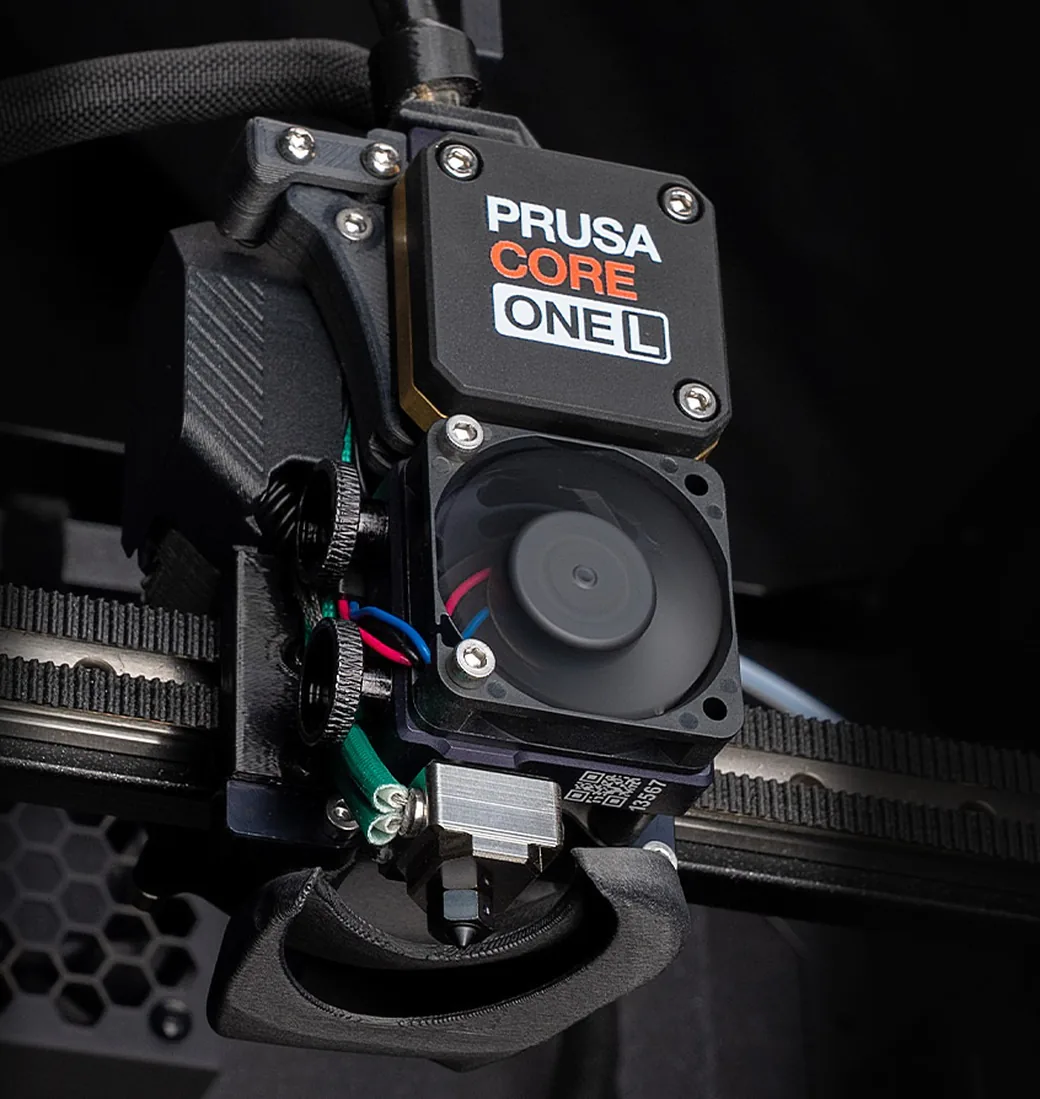
Core One L and L+ owners: buy it for PPS, PPA or stronger PA11-CF parts. Printing mostly PLA and PETG? Keep the $200.
Core One+ (Gen 2) owners: it’s worth it for stronger PA11-CF, ASA and PC Blend parts. PPS and PPA are limited to small parts on this model.
If you’re about to buy a Core One L+ and expect to print PPS or PPA: the HighTemp version costs $29.99 less than adding the hotend later. Check whether it also ships with the standard hotend, which you’ll want for PLA.
INDX, MMU, XL+ and MK4S owners: this version doesn’t fit.
If you’re choosing between Prusa and Bambu for engineering parts: our Prusa Core One vs Bambu Lab H2D comparison covers the chamber and bed differences. Our Bambu Lab Black Friday 2026 guide covers this year’s H2D and X2D deals.
Prusa HT Hotend FAQ
How much is the Prusa HT Hotend?
The upgrade kit is $199.99 on Prusa’s US store. The factory-fitted Core One L+ (HighTemp Hotend) is $2,169.
What is the Prusa HT Hotend upgrade good for?
It lets Core One printers reach 400°C for PPS and PPA filaments, though the Core One+ (Gen 2) is rated for small high-temp parts only. Prusa’s own tests also show stronger layers on PA11 Carbon Fiber and ASA.
Is the Prusa HT Hotend compatible with INDX?
No. It’s made for single-extruder Core One machines and doesn’t work with induction heating.
What We Still Don’t Know About the Prusa HT Hotend
- How small “small-scale” really is for PPS-CF on a Core One+ (Gen 2)
- Whether the L+ bed holds its variance claim during long high-temp prints
- How long the hotend and ObXidian nozzle last on abrasive high-temp fills
- No independent strength tests yet confirm Prusa’s adhesion numbers