
I earn a commission if you buy through links on this page, at no extra cost to you. As an Amazon Associate, I earn from qualifying purchases.
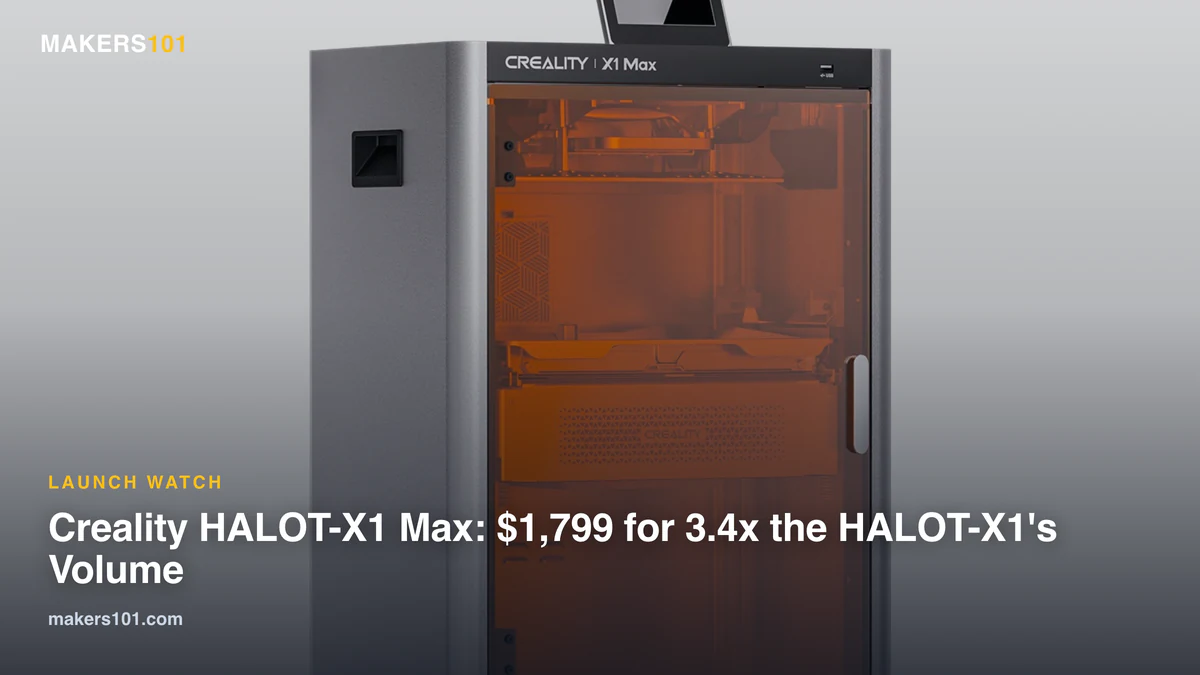
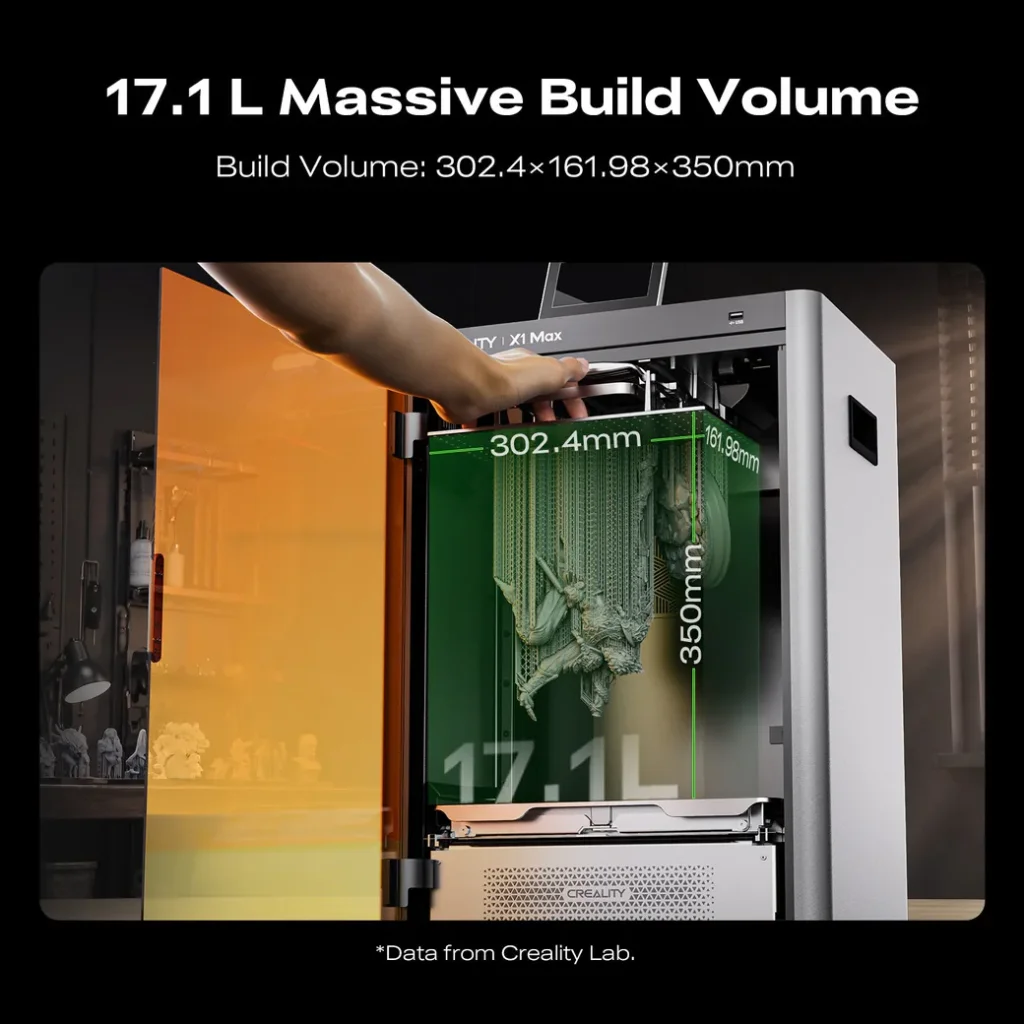
The Creality HALOT-X1 Max is listed at $1,799 and in stock on the Creality Store as of Oct. 27, 2026, with a 302.4 × 161.98 × 350 mm build volume. That works out to 17.1 liters, about 3.4 times the space of the $469 HALOT-X1.
The Max now tops a three-printer HALOT-X1 family, above the $239 X1 Neo and the X1. Creality unveiled it at IFA 2026, alongside the Ender-3 V3 Mega and aims it at animation studios, miniature and wargaming studios, and small runs of 3D-printed shoes.
Table of Contents
- Creality HALOT-X1 Max Price: $1,799, One Version, Free US Shipping
- What’s New in the HALOT-X1 Max, and What It Gives Up
- HALOT-X1 Max vs HALOT-X1: Is 3.4x the Volume Worth 3.8x the Price?
- What the HALOT-X1 Max Means for HALOT-X1 Owners and Resin Buyers
- Creality HALOT-X1 Max FAQ
- What We Don’t Know About the HALOT-X1 Max Yet
Creality HALOT-X1 Max Price: $1,799, One Version, Free US Shipping
The US store lists one configuration with no strikethrough price and no bundle, though it offers a $500 coupon pack to newsletter subscribers. Shipping is free on every 3D printer in the store.
The 5L HyperFeed resin feeder is marked optional on the official product page, and it has no listed price yet.
| HALOT-X1 Max (as of Oct. 27, 2026) | Details |
|---|---|
| US price | $1,799 (Creality Store) |
| Availability | In stock, no ship date stated |
| Build volume | 302.4 × 161.98 × 350 mm (17.1 L) |
| Screen | 13.5-inch 16K mono LCD |
| XY pixel size | 20 × 26 μm |
| Z axis | 4 lead screws + 4 linear rails |
| Chamber heating | Active, up to 40°C |
| Rated speed | 80 mm/h at 0.2 mm layers |
| Size and weight | 500 × 350 × 692 mm, 34.7 kg |
| Rated power | 1350W |

What’s New in the HALOT-X1 Max, and What It Gives Up
The biggest change is the Z axis. Like the X1, the Max keeps the build plate fixed while the light source moves, but it rides on four lead screws and four linear rails, double the X1’s two of each. Creality says the fixed platform removes vibration-induced layer lines and the four-screw frame stops the plate from “nodding.”
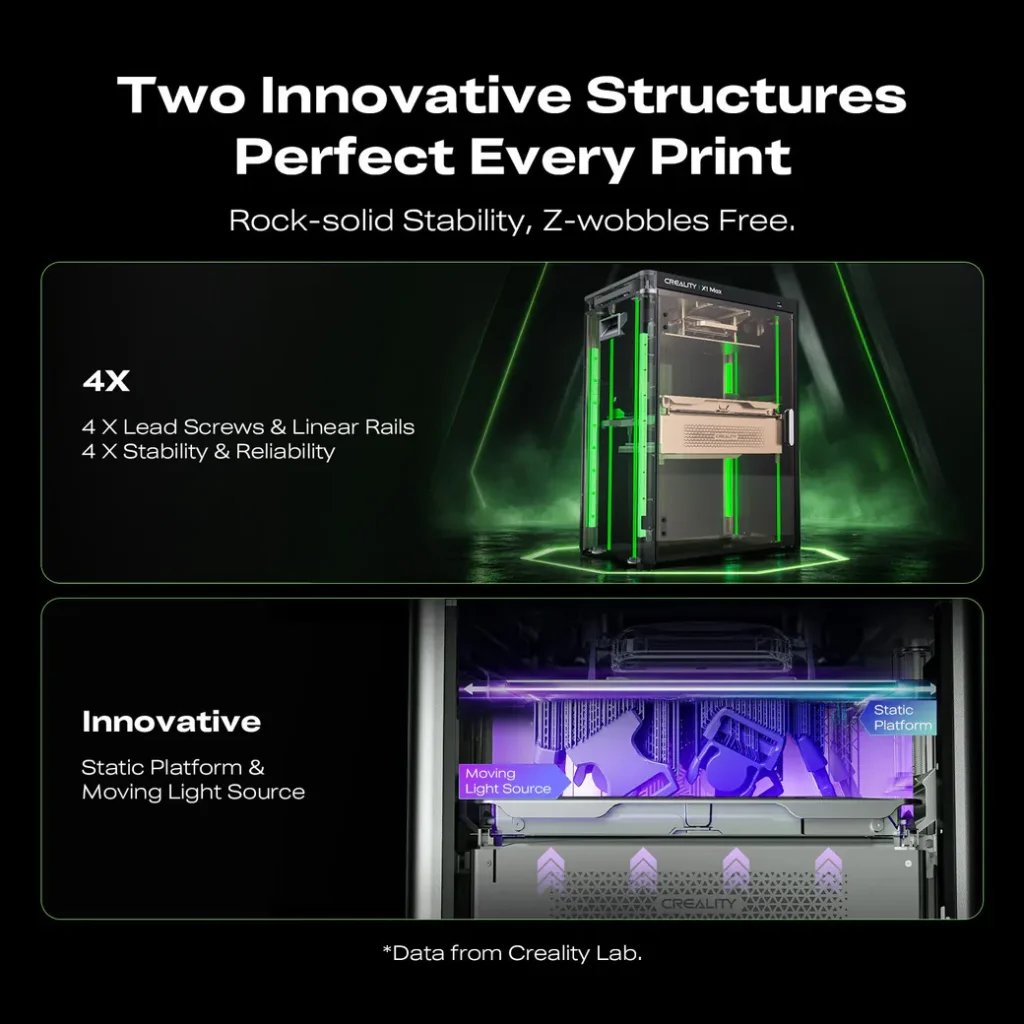
Most of the other additions target long unattended runs. The Max gets chamber heating to 40°C, an AI camera with residue detection, and eight sensors in total.
The optional HyperFeed system refills and recovers resin and reads RFID resin tags. A 12 CFM negative-pressure fan with activated carbon handles fumes, and CreFarm OS runs fleets of printers. Creality also claims its ACF release film cuts release force by 60%.
The spec sheet shows the costs too. The pixels are larger, 20 × 26 μm against 14 × 19 μm on the X1, and by my math both screens carry the same 15120 × 6230 pixel grid, spread over a larger 13.5-inch panel on the Max. Its exposure is split into 76 zones, fewer than the X1’s 92. The Max also draws 1350W against 350W, weighs 34.7 kg, and lists Lychee slicer support as “coming soon.”
Speed is hard to compare. The Max is rated at 80 mm/h with 0.2 mm layers, while the X1 page gives a maximum of 170 mm/h. Those two figures use different terms, so neither tells you which printer finishes a job first.
HALOT-X1 Max vs HALOT-X1: Is 3.4x the Volume Worth 3.8x the Price?
By my math, the Max costs about $105 per liter of build volume, against about $94 for the HALOT-X1. Going bigger does not get cheaper per liter here. For that extra cost per liter, you get chamber heating, the stiffer frame, and the monitoring. The small X1 Neo is pricier still, at about $125 per liter.
For batch work, plate area matters more than liters. The Max’s platform is about twice the X1’s footprint (302.4 × 161.98 mm against 211.68 × 118.37 mm), and the rest of the extra volume is height. If you print flat trays of miniatures, plan on roughly double the parts per plate, assuming similar spacing.
The brand’s own demo is 60 miniatures, each 31 mm tall, in about 4 hours. That number comes from Creality Lab and hasn’t been tested independently yet.
What the HALOT-X1 Max Means for HALOT-X1 Owners and Resin Buyers
If you own a HALOT-X1: the Max buys you tall one-piece prints and more automation for long runs, and you give up some XY detail. For tabletop miniatures, the X1 is still the finer printer on paper.
If you run a small studio or print farm: heating, residue detection, and fleet software come in one box. That matters more than raw size once prints run unattended.
If you’re new to resin: start with the X1 Neo or the X1. Our best Creality 3D printer guide shows where the X1 fits, and our ABS-like vs standard resin breakdown helps before you buy resin by the liter.
Creality HALOT-X1 Max FAQ
How much does the Creality HALOT-X1 Max cost?
It costs $1,799 in Creality’s US store (checked Oct. 27, 2026), and shipping is free. The optional 5L HyperFeed resin system has no published price yet.
What is the HALOT-X1 Max build volume?
The build volume is 302.4 × 161.98 × 350 mm, or 17.1 liters. The standard HALOT-X1 offers roughly 5 liters, so the Max has about 3.4 times as much room.
What is the difference between the HALOT-X1 Max and the HALOT-X1?
The Max is larger and adds a four-screw, four-rail Z axis, active chamber heating, and AI residue detection. Both use a static platform with a moving light source. The HALOT-X1 costs $469 and has finer 14 × 19 μm pixels.
What We Don’t Know About the HALOT-X1 Max Yet
There is no ship date beyond “in stock,” no HyperFeed price, and no date for Lychee support. We haven’t found any independent print tests yet, so the throughput and release-force numbers are lab claims for now. So far we found it only on Creality’s own store.
The Max is Creality’s answer if your prints keep hitting the X1’s 200 mm height limit. Just budget past the printer’s sticker price for resin, a wash-and-cure station, and possibly the feeder.