
I earn a commission if you buy through links on this page, at no extra cost to you. As an Amazon Associate, I earn from qualifying purchases.
Bambu Lab has listed TPU 75A, a softer TPU than anything it sells today, as a 2.85mm filament the store marks “Compatible only with H3C.” The 1 kg spool goes on sale November 3, the morning Bambu reveals the H3C tool changer, and no price is shown yet.
It’s the only spool that thick in Bambu’s US TPU collection, per the Bambu Lab TPU 75A store listing. The TPU for AMS and TPU 85A/90A listings both specify 1.75mm. P1S, P2S, X1, A1 and H2C owners can’t run it.
Table of Contents
- Bambu Lab TPU 75A Specs: What the Store Listing Confirms
- Bambu Lab TPU 75A Price and Release Date: On Sale Nov. 3, Price Not Listed
- Why Bambu Lab TPU 75A Uses 2.85mm Filament
- What Bambu Lab TPU 75A Means for P1S, P2S, X1, A1 and H2C Owners
- Bambu Lab TPU 75A FAQ
- Bambu Lab TPU 75A and H3C: What’s Still Unknown
Bambu Lab TPU 75A Specs: What the Store Listing Confirms
| Bambu Lab TPU 75A (as of Oct. 27, 2026) | What the listing says |
|---|---|
| Price | Not shown |
| On sale | Nov. 3, 2026, 13:45 UTC |
| Compatible printers | H3C only |
| Hardness | Shore 75A |
| Diameter | 2.85mm ±0.05mm |
| Spool | 1 kg, filament with spool |
| Colors | 10 |
| Flow rate (Bambu claim) | 10 mm³/s, “~3× faster than conventional setups” |
| Finish | Natural matte |
| Skin contact (Bambu claim) | “Certified for skin contact,” no standard named |
| Handling | Must be dried before use |
The listing pairs the diameter with a term it calls FlexFeed, but it doesn’t say what FlexFeed is, and it doesn’t say which setup the “3×” speed figure is measured against.
Bambu Lab TPU 75A Price and Release Date: On Sale Nov. 3, Price Not Listed
The US store shows “Available on November 3 at 13:45 PM (UTC)” where the price would normally sit. By my math that’s 8:45 AM EST, 15 minutes before the 9:00 AM EST reveal on Bambu’s H3C teaser page.
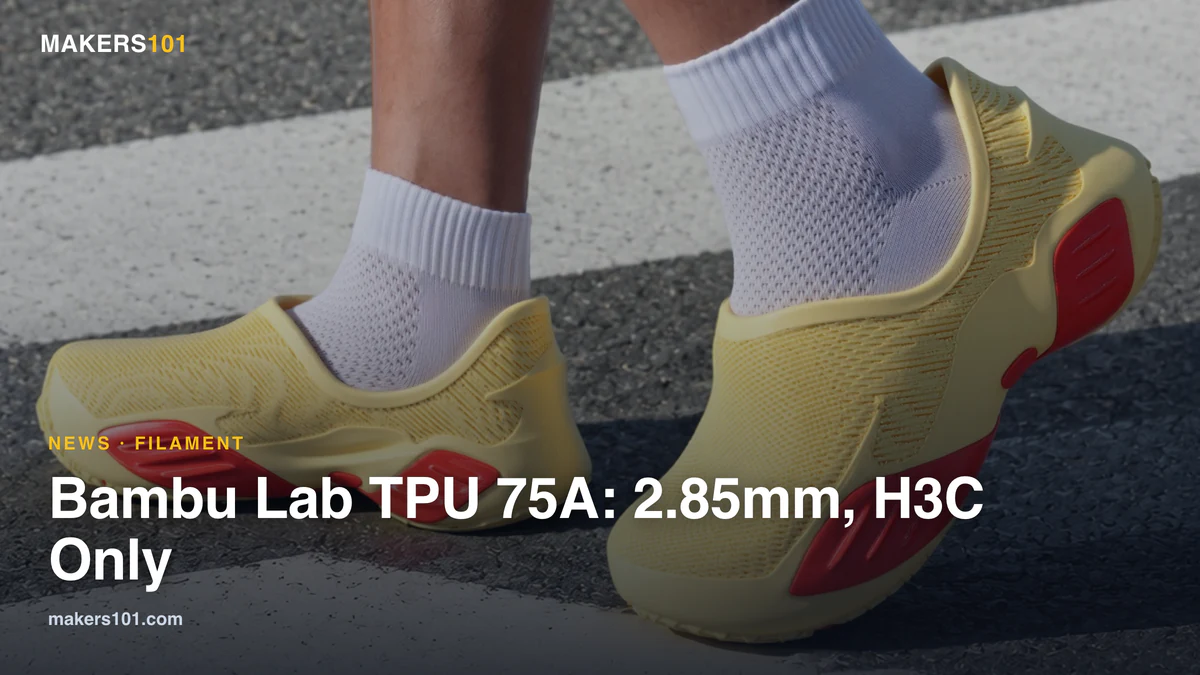
So the filament and the printer go live the same morning. Bambu’s own forum teaser pairs them directly: a shoe with a “soft, sock-like wrap,” described as “Ultra-soft TPU 75A and 90A, printed in one build on Bambu Lab H3C.”
Why Bambu Lab TPU 75A Uses 2.85mm Filament
Bambu’s own TPU printing guide puts 75A near the soft end of its hardness scale. It recommends 85A or harder “for stable printing” and warns that softer grades bend easily during feeding, which can cause buckling and tangling.
A fatter strand is the likely fix. By my math, the thicker strand has about 2.65 times the cross-section of 1.75mm filament. Bending stiffness scales with the fourth power of diameter, so it resists bending roughly 7 times as much as a thinner strand of the same material. Against today’s TPU 85A the gain is smaller, because 75A is a softer material to begin with.
Bambu’s listing ties the diameter to “reliable printing” but doesn’t explain the engineering. The stiffness math is my read, not Bambu’s explanation, and it leaves out friction: TPU’s feeding resistance in the tubes is a separate problem a thicker strand doesn’t obviously solve.
The catch: right now this spool runs on exactly one printer, and that printer isn’t out yet.
What Bambu Lab TPU 75A Means for P1S, P2S, X1, A1 and H2C Owners
If you own a P1S, P2S, X1 or H2C, the softest Bambu spool you can run is still TPU 85A, and only with a 0.6 or 0.8mm nozzle or Bambu’s TPU high-flow hotend (on the H2C, only through the right filament inlet). The AMS 2 Pro, AMS and AMS lite can’t feed it, and the AMS HT works only as a sealed dry box for TPU. Bambu sells a TPU Feed Assist Module for H, X and P series printers to ease flexible-filament feeding.
The guide also says Bambu printers “do not currently support” TPU softer than 85A, so softer third-party spools are at your own risk. Our best TPU filament roundup covers them.
If you’re on an A1, the guide lists TPU 85A as incompatible with the A1 series. Your softest Bambu option is 90A.
If printed shoes are why you’re reading, this is the use case Bambu is pitching. Our look at the Persona footwear package for Bambu printers shows what’s possible on standard TPU today.
If you were already weighing the H3C, being the only Bambu printer that runs TPU 75A is one concrete reason to wait for the reveal. Our H3C patent breakdown covers what the tool changer is likely to be.
Bambu Lab TPU 75A FAQ
How much does Bambu Lab TPU 75A cost?
Bambu hasn’t listed a price yet. The US store shows only a sale time of Nov. 3, 2026, at 13:45 UTC.
Is TPU 75A softer than TPU 85A and 90A?
Yes. On the Shore A scale a lower number means softer, so 75A sits below the 85A and 90A spools Bambu sells now.
Can I print Bambu Lab TPU 75A on a P1S, P2S or A1?
No. The store listing says the filament works only with the H3C, and its strand is thicker than the filament those printers take.
Bambu Lab TPU 75A and H3C: What’s Still Unknown
- The price of the spool
- What FlexFeed is, and whether every H3C tool takes the thicker filament or only some
- Whether the H3C will accept third-party 2.85mm TPU
- Whether the 90A in the teaser shoe is today’s standard spool or a new thicker version
- Which standard backs “certified for skin contact”
- Whether the unannounced Bambu Lab P3C will take the thicker filament too
Bambu should answer most of these when the H3C goes live on November 3.