
Heads up — some of the links below are affiliate links. If you buy through them, I earn a small commission (at no extra cost to you), which helps cover the gear I test. Thanks!
- Best overall (and easy to buy): Polymaker ASA
- Best premium / most consistent: Prusament ASA
- Best budget pick: Sunlu ASA (enclosure required)
- Strongest layer bonding, but controversial: FlashForge ASA
- The lab winners you can’t easily buy in the US: 3DO, AzureFilm, eSUN
- Rankings here lean on independent third-party testing, not marketing copy.
The best ASA filament for most people is Polymaker ASA. It prints cleanly, resists UV and weather, and you can actually buy it without importing a spool from Europe. Want premium consistency? Go Prusament. On a budget? Sunlu works if you own an enclosure.
Table of Contents
- Why Picking an ASA Filament Is Harder Than It Looks
- At a Glance: Best ASA Filaments Compared
- What Is ASA, and When Should You Choose It?
- ASA vs PLA, PETG, ABS, and TPU
- How We Ranked These
- The Best ASA Filaments
- How to Print ASA Without Warping
- Smell, Fumes, and Indoor Safety
- Beyond Standard ASA
- Is Expensive ASA Worth It?
- FAQ
Why Picking an ASA Filament Is Harder Than It Looks
If you have been staring at a dozen spools that all promise “UV resistant” and “weatherproof,” you are not alone. Every ASA brand sounds identical on the listing page. The problem is that ASA brands are not identical. In one independent test of ten brands, warping, impact strength, and layer adhesion varied wildly from spool to spool. Some “ASA” may not even be real ASA.
So this guide does something the spec sheets won’t. It ranks ASA using actual third-party test data, then weighs that against what you can realistically buy and print at home. Let’s get you a spool that survives the backyard.
At a Glance: Best ASA Filaments Compared
| Filament | Best For | Test Highlight | Diameter | Price Tier |
|---|---|---|---|---|
| Polymaker ASA | Best overall | Balanced, no glaring weakness | 1.75mm, 1kg | Mid |
| Prusament ASA | Premium consistency | Beat industrial Stratasys | 1.75mm, 800g | Premium |
| Sunlu ASA | Budget | Cheap, but warps open-air | 1.75mm, 1kg | Budget |
| FlashForge ASA | Layer adhesion | Strongest bonding in test | 1.75mm, 1kg | Budget |
| FormFutura ApolloX | Anti-warp (2.85mm) | Zero warping | 2.85mm | Mid |
Prices live in each product card below, updated as of June 2026.
What Is ASA, and When Should You Choose It?
ASA (Acrylonitrile Styrene Acrylate) is essentially ABS with a UV-resistant upgrade. It handles sun, rain, and heat without going brittle or fading, which makes it the go-to for outdoor brackets, automotive trim, drone parts, and anything that lives outside. In one popular filament tier list, ASA earns an “A” grade while plain ABS sits down at “C,” and the gap is almost entirely about weather resistance.
Here is the reassuring part. ASA smells milder than ABS while printing, closer to a faint warm-plastic note than the headache-inducing fumes ABS is known for. It still needs ventilation, which we’ll get to. But day to day, it is one of the more pleasant engineering filaments to live with.
If your part never leaves a climate-controlled room, PETG is easier and cheaper. The moment sunlight enters the picture, ASA is the answer.
ASA vs PLA, PETG, ABS, and TPU
Before you commit, it helps to see where ASA sits among the common filaments. Here’s the quick version, with each row built to stand on its own.
| Material | Best For | Outdoor / UV | Ease of Printing |
|---|---|---|---|
| PLA | Easy indoor models and prototypes | Poor (sags and yellows in sun) | Easiest |
| PETG | Durable indoor parts, light outdoor use | Moderate | Easy |
| ABS | Cheap functional parts | Poor (fades and cracks outdoors) | Hard (enclosure + fumes) |
| ASA | Outdoor and automotive functional parts | Best in class | Hard (enclosure needed) |
| TPU | Flexible, rubber-like parts | Varies by grade | Moderate |
A few comparisons people search for a lot: in PLA vs PETG vs ABS vs ASA, ASA wins the moment a part lives outdoors, while PLA stays easiest and PETG is the safe middle ground. ASA vs TPU is really a trick question, because they do opposite jobs. ASA is a rigid, weatherproof engineering plastic; TPU is a flexible, rubbery one. Choose ASA for stiff outdoor brackets and housings, and TPU for anything that needs to bend, grip, or absorb impact. If you need a part that is both tough and a little flexible outdoors, that’s where you test both. For a deeper material-by-material breakdown, see our full 3D printing filament guide.
How We Ranked These
“Best” means nothing without criteria, so here are the five that actually matter for ASA:
- UV and weather resistance. The whole reason you’re buying ASA.
- Impact toughness. Will the part crack when it gets knocked?
- Warp resistance. Can it finish a large part without lifting?
- Layer adhesion. How strongly do the layers fuse?
- Ease of printing and price. Temperature needs, drying, and cost per kilo.
No single ASA wins all five. In a 10-brand independent test by My Tech Fun, the layer-adhesion champion was weak on impact, and the anti-warp champions were merely average elsewhere. That trade-off shapes every pick below. Where a spool topped a specific test, we say so and cite where it came from.
The Best ASA Filaments
1. Best Overall: Polymaker ASA
Polymaker ASA is the spool we’d hand a first-time ASA user. In that 10-brand test it never topped a category, but it also never embarrassed itself, landing as a dependable all-rounder while pricier and flashier brands stumbled in at least one test. That consistency, plus wide availability, is exactly what you want from a default choice.
It runs at a typical 240–260°C nozzle over a 90–100°C bed, prints UV-stable parts, and shows up in stock far more reliably than the European boutique brands. You still need an enclosure and a dry spool, but Polymaker asks for nothing exotic.
- Balanced performance with no glaring weakness
- Widely available, beginner-friendly
- Standard ASA temperatures, no fuss
- Not the outright test champion (that’s 3DO, below)
- Still needs an enclosure and drying
Best For: Anyone who wants one reliable ASA and doesn’t want to gamble.

- 【UV & Weather Resistant】: Polymaker ASA 3D printer filament combines the properties of ABS with added weather resistance. UV-resistant and less…
- 【High Heat Resistance & Mechanical Properties】: Polymaker ASA filament can withstand temperatures up to 100˚C (212°F) and offers high toughness…
- 【Strong & Durable】: Polymaker ASA 3D printer filament combines strength, rigidity and reliable layer adhesion for real-world applications…
- 【Printing Settings】: Nozzle Temperature: 250˚C; Bed Temperature: 90˚C; Speed: 50mm/s. (Adjust as needed per your 3D printer; refer to standard…
- 【Risk-Free & Lifetime Technical Support】: We’re here to assist you in achieving flawless, beautiful prints. Feel free to reach out to us on Amazon…
2. Best Premium: Prusament ASA
Prusament is what you buy when consistency matters more than saving a few dollars. Its tight diameter tolerance and low tangling reputation are real, and there’s harder evidence too. In a head-to-head against industrial Stratasys ASA, the consumer-grade Prusament actually came out ahead on tensile strength, toughness, and repeatability, losing only on heat resistance by about 10°C. The reviewer’s verdict was blunt: “The winner is Prusament. Not really what I expected.”
The honest caveat: in the broader 10-brand impact test, Prusament landed near the bottom for raw impact energy. So think of it as the dependable, precise choice rather than the toughest one. It also ships as an 800g spool, not a full kilo, which dents the value math.
- Excellent consistency and diameter tolerance
- Outperformed industrial Stratasys ASA in independent testing
- Premium build quality with low tangling
- Premium price, and only 800g per spool
- Among the weakest for impact toughness
- Runs a touch hotter than budget spools
Best For: Professionals and anyone who hates spool-to-spool surprises.

- [DURABLE ASA FILAMENT FOR OUTDOOR & TECHNICAL APPLICATION] Prusament ASA is ideal for functional parts, outdoor components, enclosures, and automotive…
- [CONSISTENT EXTRUSTION FOR RELIABLE 3D PRINTING] Each filament spool is manufactured under strict quality control to ensure smooth extrusion and…
- [HIGH TEMPERATURE & WEATHER RESISTANCE] ASA is designed to withstand heat, sunlight, and harsh environmental conditions without degrading. Ideal for…
- [STRONG, STABLE PRINTS WITH PROFESSIONAL FINISH] ASA produces durable parts with good layer adhesion and a clean surface appearance. Designed for…
- [MANUFACTURED BY PRUSA RESEARCH] Prusament is produced in-house by the 3D printer manufacturer Prusa Research. Every spool is individually tested for…

3. Best Budget: Sunlu ASA
Sunlu is the value play, and for sheltered indoor-ish parts it does the job for the least money. But the testing exposes one real limitation: on an open-frame printer, Sunlu warped and failed before reaching the halfway mark, alongside Bambu Lab’s spool. Anti-warp formulation is clearly not its strength.
The fix is simple and non-negotiable for ASA anyway: print it in an enclosure. Inside a heated chamber, Sunlu becomes a perfectly reasonable budget spool. Outside one, you’ll fight lifting corners all day.
- Among the cheapest per kilo here
- Full 1kg spool, widely stocked
- Failed the open-printer warp test before 50% done
- Demands an enclosure to behave
Best For: Budget builders who already own an enclosed printer.
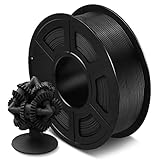
- ① 【SUNLU ASA 3D Printer Filament】ASA filament is kind of very strong and tough filament, stronger than PLA filament and ABS filament. No clog…
- ②【Brand New Spool】Using new 3rd generation high temperature resistant white spools with multi-hole design for full drying, the size has been…
- ③【UV/Rain/Heat Resistant】SUNLU ASA 3D printing filament is great for printing outdoor functional mechanical parts, UV/Rain/Heat highly…
- ④【1.75mm Filament Diameter】Dimensional Accuracy +/- 0.02mm. SUNLU filament has wide compatibility due to the small diameter error, it’s suitable…
- ⑤【Weight Upgrade】 – SUNLU ASA filament has been converted to 1KG package, more weight, same price, more economical.
4. The Controversial One: FlashForge ASA
Here’s where we have to be honest with you. In the 10-brand test, FlashForge ASA posted the single best layer adhesion of any spool, which on paper makes it tempting for strong functional parts. But the 3D printing community tells a more complicated story: a widely upvoted “PSA: FlashForge ASA is not ASA” thread argues the formulation behaves more like a blend than true ASA.
Both things can be true. It may bond beautifully between layers while not delivering classic ASA weatherability. Its impact resistance also rated poorly. If maximum layer strength is your priority and you’ll verify UV performance yourself, it’s worth a look. If you want textbook ASA behavior, buy elsewhere.
- Best layer adhesion in the 10-brand test
- Budget price, full 1kg spool
- Community disputes whether it’s “real” ASA
- Weaker impact resistance
Best For: Tinkerers chasing layer strength who don’t mind verifying claims.

- High UV Resistance – FLASHFORGE ASA UV filament combines the properties of traditional ABS filament with enhanced high-temperature resistance. It is…
- Excellent Temperature Resistance – FLASHFORGE ASA maintains its shape and integrity up to temperatures near 93°C. This makes it particularly suitable…
- Chemical Resistance – ASA exhibits good resistance to many chemicals, including oils and solvents, making it an excellent choice for applications that…
- Clog-Free, Bubble-Free: The filament is designed to be clog-free and bubble-free, ensuring a smooth and stable printing experience. It is dried for…
- Precision and Consistency: Advanced CCD diameter measurement and adaptive control systems ensure that 99% of the filament has a diameter of 1.75 mm…
The Lab Winners You Can’t Easily Buy (US)
Worth knowing, even if your cart won’t cooperate. In the independent 10-brand test, the overall points champion was 3DO ASA, with AzureFilm and FormFutura ApolloX finishing warp-free on an open printer, and eSUN dominating impact resistance (its sample didn’t break at all). The catch: 3DO and AzureFilm are European brands with little US Amazon presence, eSUN’s ASA is hard to find stateside, and ApolloX commonly comes in 2.85mm. If you’re in the EU or willing to import, these are the data-backed standouts.
How to Print ASA Without Warping
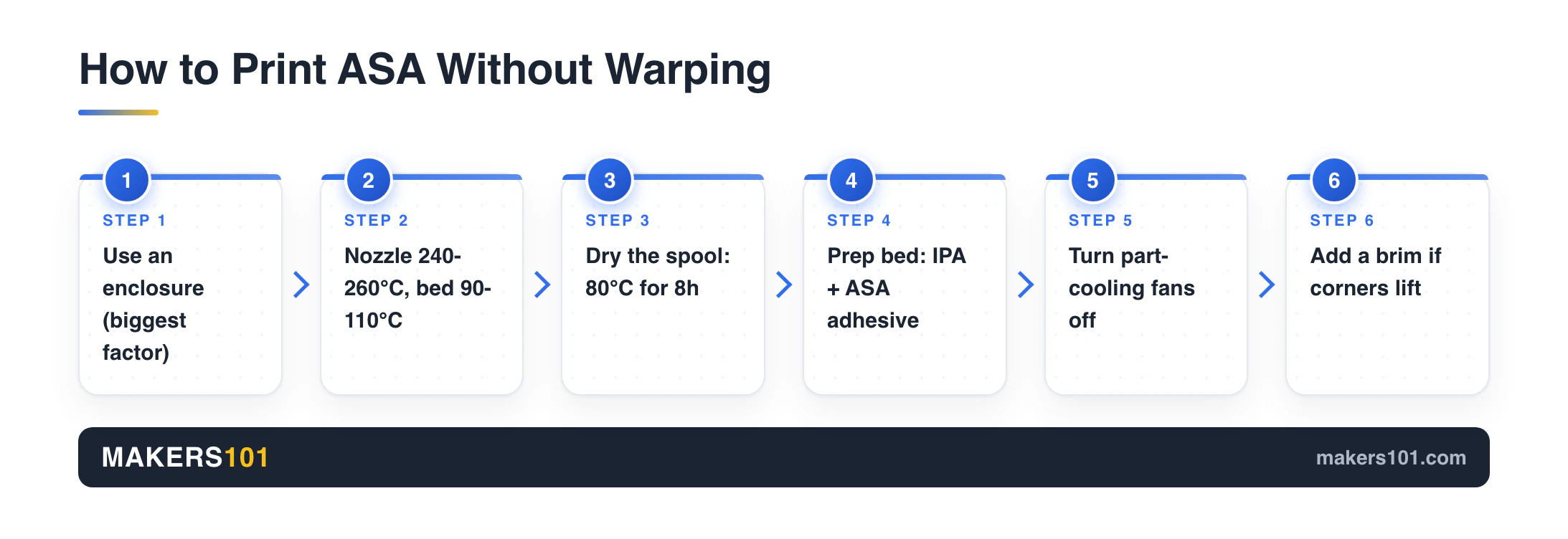
ASA is not hard once your setup is right. Success is mostly about the printer and prep, not magic slicer settings.
- Use an enclosure. A heated or passively enclosed chamber keeps temperatures stable. This is the single biggest factor in ASA success.
- Dial in temps. Roughly 240–260°C at the nozzle, with a 90–110°C bed, nudging hotter for premium spools. Preheat for 20–30 minutes and resist opening the door.
- Dry the spool. ASA absorbs moisture; around 80°C for eight hours before a big print helps.
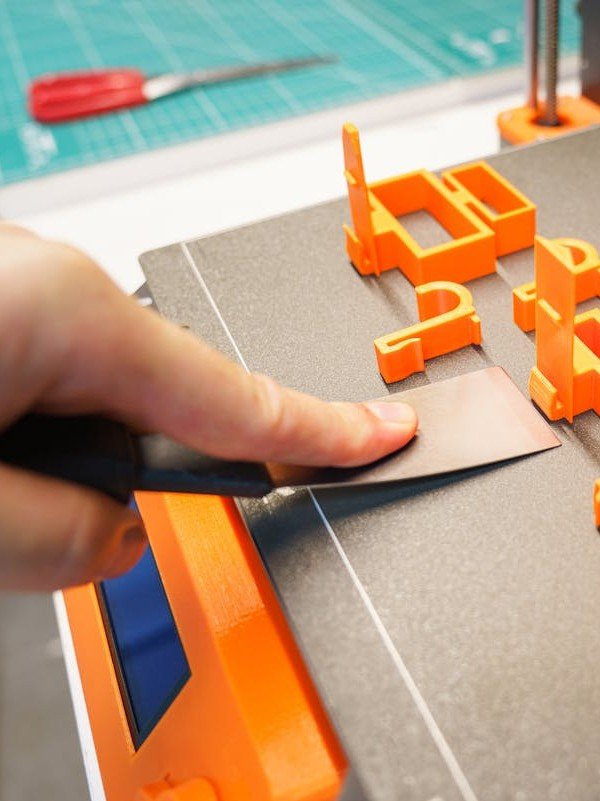
- Prep the bed. Clean it with isopropyl alcohol and add an ASA-friendly adhesive; corners lift without it.
- Turn the part-cooling fans off. Cooling fights layer bonding on ASA and ABS.
- Fix warping with a brim. Add a 10+ line brim and slow the first layer if corners still lift.
One more pro tip for strength: layers bond best when each new layer lands on a still-hot layer below. Capping layer time (around 60 seconds in your slicer) keeps that heat in the part.
So what’s the best 3D printer for ASA? Honestly, almost any enclosed machine. The enclosure matters far more than the brand, because a stable, warm chamber is what stops corners from lifting. An open-frame printer can run ASA in a pinch, but you’ll fight warping constantly. If you’re shopping, start with an enclosed, high-temp printer and most ASA problems disappear before they start.
Smell, Fumes, and Indoor Safety
A gentler smell is not the same as safe. One maker documented a genuine case of ASA fume sickness, headaches and nausea, even while printing inside an enclosed machine with a carbon filter. Enclosures contain fumes; they don’t neutralize them. Most people assume PLA gets a free pass on all this. We went through whether PLA fumes are actually dangerous and what decides it. Vent ASA to the outside or run it in a well-ventilated room, every time.
Beyond Standard ASA
Two variants are worth knowing. Lightweight ASA (LW-ASA) foams as it prints, cutting part weight by roughly half while keeping ASA’s UV and heat resistance, which props and cosplay builders love. If heat is the whole reason you’re here, start with how ASA stacks up against ABS and nylon on heat. Back to the variants; in one test a foamed armor piece weighed 3.7 oz versus 7.4 oz in PLA. Strength drops as it foams, so reach for standard ASA when toughness matters.
For a factory-smooth finish, ASA also responds to acetone vapor smoothing. A few hours in acetone vapor turns layer-lined ASA glossy without any sanding. Ventilate well, and let the part fully off-gas before handling. Not into chemical smoothing? The sand-fill-prime route works on ASA too, and we walk through it here.
Is Expensive ASA Worth It?
Not necessarily, and that’s the most useful thing the testing taught us. When consumer Prusament beat industrial Stratasys ASA on most mechanical properties, it confirmed that a premium price tag doesn’t guarantee better parts. For ASA, the bigger levers are your enclosure, your drying, and matching the spool to the job. Spend on the right brand for your use case, not the most expensive one. For pairing filament to your machine, see our guide to the best filaments for your specific printer.
FAQ
Is ASA the strongest filament? No, but it’s the best all-rounder for outdoor use. PLA and PETG are easier to print, and some nylons or carbon-fiber blends are stronger, but ASA offers the best balance of strength plus weather and UV resistance.
What’s the best ASA for a Bambu Lab printer? Polymaker ASA is the safest pick, since it prints at standard ASA temperatures and is easy to source. Any quality ASA works on a Bambu Lab machine as long as you enable an enclosure-style profile and dry the filament.
Is FlashForge ASA real ASA? It’s debated. A widely shared community PSA argues the formulation isn’t true ASA at all. Independent testing did show it had the best layer adhesion, so treat it as strong-bonding but verify weather resistance yourself.
Do I need an enclosure to print ASA? Effectively, yes. Open-frame printers caused spools like Sunlu to warp and fail mid-print. An enclosure keeps chamber temperatures stable and is the biggest single factor in ASA success.
What’s the difference between ASA and TPU? They solve opposite problems. ASA is a rigid, UV-resistant engineering plastic for stiff outdoor parts; TPU is a flexible, rubber-like filament for things that bend or absorb shock. If your part must hold its shape outdoors, choose ASA. If it needs to flex or grip, choose TPU.
ASA vs PETG vs ABS vs PLA: which should I use? Use PLA for easy indoor prints, PETG for durable everyday parts, ABS for cheap functional pieces, and ASA when the part lives outdoors. ASA is basically ABS with the UV and weather resistance dialed up, which is why it wins for anything exposed to sun and rain.
Last updated June 2026.