
Heads up — some of the links below are affiliate links. If you buy through them, I earn a small commission (at no extra cost to you), which helps cover the gear I test. Thanks!
- PLA is one of the lowest-emission filaments you can print. It isn’t a zero-emission one.
- What decides your real risk isn’t the filament. It’s room size. It’s airflow. It’s how many hours a week you run the thing.
- Your printer’s stock filter is probably activated carbon with no HEPA layer. Those two parts do completely different jobs.
- Three fixes cost nothing: check your hotend, drop your nozzle temperature, look at your filament dryer.
- A headache or scratchy throat while printing is data. Act on it instead of arguing about it.
Should you worry about PLA fumes? Print a few hours a day in an average room with the door open and the measured risk is low. Run that same printer ten hours a day in a small sealed space where you also sleep, and it’s a different question entirely. PLA is low emission, not no emission. Your room does most of the deciding.
You smelled something coming off the printer. You searched, and found two camps shouting past each other. One says PLA is basically corn and you’re paranoid. The other says you’re quietly giving yourself cancer. Both link to studies.
They’re arguing about the wrong variable. I can smell PLA when it prints, and plenty of people can’t, which tells you the answer was never going to be a single number.
This guide pulls together seven independent creators, some who measured, some who took hardware apart, some who just got sick and wrote it up, plus three long-running forum threads and the studies behind them.
Table of Contents
- What PLA Actually Releases When You Print
- How PLA Compares to ABS, ASA, PETG, and Nylon
- Why Two People Can Both Be Right About PLA Fumes
- Where You Put the Printer Matters More Than Which Filament You Buy
- The Filter Myth That Actually Hurts People
- Three Fixes That Cost Nothing
- What to Buy, In the Order I’d Buy It
- Symptoms That Mean Stop and Fix Your Setup
- What We Still Don’t Know
- Frequently Asked Questions
- The Bottom Line
What PLA Actually Releases When You Print
Two things come off a hot nozzle: ultrafine particles and volatile organic compounds. You can sometimes smell the second group. The first is invisible, and it’s the one researchers keep circling back to.
Ultrafine particles are the part that matters
Ultrafine particles (UFPs) are anything below 100 nanometers, and published measurements put PLA’s peak output between 10 and 50. A human hair is roughly 70,000 nanometers across.
Size is the whole problem. As Thomas Sanladerer put it: “The smaller the particle, the deeper it gets into your body.”
One correction, because it circulates constantly: nothing is boiling here. PLA has no meaningful boiling point. It thermally degrades, and you’re breathing degradation products.
VOCs, and why lactide isn’t the scary part
The dominant VOC from PLA is lactide, left over as residual monomer from making the plastic. A 2023 study in Sensors profiling a consumer printer recovered lactide in the highest abundance across every PLA filament it tested, and Azimi measured it at just 4 to 5 µg/min. The reassuring part: lactide isn’t listed under the major regulatory or health-risk lists for indoor air quality.
The same study turned up something more useful, and it has nothing to do with your spool. Caprolactam appeared in high abundance, a compound the authors describe as an irritant associated with ocular and respiratory toxicity. The authors traced it to the Pritt Stick glue applied to the print bed, which showed up in their control runs too.
Azimi points the same way from the other direction: there caprolactam was a real filament emission at 2 to 180 µg/min, but from nylon and imitation wood and brick filaments, at levels those authors judged could plausibly harm susceptible people in an office. Two studies, one conclusion. Caprolactam deserves respect, and it isn’t a PLA problem unless you print nylon or wood-filled.
On the Prusa forum, a member who’d actually read the paper everyone was passing around reported VOC levels “well under one part per million even in a closed space.”
The most cited emissions study here, Azimi and colleagues in Environmental Science & Technology in 2016, tested five desktop printers across up to nine filaments. They found emission rates spanning three orders of magnitude, varying primarily by filament material and, to a lesser extent, bed temperature. Their closing caution: use care running many of these printer and filament combinations in poorly ventilated spaces, or without combined gas and particle filtration. They flag styrene- and nylon-based filaments in particular.
So material sets your starting point, and the room decides what happens to it. Hold onto both halves, because they’re the key to everything below.
Some of it isn’t the filament at all
When Sanladerer ran his sensor box he picked up cyclosiloxanes, which he traced most likely to the silicone heater mats or adhesives inside the printer itself. Not the spool.
Changing filament will never fix that part. Worth knowing before you spend money chasing a cleaner brand.
How PLA Compares to ABS, ASA, PETG, and Nylon
If you remember one thing, remember this: PLA and PETG sit in one tier, ABS and ASA sit in another, and the gap is large.
| Filament | Relative emissions | Smell | Minimum setup that makes sense |
|---|---|---|---|
| PLA | Lowest tier on both axes. Its main VOC, lactide, ran 4-5 µg/min in the Azimi study | Faint | Open door, average room |
| PETG | Low, same tier as PLA. Published work reports no BPA in its particles | Almost none | Open door, average room |
| ABS | Highest particle emitter in Azimi’s test set. Exceeded WHO PM2.5 limits in Sanladerer’s testing even with the enclosure shut | Strong and obvious | Enclosure plus filtration, or vent outside |
| ASA | Dirtiest in Sanladerer’s own testing: around twice the particles of ABS, more than twice the BPA | Milder than ABS | Vent outside, not a living space |
| Nylon | High on VOC mass. Caprolactam ran 2-180 µg/min across nylon and wood/brick-filled, against PLA’s 4-5 | Moderate | Vent outside, dry filament |
How to read that table: every column has a different origin. None of it comes from one head-to-head test. The µg/min figures are VOC mass rates from the 2016 Azimi study, and they are not the same axis as particle counts. On particles, ABS topped that study while PLA sat at the bottom. The WHO comparison and the ASA particle counts come from Thomas Sanladerer’s sensor-box testing. Treat the whole table as a ranking. It isn’t one dataset.
The reversal in that table is the interesting part. ASA smells milder than ABS and measured dirtier: Sanladerer’s sensor box recorded roughly twice the particle output. His rig reads particles and VOCs and formaldehyde but never BPA, so for the chemistry he worked from published figures, and by his reckoning a few minutes of breathing at those levels reaches the safe daily BPA intake.
Which is why your nose is a bad instrument. “Just because you can’t smell it doesn’t mean it’s not there,” as he put it.
The most convincing evidence for that comes from Loyal Moses, who ran three printers in an office and gave himself ASA poisoning. Headaches and nausea and a flu-like fog, all of which cleared when he left the room. Every one of those printers had an activated carbon filter fitted. The fumes were escaping through gaps in the enclosures.
If you want lower emissions without giving up strength, PETG is the natural move, and our guide to the best PETG filament covers which brands actually print cleanly.
Why Two People Can Both Be Right About PLA Fumes
Two people can run identical printers, measure honestly, and reach opposite conclusions about PLA fumes. It happens because they aren’t measuring the same room.
Here are three findings that look like they contradict each other. All three come from people who put real sensors in the air.
| Source | What they found | Under what conditions |
|---|---|---|
| Thomas Sanladerer, custom sensor box | PLA and PETG particle output stayed within generally safe limits | Workshop with air movement |
| ItsMeaDMaDe, AirGradient monitors | VOC and particle readings climbed noticeably while printing PLA | Sealed workshop, no ventilation |
| The Next Layer | A full day of ABS and ASA barely moved the readings | Large space (he calls his own testing “imperfect, limited, and unscientific”) |
Nobody’s lying. The thing that moves between those three results was never the spool. It’s room volume, air changes per hour, print hours, and your own sensitivity.
Toxicity has always been concentration multiplied by exposure time. That framing, argued well on the Bambu Lab forum, does more work than any filament comparison chart. A low-emission material in a sealed box for ten hours a day can beat a high-emission material in a ventilated garage for one hour a week.
You can put rough numbers on this. Multiply your room’s length by width by height for its volume, then take your purifier’s rated airflow for the same units and the same hour. A CFM rating needs multiplying by 60 to compare against a room measured in cubic feet; a CADR figure describes clean-air output, so it reads lower than the fan’s headline number. Airflow divided by volume gives you air changes per hour. ItsMeaDMaDe measured four to six of them from his DIY build in a standard room and kept his air in the green with several printers running.
Two more principles worth holding at once, both from WHO positions cited in that thread. Indoor air dilutes pollutants less effectively than outdoor air, so indoor particle concentrations often run higher than outside. And there’s no fine-particle concentration below which no harmful effects are expected. That second one matters. “Below the limit” isn’t the same as “harmless,” and anyone telling you PLA is perfectly safe is overstating what the data supports.
This is exactly why that r/BambuLab thread titled “To everyone who thinks breathing filament fumes is okay” pulled 475 upvotes and over 500 comments without resolving anything. Both sides were accurately describing their own rooms.
One caution about the reassuring numbers you’ll see quoted. Vendor articles like to say PLA emissions sit far below OSHA or NIOSH limits. Those are written for healthy adults on a shift, with recovery time afterwards, which is a different question from the room where you sleep. WHO’s guidance for air you actually live in went the other way: the annual mean guideline for fine particles dropped from 10 µg/m³ to 5 µg/m³ in 2021.
Where You Put the Printer Matters More Than Which Filament You Buy
Placement changes your exposure more than filament choice does. Same printer and same spool in a different room lands you in a different risk tier, which makes this the highest-leverage decision you’ll make, and it’s free.
| Where the printer lives | Risk tier | What to do |
|---|---|---|
| Garage, basement, dedicated room | Low | Shut the door and move on |
| Living room, door open, a few hours a day | Low to moderate | An open door plus a HEPA purifier is plenty |
| Home office you sit in 8 to 10 hours a day | Moderate | You need real air exchange, not just an open door |
| Bedroom | High | Don’t print while you sleep |
| Windowless room | High | Use a fan to push air away from where you sit |
| Nursery or a child’s bedroom | Don’t | See below |
| Dorm or shared apartment | High | You’re making the call for other people too |
That nursery line isn’t theoretical. ItsMeaDMaDe was standing in a MicroCenter when he overheard someone assuring a father that PLA was “super safe” for his daughter’s bedroom. He stepped in, explained that PLA still puts material into the air, and pointed him toward a garage, a basement, or any large space with airflow. The father bought the printer anyway and put it somewhere sensible.
One counterpoint, straight from the top answers in that 113,000-view StackExchange thread: fire is a bigger risk than fumes, and a printer in your bedroom is arguably safer on that axis because you’d wake up to it. Fit a smoke alarm before you buy any filter.
For what it’s worth, I moved my own printer after thinking through exactly this list.
The Filter Myth That Actually Hurts People
Activated carbon adsorbs gases. HEPA traps particles. Two separate jobs, and the marketing around printer filters blurs them constantly.
Your stock filter is probably carbon only
Aviv Makes Robots opened the stock filter on a Bambu Lab P1S and found large chunks of activated carbon and no HEPA layer at all. Chunk size matters too, since coarse carbon offers less surface area than fine carbon for the same volume.
His work was a qualitative teardown. Read it as “here’s what’s physically inside the thing” and don’t expect a measured percentage.
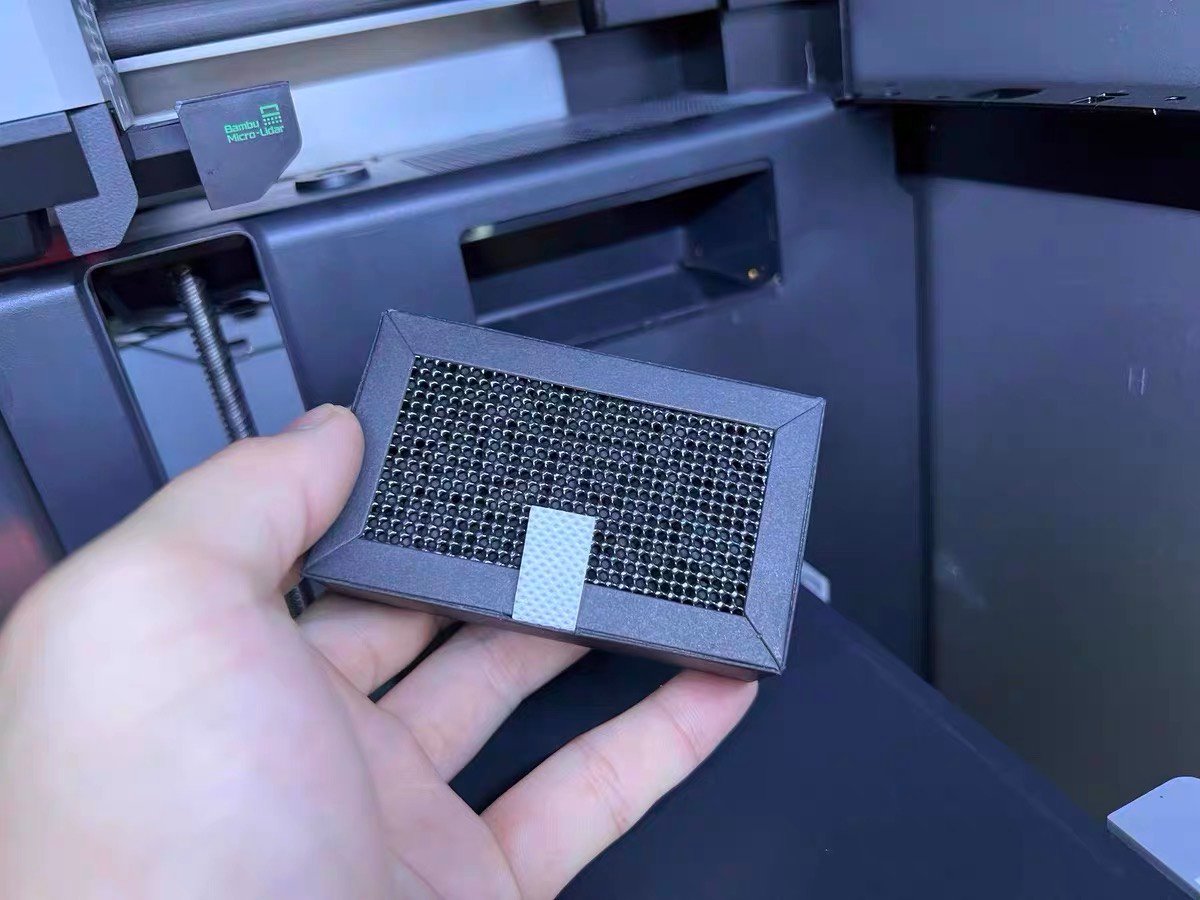
The Loyal Moses case from earlier is what that costs: carbon filters on all three printers, ASA poisoning anyway.
HEPA does catch nanoparticles, and the myth runs backwards
You’ll read that HEPA filters can’t stop particles as small as printer emissions. That gets the physics inverted.
The US definition of true HEPA is 99.97% capture at 0.3 micrometers. The European H13 grade is specified at the most penetrating particle size instead, which lands somewhere around 0.1 to 0.3 micrometers depending on the medium. Either way, that number is a worst case. Go smaller than the most penetrating size and capture efficiency climbs again, because diffusion grabs tiny drifting particles that hole size alone would miss.
Printer emissions land mostly in the 1 to 100 nanometer band, or 0.001 to 0.1 micrometers. That range sits at and below the hardest size to catch, which is the part people get backwards. HEPA is well suited to this job.
The real limitation runs the other way. HEPA does nothing for VOCs. That’s what carbon is for, and small carbon beds saturate fast. Sanladerer measured the activated carbon in an IKEA purifier cutting VOCs by only about 30% while dropping particles dramatically. Carbon also loads up over time and needs replacing.
An enclosure by itself does nothing for emissions
This one surprises people. In Sanladerer’s testing there was no significant difference in emissions between running with the enclosure open and running with it shut. His conclusion: “An enclosure is only useful if it’s part of a filtration or extraction system.”
There’s a nastier version of this problem. A sealed enclosure concentrates VOCs while it runs, then hands them to you all at once when you open the door. Prusa forum members watching Dyson air-quality monitors reported exactly that spike at the moment of opening.
If you want your enclosure to actually do something, it needs filtration or extraction attached, which is the whole point of our DIY 3D printer enclosure build.
Three Fixes That Cost Nothing
Do these before you buy anything. The first is sometimes the entire answer.
Check your hotend before you blame the filament
This is the most useful thing in any thread I read on this topic, and neither of the two articles ranking for it mentions it.
An asthmatic user on StackExchange had a sore throat and breathlessness whenever he printed, plus headaches. The source turned out not to be the nozzle. Filament was oozing out of the extruder in places other than the nozzle, landing on a hot dirty hotend, and slowly baking. He stripped the extruder, reassembled it with PTFE tape on all the threads, and both the oozing and the burnt smell stopped. His symptoms went with them.
Burning residue on a hot block isn’t the same emission profile as clean molten extrusion. If your printer smells worse than your friend’s identical machine, look there first. It costs nothing but an evening.
Drop your nozzle temperature
Print temperature is a real lever. Sanladerer’s point is that around normal printing temperatures, each extra degree drives a disproportionate rise in particle output.
Practical version: if you’re running PLA at 215°C out of habit, step down toward 200 to 205°C and watch your layer adhesion. Our guide to nozzle temp for PLA covers how to find the floor for your specific spool without wrecking part strength.
Check what else is in the room
Your printer may not be the loudest thing in your air. A bed adhesive was the notable irritant source in that Sensors study, and if you glue-stick a large bed before every print in a small room, that’s part of what you breathe. Same for solvent and primer, and for anything you sand. Our roundup of the best glue sticks for 3D printing covers which are worth using at all.
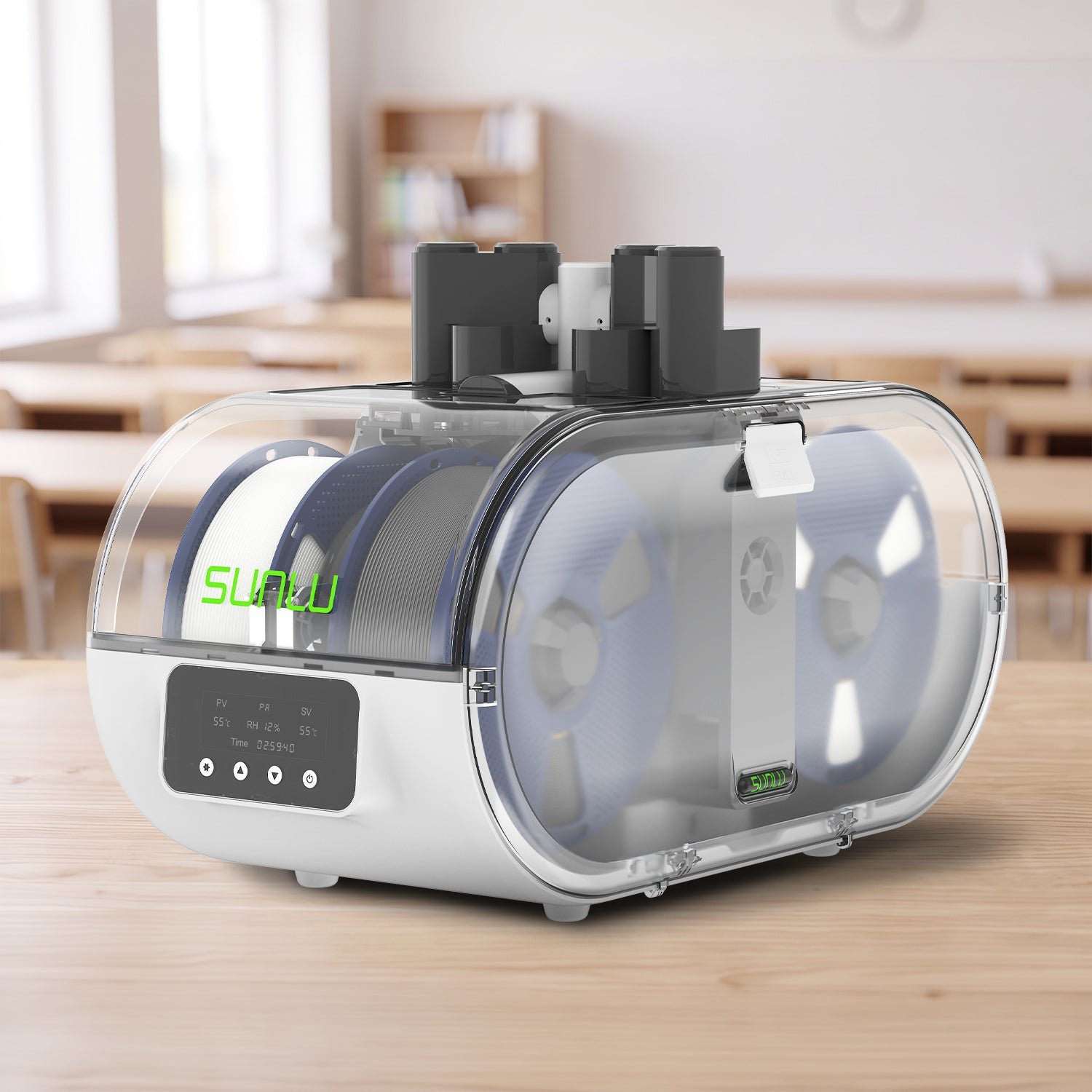
Look at your filament dryer, not your printer
The Next Layer went hunting for his workshop’s worst polluter and didn’t find it in the printer. A filament dryer running overnight with four rolls of waterlogged filament sent his air quality readings off a cliff. Printing ABS and ASA all day had barely registered.
Prusa forum members report the same relationship from the other direction: wet filament produces noticeably more particles than dry filament. So drying isn’t only a print-quality issue.
His line is worth keeping: “When it comes to air quality, you have much bigger fish to fry than ABS printing.”
If your filament is damp often enough that the dryer runs constantly, fix the storage instead. Our guide on how to dry and store filament walks through it.
What to Buy, In the Order I’d Buy It
Work down this list and stop when your situation is covered. Most people can stop at the second tier.
Free: airflow you already own
Open the door. Put a fan you already have between you and the printer, blowing air away from where you sit. Brandon Santana runs his machines in a windowless room and does exactly that.
Don’t assume an open window is automatically an upgrade. The Next Layer works in central Tel Aviv with four construction sites within 100 meters, and opening a window brought more PM2.5 in than it let out. Ventilation also only works as a circuit: air needs a way in and a way out. One cracked window gives you neither.
Around $100: a purifier pairing true HEPA with real carbon
Specification beats brand here. You want a genuine HEPA element for particles, a real carbon bed for gases, and enough of both for the room you’re in. Sanladerer put an IKEA HEPA-and-carbon unit in a room during ABS printing and watched particles fall to zero within an hour; Nathan Builds Robots reaches for a Levoit. The ceiling worth knowing: that same unit only cut VOCs by about 30%.

- 𝐖𝐇𝐘 𝐂𝐇𝐎𝐎𝐒𝐄 𝐀𝐇𝐀𝐌 𝐕𝐄𝐑𝐈𝐅𝐈𝐃𝐄 𝐀𝐈𝐑 𝐏𝐔𝐑𝐈𝐅𝐈𝐄𝐑𝐒: AHAM…
- 𝐆𝐄𝐍𝐔𝐈𝐍𝐄 𝐑𝐄𝐏𝐋𝐀𝐂𝐄𝐌𝐄𝐍𝐓 𝐅𝐈𝐋𝐓𝐄𝐑𝐒: For the best performance and longest lifespan…
- 𝐄𝐅𝐅𝐄𝐂𝐓𝐈𝐕𝐄 𝐏𝐔𝐑𝐈𝐅𝐈𝐂𝐀𝐓𝐈𝐎𝐍: 360° Air Intake and a compact design ensure optimal airflow…
- 𝐈𝐌𝐏𝐑𝐎𝐕𝐄𝐃 𝐅𝐈𝐋𝐓𝐑𝐀𝐓𝐈𝐎𝐍: While the Nylon Pre-Filter and High-Efficiency Activated Carbon Filter…
- 𝐐𝐔𝐈𝐄𝐓 𝐎𝐏𝐄𝐑𝐀𝐓𝐈𝐎𝐍: With noise levels as low as 27dB, the Core 200S-P cleans your air without disturbing you…

Around $120 as a DIY build: a Corsi-Rosenthal box
ItsMeaDMaDe built one from four high-grade HEPA filters and a box fan for about $120 at the time. Switching it off sent his numbers climbing again, which is the cause-and-effect check most demos skip. It has limits: it helped with acrylic laser-cutting fumes but only pulled those back to yellow.
Upgrade the filter in your enclosure
If your machine has a filter bay, aftermarket cartridges add a HEPA 13 layer, finer carbon and better sealing foam. Aviv rated that drop-in upgrade as the sensible pick for most hobbyists. Standalone in-chamber units are more than an occasional high-temperature printer needs.
Symptoms That Mean Stop and Fix Your Setup
Your body is measuring your actual room, which is more than any study can do for you.
Watch for headaches, a scratchy throat and eye irritation while printing. ItsMeaDMaDe’s rule is a good one: “Listen to your body. If you start getting a headache or if your throat starts feeling scratchy, that’s a cue.” Add recurring odor buildup, air that feels stale, and visible dust settling around the printer.
The stronger warning sign looks like the Loyal Moses pattern: headaches plus nausea plus a flu-like fog that lifts when you leave the room. That’s your room talking to you.
Two firsthand reports from the StackExchange thread, caveats attached: one user developed respiratory problems after two months of daily PLA printing and calls his own lungs unusually sensitive; another, who has asthma, traced his symptoms to that dirty hotend. Both already knew they were sensitive. “PLA poisoning” isn’t a clinical diagnosis, and none of this is medical advice. Persistent symptoms mean see a doctor. The forum can wait.
Don’t dismiss the sensitive people either. Users on r/3Dprinting who smell PLA through a closed enclosure get told they’re imagining it, and “if I can smell it, there is definitely something in the air” is a reasonable instinct.
What We Still Don’t Know
Honest gaps, because the confident articles on this topic are overselling.
There are no long-term exposure studies. Desktop FDM is too young. Anyone claiming to know the 20-year outcome is guessing.
Toxic and carcinogenic are different questions. The sharpest point in the Bambu forum thread: a VOC can be toxic without being carcinogenic, so “no carcinogenic effect” doesn’t rule out respiratory or inflammatory harm.
One popular paper is widely misquoted. A Prusa forum member cited PMC7908560 as evidence of toxic PLA particles and was corrected by someone who’d read it: the paper didn’t examine PLA at all, and its toxicity references were to VOCs.
Not all PLA is the same PLA. Azimi found Dremel PLA emitting materially more than FlashForge; the Sensors team found one brand throwing off far more alkanes and aromatics than the rest. Both concluded brand matters. There is still no standard test method for sampling print filaments at all.
Specialty PLA is a blank. Glow-in-the-dark blends carry a very different additive load, as do wood-filled and metal-filled ones, and there’s almost no accessible testing. We don’t know, so we won’t pretend otherwise. Food contact is a separate question again: whether PLA is safe to breathe and whether it’s safe to drink from are different problems, and that one needs its own guide.
Frequently Asked Questions
Ordered roughly by how often people actually ask them.
Should I worry about PLA fumes?
Worry is the wrong frame; check your room instead. An hour or two of PLA with the door cracked barely registers in any measurement here, while the same machine in a closed bedroom you occupy all day is a different situation.
Can I sleep in the same room while a PLA print runs?
Better not to. Bedrooms are small and closed, and you’d breathe that air for eight unbroken hours, so finish prints about an hour before bed.
How long do PLA fumes linger after a print finishes?
About an hour in a reasonably ventilated space. Treat that as guidance; nobody has measured it for PLA specifically. Prusa forum regulars use a one-hour gap before children sleep nearby. The one meter-backed data point comes from a Bambu forum member printing ABS, not PLA, whose readings fell back to baseline roughly sixty minutes later. PLA starts from a much lower peak, so treat an hour as conservative.
Is my printer’s carbon filter enough, or do I need HEPA too?
You need both. Gases are the carbon’s job and particles are the HEPA’s, and most stock printer filters ship with only the first.
Are PLA fumes carcinogenic?
No evidence says they are, and no long-term study could settle it yet. PLA is an established low emitter whose main VOC, lactide, ranks low for harm, but a short research history isn’t proof of safety.
Is PLA safe to print around pets?
Nobody has tested it, so treat this as reasoning. Pets weigh less, breathe nearer the floor, and have no way to walk out, making the same air a larger relative dose. Keep the printer out of rooms where a pet lives all day.
Is it safe to print PLA in a basement with no ventilation?
One of the better options, as long as nobody lives down there. Prusa forum regulars note that damp and mold are a more realistic basement health concern than PLA.
Does sanding PLA prints create a separate hazard?
Yes, and it’s a genuinely different risk. Sanding and cutting throw off fine dust that’s easy to inhale and hard to clean up, so wear a mask and control it at the source. Use dust control and a mask. Your printer’s filter won’t touch it.
The Bottom Line
Printing ABS, ASA or nylon? None of the PLA reassurance applies to you. Vent it outside.
For everyone else: don’t treat “I can’t smell anything” as an all-clear. ASA measured dirtier than the material that smells worse. If you’re still setting up, our list of beginner 3D printing mistakes covers what else to get right early.
Last updated: August 9, 2026.