
I earn a commission if you buy through links on this page, at no extra cost to you. As an Amazon Associate, I earn from qualifying purchases.
Certification details verified directly against manufacturer and standards-body pages in August 2026.
You wanted to print a cookie cutter. Maybe a measuring scoop, or a cup for your desk. Then you searched, and the answers split down the middle: half the internet says food safe 3D printer filament is a myth, the other half says wash it and move on.
Both camps argue from assumption. Vendor pages warn about bacteria in layer lines, and each of those warnings comes from someone with hardware or filament to sell. Forums fire back that the claim was debunked years ago. Neither side tends to show a source.
There is real evidence here: a peer-reviewed microbiology paper (a regional IEEE conference paper, and I’ll come back to what that’s worth), certification documents you can download, and manufacturers contradicting their own marketing. This guide puts it in one place so you can decide for your own kitchen.
Table of Contents
- What “Food Safe” Actually Means in 3D Printing
- The Certification Decoder: What Each Standard Actually Tests
- Why No Filament Is FDA Certified (Manufacturers Say So Themselves)
- The Layer Line Argument, and What the Research Actually Found
- Your Nozzle Is Probably the Bigger Problem
- The Contamination Nobody Mentions: Bed Adhesion Glue
- Food Safe 3D Printer Filament Options, and What They’re Actually Certified For
- Can You Put a 3D Print in the Dishwasher?
- Three Ways to Actually Make a Print Food Safe
- What I’d Actually Do
- Frequently Asked Questions
What “Food Safe” Actually Means in 3D Printing
Food safe is not one property. It’s four separate problems wearing the same label, and no filament solves all four.
Food grade describes a material meeting a regulatory standard for food contact. Food safe describes a finished object you can actually eat from. Printing is what turns the first into a question about the second.
| What worries you | Which problem it is | Can certification fix it? | What you can do |
|---|---|---|---|
| Plastic leaching into food | Chemical migration | Yes (EU 10/2011 and similar) | Buy filament with a published certificate |
| Fumes and particles while printing | Heated emissions | Yes (UL 2904) | Ventilate, or choose a low-emission filament |
| Bacteria in the layer lines | Cleanability | No | Hand wash, avoid liquids |
| Metal from the hot end | Equipment contamination | No | Switch to a stainless nozzle |
Only the top two rows are things a certificate can answer. The bottom two are yours to manage, and they’re the ones marketing never mentions. If you print in a bedroom or closed office, the emissions row deserves its own look at what PLA actually puts into your room air.
The Certification Decoder: What Each Standard Actually Tests
Certification labels get thrown around loosely in filament marketing, and several have nothing to do with food. Here’s what each actually covers.
The standards that certify the material
| Standard | What it tests | Certifies material or part? | Why you’d care |
|---|---|---|---|
| EU 10/2011 | Migration into food simulants (water, acid, oil) at set time and temperature | Material | The most common real food-contact certificate on filament |
| EC 1935/2004 | Framework rule for all food-contact materials in the EU | Material | The umbrella 10/2011 sits under |
| FDA 21 CFR | US rules for food-contact substances, by material class | Material | “FDA compliant resin” usually points here |
| NSF/ANSI 51 | Food equipment materials | Material and component | Shows up in commercial kitchen contexts |
| EN 71-3 | Heavy metal migration from toys | Material | Relevant if kids will handle the print |
For a print a child will handle, EN 71-3 is the one to look for. It’s the same EN 71 toy-safety standard that governs the plastic in store-bought toys, and it’s worth reading alongside the wider question of 3D printing around kids.
The standard that certifies emissions, not contact
UL 2904, marketed as GREENGUARD, is the only standard written specifically for 3D printer emissions. UL published it in February 2019. It measures volatile organic compounds and ultrafine particles released during printing, which has nothing to do with whether you can eat off the result.
It’s rare. The first certification under it went to a Raise3D industrial machine in October 2019, and the first consumer printer to earn it was the Prusa MK4/MK4S in September 2024, tested with Prusament PLA and PETG.
One label that gets misread constantly
ASTM D4236 turns up on epoxy resins sold as “food safe” coatings. Its official title is Standard Practice for Labeling Art Materials for Chronic Health Hazards. It is an art supply labeling standard. It says nothing about food contact.
That doesn’t make those resins dangerous. It means the certificate being waved at you answers a different question than the one you asked. For coatings that genuinely touch food, the US reference point is 21 CFR 175.300.
Why No Filament Is FDA Certified (Manufacturers Say So Themselves)
No FDM filament on the market carries FDA certification as food safe. That claim doesn’t come from a critic. It comes from the filament companies.
Polymaker published a video saying so directly: PLA and PETG are not certified food safe, and certification could only ever attach to a finished object. The FDA wants a material with no harmful substances, no effect on taste or smell, plus durability and easy cleaning. Printed parts stumble on the last one. Polymaker’s summary is blunt: printing can turn a food safe material into an unsafe one.
Bambu Lab sells a certified filament and draws the same line on its PLA Pure page, in wording that undercuts the marketing category it belongs to:
“Food-contact certification applies to the filament itself. Producing food-contact-safe printed parts depends on equipment hygiene (particularly the nozzle), printing environment, and other factors.”
Two manufacturers, opposite commercial incentives. One explains why it won’t claim food safety, the other sells the most certified spool available. They describe the same boundary.
The Layer Line Argument, and What the Research Actually Found
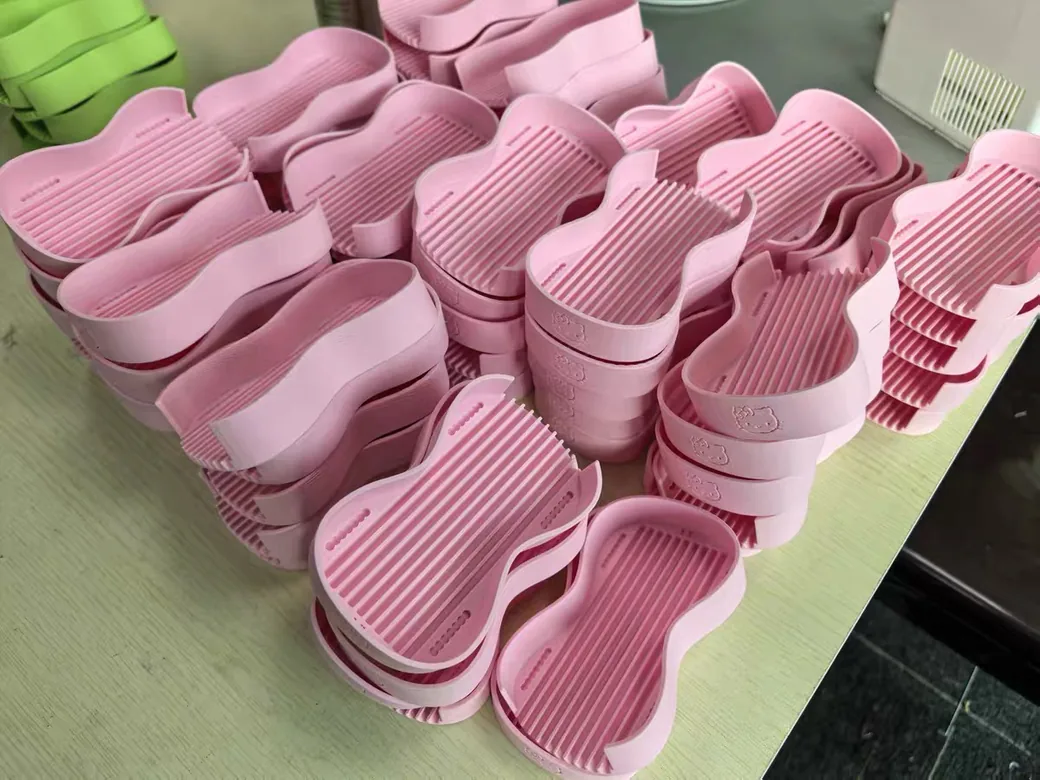
Layer lines trap bacteria and can’t be cleaned. You’ll read that on nearly every page about this subject. The published research does not support the strong version of that claim, though it doesn’t fully clear printed parts either.
What every vendor page says
The consistency is striking. Prusa’s knowledge base calls layer grooves near-impossible to clean. Craftcloud names Salmonella as the organism trapped in the gaps.
Formlabs describes narrow crevices left by round extrusion. AmeraLabs and Stratasys reach that same verdict. So do Ultimaker and Coex.
Not one of those pages comes from a publisher without a printer, a resin, a filament or a print service to sell.
What the community says back
The most-upvoted thread on the subject in r/3Dprinting is titled “There is a lot of misinformation regarding the food safety of 3d prints.” It sits at 194 upvotes and roughly 140 comments, arguing that the bacteria claim comes from old studies and inherited assumptions.
The community is not unanimous. A top reply in r/BambuLab still reads: “Doesn’t matter the filament, FDM prints aren’t food safe because of the bacterial growth in the layer gaps. Use once and throw away or coat.”
What the two published studies actually measured
Matt Thomas and colleagues at Utah Valley University ran the study most often pointed to, published at the 2023 IEEE Intermountain Engineering, Technology and Computing conference (DOI 10.1109/ietc57902.2023.10152238).
They printed test pieces in PLA, PLA+ and PETG, inoculated them with Salmonella typhimurium, added chicken blood, then left parts in a warm environment for three months to grow biofilm. Controls: glass, metal cutlery, cloth, freshly washed hands. Cleaning was ordinary: dish soap and fingers, no brush, water at 120 °F. Verification came from protein-residue swabs and scanning electron microscopy.
The parts came back clean. Squeezing distilled water through a printed cube produced clean water.
Under SEM, Thomas reports no pores at all. What he found instead: layer lines, cusps, dimples. The lines run around 10 microns wide and deep. At bacterial scale that’s a canyon, and soapy water has low enough surface tension to flow into it where plain water won’t.
A second study points somewhere subtler. Hall and colleagues (2021) tested biofilm formation by E. coli, P. aeruginosa and S. aureus across eight PLA polymers.
They found it depends on surface structure and hydrophobicity, with antimicrobial behaviour varying widely between polymers. That work was framed around medical devices, and it suggests surface does matter.
The honest read
Take the limitations seriously. IETC is a regional IEEE conference, the paper’s citation count is in the low single digits, and Thomas advocates for the conclusion he reached. His glass controls still grew fewer colonies than the printed parts.
What survives all that is narrower than either camp claims. Layer lines are not an uncleanable bacterial fortress. They also aren’t irrelevant, and your choice of polymer changes the result. Thomas’s own verdict was “yes, and a small no”: fine for dry food, murkier once liquid is involved, since colorants and binders can leach.
Bambu arrives at the same line from the opposite direction, its product copy reading: “Due to layer lines, printed parts are not suitable for holding liquid foods.” Thomas blames leaching, Bambu blames geometry, and two companies with opposing incentives land on one practical boundary. Polymaker never separated liquids from anything else, so it isn’t a third vote here.
Slant 3D’s Gabe put it as the wooden cutting board comparison, and it holds up. Grooved, porous, hard to sterilise, and in nearly every kitchen on earth.
Your Nozzle Is Probably the Bigger Problem
Change one thing before printing something that touches food, and make it the nozzle. The bacteria question at least has a controlled experiment behind it. The metal question has almost no discussion at all.
Standard brass contains roughly 2% lead, added to make it machinable, and even brass sold as “lead-free” can legally carry up to 0.25%. A typical nozzle weighs about 2 grams, putting roughly 40 milligrams of lead in the nozzle itself. For scale, 3D Print Stuff, who ran this comparison, put adult lead toxicity at 25 micrograms per decilitre of blood across about 5 litres, converting that to roughly 1.25 milligrams.
Read that carefully, because two leaps are buried in it. Forty milligrams is the total lead content of the brass, and what actually migrates into a print is a separate quantity nobody has published.
The second leap is the conversion itself. 25 µg/dL measures concentration in blood, and a swallowed dose is a different quantity entirely. Treating them as interchangeable assumes every microgram is absorbed and none excreted. This exposure is unquantified in both directions.
A second mechanism doesn’t involve lead at all. Nozzles wear, and as the orifice erodes, metal particles leave with the extrusion. Prusa makes this exact argument in its food safety article without ever using the word lead, treating the nozzle as a consumable that grinds itself into your parts. A third risk sits upstream: printers with a PTFE liner running into the hot zone can degrade that liner at high temperatures, which argues for an all-metal hot end here, particularly with PETG.
The fix is a stainless steel or titanium nozzle. Both are ordinary food-contact metals with no lead question attached.
Buying one is where it gets annoying. I went through the obvious Amazon listings while writing this and the top results were traps.
One pack advertised “stainless steel” in the title, and the stainless part turned out to be the cleaning needles. Another was a mixed set with brass nozzles alongside the steel ones. A genuine E3D V6 nozzle, the one most often recommended, ships in brass by default.
So there’s no card to click here. Read the listing for the material of the nozzle body, buy from the hot end manufacturer where you can, and skip assortment packs. Worth confirming which nozzle material you actually have first, since most printers ship brass and never mention it.
Hardened steel isn’t the same thing, either. It’s sold for abrasive filaments like carbon fibre blends, solving wear while leaving food contact untouched.
The Contamination Nobody Mentions: Bed Adhesion Glue
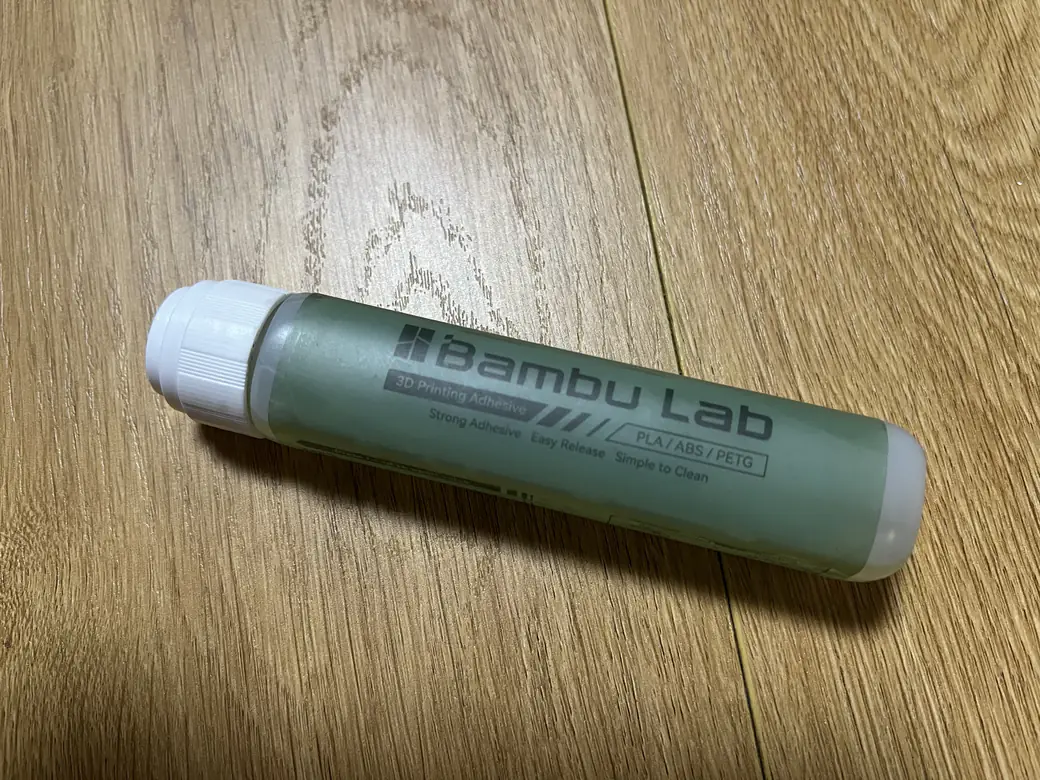
Bambu Lab’s PLA Pure page carries a line worth quoting in full: “For contact-safe finished parts, the use of Bambu Liquid Glue or Solid Glue is not recommended.” The suggested alternative is raising the bed temperature instead.
Think about where that glue goes. You spread it on the plate, the first layer presses into it, and on a cookie cutter or coaster or tray, that first layer is often the exact face that meets food. Every food safety guide I read for this piece covers nozzles and materials. Not one mentions the thing many people smear on the plate before every print.
One boundary on this. Bambu wrote that warning about its own liquid and solid glue, and glue sticks in general sit outside what it covers. No manufacturer I found publishes food-contact data for any bed adhesive.
Treating all of them as suspect here is my inference from Bambu’s caution, and nobody has documented it either way. If you rely on a glue stick for bed adhesion, raise bed temperature for these prints and skip it.
Food Safe 3D Printer Filament Options, and What They’re Actually Certified For
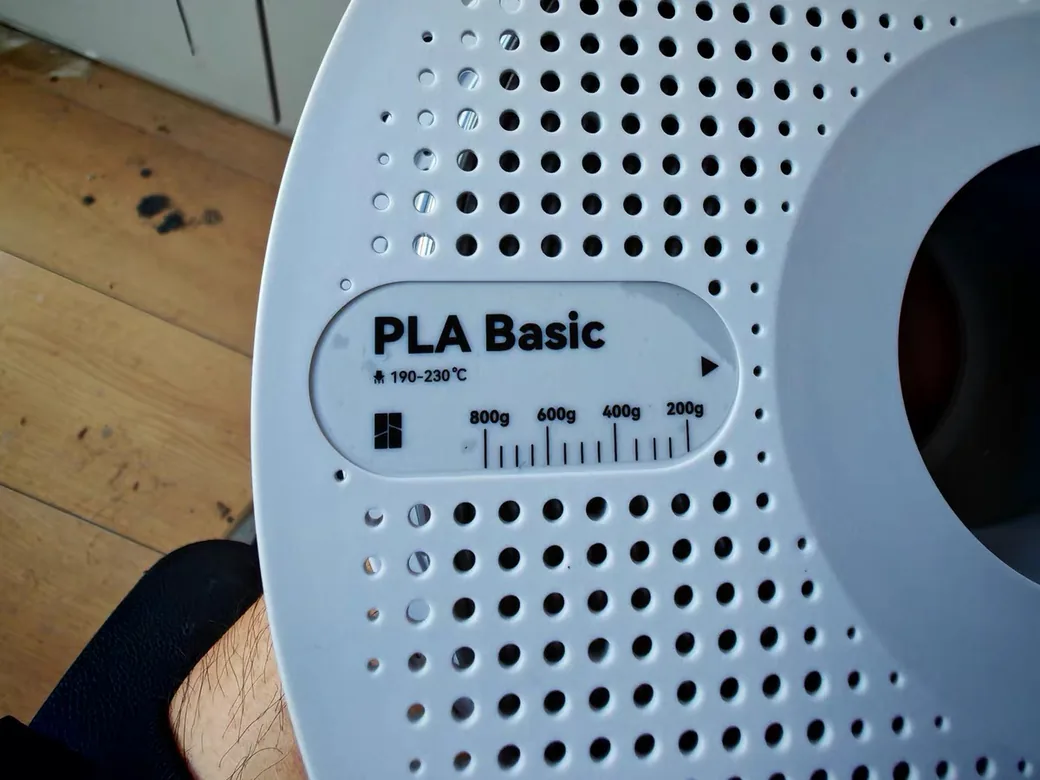
Essentially one spool qualifies on paper today, and the more useful skill is knowing how to check any other one yourself.
| Material | Food-contact status | Vendor temp figure | OK for liquids? |
|---|---|---|---|
| Bambu PLA Pure | Yes, EU 10/2011 downloadable | 60 °C (printed part) | Ruled out by Bambu |
| Fillamentum HIPS Extrafill | Vendor states food-contact safe | 95 °C (material) | Not established |
| PP | SUNLU claims compliance, no document seen | Not compared here | Not established |
| PETG (most brands) | None published | Not verified here | Not established |
| PCTG | None published | Not verified here, survived one wash test | Not established |
| ABS | None published | ~105 °C Tg (material) | No |
Certified today: Bambu PLA Pure
PLA Pure is the only consumer filament I found carrying food contact, toy safety and emissions certification at once. Bambu says the formula runs to five ingredients, each certified individually for EU food contact. Its pitch is that most food-contact filaments are tested only as a finished spool while PLA Pure was tested ingredient by ingredient.
The company doesn’t publish the full list. Tom Buck, reviewing it, identified PLA, an acrylic copolymer, colour pigment and ethylene bis-stearamide among them. The page offers a downloadable EU 10/2011 Food Contact Report and an EN 71-3 Toy Safety Report, plus UL GREENGUARD 2904 for emissions. It runs $24.99 MSRP per kilo.
Tom Buck ran side-by-side prints against standard PLA and reported no visible difference in quality or finish, and none he could feel in strength. Call that an experienced eye. It isn’t a tensile test. The trade-off is colour: five soft pastels, because those pigments are the safe ones.
Two limits come printed on Bambu’s own page: 60 °C maximum, and no liquid foods.
One thing to check before you buy: that $24.99 is Bambu’s own store price. On Amazon the same 1 kg spool runs closer to $35.

The test that tells you more than any spec sheet
Stop asking whether a material is food safe. Ask whether this manufacturer published a certificate for this spool.
Bambu shows why. On the PLA Pure page the certification reports sit there as downloads. On the PETG HF page, same company and same store, I searched for “food,” “certification,” “EU 10/2011” and “report.” Zero matches for any of them. So when people ask whether Bambu PETG is food safe, the honest answer is that Bambu declines to say.
SUNLU shows the same gap from another angle. A post on SUNLU’s own store blog refers to “Sunlu FDA-approved PLA or PETG.” The certifications listed on SUNLU’s site are CE, FCC, RoHS: product safety and EMC, radio emissions, hazardous substances in electronics. None is a food-contact standard, and I found no published food-contact certificate for their PETG. Their PP filament does carry a separate food-contact claim, and PP genuinely belongs on the food-safe plastics list.
None of this makes those filaments unsafe. It means nobody documented that they’re safe, and you carry that risk.
HIPS, the one that survives heat
Fillamentum’s HIPS Extrafill is the most interesting option almost nobody recommends. The company states plainly that it’s safe for food contact applications and BPA-free, rating temperature resistance up to 95 °C. Chemical resistance covers water, acids, alkalis, ozone, alcohols, oils and greases, which is a fair description of a kitchen.
It prints at 230–250 °C with a 90–105 °C bed, comes in 1.75 mm and 2.85 mm at ±0.05 mm, and wants an enclosure. It’s less forgiving than PLA.
One wrinkle worth knowing before you trust that chemical resistance list. HIPS dissolves in limonene, which is why Fillamentum sells a limonene-based smoothing product for it and why HIPS works as a dissolvable support material. Limonene is a citrus oil.
So read “resistant to oils and greases” as covering cooking oils, with one known solvent exception.
What I could not verify
NonOilen gets recommended in filament roundups as food-contact certified and dishwasher safe. I went to Fillamentum’s site to confirm. Searches for “food” and “dishwasher” returned nothing on the NonOilen pages, and the only certifications listed are ISO 9001 and ISO 14001, which are company management standards. Neither speaks to food contact.
The claim may be true and documented somewhere I didn’t reach: a technical data sheet, a distributor’s file, a certificate that sits with the resin supplier. What I can tell you is that I looked at the obvious places and came up empty, which is more than the roundups repeating it can say.
Two others sit in the same bucket: PCTG, whose one promising result is the dishwasher test covered below, and silver-nanoparticle antimicrobial CPE, for which I found no manufacturer documentation supporting food use at all.
To narrow options by material properties, the filament picker sorts by the specs that matter.
What to avoid
ABS gets left off the food-safe list on two counts: its additive package, and the same layer line question as everything else. People print burger presses and cutters from it anyway. Brief dry contact is a defensible risk; a bowl you eat from daily is not.
Can You Put a 3D Print in the Dishwasher?
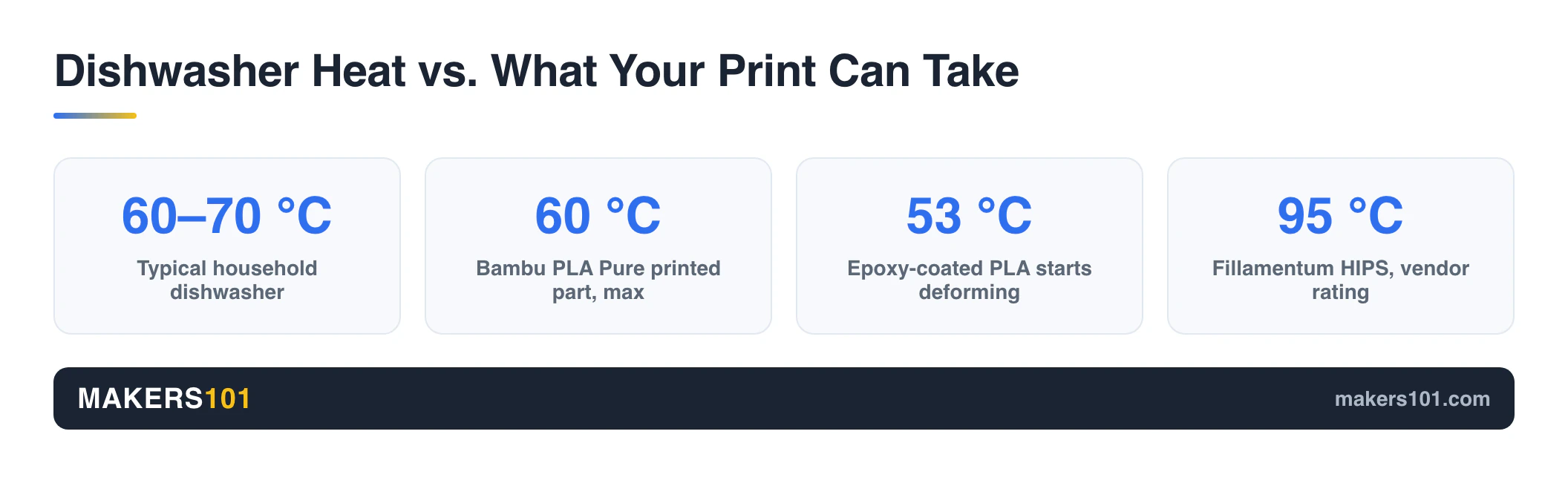
Mostly no, and the reason is temperature. Dishwashers run hot enough to deform the plastics people usually print with.
The temperature math
Bambu rates PLA Pure parts to 60 °C maximum, and household dishwashers typically run in the 60–70 °C range. By its own manufacturer’s number, the most thoroughly certified food-contact filament you can buy is rated at or below where your dishwasher runs.
Coating doesn’t rescue it. Igor at My Tech Fun ran a controlled heat test on epoxy-coated versus bare PLA: the coated sample began deforming at 53 °C, the uncoated at 51 °C. Two degrees. Epoxy buys a sealed, waterproof surface and almost no heat tolerance.
What survives and what cracks
ABS sits near 105 °C at glass transition, so it won’t slump on the first cycle, though repeated heat cycling invites warping.
KHA Entertainment ran a direct comparison: a PCTG container came through a cycle intact while the same container in PETG turned brittle and cracked under light pressure. Single cycle, single tester. Treat it as a signal.
Of the materials I compared on temperature, Fillamentum HIPS is the only one that clears dishwasher heat while also carrying a food-contact claim. ABS clears the heat and makes no such claim. Material temperature resistance isn’t the same as a printed part surviving either, since wall count and geometry change how heat plays out.
Before committing anything to repeated washing, it’s worth knowing how PLA holds up once water is involved.
Three Ways to Actually Make a Print Food Safe
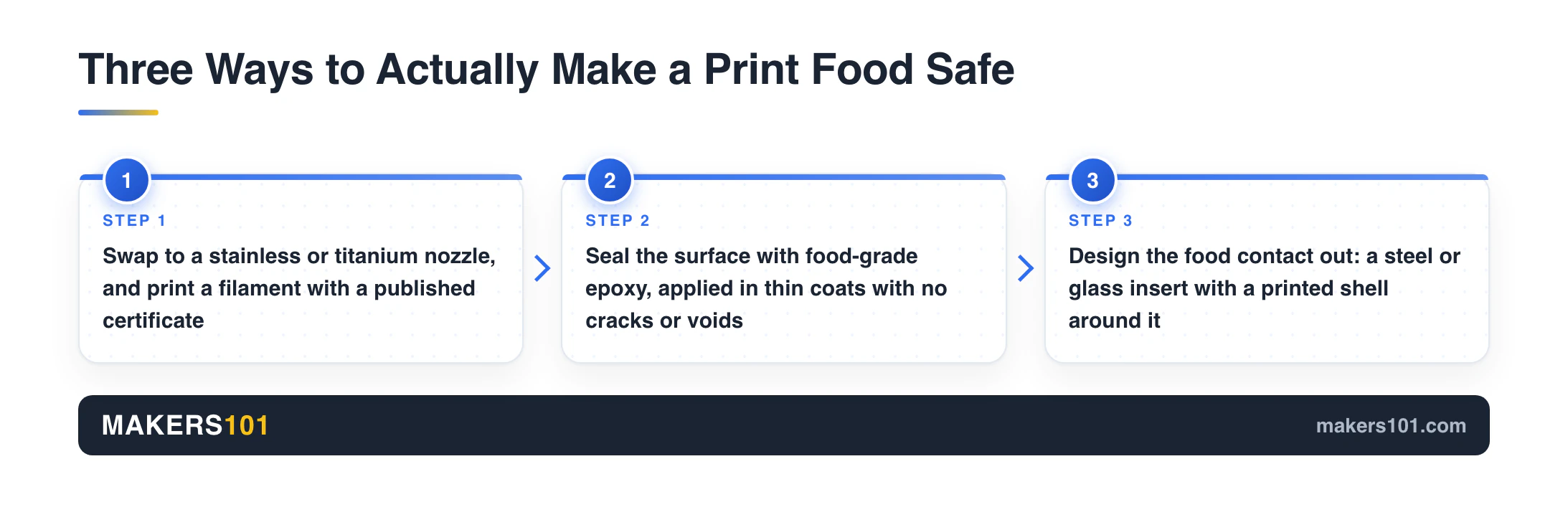
Swap the nozzle, seal the surface, or design the food contact out of the part. Those are the three that work, and most guides only cover the first two.
1. Swap the nozzle and use a certified filament
Alex’s Alchemy argues certification has to cover the polymer and the extrusion process that turned it into filament, since resin grade alone isn’t enough. Good for dry-contact items you’ll reuse.
2. Seal the surface with a coating
Strongest evidence here, and the longest list of conditions. Igor cites collaborative university research finding that properly epoxy-coated prints can be cleaned like smooth injection-moulded parts. The conditions: food-grade epoxy, food-grade filament, a clean printer, correct mixing and curing, no cracks or voids in the coating. Miss one and the finding doesn’t apply to you.
Vertical faces need several thin coats, because one thick pass runs. Complex geometry is genuinely hard to cover, and Igor gave up partway through a Benchy because the crevices were too tight. Don’t expect strength either, since the same tests measured a 4–10% gain.
And check what your “food safe” resin is actually certified to, given how often ASTM D4236 gets cited for the job.
3. Design the food contact out of the part
The cleverest approach skips the problem entirely. A maker on the YouTube channel “done right” wanted a printed mug, decided the layer lines weren’t worth arguing about, bought a steel inner cup and modelled a shell around it with a boolean subtraction of the measured cup body. Food touches steel. Plastic handles looks and grip.
He’s honest that it isn’t perfect, since your lip still meets the printed rim. It still beats trying to seal a printed vessel.
If the part actually needs to pass real certification rather than a workaround, the surer route is skipping the print for that surface altogether — machines that injection-mold from a 3D-printed mold insert get you a genuinely molded piece instead of a printed one.
What I’d Actually Do
Three tiers, and the answer changes at each one. A stainless nozzle, a certified filament and a bare build plate apply to all three; the tiers differ in what else you need.
| What you’re making | Verdict | What else it takes |
|---|---|---|
| Cookie cutters, scoops, dry-snack trays, coasters | Go ahead | Nothing further. Hand wash and use. |
| Bowls, spoons, butter dishes: reused, wet or oily | Do it properly | Hand wash only, never the dishwasher, and wash it after each use rather than letting residue sit |
| Cups, hot food, anything a child mouths | Don’t print the contact surface | A steel or glass insert with a printed shell around it |
Zion Brock, who did the deepest public breakdown of these certifications, has used printed butter dishes and rolling pins for over a year on exactly the middle row’s terms.
Three questions decide it: how long the contact lasts, whether liquid is involved, and how hot it gets.
Frequently Asked Questions
Is PLA food safe?
As a raw polymer, yes, and some spools now carry EU 10/2011 certification. Your printed object is a separate question: the certificate stops at the filament and says nothing about your nozzle, and bed adhesives are unknown territory since no manufacturer publishes food-contact data for them either way. For dry, brief contact PLA is a reasonable pick. It softens well below boiling point, so hot liquid is out.
Is PETG food safe, and can I drink out of a PETG cup?
The raw material is common in medical and food packaging, which is where the confusion starts. Printed PETG carries no such guarantee, and a cup is the hardest case of all. Both sources here that addressed liquids directly (Thomas, then Bambu) turn cautious on them.
Which is better for food contact, PLA or PETG?
Chemistry doesn’t separate them, since both qualify as food-safe plastics. Documentation does: you can buy PLA today with a downloadable certificate, and equivalent PETG paperwork is scarce.
Is ABS food safe?
No. What it contains, plus the usual cleanability problem, keeps it off the list. Heat is its one advantage, with the highest glass transition of anything covered here.
Is Bambu PETG food safe?
Bambu doesn’t say. It documents PLA Pure and stays quiet on PETG HF, and that quiet is your answer.
Is it safe to eat out of a 3D-printed bowl?
For dry food the published research backs it, provided you hand wash. Wet or hot food weakens the case fast, and a bowl gets washed hundreds of times over its life.
What filament should I use for cookie cutters?
Any food safe 3D printer filament with a published food-contact certificate, which in practice means PLA. PLA Pure is simply the easiest to verify. Use a stainless nozzle, keep adhesion products off the first layer, wash by hand. Brief contact plus an oven afterwards is why nobody argues about this one, and a common community reply is that baking deals with whatever the cutter left behind.
If you sell them, describe them accurately. “Food safe” carries a regulatory meaning you can’t back up, and Polymaker’s point applies to you directly: certification would attach to your finished object, and nobody has certified it.
Is it okay to eat 3D printed food?
Different technology entirely. This guide is about plastic objects that touch food. Printed food means machines extruding edible ingredients, a separate field with its own equipment. Nothing here transfers.
Is the FDA allowing 3D printed food?
There’s no printing-specific food rule to point you to. The FDA’s published 3D printing guidance covers medical devices, and I found no equivalent framework for printed food on its site. For this guide’s subject the answer is narrower: no FDM filament carries FDA food-safe certification, and certification would only ever apply to a finished item anyway.
CERTAIN CONTENT THAT APPEARS ON THIS SITE COMES FROM AMAZON. THIS CONTENT IS PROVIDED ‘AS IS’ AND IS SUBJECT TO CHANGE OR REMOVAL AT ANY TIME.
Price details
Product prices and availability are accurate as of the date/time indicated and are subject to change. Any price and availability information displayed on Amazon.com at the time of purchase will apply to the purchase of this product.