
Heads up — some of the links below are affiliate links. If you buy through them, I earn a small commission (at no extra cost to you), which helps cover the gear I test. Thanks!
- Asking “is PLA waterproof” mixes two separate things. The plastic handles water fine. The printed part is what leaks.
- PLA doesn’t dissolve in water. It needs temperatures above 60°C before it starts breaking down at all.
- Shallow water is a non-event. Pressure and time are what push water into the walls.
- Wall count, flow rate, and temperature fix more leaks than any sealant will.
- Hot water and sunlight are what actually kill PLA parts. No coating saves you from either.
| Your real question | The answer | What it depends on |
|---|---|---|
| Will water ruin PLA? | No. It won’t dissolve or rot at room temperature | Needs composting heat to degrade |
| Can a print hold water? | Yes, but default slicer settings often leak | Walls, flow rate, Z-seam, shape |
| Can it stay submerged? | Shallow yes. Under pressure, water enters the walls | Depth and time |
| Can it hold hot water? | No. Deformation starts near 51°C | Nothing you coat it with helps |
| Can it live outdoors? | Short term yes. Long term, switch material | UV is the slow killer |
| Can it hold drinking water? | Not advisable | Layer lines trap bacteria |
You’ve got a spool of PLA and a printer, and you want to make a planter, a soap dish, or something for the garden. Then you stop and wonder whether it’ll survive the first rinse.
Search “is PLA waterproof” and almost every result tells you no. Then you find the r/3Dprinting thread with 2,482 upvotes where someone deliberately printed a single 0.2mm bottom layer so water would slowly weep through into a plant pot. Days later it still hadn’t leaked a drop.
The truth sits in between, and it’s more useful than either answer. Here’s how to get a watertight print out of the spool already sitting on your desk, and when to give up and buy something else.
Table of Contents
- Is PLA Waterproof? It Depends Which Question You’re Asking
- Why FDM Prints Leak in the First Place
- How Deep, How Long: What Pressure Testing Shows
- Print Settings That Make PLA Hold Water
- What Coatings Actually Do (And What They Don’t)
- Design the Leak Out Instead of Sealing It
- Hot Water and Sunlight Kill PLA Faster Than Water Ever Will
- When to Stop Fighting and Switch Filament
- Can You Drink From a PLA Print?
- FAQ
Is PLA Waterproof? It Depends Which Question You’re Asking
PLA the material handles water fine. It doesn’t dissolve, swell, or rot sitting in a bucket at room temperature.
The confusion comes from PLA’s reputation as a compostable plastic. That reputation is half true and badly misread. PLA only becomes bioavailable above 60°C, and even in a hot composting or landfill environment it takes anywhere from one to two years up to a decade to break down. Your kitchen sink, your plant saucer, and a week of rain don’t come close to those conditions.
So when people say PLA isn’t waterproof, they’re describing something else: the print leaks. That’s a geometry and settings problem sitting on top of a perfectly water-stable plastic.
Three separate questions hide inside “waterproof,” and mixing them up is why the advice online contradicts itself so often. Does the material degrade? Does the part leak? Does water soak into the walls? The answers are no, sometimes, and yes.
Watertight vs. Waterproof: Two Different Promises
Watertight means it holds water without leaking. Waterproof means it survives being in water long term. A vase-mode cup can be watertight on your desk and still fail as a waterproof part 30 feet underwater.
Most of what you want falls into the first category. Planters, soap dishes, drip trays, garden markers. Those are watertight problems, and they’re solvable.
Why FDM Prints Leak in the First Place
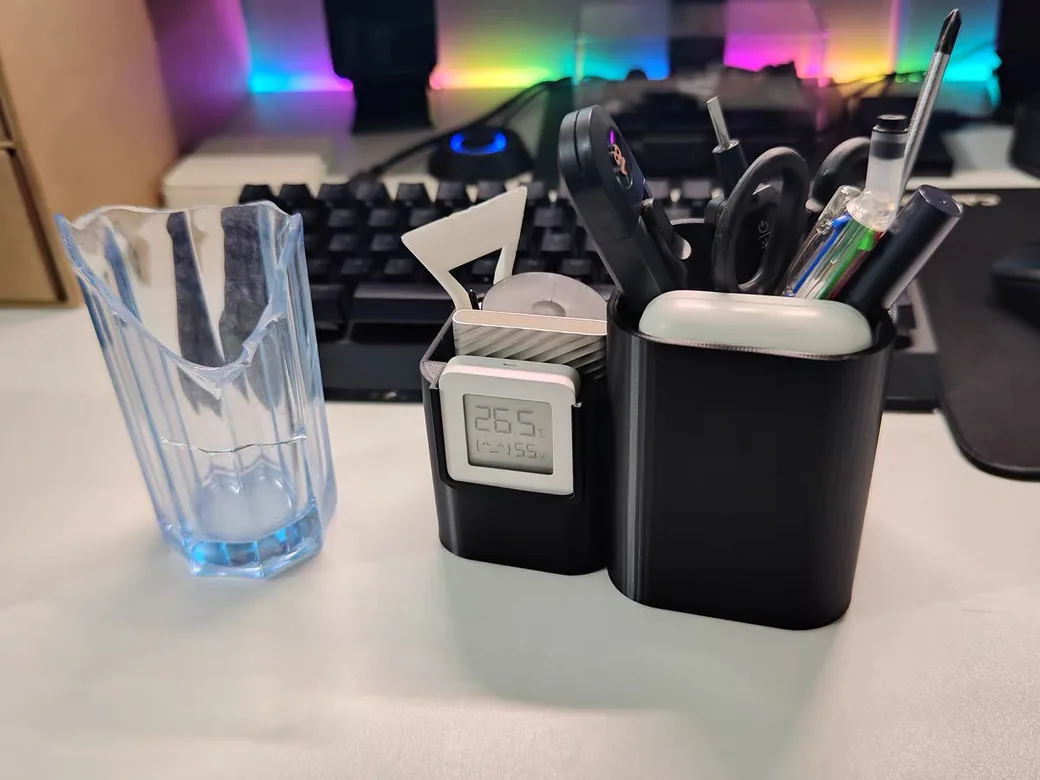
Your print isn’t solid. It’s a shell of walls wrapped around a lattice of infill, and water finds its way through the gaps between extruded lines and between layers.
That’s the whole mechanism. The plastic is waterproof and the assembly isn’t.
You can prove it with a single variable. The Taboretum channel printed the same container twice on the same printer with the same filament, changing only the slicer settings. The default-settings version leaked. The tuned version held water.
Leak paths show up in a predictable order. The bottom layer fails first, then the Z-seam where each layer starts and stops, then the layer bonds, then the gaps between adjacent wall lines.
Before you blame the print, check the hardware attached to it. When the Space Cowboy channel built a 3D printed air tank, the first leaks came from underneath the pressure gauge fitting. The printed wall itself held. Threads, inserts, and O-ring seats are the usual suspects, and they’re much easier to fix than a porous shell.
The 0.2 mm Bottom That Refused to Leak
That Reddit thread deserves a second look, because it’s the cleanest evidence that leaking isn’t inevitable. The poster wanted a slow leak. They designed a single 0.2mm bottom layer specifically so water would seep out into the soil over days.
It held. “Not at all what I expected based on what I’ve heard about the water tightness of 3D prints,” they wrote. Nearly 500 comments piled in, most of them equally surprised.
Modern printers with good first layers produce a denser bottom than the community folklore assumes.
How Deep, How Long: What Pressure Testing Shows
For anything on your desk or your balcony, water depth is irrelevant. Pressure and duration are the two variables that decide whether water gets in.
The CPSdrone team, who build underwater drones, ran FDM parts through a pressure chamber and weighed them afterward. The numbers give you a scale that most guides skip entirely.
| Condition | Result |
|---|---|
| 10 cm deep, 10 minutes | No weight gain, no leaks |
| 1 bar (about 10 m deep) | Part gained 24 g of water |
| 7 bar (about 70 m deep) | Part gained 88 g |
| 9 bar for 62 hours | Heaviest leakage of the test |
Read the first row again. At the depth of an actual planter or a fish tank, a standard FDM print took on nothing at all.
Water Doesn’t Just Pass Through. It Parks in the Walls.
The same team tested a solid part with no interior cavity at all. It gained 25 g after ten minutes and 41 g after twenty hours.
There was nowhere for that water to go except into the wall material itself. So a part can look bone dry on the inside and still be carrying water in its structure. For anything with electronics inside, that matters more than a visible drip.
Resin Prints Aren’t the Shortcut Either
Resin gets recommended as the dense, poreless alternative. The same test series says otherwise. Resin parts printed with 0.8mm walls came out with holes and turned brittle, and they failed at lower pressure than an FDM part treated with a pore sealer.
Print Settings That Make PLA Hold Water
Most leaks are a slicer problem, and fixing them costs nothing. Six settings do almost all the work.
Wall count. Start at two. A simple cylinder printed with a single 0.5mm wall held water fine in the 3D Printer Academy test on a Bambu Lab P1S, but a full-size watering can with the same single wall leaked, because the larger and more complex shape gave layer adhesion more chances to fail. Going to two walls and placing the inner and outer lines right against each other made it fully watertight.
Temperature. Print at the top of your filament’s range, around 210°C for standard PLA. Fully melted plastic bonds harder between layers, and weak layer bonds are leak paths. If you’re not sure where your spool actually sits, start with the right nozzle temp for PLA and work up.
Line width. Set extrusion width to roughly 200% of your nozzle, so 0.8mm lines from a 0.4mm nozzle. Orca and Bambu Studio keep Line width under Quality; PrusaSlicer puts it in Print Settings under Advanced. Fatter lines mean more contact area where adjacent passes fuse together.
Speed. Cut it to about half your normal rate. A hotend can only melt so much plastic per second, and wide lines at full speed give you under-extrusion exactly where you don’t want it.
Flow rate. Push the bottom layers to 120% and leave the rest at 100%. In Orca and Bambu Studio this lives under Quality as Flow ratio, and in PrusaSlicer it’s Filament Settings under Extrusion multiplier. Some PrusaSlicer profiles ship with a 95% extrusion multiplier, which deliberately under-extrudes by 5%. That alone is enough to leave a porous floor.
Retraction. Limit it or turn it off. Every retraction risks a small gap at the seam, and gaps that stack up across layers become a channel.
If you’d rather start from a known-good baseline than guess, the Print Settings Finder gives you a starting profile by material and nozzle.
When Vase Mode Is the Easy Answer (And When It Isn’t)
Vase mode prints the whole object as one continuous spiral, which eliminates the Z-seam entirely. For a cup, a vase, or a simple planter, it’s the fastest route to watertight walls.
It only works when every layer is a single closed loop. Any shape that splits into two islands breaks it. And the bottom is still printed as stacked lines, so it needs the same flow rate attention as any other print.
Why Cranking Infill to 100% Costs More Than It Fixes
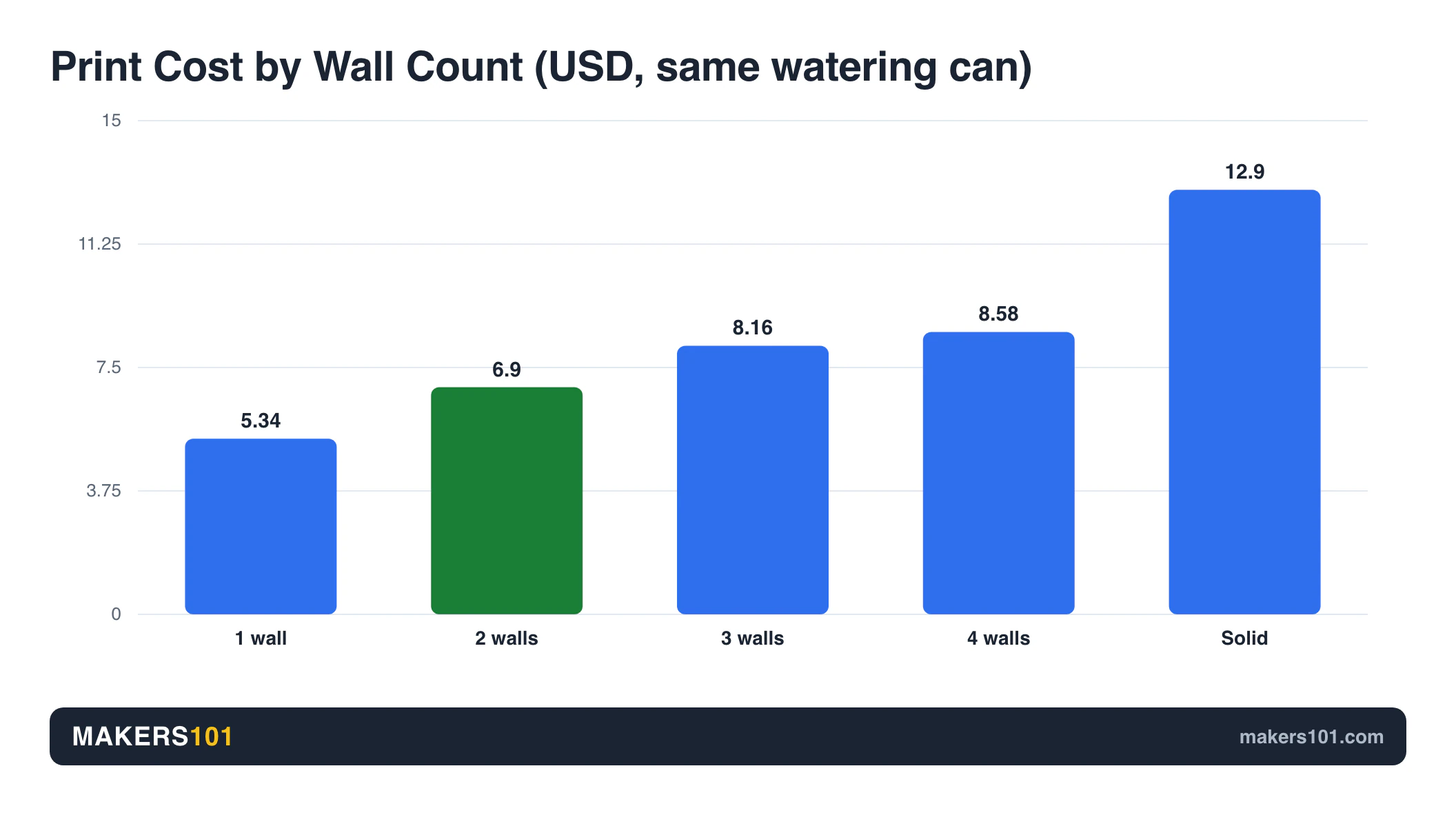
Solid infill feels like the obvious fix. Check the cost first. Across the same watering can, the 3D Printer Academy test priced one wall at $5.34, two at $6.90, three at $8.16, four at $8.58, and fully solid at $12.90.
A comparable watering can sells for about $10. The tuned two-wall version came in under $7 and didn’t leak. Solid costs you more than buying it and doesn’t buy you anything the second wall didn’t already.
What Coatings Actually Do (And What They Don’t)
Coatings solve leaking. They don’t solve heat, and they barely touch strength. Knowing which of those three you’re buying saves a lot of disappointment.
Epoxy Resin: The One That Reliably Seals
Igor at My Tech Fun ran the claims about epoxy through actual instruments using BQ Silk PLA and Smooth-On XTC-3D. On waterproofing, the result was unambiguous. Two vase-mode cups, one coated and one bare: the coated cup stayed completely dry on the paper underneath while the bare one leaked. Coating the outside alone was enough.
The other claims held up far less well. Tensile strength improved by only 4 to 10%, less than he expected. Heat resistance moved almost not at all: the coated PLA started deforming at 53°C against 51°C for bare PLA.
Two degrees. That’s the entire benefit, which means a coat of epoxy will not let your print hold hot coffee.
Application is the real constraint. He struggled to coat half a Benchy cleanly because the small gaps were hard to reach, so intricate geometry means pinholes unless you’re patient.

- High-Performance 3D Print Coating – Clear top coat for smoothing & finishing 3D printed parts.
- Ideal for application to both SLA & SLS prints, as well as PLA, ABS, Laywoo, Powder Printed Parts, and other rigid media.
- Mix Ratio of 2A:1B by Volume -Working time of 10 minutes – Cures to hard, impact-resistant coating in 3.5 hours – 80D Shore Hardness.
- Epoxy top coating self-levels and wets out uniformly without leaving brush strokes; offers excellent coverage.
- Perform a small-scale test of your project materials to determine suitability and compatibility. Refer to the technical bulletin for more information…
Chemical Pore Sealers: The Extreme End
If you need a part that survives real depth, chemical pore sealers outperform everything else in the hobby range. The CPSdrone tests put a treated FDM part at 9 bar for 62 hours with virtually no leakage, which is the toughest published result I’ve come across for a desktop-printed part.
The process is a soak followed by a long dry. The chemistry works down inside the pores and closes them there, so there’s no surface film doing the work.
Clear Sprays: Fine for Rain, Not for Soaking
The two products people ask about most on Reddit are Rust-Oleum clear coat and Gorilla spray sealant. Both are light protection. They’ll shrug off rain on a garden gnome and add a bit of UV cover.
Neither has published side-by-side immersion data, so treat them as weather protection. If your part needs to hold standing water, that’s an epoxy job. The same logic applies to painting 3D prints, where the primer coat does most of the real work.
- Weather and corrosion resistant coating protects exterior/interior surfaces like wood, metal, concrete, masonry and more
- Oil-based formula provides a durable protective coating with excellent rust prevention
- Dries to touch in 2 to 4 hours and covers up to 15 sq. ft.
- Excellent resistance to abrasion, fading and chipping
- Flat finish minimizes surface imperfections

Design the Leak Out Instead of Sealing It
The most reliable waterproof print is one designed not to let water in. Slant 3D builds electrical enclosures for warehouses and outdoor equipment with no gaskets at all, relying on geometry to keep water out.
Their approach uses a groove with a lip that catches water, routes it into an internal channel, and drains it out through egress points. Water never reaches the interior because it’s given an easier path. That interior groove has undercuts no mold could produce, which is exactly the kind of geometry 3D printing is good at.
It has a limit and they say so: overwhelm the drain channel with enough pressure or volume and water gets through anyway.
For a simpler route, a small TPU gasket lets a printed container be fully submerged with everything inside staying dry. And if you’re wondering how high the ceiling goes, the Space Cowboy air tank held 100 PSI while staying completely airtight. For outdoor enclosures that also face sun, ASA filament pairs well with this design approach.
Hot Water and Sunlight Kill PLA Faster Than Water Ever Will
Room temperature water is close to harmless for PLA. Heat and UV are what actually end its life, and both arrive faster than most people expect.
Why the Dishwasher Is Off Limits
PLA starts deforming around 51°C in the My Tech Fun bench test. A dishwasher’s wash cycle runs well past that, and so does a car dashboard in summer.
Coating doesn’t rescue this. The epoxy-coated sample moved that threshold to 53°C, a gain small enough to ignore. Parts that face hot water or a hot car need heat resistant filament. A better sealant won’t get you there.
How Long PLA Survives Outdoors
Sunlight works slowly and then all at once. UV embrittles PLA over a season or two. The part cracks under a load it used to handle, while still looking fine.
PETG lasts far longer out there. One maker’s PETG camera mounts have gone through several cold winters and hot summers with no sign of degrading, and Slant 3D ships PETG enclosures that hold up for years outdoors despite weaker UV resistance than ASA. If you go PETG, pick opaque over semi-translucent: it handles UV better and yellows less.
That pair of weaknesses, low heat tolerance and poor UV stability, is the honest answer to what’s wrong with PLA. Water isn’t on the list.
When to Stop Fighting and Switch Filament
Switch material when the part will be submerged long term, sit in direct sun, or touch hot water. For everything else, tuning settings is cheaper and faster.
| Material | In water | In sunlight | Print difficulty |
|---|---|---|---|
| PLA | Fine at room temperature, needs tuned settings | Poor | Easiest |
| PETG | Good, lasts years outdoors | Moderate, choose opaque | Slightly harder than PLA |
| ASA | Good | Best | Needs an enclosure to avoid warping |
PETG or ASA: Pick by Sunlight, Not by Water
Both handle water well, so let sun exposure decide. ASA wins clearly on UV stability, while PETG is easier to print and cheaper per spool. ASA also brings higher impact strength than PC PBT and can be vapor smoothed with acetone, at the cost of needing an enclosure to control warping.
Most people asking this question should start with PETG. The best PETG filament picks cover what’s worth buying, and the Filament Picker narrows it by use case if you’re torn.
One honest note before you spend anything. If you just want a planter for the balcony, the PLA already on your shelf with two walls and a 120% bottom flow will do the job. Buying a new spool for that is money you don’t need to spend.
Can You Drink From a PLA Print?
Treat this as a no by default. Layer lines are microscopic crevices where bacteria settle, and sealing the part doesn’t make that hygiene problem disappear.
An epoxy coating can in principle make a print as cleanable as an injection molded part, and Igor’s university collaboration confirmed exactly that. The conditions are strict though: food-safe epoxy, food-safe filament, a clean printer, correct mixing and curing, and a coating with no cracks or holes. Miss one and the argument collapses.
The practical answer for a water bottle or a jug is to buy the food-contact vessel and print the bracket that holds it. That trick shows up again in our food safe filament guide, this time as a steel cup inside a printed shell.
FAQ
How long will PLA last in water?
Indefinitely at room temperature, as far as the material goes. PLA needs composting-grade heat to become bioavailable, so a bucket, a pond, or a plant saucer won’t degrade it. What changes over time is water gradually working into the wall structure, which matters for enclosed electronics and not much else.
What happens if PLA gets wet?
A finished print gets wet and nothing happens. Unprinted filament is the opposite case: PLA on the spool absorbs moisture from the air and prints badly afterward, with stringing and weak layers. Dry the spool, don’t worry about the part.
What 3D filament is waterproof?
No filament is waterproof in print form on its own. The leak path runs between extruded lines, and every plastic shares that weakness. PETG, ASA, PP, and TPU all handle water well as materials. Any of them still needs adequate walls and flow rate to hold water reliably.
Can you coat PLA to make it waterproof?
Yes. Brush-on epoxy such as XTC-3D sealed vase-mode cups completely in bench testing while uncoated cups leaked, and coating the exterior alone was sufficient. Chemical pore sealers go further and have survived 9 bar for 62 hours. Clear spray paints are weather protection and shouldn’t be trusted with standing water.
How long will PLA last outdoors?
Expect a season or two before UV embrittlement shows up, faster in strong sun. Failure shows up as cracking under normal load, often before any colour change is obvious. PETG stretches this to years, and ASA is the material to pick for permanent outdoor installations.
Is PLA waterproof after printing?
Printing doesn’t change the plastic’s relationship with water, so the answer is the same before and after. What printing decides is whether the part leaks, and that comes down to wall count, bottom layer flow, Z-seam quality, and shape complexity.
Is PETG waterproof?
PETG resists water better than PLA and tolerates hot water far better, with a heat deflection point around 25°C higher. It still leaks through the same layer gaps if you print it with thin walls and default flow. Material choice raises your ceiling and settings still decide the outcome.