
Heads up — some of the links below are affiliate links. If you buy through them, I earn a small commission (at no extra cost to you), which helps cover the gear I test. Thanks!
- The best paint for 3D prints is acrylic paint applied over a filler primer coat. The primer does most of the work. It fills layer lines and gives the paint something to grip.
- Best budget pick: FolkArt craft acrylic. Roughly a dollar a bottle, and cheap enough that a ruined test piece costs you nothing.
- Best for miniatures and fine detail: Army Painter Warpaints Fanatic. High pigment load, but its reds lean pink.
- Best filler primer: Seymour 20-1674 hides layer lines better than Rust-Oleum. The price gap is far smaller than the usual claim.
- Fastest route to color: acrylic paint markers, but only over primer. On bare filament they go blotchy.
- Sometimes the right answer is no paint at all. A different filament or a vapor smoothing session can get you a clean surface for less effort.
Last updated: August 7, 2026.
Search for the best paint for 3D prints and you get a strange result. Nearly every article on the first screen is a how-to tutorial, not a buying guide. Most are published by companies that sell paint, sell printers, or run print farms.
So you learn the theory. You still don’t learn what to put in your cart.
That’s the gap this guide fills. Every pick below is named, priced, and tied to a specific job. Where the evidence comes from someone else’s test, I say so plainly.
Table of Contents
- Best Paint for 3D Prints at a Glance
- Start Here: Do You Actually Need Primer?
- Which Paint Types Actually Stick (and Which Ones Ruin Prints)
- Best Acrylic Paint for 3D Prints (Hand Brushing)
- Best Spray Paint for 3D Prints
- Best Filler Primer: Rust-Oleum vs Seymour
- Faster Routes: Airbrush Kits and Acrylic Markers
- How Much Prep Do You Actually Need?
- When You Should Not Buy Paint at All
- Mistakes That Ruin a 3D Print Paint Job
- Frequently Asked Questions About Painting 3D Prints
Best Paint for 3D Prints at a Glance
| Pick | Type | Best for | Price tier | The one-line verdict |
|---|---|---|---|---|
| FolkArt craft acrylic | Brush-on acrylic | Beginners, bases, terrain | Budget | Cheap enough that mistakes stop mattering |
| Army Painter Fanatic | Model acrylic | Miniatures, fine detail | Mid | Dense pigment, weak reds |
| Citadel Mephiston Red | Model acrylic | Fixing that red gap | Mid | Buy one pot, not the range |
| Rust-Oleum 249279 | Spray filler primer | Most prints, most people | Budget | The sensible default |
| Seymour 20-1674 | Spray filler primer | Helmets, props, deep layer lines | Mid | Better coverage, smaller premium than you think |
| Createx 5801-00 | Airbrush acrylic | Airbrush owners | Mid | Finer pigment, six primaries |
| Arrtx metallic markers | Paint marker | Fast terrain and test pieces | Budget | Brilliant over primer, blotchy without |
Prices verified August 7, 2026.
Brands you will see mentioned everywhere
A few names come up constantly in painting discussions without ever getting placed. Here is where each one actually sits.
Vallejo and Citadel are the premium model ranges. Both are excellent and both are the wrong starting point for a first attempt, because the cost of a failed experiment matters more than the quality of the paint when you’re learning.
Tamiya makes thin, wide-range spray cans that model builders favour for even coats. Montana Gold is a high-coverage spray more common in the graffiti and prop world.
Angelus is a leather paint that gets used on 3D prints with its 2-Hard additive. Worth knowing about, though the most detailed guidance on it comes from Angelus’s own blog, so read it as a manufacturer’s recommendation rather than an independent test.
Rust-Oleum and Seymour are the two filler primers worth comparing, and that comparison gets its own section below.
Start Here: Do You Actually Need Primer?
Yes, on anything you care about. This is the single most common question about painting 3D prints, and the honest answer isn’t a diplomatic “it depends.”
Designed In Layers ran acrylic paint markers over both kinds of surface. On a primed model, the metallic colors covered so completely the result looked close to chrome. On bare pearlescent PLA with no base coat, saturated colors went blotchy because the filament soaked up the acrylic.
Those were two different sets of markers on two different models, so it isn’t a clean single-variable test. Pigment density plays a part, and the gap looks widest on lighter, more transparent colors. The direction is still hard to miss. Primed surfaces take color. Bare filament drinks it.
Priming is the unglamorous step people skip to get to the fun part. It’s also the one that decides how the finished thing looks.
What to spray on 3D prints before painting
A filler primer rather than a plain primer. Plain primer improves adhesion. Filler primer improves adhesion and partially fills the valleys between layer lines, which is the actual problem with an FDM print.
Two coats is a reasonable starting point. Sand lightly between them if the surface still catches the light unevenly. Where to stop is the tricky part, and we covered which grit to sand to before painting.
There’s one honest exception. If a surface will be hidden by another part after assembly, it doesn’t need the same treatment. Skipping the inside of a helmet’s ear cups is a time-saving decision, not a mistake.
Which Paint Types Actually Stick (and Which Ones Ruin Prints)
Acrylic is the default for 3D prints, and for most people the discussion can stop there. It’s water-based, dries fast, cleans up with water, and sticks well to primed plastic.
The other categories are worth knowing mainly so you can avoid the ones that cause damage.
Enamel gives a harder, more durable finish. It also needs far longer to cure and produces strong fumes, so it wants ventilation and patience.
Spray paint covers quickly and evenly. Thin coats matter more here than anywhere else, because a heavy pass will pool in the layer lines you just filled.
Solvent-based paints deserve caution. Oil-based products can attack PLA, and lacquer can soften ABS. The risk isn’t theoretical: it’s why “any spray paint works” is bad advice.
Paint compatibility by material
| Material | Safe default | Watch out for |
|---|---|---|
| PLA | Acrylic over filler primer | Oil-based and hot solvent sprays |
| ABS / ASA | Acrylic or enamel over primer | Lacquer can soften the surface |
| PETG | Acrylic over primer | Poor adhesion without primer |
| Resin | Acrylic over primer | UV exposure, not the paint |
| Nylon / TPU | Flexible or vinyl-specific paint | Rigid paint cracks on flex |
Resin prints carry one extra warning that has nothing to do with paint. They aren’t UV resistant. Prolonged sun exposure makes them brittle and discolored, so an outdoor resin part needs a UV-resistant topcoat regardless of what color you put on it.
Best Acrylic Paint for 3D Prints (Hand Brushing)
For hand brushing, buy cheap paint first and expensive paint later. The skill gap between a beginner and a good result is technique, not pigment.
Best budget pick: FolkArt craft acrylic
FolkArt sits at about $1.17 a bottle at Hobby Lobby as of August 2026, which makes a failed experiment cost less than a coffee. That’s the entire argument for it.
Gordo3D makes the point well: start with cheap paints to test the waters, because you only lose a few dollars if you decide painting isn’t for you. The same logic runs through miniature painting advice, where cheap craft paint is standard for bases and terrain so the expensive pots get saved for the model itself.
One buying note. The Amazon multi-packs work out more expensive per bottle than single bottles at a craft store. Convenient, but not cheaper.
- Costs almost nothing per bottle
- Available in most craft stores
- Fine for bases, terrain, and large flat areas
- Lower pigment density than model paints
- Needs more coats on detailed surfaces

- VERSATILE PAINT KIT – This acrylic paint set includes 18 – 2 oz bottles of acrylic craft paint. The colors in this set include: FolkArt Wicker White…
- BEAUTIFUL MATTE FINISH – FolkArt Acrylic Paint has a stunning matte finish – perfect for all your arts and crafts
- USE ON MULTIPLE SURFACES – Use FolkArt Acrylic Paint on a variety of surfaces such as wood, paper, canvas, Styrofoam, paper mache, and so much more
- EASY CLEAN UP – Clean up is easy with FolkArt acrylic paint! Simply clean up while wet with soap and water
- AMERICAN MADE, TRUSTED BRAND – FolkArt Acrylic Paints are proudly made in the USA

Best for miniatures: Army Painter Warpaints Fanatic
If you’re painting something small with real detail, denser pigment starts to earn its price. The Fanatic range is built around a six-step system running from darks to lights, which makes shading decisions easier.
It also has a flaw worth knowing before you buy. According to Painted4Combat, who paints with the range regularly, the reds aren’t very red. They lean pink, including the ones labelled as warm reds.
That’s the kind of detail a paint retailer’s blog will never tell you.
The fix is cheap. Buy the starter set for the system, then add a single pot of Citadel Mephiston Red for a true red. Per millilitre it is the most expensive paint in this guide, so buy the one pot and stop there.
- High pigment load, good coverage on small detail
- Six-step dark-to-light system simplifies shading
- Reds lean pink and need a substitute
- Several times the cost of craft paint per bottle

- 🚀 THE PERFECT STARTER SET – The Warpaints Fanatic Starter Paint Set Comes with Everything You Need to Get Started with Painting Any Wargaming…
- 🖌️ FREE BRUSH AND MINIATURE INCLUDED – The Warpaints Fanatic Starter Paint Set Comes with Both a Starter Brush and Miniature Figure For FREE…
- 🔥 TAKE YOUR MINIATURE PAINTING TO THE NEXT LEVEL – Warpaints Fanatic Is Easy to Use, High-Quality Acrylic Paint with Unsurpassed Coverage and…
- 🎨 EASY-TO-USE FLEXIBLE COLOUR TRIAD SYSTEM – Each Paint Is Part of a Flexible Colour Triad System: A Segment, Or Family, Of Paint Colours That Are…
- ✔ CUSTOMER SATISFACTION – We Are Confident That You Will Love Our Warpaints Fanatic Starter Paint Set. If You Encounter Any Issues, Our Dedicated…

- Paint Pot size: 12ml
- Specially formulated to provide a solid basecoat with a high pigment count
- Smooth matte finish
Three brush techniques that matter more than the paint
Thin your paint with a few drops of water. Undiluted craft acrylic leaves visible brush strokes.
Build up thin coats instead of one thick one. Thick coats are what produce globs and stroke marks.
Paint light colors before dark ones. Covering a light base with a dark color is far easier than the reverse.
Best Spray Paint for 3D Prints
Spray paint works well on 3D prints, with one rule: thin coats, several of them. A heavy pass floods the layer valleys and undoes the filler primer underneath.
Ventilation isn’t optional. Spray outdoors or in a properly ventilated space, and wear a respirator rather than a dust mask.
Sealing and clear coats
A clear topcoat protects the color and evens out the sheen. Matte is the safer choice on 3D prints, because a gloss finish reflects light along every remaining layer line and makes the surface look worse than it is.
For anything living outdoors, and for every resin print, pick a topcoat that specifically claims UV resistance. Primer also hides support marks on ABS-like resin prints, which come off rougher than standard resin. Standard clear coats offer limited UV protection.
For indoor pieces, a cheap matte clear like Rust-Oleum’s 285093 does the job. It’s the dullest purchase in this guide. It’s also what stops a good paint job wearing off at the fingertips.
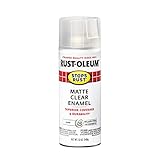
- Weather and corrosion resistant coating protects exterior/interior surfaces like wood, metal, concrete, masonry and more
- Oil-based formula provides a durable protective coating with excellent rust prevention
- Dries to touch in 2 to 4 hours and covers up to 15 sq. ft.
- Excellent resistance to abrasion, fading and chipping
- Flat finish minimizes surface imperfections
Best Filler Primer: Rust-Oleum vs Seymour
On deep layer lines, Seymour 20-1674 buries them more completely than Rust-Oleum 249279 does, and the real cost difference is much narrower than the “three times the price” line you’ll hear repeated. Finishing a helmet or a prop? Buy the Seymour. For everything else, Rust-Oleum remains the sensible default.
That’s the short version. The evidence is worth walking through, because almost nobody publishes this comparison.
Misfit Printing ran the two side by side under controlled conditions: identical Mario and Luigi models, printed on a Bambu Lab P1P at default settings, sprayed with no sanding at all. After one coat, Seymour covered better on the hard parts, specifically the eyes and nose. After two coats the gap was clear enough to see at a glance.
A second, unrelated source confirms the can is good to work with. Galactic Armory uses Seymour high-build filler primer in prop work and reports it’s sandable roughly thirty minutes after spraying, which is what makes a same-day workflow possible.
Be clear about what that second source does and doesn’t show. Galactic Armory never put Seymour against Rust-Oleum. The coverage advantage rests on one test, by one person. What you get from the second source is a working confirmation that the product performs in real prop making. Not a replication.
The price gap is smaller than you have been told
The usual line is that Seymour costs about three times as much as Rust-Oleum. I checked that against current US retail, and it doesn’t hold up.
The two cans aren’t the same size, which is where the claim goes wrong.
| Rust-Oleum 249279 | Seymour 20-1674 | |
|---|---|---|
| Net fill | 11 oz | 15 oz |
| Price (Aug 7, 2026) | $7.97 | $14.93 |
| Coverage | 10–12 sq ft | 18 sq ft |
| Cost per ounce | $0.72 | $1.00 |
| Coverage per dollar | 1.25–1.51 sq ft | ~1.21 sq ft |
Compare sticker prices and Seymour looks like it costs 1.87 times as much. Compare by volume and it’s 1.38 times. Compare by square feet of coverage per dollar, which is the number that actually decides what a project costs, and the premium lands somewhere between 4% and 25% depending on where Rust-Oleum falls in its own 10 to 12 sq ft range. Take the middle and you get roughly 15%.
Two caveats on that math, because it’s my calculation rather than a lab result. Both coverage figures are manufacturer claims, and the two companies don’t necessarily assume the same film thickness. The range matters more than the midpoint.
Even at the unfavourable end of it, the direction of the original claim holds and the multiplier doesn’t. For a single helmet or a set of props, the gap is small enough to ignore. Buy the Seymour.
The buying trap
Seymour sells a weld-through primer in packaging that looks very similar to the filler primer. The creator who ran the comparison above bought the wrong one by mistake.
Check for the word “Filler” and the model number 20-1674 before you pay.
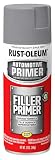
- Filler primer is suitable for use on wood, metal and fiberglass surfaces
- Oil based paint with Stops Rust formula provides rust resistant base coat for cars, trucks and other vehicles
- Covers up to 12 sq ft and dries to the touch (and can be recoated) in 10 minutes
- Filler spray paint fills minor surface imperfections with excellent rust resistance
- Flat finish can be covered with any topcoat with superior adhesion

- Specifically formulated to meet the performance needs of body shop personnel
- Minimizes the appearance of deep surface scratches on metal surfaces
- Dries fast to form a thick, sandable base coat in no time
- Large sprayhead gives a professional looking application
- Heat resistant up to 250˚F and VOC Compliant
What this test doesn’t prove
One comparison, two models, no sanding between coats, and a judgment made by eye. It’s a useful data point rather than a laboratory result. If you sand between coats, which most people should, the gap may well narrow.
Faster Routes: Airbrush Kits and Acrylic Markers
Two shortcuts beat a brush for specific jobs. An airbrush gives you even coats indoors year-round, which matters most in winter when rattle cans are unusable. Acrylic markers put color on a model in about twenty minutes, as long as it has been primed first.
Airbrush: the indoor option
The usual reason to buy an airbrush is finish quality. The underrated reason is weather. Rattle cans need ventilation you can’t get in a cold garage in January, and an airbrush lets you prime and paint indoors instead of waiting for spring.
For paint, the Createx 5801-00 primary set gives you six 2 oz bottles for about $25: four transparents plus opaque black and white. The pigment is ground finer than craft acrylic, which matters when you’re pushing it through a 0.3mm nozzle.
The set is all primaries, so flesh tones and metallics have to be mixed. A color mixing app helps more than you would expect.
- Even coats with no overspray drift
- Works indoors year-round
- Finer pigment, less nozzle clogging
- Real learning curve, plus cleaning after every session
- Primaries only, so mixing is mandatory
If you don’t own a compressor yet, an all-in-one starter kit is the cheapest way in. The Timbertech AS18-2K bundles a dual-action gravity-feed brush with a compressor and hose at around the price of two decent model paint sets. It won’t outlast a workshop-grade rig. For a few models a year, it doesn’t need to.
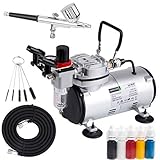
- Oil-less piston, maintenance free, portable, quiet (47db), Built-in carry handle. Perfect for nails paiting, temporary tattoos, cake decorating, craft…
- Air flow 20-23L/Min, Autostart(3Bar)-Autostop(4Bar)
- Regulator with gauge, water trap and air filter,Pressure relief safety valve, overheat protector
- Basic Double-Action Gravity Feed Airbrush with 0.30mm Nozzle/Needle,6ft air hose,mini filter, cleaning brush & 5*Paints
- Ideal for designers, modellers, artists, cake decorators, nail art and spray tanning (Please note: This Air Compressor is only fit for airbrush, not…
Acrylic markers: color in twenty minutes
Paint markers are the fastest way to get color onto a print. In the Designed In Layers test, a full model was colored in about twenty minutes.
The metallics are the standout. Over primer they cover almost like chrome, which isn’t what most people expect from a pen.
The limits are real, though. Without a base coat the color goes blotchy, and the brush tips lose their fine point after heavy use. Treat them as consumables for terrain, test pieces, and tabletop scenery rather than display models.
One naming trap: the brand is spelled Arrtx, which is easy to mishear as “Art X” and impossible to find under the wrong spelling.

- 【12 Vivid Metallic Colors】-Available in 12 subtle and dazzling metallic colors, our metallic pens are not only acrylic compared to regular…
- 【Safe Quality】-Non-toxic,odourless,eco-friendly and ready-to-go,these acrylic paint markers set bring your creations to life without the wait…
- 【Draw Everywhere】-Our acrylic paint markers paint pens can work well on variety of surfaces. such as rock painting, ceramic, glass, wood, fabric…
- 【Easy to use】-Say goodbye to the hassle of shaking your markers before each use. Our paint pens acrylic markers are designed to be ready-to-go…
- 【After Sales】-At Arrtx, we are dedicated to providing top-quality art supplies and services for art enthusiasts. We offer a one-year warranty and…
How Much Prep Do You Actually Need?
Budget somewhere under two hours for a helmet-sized print off a good machine, and stop well short of a mirror finish. A timed run put sanding and filling at 103.5 minutes; a separate test found that polishing to 5000 grit over three days made the surface look worse, not better. Both numbers are worth understanding, because they bracket the useful range. That two-hour budget is exactly what full-color printing wants to delete. We checked whether a $3,599 machine really deletes it.
On the encouraging side, Galactic Armory timed the job properly. Sanding and filling a Master Chief helmet to a paint-ready state took 103.5 minutes, with another 5.5 minutes for assembly. Under two hours, by hand, no power tools.
Read the conditions before you take that number home. The helmet came off a Bambu Lab X1 Carbon at 0.16mm layer height, the clock excluded setup, cleanup and drying, and the filling wasn’t just sandpaper: the run used SLA resin cured under UV to fill layer lines, plus Bondo for the flaws. The person holding the sandpaper is an experienced prop maker. The video never addresses how long the same job takes someone learning, which is its own kind of answer.
So treat 103.5 minutes as a floor, not a promise. A rougher print off a cheaper machine, sanded by someone learning, is a different afternoon entirely. The useful part of the number is that it kills the “six to twelve hours” figure that scares people off finishing altogether.
On the discouraging side, there’s such a thing as too much sanding. NuggetsInclusive polished a test piece all the way to 5000 grit over nearly three days. The result looked dingy and scratched, worse than a simple prime-and-paint job.
The goal isn’t to make the print smooth. The goal is to knock down the high points of the layer lines and let filler primer handle the rest.
A filler recipe worth stealing
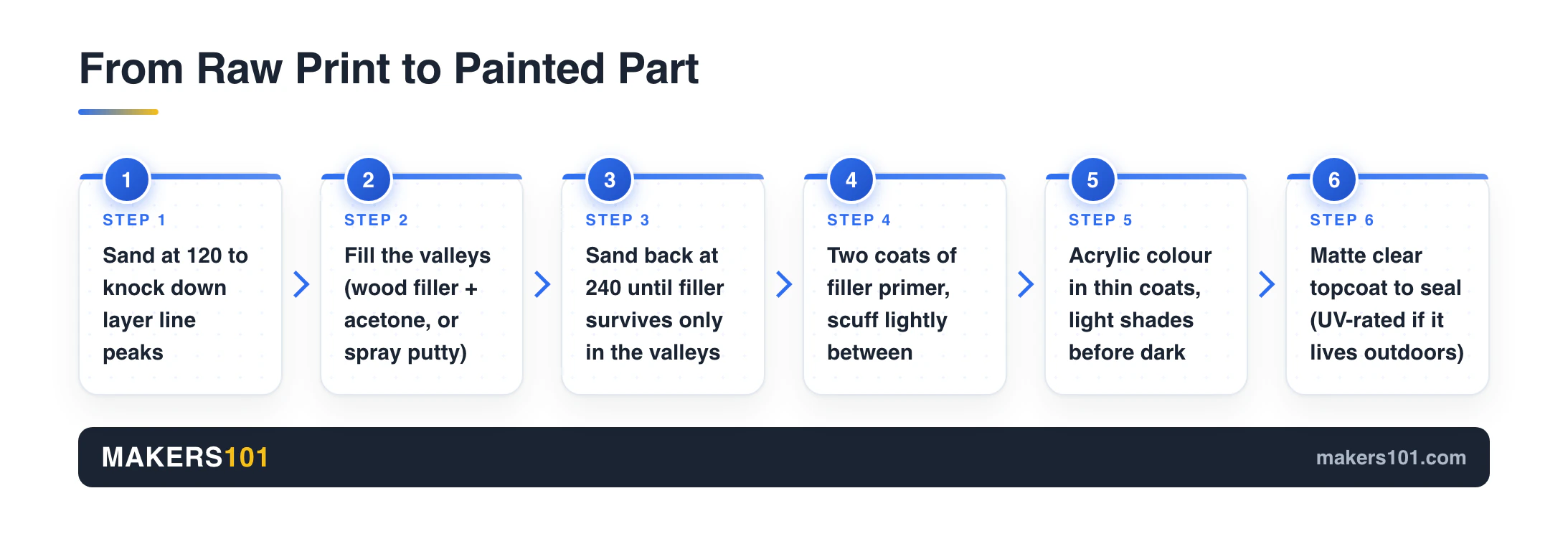
Emily Boe uses a mix that solves a real problem cheaply: DAP plastic wood filler thinned with acetone, roughly two parts filler to one part acetone, mixed to the consistency of melted ice cream.
The acetone does two jobs. It thins the filler enough to sink into the layer lines instead of sitting on top of them, and it speeds drying to under thirty minutes.
Brush it on across the layer lines rather than along them, then sand back until the filler survives only in the valleys.
On grit, Emily Boe’s helmet run is a workable template: 120 to knock down the layer line peaks before filling, then 240 to level the dried filler. Galactic Armory’s timed build ran wider, opening at 60 for the roughest areas and finishing with 600 and a wet-sanded final pass. Neither ladder chases a shine. Filler primer covers what 240 leaves behind, and going finer than 600 mostly buys you the dingy, over-polished result described above.
Save yourself the work upstream
Every minute of sanding is a decision you made in the slicer. Printing curved parts at a finer layer height costs print time and saves far more finishing time.
If your printer is stuck with a 0.4mm nozzle, there are settings that close some of that gap. We covered how to make a 0.4mm nozzle print closer to 0.2mm quality in a separate guide.
This is where my own printing habits changed. Looking at parts off my own Bambu machines, the gap between 0.2mm and 0.16mm barely registers in the slicer preview and is plain enough on the finished part if you hold it under a raking light. Grey primer is known to make that difference easier to see, because it strips out color and texture and leaves you looking at nothing but geometry. So I set layer height by what a part is destined for rather than by how it looks straight off the plate.
When You Should Not Buy Paint at All
If what you actually want is a clean surface rather than a specific color, paint may be the most expensive way to get there. Three cheaper routes are worth checking first.
Change the filament. Filled filaments hide layer lines on their own. In a ten-method comparison, PETG CF came out as the best performer for disguising layer lines with no post-processing at all. Picking the right PETG filament can do more for surface appearance than a coat of paint. Our filament picker can narrow the options if you’re unsure.
Smooth it chemically. Acetone vapor smoothing removes layer lines from ABS and ASA filament without sanding or filler. A five-hour session was enough to reach a perfect gloss rating in AzureFilm’s test. The trade-offs are that the finish comes out shiny, sharp details can blur together, and acetone vapor requires serious ventilation. For the wider choice between epoxy, solvents, primer, and material swaps, see our XTC-3D alternative guide. For PLA specifically, we also have a safer XTC-3D workflow that keeps the coating thin and paint-ready.
Change the model. Fuzzy skin and small geometric surface patterns distract the eye from layer lines. Stripes do the opposite and make them more obvious.
One myth to retire while we are here. Halving your print speed doesn’t meaningfully improve layer line visibility. It costs hours and buys almost nothing.
Mistakes That Ruin a 3D Print Paint Job
Ruined paint jobs almost never come from exotic errors. Six repeat offenders account for most of them.
- One thick coat instead of several thin ones. This is the most common cause of brush strokes and globs.
- Skipping primer. Bare filament absorbs acrylic and the color goes patchy.
- Sanding past the point of return. Polishing to a mirror grit can leave a dingy, scratched surface that looks worse than a primed one.
- Buying the wrong can. Weld-through primer and filler primer share a look on the shelf.
- Forgetting about assembly. Paint builds up in sockets and joints, and parts stop fitting. Scrape the mating surfaces clean with a hobby knife before you glue.
- Vapor smoothing a sharp-edged model. Chemical smoothing blurs crisp detail, so it suits organic shapes far better than mechanical ones.
A hairdryer is the most underrated tool in this list. It dries a layer between coats and shortens a long painting session considerably. It’s worth adding to the 3D printer accessories you keep within reach.
Frequently Asked Questions About Painting 3D Prints
What kind of paint do you use on 3D prints?
Acrylics on a primed surface handle almost every case. They’re water-based, dry quickly, and bond well to primed plastic. Enamels and spray cans work too, but they ask for more ventilation and a longer cure.
What paint to use on PLA 3D prints?
Ordinary hobby or craft acrylics, once the part has been primed. PLA takes color well after that step. Steer clear of oil-based products, which can attack the plastic itself.
Will paint stick to PLA without primer?
Poorly. Bare PLA absorbs acrylic unevenly, which produces a patchy finish. A marker test on primed versus unprimed PLA showed near-chrome coverage on the primed piece and blotchy color on the bare one.
Can you paint directly on PLA filament?
You can, but the result will be uneven and will chip more easily. It’s only reasonable for rough prototypes or surfaces that will be hidden after assembly.
Does acrylic paint stay on 3D prints?
Yes, provided the surface is primed first and sealed afterwards. Acrylic bonds reliably to a primed shell, and a clear topcoat then shields the color from handling and sunlight.
Does spray paint work on 3D prints?
Yes, and it gives more even coverage than a brush. The rule is several thin coats rather than one heavy pass, because a heavy coat pools in the layer lines and undoes your surface prep.
What to spray on 3D prints before painting?
Use a sandable filler primer. It grips the plastic and levels the surface at the same time, which a plain adhesion primer won’t do. Start with two coats and scuff lightly between them.
What type of spray paint is waterproof and suitable for 3D prints?
No spray paint is waterproof on its own. Water and UV resistance come from the topcoat, so use an acrylic or enamel color coat sealed with a clear coat rated for UV resistance. This matters most for resin prints, which become brittle in sunlight regardless of paint. Paint won’t seal a container either. We break down what actually stops a print leaking.