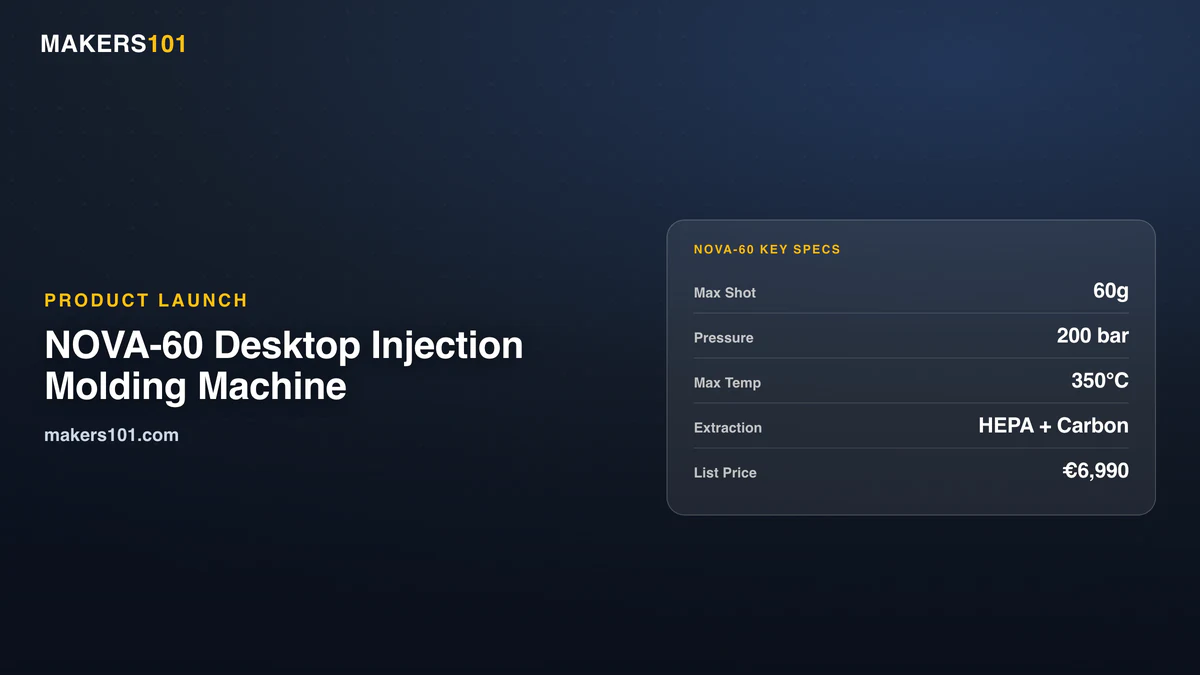

- The NOVA-60 desktop injection molding machine is what Austrian manufacturer plasticpreneur launched on September 15, 2026, under its Polyverse Solutions brand. It’s built around a Universal Mould System that takes either 3D-printed or machined aluminum mold inserts, letting R&D teams injection-mold real parts from a prototype without commissioning a steel production mold.
- Deliveries actually started back in April 2026, across seven-plus European countries, with customers including Prusa Research.
- Core numbers: 60g max shot, 200 bar injection pressure, a manual handwheel that needs no electricity to build pressure, 350°C max temperature, and built-in activated-carbon plus HEPA fume extraction.
- List price sits just under €7,000, excluding tax and shipping. This is a lab validation tool, not a production press.
You’ve printed the prototype. It looks right, it fits right, and you still don’t know if it’ll survive the real world.
That gap between a 3D-printed part and an actual injection-molded one is where a lot of product development stalls. You either spend weeks and thousands of dollars on a steel mold to find out, or you guess.
The NOVA-60 desktop injection molding machine, launched by Austrian manufacturer plasticpreneur on September 15, 2026, is built to close that gap without the steel mold. You start from a mold insert, either printed or machined, drop it into the machine, and shoot real polymer through it on your own bench. Here’s what it does, and who it’s actually for.
Table of Contents
- What Happened: NOVA-60 Launches With 3D-Printed Mold Support
- NOVA-60 Desktop Injection Molding Machine Specs: Shot Size, Pressure, and Price
- Why It Matters: 3D Printing Still Can’t Match an Injection-Molded Part
- My Take: Who NOVA-60 Actually Makes Sense For
- What’s Next for Polyverse Solutions
- Frequently Asked Questions About the NOVA-60
What Happened: NOVA-60 Launches With 3D-Printed Mold Support
plasticpreneur announced the NOVA-60 in mid-September 2026, positioning it as part of its Polyverse Solutions lineup. Its core piece is the Universal Mould System: the same platform accepts either 3D-printed mold inserts or machined aluminum ones, so you’re not locked into one tooling method.
The steps are simple: print or machine a mold insert, set it in the NOVA-60, and inject your target polymer. You get a part made by the actual injection process early in development, instead of guessing from a 3D-printed stand-in.
If a 3D-printed insert doesn’t hold up, you swap in a machined aluminum one on the same platform. No new molding station required.
The September announcement isn’t really when this started. Deliveries began back in April 2026, and the NOVA-60 has already been running in more than seven European countries. Customers so far include corporate R&D departments, mid-sized manufacturers, and Prusa Research, the 3D printer maker.
plasticpreneur itself isn’t new to this. The company, based in Klagenfurt, Austria, has been building small-scale plastics processing and recycling machines for more than seven years, and says it has delivered over 1,000 machines to 110-plus countries.
NOVA-60 Desktop Injection Molding Machine Specs: Shot Size, Pressure, and Price
Three numbers matter most if you’re sizing this machine up: a 60g maximum shot, 200 bar of injection pressure, and a €6,990 list price before tax and shipping.
| Spec | Value |
|---|---|
| Max shot volume | 60g |
| Injection pressure | Up to 200 bar |
| Pressure mechanism | Manual handwheel + rack-and-pinion (no electricity needed) |
| Max temperature | 350°C |
| Footprint / weight | ~58 x 40 x 100cm / ~50kg |
| Cycle rate | ~7 cycles/hour, ~0.5kg/h output |
| Fume extraction | Activated carbon + HEPA |
| List price | €6,990 (excl. tax/shipping) |
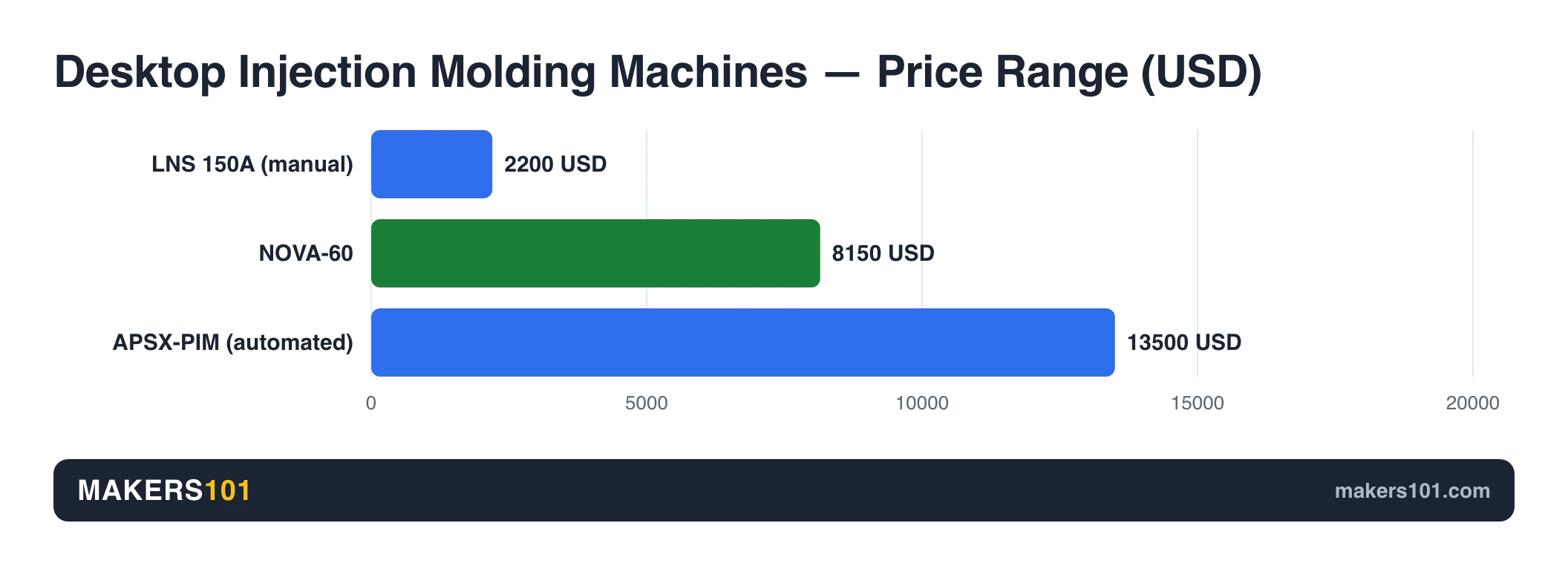
That figure comes straight from plasticpreneur’s own spec sheet. All3DP’s roundup of desktop injection machines lists the NOVA-60 at roughly $8,150, which lines up once you account for the currency conversion and the fact that the euro price excludes tax and shipping. Same machine, two ways of quoting it.
For context, the desktop and benchtop injection molding category All3DP tracked runs from about $2,200 for the manual LNS Technologies Model 150A up to $13,500 for the automated APSX-PIM. The NOVA-60 sits toward the middle: priced above the cheapest manual machines, well under the automated ones.
If the upfront number is the sticking point for you, plasticpreneur also offers leasing from €108 a month.
Why It Matters: 3D Printing Still Can’t Match an Injection-Molded Part
3D-printed prototypes are still measurably weaker than injection-molded parts, and the industry has spent the last two years attacking that gap from two directions: fixing the material, or fixing the mold. NOVA-60 is built around the second one.
One approach fixes the material. Formlabs released its Tough 1500 Resin V2 in March 2025, tuned to match the toughness and durability of injection-molded polypropylene. The company claims ten times the fracture toughness and three times the impact strength of the previous version. (Formlabs’ printers use SLA resin printing, curing liquid photopolymer layer by layer. An FDM printer melts filament instead.)
Numbers like that are hard to picture. In independent bend tests on an earlier generation of Formlabs Tough resin, printed samples survived repeated flexing that snapped a standard printed ABS-like resin outright, and a printed part dropped from a foot in an egg-drop test came away intact. The tradeoff was slower curing, six to eight seconds per layer, plus lower dimensional precision and supports that were harder to remove. Toughness costs you something else.
The other approach fixes the mold instead. Axtra3D showed off ceramic-filled 3D-printed mold inserts in 2024 that can be produced in about a day and hold up for hundreds to over a thousand injection cycles. That’s the idea behind the NOVA-60’s Universal Mould System too: skip the steel tooling, print the insert, and find out if your design works before you commit to a production mold.
Avoiding that steel tooling in the first place comes down to volume. A traditional injection mold only pays for itself once you’re making thousands of units, and CNC-machining a comparable mold insert typically costs three to five times more than printing one. Machines like the NOVA-60 trade that economy-of-scale math for something closer to economy of scope. You can afford to try a design in real plastic even when you’re only making a handful of parts.
There’s an expectations gap here too, alongside the technology one. On r/InjectionMolding, practitioners shopping in the sub-$3,000 range get told, bluntly, that they’re shopping in toy territory. One process engineer put a realistic price on a functional press with an ejection system at around $25,000. The NOVA-60’s positioning, industrial-grade pressure and temperature at a fraction of that cost, is a direct answer to that gap, even if it doesn’t fully close it.
The same thread raised a real safety point unprompted: several plastics off-gas toxic compounds, including hydrogen cyanide and formaldehyde, when they’re overheated. That’s exactly what the NOVA-60’s built-in activated-carbon and HEPA extraction system is there to handle. On a machine meant to sit on an office bench, that’s a real requirement.
There’s a use case beyond prototyping, too. FDM-printed parts can’t get FDA food-contact certification on their own: layer gaps trap bacteria, brass nozzles can leach lead, and the printed surface itself stays porous.
Printing the mold and then injection-molding the final part sidesteps that problem. Certification looks at the finished object, and that object came out of a real injection mold. That makes a machine like the NOVA-60 relevant well beyond general R&D, especially for teams developing food-contact prototypes.
My Take: Who NOVA-60 Actually Makes Sense For
I’d put the NOVA-60 in the validation category. It’s the machine you reach for to prove a design works in real plastic ahead of any production commitment.
Part of that comes down to the printed mold insert itself. The same shrinkage and warping that make FDM parts hard to hold to tight tolerances don’t disappear just because you’re using the print as a mold instead of a final part. Swap materials or colors on the same file and the fit can shift. That’s the technical reason behind plasticpreneur’s own caution that printed inserts suit validation better than volume production.
The handwheel is also worth sitting with. Building 200 bar by hand means someone stands at the machine for every shot. That’s fine in a lab, running a few dozen test parts with notes between them. It’s a different story on a factory floor where cycle time is the whole point.
Where I’d actually point someone: a small team already selling 3D-printed parts commercially and starting to bump into what 3D printing can’t do, whether that’s part strength, surface finish, or getting to the same plastic customers expect from a mass-produced product.
If you’re picturing thousands of units a month, this isn’t that machine, and plasticpreneur isn’t marketing it as one. Treat that price tag as the cost of finding out whether your design deserves a real mold. It isn’t a shortcut around buying one.
Before you request a quote, get clear on three things:
- Shot size: does your part fit inside 60g of material, including the runner?
- Cycle count: how many test shots do you actually need to validate a design (dozens, not thousands)?
- Tooling path: can you print a mold insert in-house, or will you need a machined aluminum one from day one?
What’s Next for Polyverse Solutions
Polyverse Solutions already sells a second machine alongside the NOVA-60: the VORTEX-90 desktop granulator, which grinds plastic scrap back into reusable feedstock. It’s a live product on the company’s site today, not a future promise.
According to plasticpreneur’s stated roadmap, a mold temperature control unit and additional Universal Mould sizes are still to come, though the company hasn’t given a firm timeline for either.
The bigger goal, according to the company, is a compact R&D setup that covers everything from material prep to molding to final validation, without shipping a part out to a toolmaker at any step.
Frequently Asked Questions About the NOVA-60
What is the NOVA-60 desktop injection molding machine?
It’s a compact injection molding machine from Austrian manufacturer plasticpreneur, sold under the Polyverse Solutions brand. It brings real injection pressure and temperature onto an R&D bench, using mold tooling that can be either printed or machined.
How much does the NOVA-60 cost?
plasticpreneur lists it at €6,990 excluding tax and shipping, roughly $8,150 by independent estimates. Leasing is available from €108 a month.
Can you use 3D-printed molds in the NOVA-60?
Yes. That’s the machine’s core feature. The Universal Mould System accepts 3D-printed inserts directly, and you can switch to a machined aluminum insert on the same platform if the printed one doesn’t hold up.
Is the NOVA-60 meant for production, or just prototyping?
Prototyping and validation. The manual handwheel pressure system and the printed mold’s own wear limits make it better suited to validating a design than to running a production batch.