
Researchers at MIT, Northeastern University and Utrecht University have developed scale-rich metamaterials that spread deformation through irregular networks of supporting beams. Their open-access Nature paper, published on November 11, 2026, combines mechanical tests with simulations to show how these networks can absorb energy while limiting concentrated damage.
The centimetre-scale test pieces came from a Phrozen Sonic Mini 8K desktop resin printer. For makers, the useful detail is how the geometry changes the printed part’s behaviour. The study gives a close look at fabrication and testing with commercially available resins, alongside more specialised work that sits beyond a desktop setup.
How scale-rich metamaterials grow their structure
The design starts with a beam growing from a random position and angle until it meets another beam or the boundary. More beams follow. Two parameters control the starting thickness and how quickly thickness decreases as the network grows, producing a structure with widely varying beam lengths, thicknesses and connections.
Those beams are called ligaments in the paper. Their arrangement replaces the repeated cell found in a conventional square lattice or honeycomb. Changing the growth parameters gives the researchers control over density and how strongly stiffness depends on loading direction.
The main compression and impact specimens began as two-dimensional networks. The team added a uniform thickness to make solid printable parts, choosing that thickness to suppress out-of-plane deformation and approximate plane-strain behaviour. Extensions into three-dimensional plate and beam networks appear in the modelling and outlook; they aren’t the main specimens used in those mechanical tests.
How the resin specimens were printed and tested
The centimetre-scale pieces were made by vat photopolymerization, with a layer height of 0.025 mm and the manufacturer’s recommended exposure settings. If you’re used to filament printing, how a resin printer cures each layer explains the process behind these samples.
Resin choice depended on the experiment. The nonlinear compression and impact specimens used Anycubic Tough Resin 2.0 for its high elongation to break. Linear-elastic testing used Formlabs Clear v4, selected because its stiffer, more brittle response made the elastic properties easier to extract. That split matters when interpreting the results: the tests served different purposes and used different resins.
After printing, the researchers washed the parts in isopropyl alcohol and let them air-dry. How to clean resin prints covers a typical desktop IPA wash; the paper itself only records that solvent wash and air-drying. They stored the dried specimens away from ambient ultraviolet light and tested them 72 hours after printing. Integrated top and bottom plates, each 5% of the architecture’s height, helped make the tests repeatable.
The desktop process had a feature resolution of about 100 μm. Lower-density, micrometre-scale examples were fabricated separately with two-photon lithography, reaching submicrometre features. These were separate fabrication routes and sample scales. A desktop resin machine can’t reproduce the two-photon examples simply by using the same geometry.
Slow compression tests used an Instron 5500 load frame. For impact testing, an Instron Dynatup drop tower released a 6.2 kg impactor from 0.8020 m above the specimen, reaching approximately 4 m/s at contact. A high-speed camera recorded the response at 9,000 Hz. Those conditions define the impact evidence; they don’t establish performance in a wearable product.
What changed under compression and impact
In large-deformation compression, the square, hexagonal and Voronoi reference structures developed concentrated collapse patterns, including buckling layers or compaction bands. The scale-rich specimens distributed deformation more broadly. Their energy absorption, calculated from the stress-strain response up to 40% engineering strain, could match or exceed those three reference architectures.
The drop tests also favoured the network designs within the comparison set. They combined lower peak force with higher energy dissipation per unit mass than the reference structures tested, with force-time curves closer to a steady plateau. The comparison included ordered lattices and disordered networks. It doesn’t establish superiority over commercial helmet liners or untested metal lattices.
Stiffness was tunable too. At 40% relative density, the ratio of minimum to maximum Young’s modulus ranged from 0.12 to 0.88 across the scale-rich design space. A ratio closer to one means stiffness varies less with direction. This gives a concrete example of how much directional response the geometry can change at a fixed density.
A separate protective structure, inspired by the radial density gradient in Citrus maxima (pomelo), surrounded a fragile disc. Photoelastic experiments showed fewer stress fringes inside the PMMA payload than in equal-density square and hexagonal references. Nonlinear simulations quantified the benefit: at the same macroscopic strain, average von Mises stress in the protected payload was lower by up to about 4.9× relative to the reference geometries. That number describes simulated payload stress under the stated comparison.
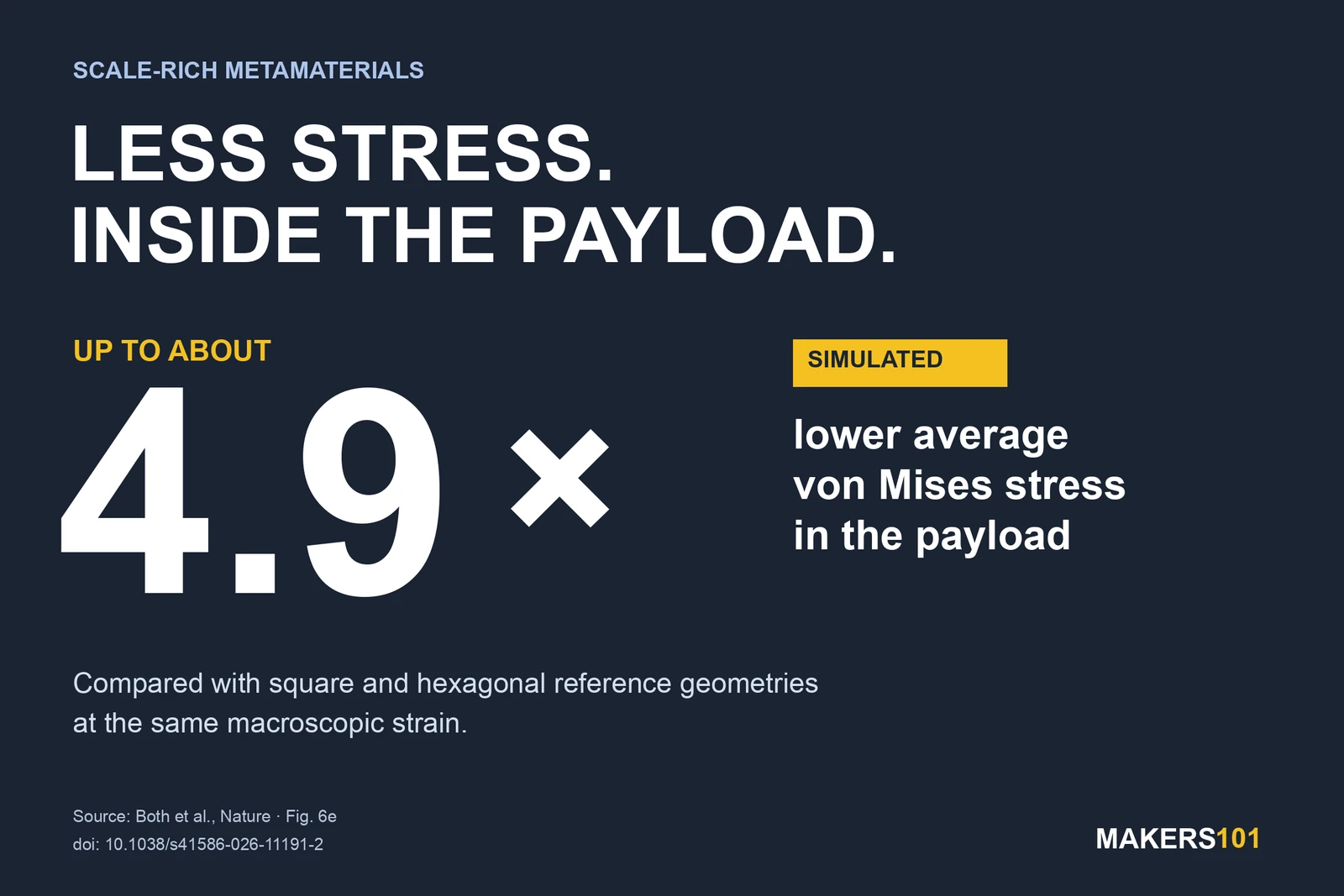
Source: Both et al., Nature, Fig. 6e. Original Makers101 typographic graphic.
The wave-control result has a different evidence boundary. A Luneburg-like lens assembled virtually from scale-rich cells focused elastic waves in steady-state finite-element simulations. The paper doesn’t report a printed lens validated by physical wave measurements.
What makers can explore now
The authors’ public code repository provides a way to examine the geometry-generation process. Its README describes a notebook, 2D_SR_samples.ipynb, that generates samples and exports watertight STL files. We haven’t run that notebook or checked its output against the paper’s impact specimens. The export description remains an unverified repository claim.
Helmets and armour remain prospective applications in the MIT News announcement. The simulated lens likewise points toward possible wave-control applications. These results don’t provide a tested protective-equipment design for home printing.
For a maker exploring the code, the first useful step is to inspect how the generated network becomes a solid mesh. An STL export alone doesn’t verify printability or mechanical performance. Reproducing a particular specimen would also require matching its geometry and fabrication conditions to the published Methods before comparing test results.