
Heads up — some of the links below are affiliate links. If you buy through them, I earn a small commission (at no extra cost to you), which helps cover the gear I test. Thanks!
- Anker’s eufyMake previewed a new eufyMake fabric printer at IFA 2026 Berlin on September 4, 2026. It combines direct-to-garment (DTG) and direct-to-film (DTF) printing for T-shirts, hoodies, and tote bags, and it’s not shipping until Q1 2027, with no model name, price, or spec sheet confirmed yet.
- eufyMake E1 owners get three free upgrades from the same announcement: faster bidirectional printing, a Roll-to-Film attachment (late September), and a bigger ink supply system (Q4 2026).
- This is the second time Anker has entered a new print category on the back of a record-breaking Kickstarter. The first one, AnkerMake, got discontinued in July 2025.
- Desktop DTF printing already exists, and its pricing is public. xTool’s Apparel Printer gives you a solid guess at where eufyMake will land (see the table below).
You’ve probably already seen the headline. Every outlet that covered the IFA preview stopped at the announcement. None of them checked what happened to AnkerMake’s last printer, or noticed eufyMake got here the same way twice: a record-breaking Kickstarter.
Table of Contents
- At a Glance: eufyMake Fabric Printer vs eufyMake E1 vs xTool Apparel Printer
- What Happened at IFA 2026: eufyMake’s Fabric Printer Preview
- eufyMake E1’s Free Upgrades Announced Alongside the Fabric Printer
- From a $8.8M Kickstarter to a $46.76M Kickstarter: Anker’s Pattern
- Why AnkerMake’s 3D Printers Were Discontinued in 2025
- What Desktop DTF Printing Actually Costs: The xTool Apparel Printer Reality Check
- My Take: Anker Didn’t Choose This Pivot, the Market Did
- What’s Next for the eufyMake Fabric Printer
- FAQ: eufyMake Fabric Printer
At a Glance: eufyMake Fabric Printer vs eufyMake E1 vs xTool Apparel Printer
Right now, the only desktop machine you can actually buy for T-shirts and tote bags is the xTool Apparel Printer. eufyMake has one printer on sale (the E1), and it’s the wrong tool for fabric.
| eufyMake Fabric Printer | eufyMake E1 | xTool Apparel Printer | |
|---|---|---|---|
| Status | Previewed 2026-09-04, co-creation beta | On sale | On sale |
| Price | Not announced | $2,409–$3,209 | ~$8,000 (vs. ~$4,000 for a Procolored F13 Panda) |
| Technology | DTG + DTF, combinable | UV flatbed | DTF, all-in-one |
| Best fit | T-shirts, hoodies, tote bags, hats, denim | Hard and semi-hard surfaces | T-shirts, hoodies, tote bags |
Prices as of 2026-09-19, pulled from eufyMake’s IFA preview page and the xTool comparisons in the “what it actually costs” section below.
What Happened at IFA 2026: eufyMake’s Fabric Printer Preview
The eufyMake fabric printer exists only as a preview so far. Anker’s eufyMake brand showed it off at its IFA Berlin booth on September 4, 2026, and opened a co-creation program to refine it before launch.
The machine does two things. Direct-to-garment (DTG) prints straight onto the fabric for a soft, breathable finish. Direct-to-film (DTF) prints onto a transfer film first, which works across more material types and supports specialty effects. You can combine both on the same garment.
eufyMake says it holds color consistency across light and dark fabrics, which has historically been DTG’s weak spot. Full-color DTG designs can also pair with single-color embroidery, so you can get a more detailed embroidered look without buying a multi-color embroidery machine. An “intelligent cleaning algorithm” is supposed to cut down on maintenance and white-ink clogs, a problem you’ll see come up again later in this article.
None of that comes with a ship date better than “Q1 2027.” No model name, no price, no spec sheet.
Bambu Lab is reportedly circling this same UV and inkjet printing space right now, years after Anker got there first. If you want the full timeline on that, see how Bambu Lab’s own UV printer ambitions stack up.
eufyMake E1’s Free Upgrades Announced Alongside the Fabric Printer
Current E1 owners don’t have to wait until 2027 for anything. eufyMake gave them three free upgrades in the same announcement.
Three upgrades came out of the same event. Bidirectional printing doubles print speed with no new hardware required. A Roll-to-Film attachment ships in late September 2026 for longer, batch-style printing.
A high-capacity continuous ink supply system follows in Q4 2026. All three roll out automatically at no cost to current owners.
The E1 itself currently sells for $2,409 (Basic Bundle) or $3,209 (Deluxe Bundle, which adds a rotary attachment and laminator).
From a $8.8M Kickstarter to a $46.76M Kickstarter: Anker’s Pattern
This isn’t the first time a record-setting Kickstarter has carried Anker into a brand-new printing category. It’s the second one.
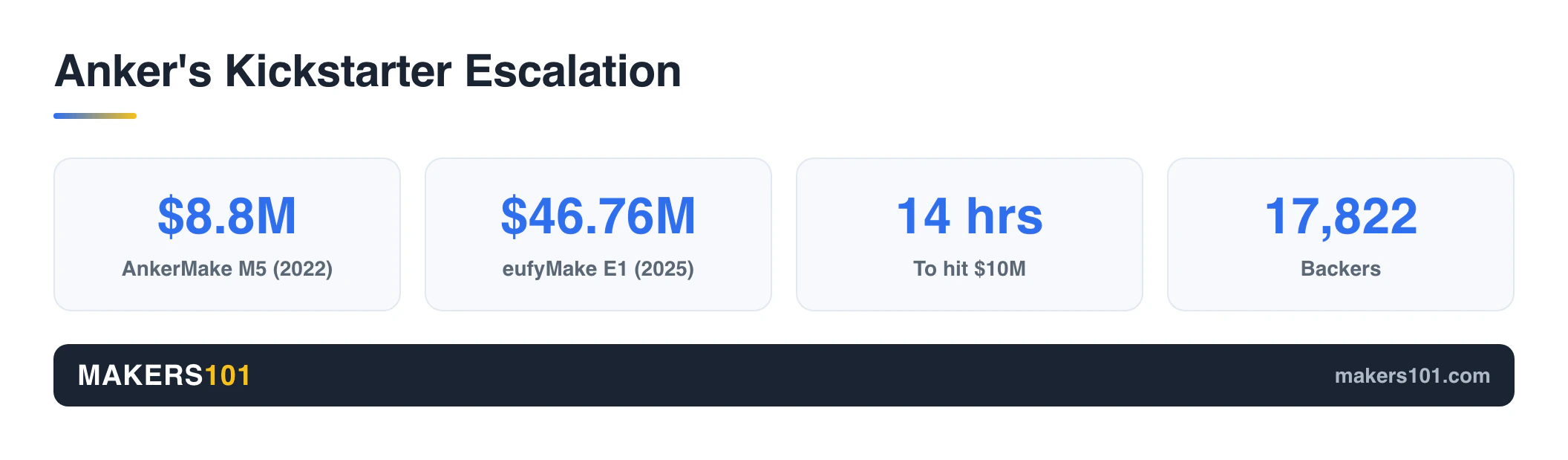
AnkerMake launched its first 3D printer, the M5, in 2022 with an $8.8 million Kickstarter, a launch that briefly put Anker in direct competition with Bambu Lab. Three years later, that war was over, and Anker had lost it.
In its place came eufyMake. The E1 UV printer launched on Kickstarter on April 29, 2025, and crossed $10 million in 14 hours. By June 24, it had broken the record for the most-funded project in Kickstarter history, beating the previous record of $41.7 million. It closed at $46,762,258 from 17,822 backers.
Two new print categories, two crowdfunding blitzes, two records chased. Make of that what you will.
Why AnkerMake’s 3D Printers Were Discontinued in 2025
AnkerMake’s 3D printer line stopped in July 2025, with no graceful send-off.
Anker spokesperson Brett White confirmed to The Verge that the AnkerMake M5 and M5C were discontinued, as SlashGear reported. The official reason was supply chain problems with critical components. White also said eufyMake “hasn’t ruled out” new 3D printers down the line, but gave no timeline.
EufyMake had already been set up as a separate brand before the 3D printer line was paused, and it hadn’t launched a single 3D printer under that new brand. Most coverage of the shutdown missed that detail. UV printing looks less like a pivot Anker backed into and more like it was already the plan.
Line up the dates and the timing gets interesting. The E1 Kickstarter broke its funding record in June 2025. Anker confirmed the M5C was dead a month later. One month apart.
What Desktop DTF Printing Actually Costs: The xTool Apparel Printer Reality Check
eufyMake hasn’t priced its fabric printer yet, but you don’t have to guess blind. A competing machine already shipped, and its owners have been posting real numbers for over a year.
xTool’s Apparel Printer, a dedicated DTF all-in-one, launched via its own crowdfunding campaign in 2025 and raised over $1 million before it ever hit retail. A full bundle runs about $8,000, well above a comparable Procolored F13 Panda setup at roughly $4,000.

- Comprehensive System Protection & Safety: Designed to support consistent operation and protect your investment, this xTool Apparel Printer Plus Bundle…
- One-Click Automated Workflow: Simplify the entire printing process with the Print-to-Bake system that automates printing, cutting, powdering, and…
- Industry-First Built-in Humidification – Smarter Environmental Control: The built-in humidifier automatically activates as needed to maintain an…
- Upgraded White-Ink Circulation – HydraFlow Damper & Wet Capping: The HydraFlow Damper replaces four narrow ink channels with a single wide channel…
- Pro-Grade HD Print Quality: Achieve vibrant, detailed prints with dual I1600 printheads and 720×1800 DPI resolution. The G7-certified color accuracy…
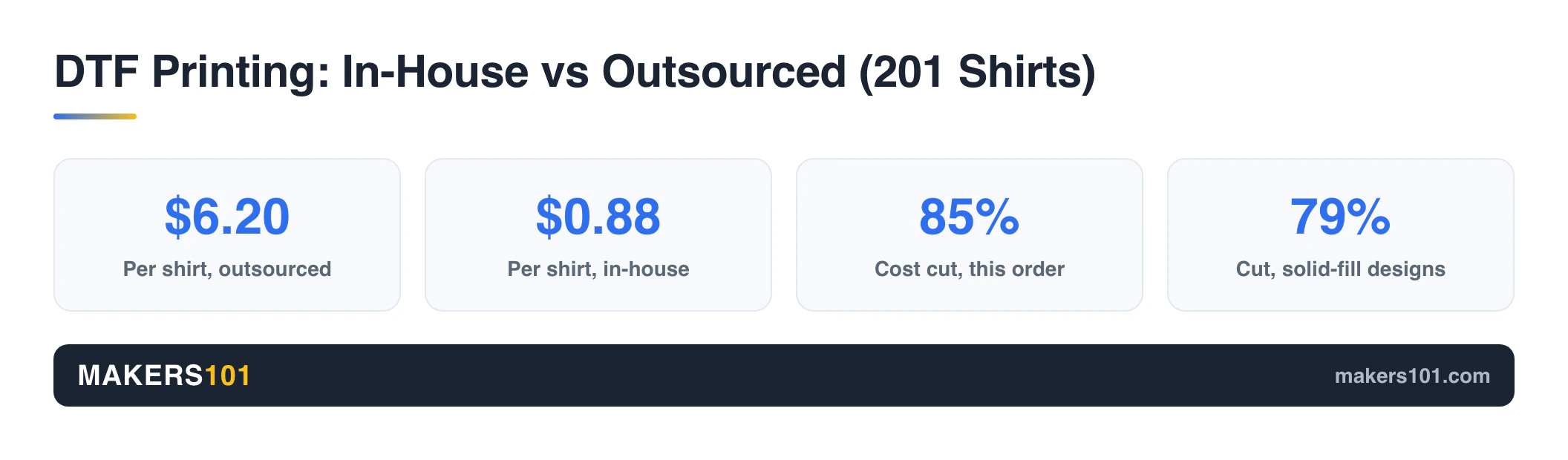
The economics behind that price are where it gets useful. One creator tracked an order of 201 shirts: $1,246.13 outsourced to a transfer company, working out to $6.20 a shirt. Printing the same transfers in-house cost $176.62, or $0.88 a shirt. That’s an 85% cut, and even ink-heavy solid-fill designs still saved 79%.
The trade-offs are real too. DTF powder releases volatile organic compounds when heated, so open-bin machines need a respirator and proper ventilation. Leave a DTF printer unplugged for too long and the print head clogs; one owner had to replace theirs after doing exactly that.
Print heads themselves usually carry a one-month warranty, extendable to six with training, against a 12-month warranty on the machine body. Budget for the ink and the print head as ongoing costs, on top of the sticker price.
White-ink clogging is the specific failure mode competitors solve with 24/7 automated ink circulation that runs continuously in the background. That’s the same problem eufyMake’s “intelligent cleaning algorithm” is pitched to solve on the fabric printer. Whether it holds up hour after hour the way shipped machines already do is a claim worth testing once units are actually in hands.
None of this tells you what eufyMake will charge. It tells you what the category actually costs to run once the marketing copy is gone.
My Take: Anker Didn’t Choose This Pivot, the Market Did
I don’t think Anker sat down and strategized its way from 3D printers to UV printers to fabric printers. I think the market did that for it.
Look at the calendar again. The E1’s Kickstarter broke a funding record in June 2025. The M5C’s discontinuation became public a month later.
Reading that as a clean, deliberate pivot gives Anker more credit for foresight than the timing supports. It looks more like a company running two bets at once, watching one get crushed by Bambu Lab while the other became the biggest Kickstarter in the platform’s history, and following the money.
What Anker is actually good at isn’t building the best 3D printer. Two crowdfunding records in two different categories say the real skill is telling a personalization story that gets people to pre-pay. The fabric printer is the third swing at that same pitch.
The economics back that up. Independent tests of desktop UV printers, a different but related personalization category, have shown coasters costing under a dollar to produce sitting next to $8 print-on-demand listings for the same item, a margin gap that has nothing to do with 3D printing and everything to do with owning the hardware yourself. Anker isn’t really selling machines. It’s selling that margin, three times now.
You won’t find this angle in the day-one coverage. PetaPixel, Digital Trends, and The Verge reported what Anker announced. None of them went back and lined up the AnkerMake shutdown against the E1’s funding record.
What’s Next for the eufyMake Fabric Printer
Between now and Q1 2027, there are exactly two things worth watching: the model name and the price. Everything else, like co-creation feedback or feature tweaks, is refinement around those two unknowns.
Once either one leaks, treat it as a hard reset on everything in this article. Product previews age fast, and a confirmed price or spec sheet supersedes speculation immediately.
FAQ: eufyMake Fabric Printer
Can eufyMake print on fabric?
The E1 struggles with it. eufyMake’s current printer is a UV flatbed machine built for hard and semi-hard surfaces. The dedicated fabric printer previewed at IFA 2026 targets DTG and DTF work on soft goods like T-shirts and hoodies specifically, but it isn’t shipping until Q1 2027.
How much does an eufyMake printer cost?
The eufyMake E1 costs $2,409 for the Basic Bundle or $3,209 for the Deluxe Bundle, as of September 19, 2026. The eufyMake fabric printer doesn’t have a price yet. Comparable desktop DTF machines range from about $4,000 to about $8,000, so that’s a reasonable guess, nothing more.
What printer is best for printing on fabric?
Right now, the xTool Apparel Printer is the most complete option you can actually buy. It automates DTF printing from powder application through curing in one machine, for about $8,000. eufyMake’s fabric printer may end up competitive once it ships, but it isn’t purchasable until 2027 at the earliest.
What is the best machine to print directly on fabric at home?
True DTG is thinner on the ground than DTF. xTool’s Apparel Printer, the most complete shipping option today, is DTF-only, not DTG, so it’s a strong choice for transfers but not for printing straight onto the fabric itself. If soft, breathable prints on cotton or blends matter most to you, eufyMake’s fabric printer is aiming at exactly that combination, but it won’t ship until 2027.