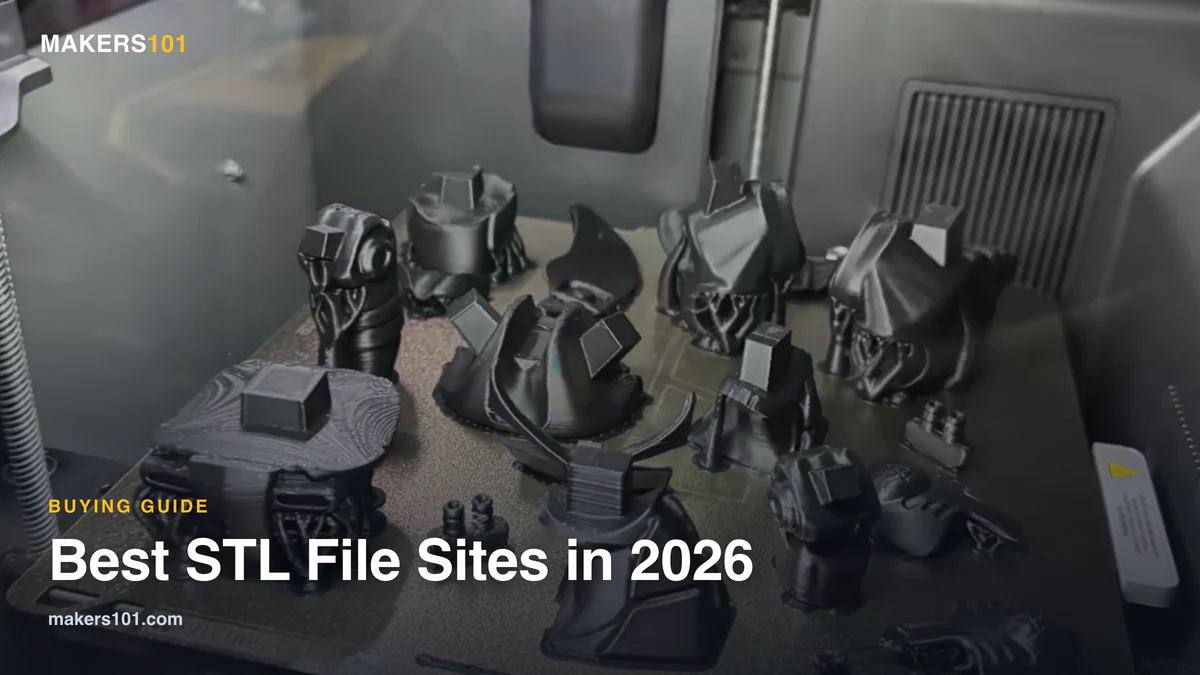

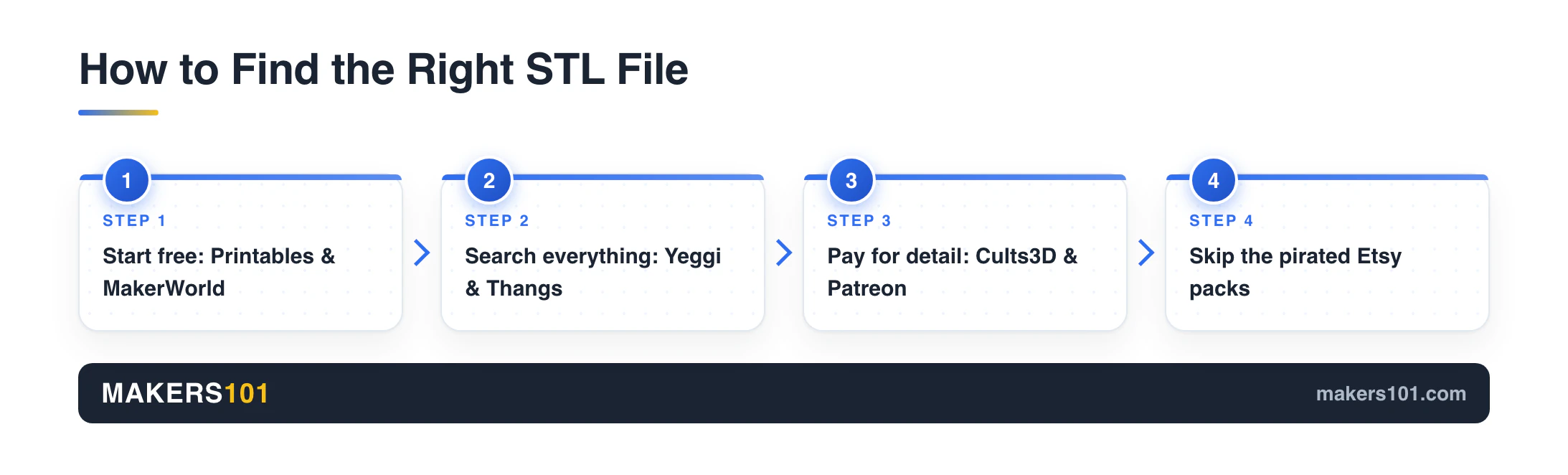
- Best free, hands down: Printables and MakerWorld. Big libraries, real quality, active creators.
- Best old reliable: Thingiverse. Still huge, still 100% free, just dated.
- Best for collectibles and minis: Cults3D, MyMiniFactory, and Patreon creators. You pay, but the quality is real.
- Fastest way to search everything: aggregators like Yeggi, Thangs, and 3dsearch hit dozens of sites at once.
- One rule to remember: free sites are great for functional parts and widgets. Paid sites are where the display-grade detail lives. Skip the cheap STL “packs” on Etsy. They’re almost always pirated.
You scroll past a flexi dragon on TikTok. A perfect little articulated Pokemon. A Baby Yoda that looks store-bought. And you think: I want to print that. Then you go looking, and every link points to a paid subscription that locks the file behind a monthly fee.
So where do people actually get these files? And which of the best STL file sites are worth your time?
Here’s the honest version. Some great models are free. Some are worth paying for. And a surprising number of “cheap” files are stolen and resold. This guide sorts the whole mess into three layers: free libraries, search engines that scan everything at once, and paid sites for the display-grade stuff. By the end, you’ll know exactly where to click for whatever you’re trying to print.
What Counts as the “Best” STL Site?
“Best” isn’t one thing. A site that’s perfect for a quick phone stand is useless for a museum-grade bust. So before the list, here’s what actually separates a good repository from a frustrating one.
Five things matter:
- Model quality. Is the geometry clean and print-ready, or a low-poly mess?
- Licensing. Can you just print it, or can you legally sell the prints too?
- Search. A million models mean nothing if you can’t find the one you want.
- Community. Active creators mean fresh models and bug fixes. Dead sites rot.
- Safety. Is the file legit, or pirated from someone who never got paid?
Keep one idea in your head as you read. Free versus paid isn’t good versus bad. It’s a split by purpose. Free sites win for functional parts. Paid sites win for detail you’d put on a shelf.
STL Sites at a Glance
Here’s the whole field in one place. Skim it, then jump to the section that fits you.
| Site | Free or Paid | Best for |
|---|---|---|
| Printables | Free | High-quality models, contests, all-around use |
| MakerWorld | Free | Bambu users, AI tools, rewards for uploading |
| Thingiverse | Free | The biggest free archive, functional parts |
| MyMiniFactory | Free + Paid | Tabletop minis, curated and tested files |
| GrabCAD | Free | Engineering parts, jigs, CAD source files |
| Cults3D | Paid | Display-grade collectibles, supporting artists |
| CGTrader | Paid | Professional models across many fields |
| Yeggi / Thangs | Free (search) | Searching every site at once |
| Patreon creators | Paid | Themed collections, monthly model drops |
Best Free STL Sites
If you’re just starting out, you can go a long way without spending a cent. Free sites are loaded with functional parts, cosplay props, and clever little organizers you didn’t know you needed. The catch? A lot of free models are made by beginners. They can be low-poly and rough. For everyday printing, that’s totally fine. Here are the ones worth bookmarking first.
Thingiverse: The Granddaddy (Still Free, Still Huge)
Thingiverse is where most of the 3D printing world started, and it’s still the biggest free archive online. Millions of files, all free, no account gymnastics. If you need a bracket, a hook, a vent adapter, or a quick fix for something around the house, you’ll probably find it here first.
Now owned by UltiMaker, it leans hard into the open-source spirit. Almost everything is free to download, remix, and reprint. The “Customizer” tool even lets you tweak certain models in the browser, like resizing a box or changing text, without touching CAD. That’s a gift for beginners.
Be honest with yourself about the trade-off, though. The site feels its age. Search is clunky, the interface is dated, and quality swings wildly from print-ready to barely usable. Think of it as a giant secondhand shop. The treasures are real, but you’ll dig.
Standout feature: the sheer size of the free archive, plus in-browser Customizer for simple tweaks.
- The largest free library anywhere, nothing paywalled
- No account needed to browse or download
- Unbeatable for common functional parts and household fixes
- Dated interface and weak search
- Quality is hit or miss across older uploads
- Few high-detail or display-grade models
Best for: beginners and anyone hunting practical, everyday prints on a zero budget.
Printables: The Best Thingiverse Alternative
Printables, run by printer-maker Prusa, is what most people reach for when Thingiverse frustrates them. Cleaner interface, better search, and well over a million models that skew higher in quality. For a lot of makers, this is the new default.
What sets it apart is the ecosystem. Printables pioneered the design-contest model that everyone else later copied, so there’s a steady flow of fresh, polished work. It also lands brand partnerships you won’t see elsewhere, like licensed accessories from Philips or official models tied to big studios. There’s even an education section with classroom-ready files.
It rewards you for taking part, too. Download, comment, and upload to earn “Prusameters” you can spend in the Prusa store. You don’t need a Prusa printer to use any of it. A free account is all it asks.
Standout feature: contest-driven model quality plus a rewards system that pays you back in store credit.
- High average quality with active moderation
- Excellent search and a clean, modern layout
- Earn store credit just for participating
- Best features nudge you toward a (free) account
- Smaller total catalog than Thingiverse
- Tilts toward practical, FDM-friendly designs
Best for: makers who want Thingiverse-style variety without the dated experience.
MakerWorld: Points, AI Tools, and a Creator Land-Grab
MakerWorld is Bambu Lab’s library, and it came out swinging. One creator I follow called it “the cool kid” of model sites, and the nickname fits. Upload a model, earn points, then redeem those points for actual filament. That single feature pulls in creators by the thousand.
The other draw is the built-in AI tools. MakerWorld’s Maker Lab can turn a photo into a printable model without any CAD skills, which is a genuine on-ramp for beginners. Models also ship with pre-tuned print profiles, so on a Bambu machine you can go from browser to printing in a couple of clicks.
Behind the scenes, there’s a real money fight between these newer platforms, all paying creators to post exclusive models. That competition is part of Bambu’s Let’s Make It fund and similar programs, and it’s good news for you. More incentives mean more, better models showing up free.
Standout feature: points-for-filament rewards and one-click print profiles tuned for Bambu printers.
- Earn points for uploads, redeem for real filament
- Built-in AI tools build a model from a single photo
- Pre-tuned profiles make printing nearly foolproof on Bambu
- Profiles and perks lean heavily toward Bambu owners
- Newer, so the back catalog is shallower
- An account is required to download
Best for: Bambu Lab owners, and beginners who want the smoothest path from file to finished print.
MyMiniFactory: Curated, and Big on Tabletop
MyMiniFactory takes a different path. Instead of accepting everything, it tests and curates uploads, so you’re less likely to download a file that won’t slice. That quality control matters when you’re printing something detailed.
It’s also the home base for tabletop gaming. If you print D&D minis, terrain, or wargaming pieces, this is one of your first stops. The “Tribes” system lets you subscribe to individual sculptors for a monthly drop of new minis, which is how serious hobbyists build a collection. Plenty stays free, and the paid line is always clearly marked.
Standout feature: human-vetted files plus the Tribes subscription model built for miniature collectors.
- Files are vetted, so fewer failed slices
- The best free hub for tabletop and miniatures
- Clear split between free and paid, no checkout surprises
- Smaller free selection than the giants
- The best minis sit behind paid Tribe subscriptions
- Less useful for purely functional parts
Best for: tabletop gamers and anyone who values a guaranteed-printable file.
Quick Hits: More Free Libraries Worth Bookmarking
These aren’t your daily drivers, but each one owns a niche worth knowing:
- Pinshape: a tidy mix of free and premium models, strongest for home and hobby prints.
- Free3D: huge for general 3D assets, though you’ll want to filter for genuinely print-ready files.
- Sketchfab: the place for artistic and visual models, with a massive creator community and easy previews.
- YouMagine: small but proudly open-source, run by people who care about sharing freely.
- Creality Cloud (soon rebranding to Flow Print) and Elegoo’s Next Print: newer platforms throwing real money at creators, so their libraries are growing fast and skew toward color prints.
- GrabCAD: the engineering outlier. A community over a million members strong, full of CAD source files and STLs for mechanical parts, custom jigs, that sort of thing. Functional and technical, not figurines. If you’re printing a replacement gear or a custom bracket, start here.
The Fastest Way to Search: STL Aggregators
Here’s the trick most beginners miss. Don’t hop from site to site. Use a search engine that scans all of them at once.
Aggregators don’t host models. They index them. Yeggi is the big one, basically Google for STL files, with millions of models pulled from across the web. Thangs is excellent too, with a clever search that finds similar shapes, not just matching names. STL Finder rounds out the group. A newer purpose-built option, 3dsearch.net, searches eight platforms at once and lets you sort by download count, which is a fast way to skip the junk and surface what people actually print.
One neat tip from the community: a maker built a simple bookmarklet, with a little help from ChatGPT, that fires off a search across every major repository in one click. You don’t need to be that fancy. But it shows the mindset. Search wide first, then narrow down.
Best Paid STL Sites & Patreon (for Display-Grade Models)
At some point, free runs out of road. When you want a detailed bust, an accurate scale model, or an articulated figure that looks professional, you’re in paid territory. Don’t think of it as losing the free deal. Think of it as paying the artist who spent forty hours sculpting the thing.
Cults3D & CGTrader: The Trusted Marketplaces
Cults3D is the go-to boutique for premium models. Huge catalog, strong creators, and you buy directly from the person who made the file. Most models are pay-per-file, so there’s no subscription to manage, and licensing terms are spelled out on each listing. CGTrader leans more professional and broad, covering everything from product-design assets to game-ready models, and it often has both free and paid versions of a file side by side.
The real value here is trust. You’re getting the authentic file from its source, with clear licensing, and your money goes to the designer instead of a reseller. One creator who’s bought from both for years had exactly one problem the whole time, quickly resolved. That’s the kind of reliability you’re paying for.
Standout feature: buy-once, professionally sculpted files with explicit, per-model licensing.
- Display-grade detail you won’t find on free sites
- Pay per file, no subscription required
- Clear commercial-license options for sellers
- Prices add up if you download a lot
- Quality still varies between individual sellers
- Some files demand a capable resin printer to do them justice
Best for: collectors and small businesses who want premium files and the right to sell their prints.
Patreon: How Collectors Actually Build Themed Sets
This is the part nobody explains clearly. The cool stuff you see online, the flexi animals, the matching squads of minis, often lives on Patreon. Creators run monthly subscriptions and drop new themed packs every month: superheroes one month, anime characters the next, all in a consistent style.
There’s a well-known gripe worth addressing. On many Patreons, a month’s releases are only free to grab during that month, then they vanish behind a back-catalog paywall. It feels like a trap if you don’t expect it. So play it smart. Subscribe in the months when the drops match what you actually want to print, grab everything, then pause. For frequent printers, a subscription often beats buying files one at a time, and some creators stack on member discounts too.
One more reason to go this route: many Patreon artists, like K3D Studios, make fully original designs. That keeps you clear of copyright trouble and, with the right license, even lets you sell your prints.
Standout feature: monthly themed drops in a consistent style, straight from the sculptor, often with commercial rights.
- Cohesive, themed collections you can’t get anywhere else
- Direct support to the artist, plus member discounts
- Original-design creators give you safe commercial licensing
- Releases often vanish after their month, so timing matters
- Recurring cost that’s easy to forget to pause
- Quality and reliability vary from one creator to the next
Best for: hobbyists building a matching collection of minis or figures over time.
The Piracy Trap: Why That Cheap STL “Pack” Is a Red Flag
Let’s talk about the deal that looks too good. You find a huge STL bundle on Etsy or a marketplace listing for a quarter of the normal price. Walk away.
These bundles are almost always pirated. Here’s a real example one creator documented: a model that sells straight from its designer for full price showed up on Etsy for roughly a quarter of that, listed by someone who had nothing to do with making it. The files get leaked from private Telegram groups and resold by people cashing in on someone else’s work. One creator described buying a brand-new model and watching it leak online the same day.
Beyond the ethics, there’s real risk to you. Some companies aggressively pull down fan models, so pirated listings vanish and leave you with nothing. The fix is simple. Buy from the creator or a trusted platform. If a price seems impossible, it usually is. Spotting the legit source protects the artists and saves you the headache.
Can’t Find It? Generate Your Own (AI and Scanning)
Sometimes the model just doesn’t exist yet. Good news: you no longer need CAD skills to make one.
AI generators have gotten genuinely useful. You can describe an object in plain text and get a rough STL back, or feed in a photo and let the tool build a 3D model from it. MakerWorld’s Maker Lab and similar tools turn a single image into a printable file. For shop organization, Tooltrace.ai is almost magic. Snap a photo of your tools on a sheet of paper, and it spits out a custom Gridfinity tray with cutouts for each one. No measuring, no CAD.
If you want a physical object copied exactly, scanning is the other route. A decent scanner turns a real part into an editable model, which is perfect for replacements and repairs. We break down the options in our guide to scanning your own object into a model. Between AI and scanning, “it doesn’t exist” is rarely a dead end anymore.
Frequently Asked Questions
What is the best website for STL files?
For most people, Printables is the best all-around pick. It’s free, the model quality is high, search works well, and the community is active. If you own a Bambu printer, MakerWorld is a close rival thanks to its rewards and AI tools. For paid, display-grade models, Cults3D leads.
What are the best free STL file sites?
Printables, MakerWorld, and Thingiverse are the top three free libraries. Printables and MakerWorld offer the best quality and newest features. Thingiverse offers the biggest archive of older, functional designs. All three are completely free to download from.
Are there good sites like Thingiverse?
Yes, and several are better. Printables is the most popular Thingiverse alternative, with a cleaner interface and higher-quality models. MakerWorld, MyMiniFactory, and Thangs are all strong options depending on whether you want rewards, curated minis, or wide search.
Are those flexi animals and cool minis only available on paid subscriptions?
Often, yes. The most detailed flexi figures and matching mini sets usually come from individual artists on Patreon, where you subscribe monthly. Some show up free on MakerWorld or Printables, but the polished, themed collections are typically paid. That’s the trade-off for professional-grade design.
Is it safe to buy cheap STL files on Etsy?
Be very careful. Many ultra-cheap STL bundles on Etsy and similar marketplaces are pirated files resold without the creator’s permission. If a pack costs a fraction of the original price, that’s a red flag. Buy from the creator’s own store, Cults3D, or another trusted platform instead.
Can you 3D print an STL file directly?
Not quite directly. You first open the STL in a slicer, which converts the model into instructions your printer understands. The slicer creates a G-code file, and that’s what you send to the printer. It takes one extra step, but the slicer does the heavy lifting.
Can I legally sell prints made from STL files I download?
Only if the license allows it. A free download is not the same as a commercial license. Many models are for personal use only, so selling those prints breaks the rules. Look for files marked “commercial use,” or subscribe to creators who grant a commercial license, which several Patreon artists and Cults3D sellers do. When in doubt, message the designer and ask.
Where can I find free D&D and tabletop miniatures?
MyMiniFactory is the best starting point, with a large free tabletop section and curated, print-ready minis. Thingiverse and Printables also carry plenty of free terrain and figures. For matching, themed armies, most hobbyists eventually subscribe to a sculptor on Patreon or a MyMiniFactory Tribe.
Is MakerWorld only for Bambu Lab printers?
No. Anyone can browse and download MakerWorld files, and most print fine on any machine. The catch is that the one-click print profiles and some rewards are tuned for Bambu printers. On another brand, you just slice the STL yourself like you would from any other site.
Now You’ve Got the Files
Finding great models is half the battle. The other half is printing them well. Once you’ve downloaded a few files you love, the next questions are about hardware and materials. If you can’t install a slicer on the computer you’ve got, there are a few that run in a browser tab. And when a model you grabbed turns out to be bigger than your plate, you can cut it into printable sections instead of scaling it down.
If you’re still choosing a machine, start with our roundup of a beginner-friendly 3D printer. And if your prints are coming out rough, the issue is often the material, not the model, which is exactly what we cover in our guide to dialing in your filament.
Bookmark two or three sites from this list, grab a model, and print something today. The files are out there, and most of the best ones are free.
Last updated June 2026.