
I earn a commission if you buy through links on this page, at no extra cost to you. As an Amazon Associate, I earn from qualifying purchases.
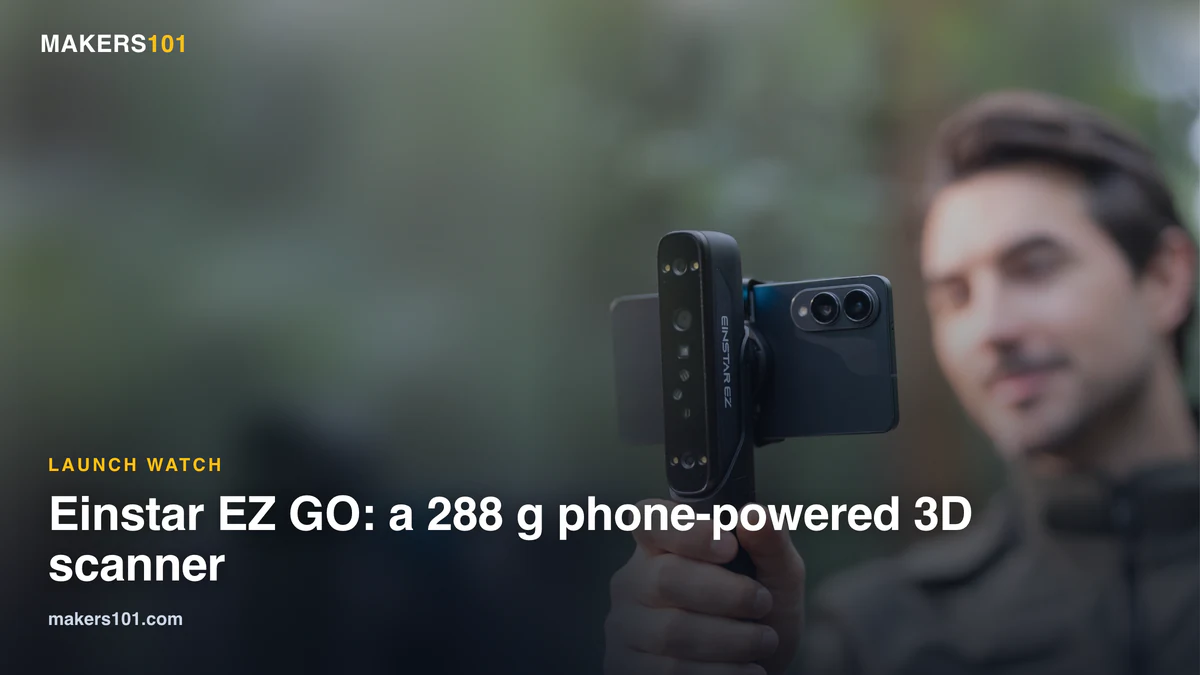
EINSTAR has revealed the Einstar EZ GO, a handheld 3D scanner that weighs 288 g and snaps onto your phone, which shows a real-time preview while you scan. The official EZ GO page lists it as coming soon, with a waitlist and no US price yet.
That puts the Shining 3D brand head to head with the $699 Creality Pika, the 260 g pocket scanner that also runs off a phone. The EZ GO is 28 g heavier and leans hard on one headline feature: 3D Gaussian Splatting.
Table of Contents
What the Einstar EZ GO Does on Paper
The scanner snaps onto your phone magnetically, and you scan one-handed while the phone shows a real-time preview. The company says no extra hardware is needed. That skips both the laptop and the all-in-one route EINSTAR took with its VEGA.
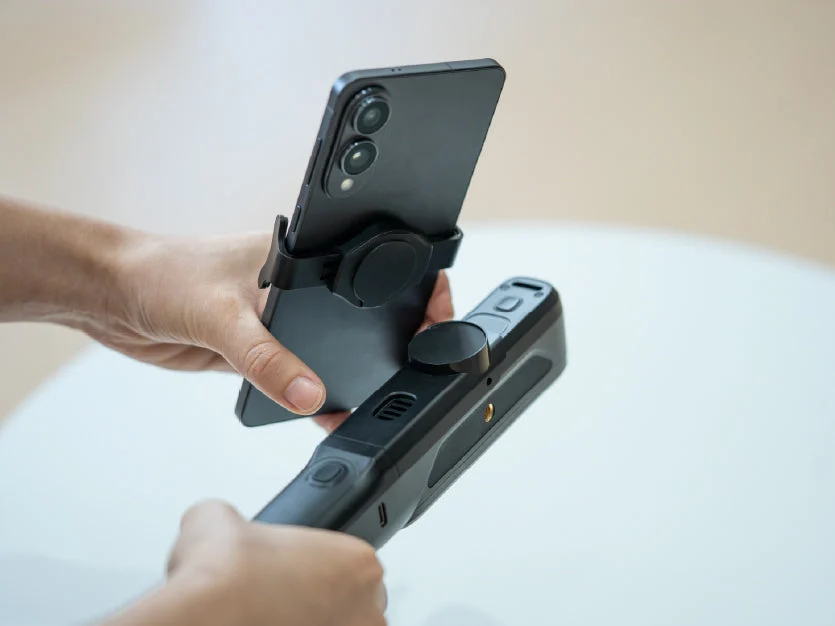
Here is the rest of the spec sheet as the product page states it. None of it has been independently tested yet:
| Claim | What the page says |
|---|---|
| Weight | 288 g, “fits in your pocket” |
| Markers | Marker-free laser scanning |
| Light source | Infrared VCSEL, pitched as safe for scanning people |
| Color | RGB camera for full-color scans |
| Tracking | AI tracking for black, reflective, or low-texture surfaces |
| Bright light | Works in light up to 80,000 lux |
| Capture size | A wide capture area for medium to large objects |
The headline feature is 3D Gaussian Splatting (3DGS). EINSTAR pitches it for “complex and intricate materials”: reflective metal, glassware, hair and fuzz, plants, liquid surfaces, and fabric wrinkles.
What Einstar EZ GO Leaves Out So Far
The page gives no accuracy figure, no point distance, and no list of supported phones. It also doesn’t say whether the Gaussian splat is processed on the phone or in the cloud.
For anyone who prints, one gap matters most. A Gaussian splat is a cloud of soft colored blobs built for looking at on a screen. It isn’t a watertight mesh, so a slicer can’t use it directly without a separate conversion step.
The page also promises laser scanning and “authentic 3D geometry data to support design and mass production,” so a regular geometry output likely sits alongside the splats. It lists no export formats, though. How good that geometry is will decide whether this is a printing tool or a capture toy.
Where the EZ GO Fits in the EINSTAR Lineup
Here is what the brand’s US store charges for its current handhelds, checked Oct. 21:
| Scanner | US price | Store description |
|---|---|---|
| EINSTAR (original) | $759 | Portable prosumer scanner |
| EINSTAR 2 | $1,249 | Updated EINSTAR |
| EINSTAR Rockit | $1,899 | Wireless, Wi-Fi and swappable battery |
| EINSTAR VEGA | $1,999 | Wireless all-in-one |
| EINSTAR EZ GO | Not announced | Phone-powered (product page) |
By my read, leaning on a phone you already own for the screen is one way to cut hardware cost. The page calls the EZ GO “ultra-accessible” and “cost-effective.”
That reads like a play for the bottom of the range, possibly under the $759 original EINSTAR. It’s a guess until a price appears.
What the Einstar EZ GO Means for Scanner Buyers
If you were about to buy a Creality Pika: the Pika is real, priced at $699, and comes with a claimed 0.03 mm accuracy figure. Our Pika vs Revopoint POP 4 comparison covers how it stacks up. The EZ GO has nothing to compare on accuracy yet, so it can’t beat the Pika on paper today.

If you scan to make printable parts: wait for mesh accuracy numbers before you treat 3DGS as a selling point. Splats help with plush toys and shiny trophies you want to show off, not with a bracket that has to fit.
If you can wait a few weeks anyway: Bambu Lab has confirmed a November 2026 launch for its S1 scanner, also without a price. We’re covering what’s confirmed in our Bambu Lab S1 scanner page.
If you’re new to scanning: our guide to the best 3D scanners for makers explains which types work for 3D printing.
What We Still Don’t Know About the Einstar EZ GO
- US price and release date
- Accuracy, resolution, and working distance
- Which phones work, and whether both iPhone and Android are supported
- Where the 3DGS processing happens, and whether it costs extra
- Export formats (STL, OBJ, PLY), and whether meshes come from the laser data or the splat
- Battery life, if the grip carries its own battery
The page also runs a newsletter giveaway for an EZ GO, with winners announced by email on Nov. 10. That hints a launch isn’t far off, but naming winners isn’t the same as shipping units, and EINSTAR hasn’t given a date. The price is the number that decides whether this is a Pika rival or just another pocket scanner.