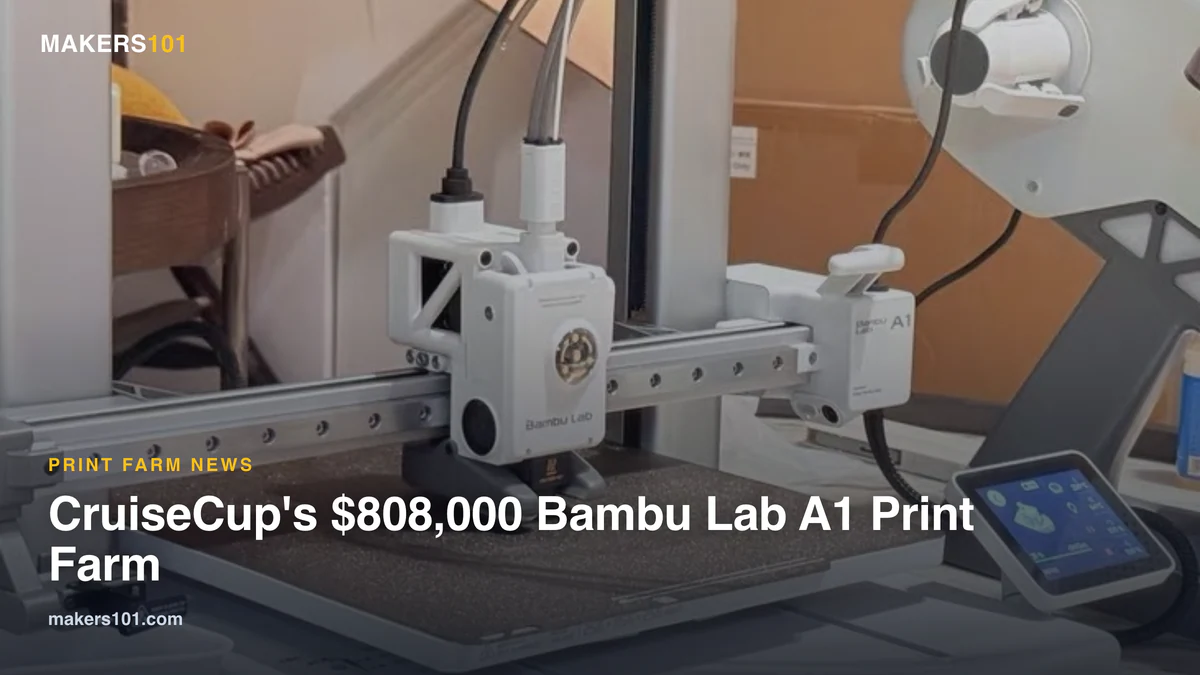

CruiseCup, a 3D-printed can cooler brand run by 19-year-old Mike Satterlee, brought in $808,000 in 2025 gross revenue across its website and TikTok Shop, according to documents reviewed by CNBC Make It. It now runs 160 printers in New York, CNBC reports, out of the $3,600-a-month warehouse it rents in Clifton Park.
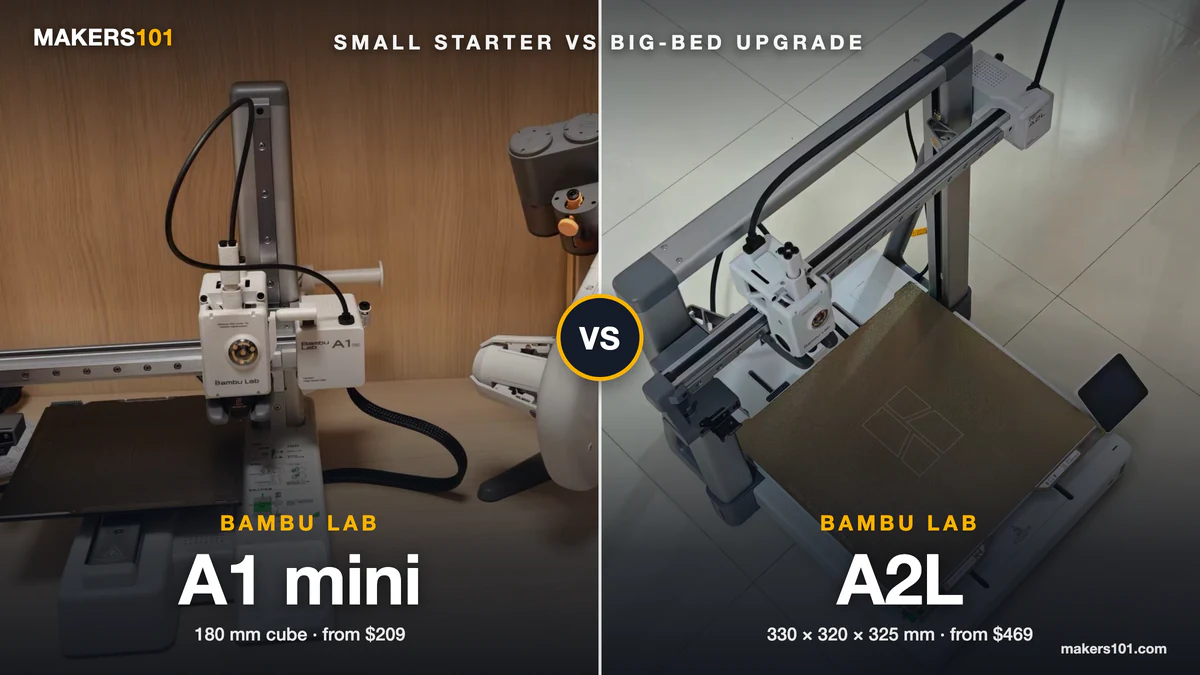
In January, Satterlee said most of his printers were the Bambu Lab A1, which Bambu’s US store lists at $299. That makes CruiseCup a rare public look at what a farm of entry-level printers can earn, and where it stopped keeping up with demand.
Table of Contents
- How CruiseCup Grew From One Basement Printer to 160 Machines
- The Print-Time Math Behind CruiseCup’s Bambu Lab A1 Farm
- Why CruiseCup’s Bestseller Is Moving From Printed Plastic to Steel
- What CruiseCup’s Numbers Mean if You Sell Prints From a Bambu Lab A1
- What We Still Don’t Know About CruiseCup’s Business
How CruiseCup Grew From One Basement Printer to 160 Machines
Satterlee bought a roughly $500 printer with his savings in September 2022. His first printing business, Solefully, made shoe charms for Crocs in his parents’ basement and brought in about $250,000 in 2024 sales, by his estimate.
That revenue let him start renting a $3,600-per-month warehouse in November 2024. In August 2025, an Instagram post for a cooler that holds two 12-ounce cans and reloads from the top or bottom went viral. CruiseCup brought in $100,000 that month, and Satterlee worked out that his 60 printers would need about six weeks to fill the orders.
He kept buying machines. “I’d be buying batches of 30 printers and still not being able to keep up,” he told Business Insider. He now runs the company full-time with one other employee.
The Print-Time Math Behind CruiseCup’s Bambu Lab A1 Farm
In a January interview with Entrepreneur, Satterlee said the A1 was “the best for my purposes.” He also runs “a couple of higher-end and lower-end ones,” but most of the fleet was A1s at the time.
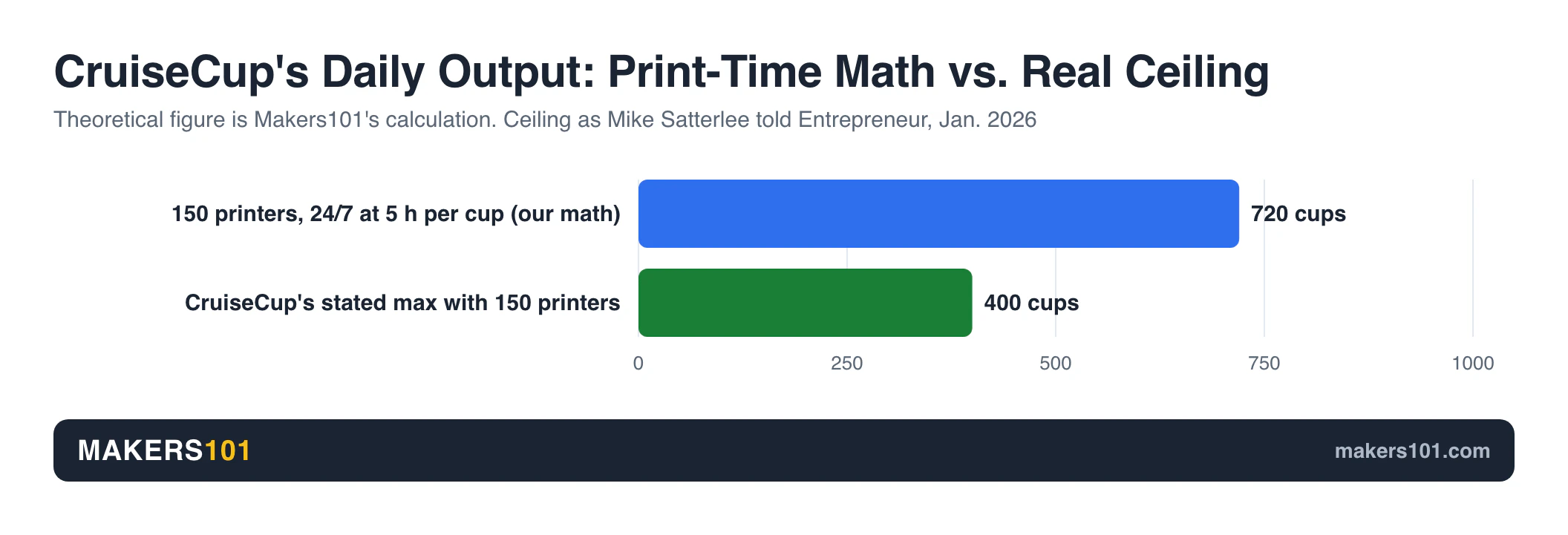
A full build plate holds three of his best-selling coolers and takes 15 hours, which works out to five hours per cup. With 150 machines, he said, the farm could make “a max of 400 cups per day.”
By our math, 150 printers running around the clock at five hours a cup would make 720 cups a day. His stated max was about 56% of that. He didn’t explain the difference, though he did say, “It’s difficult when printers fail or break.” In our read, idle time between plates and other products sharing the fleet may account for some of it. His employees also removed supports, printed labels and packed orders, so labor sat on top of print time.
Revenue isn’t take-home pay. CruiseCup is profitable, but Satterlee pays himself $500 to $1,500 a month because he lives with his parents. The rest goes into more printers, social media ads and new products. He declined to share annual profit figures.
Why CruiseCup’s Bestseller Is Moving From Printed Plastic to Steel
Printing hit a wall when a video took off. Satterlee told Entrepreneur that sourcing a metal version would let him scale ads without worrying about printer capacity: “With manufacturing, I can just order 10,000 units upfront.”
Part of that shift has happened. CruiseCup now sources stainless steel models from an outside manufacturer, while its printers keep making the plastic line. On October 19, its store listed the stainless steel double cooler at $39.99 and the plastic double at $29.99.
Similar designs are easy to find. MakerWorld already hosts free two-can reload koozie models, and one of them, the Double Chuggo Reloadable Can Koozie, shows 3,384 downloads. Satterlee has two patents pending on CruiseCup designs. Pending is not granted, though either could still be. Until then, in our read, the brand and its social following do most of the protecting, and in January he said his cost per acquisition on Facebook had been “terrible.”
Next on his list: UV printing for decoration, more kinds of drinkware, and a bigger marketing team to get CruiseCup onto retail shelves.
What CruiseCup’s Numbers Mean if You Sell Prints From a Bambu Lab A1
- You own one A1 and want to sell. At five hours a part, a single printer running nonstop tops out under five cups a day by our math. That’s a side income, not a viral-scale business. Our honest numbers on making money with a 3D printer walk through costs per print.
- You’re planning a small farm. At CruiseCup, scale brought rent, ad spend and staff on top of the machines. The A1 is $299, or $399 for the Combo with the AMS lite, and our guide to 3D printers for small businesses and Etsy sellers compares bigger options.
- You want to sell someone else’s design. Satterlee designs his own products. If you print a model from MakerWorld or Printables, check its license first, and our guide to commercial licenses for 3D prints explains what’s allowed.
Demand is real. A Shopify spokesperson told CNBC that the number of 3D-printed products sold on the platform rose 112% from October 2025 through September 2026. In our read, growth that fast also invites more sellers into the same niche.
What We Still Don’t Know About CruiseCup’s Business
- Profit. Satterlee hasn’t shared annual profit or what each cup costs to make.
- Fleet reliability. He hasn’t said how often the A1s fail or how much maintenance costs.
- Patents. Both applications are still pending.
The plastic coolers still come off the printers in New York, most of them A1s as of January. Whether the steel line takes over CruiseCup’s bestseller will show up in its 2026 numbers.