
Last updated: September 13, 2026
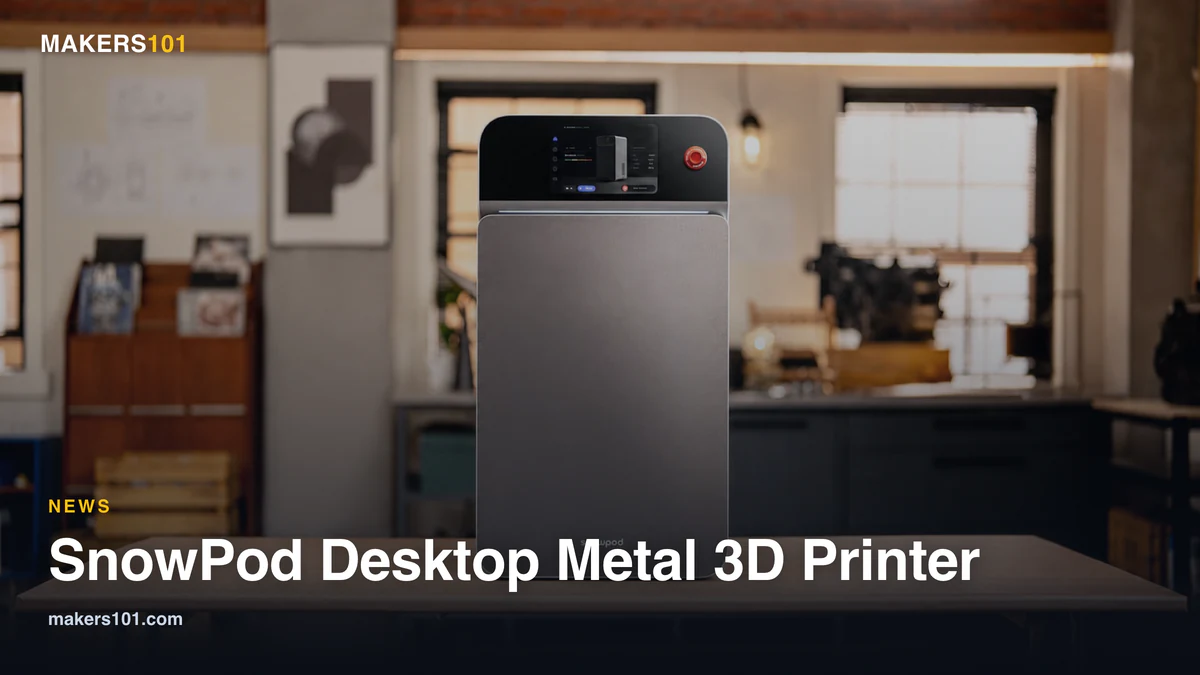
- SnowX, a new brand reportedly tied to Suzhou-based Rongspeed Technology, has unveiled SnowPod, a desktop metal 3D printer built for individual creators instead of industrial factories. Early disclosures point to a Kickstarter launch reportedly planned for Q4 2026, though SnowX hasn’t made an official announcement confirming that date.
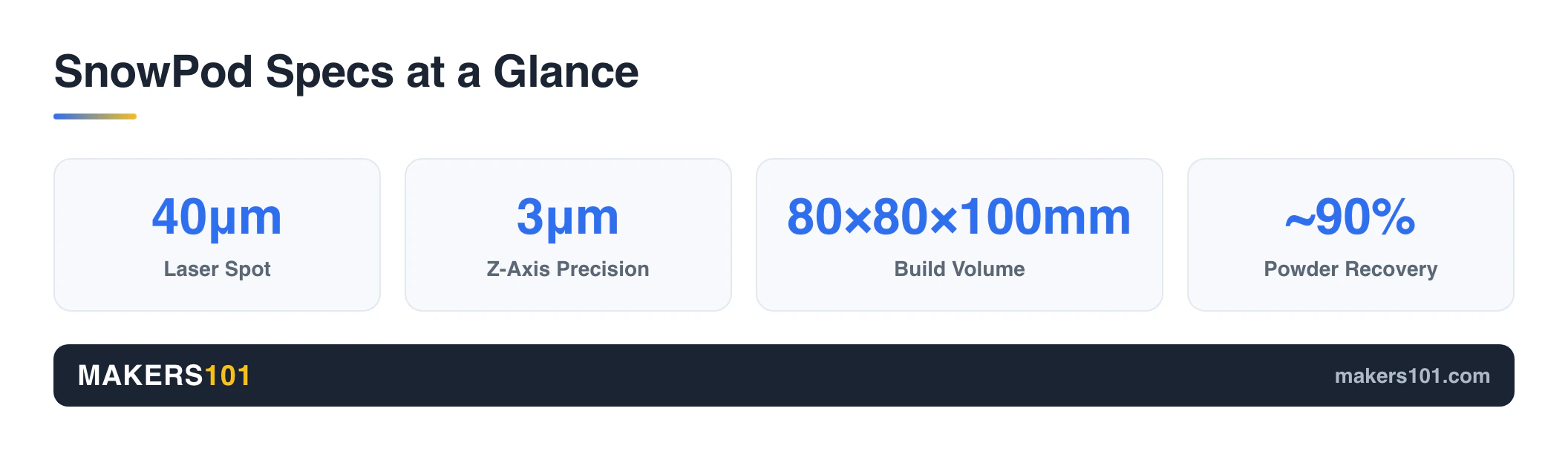
- SnowPod uses SLM (selective laser melting), measures 360×360×660mm, and offers an 80×80×100mm build volume with a 40μm laser spot and 3μm Z-axis precision, printing in ER316L stainless steel.
- The real engineering story is the closed powder loop, air-quality interlocks, and tear-away supports built to remove what actually scares people off metal printing.
- SnowX is targeting Q4 2026 for a Kickstarter launch, though that date comes from early disclosures rather than an official announcement. Pricing hasn’t been revealed.
- SnowPod has no connection to Desktop Metal Inc, the publicly traded industrial metal AM company. Same generic term, unrelated companies.
Desktop FDM printers sit on garage benches and office desks now without anyone thinking twice. Metal printing never made that jump, and it wasn’t because nobody could shrink the hardware.
Nobody had solved the parts that matter when you’re working alone: powder safety, getting supports off without a saw, and not needing a chemistry background to run the thing. SnowX says its new SnowPod desktop metal 3D printer does exactly that.
Here’s what’s actually been shown, what’s still unconfirmed, and whether the pitch holds up.
Table of Contents
- What Happened: SnowX Unveils the SnowPod Desktop Metal 3D Printer
- Inside the SnowPod: 40μm Precision and an 80×80×100mm Build Volume
- Why Powder Safety Was SnowPod’s Real Engineering Problem
- NitroPod and SnowPath: The Supporting Cast Behind SnowPod
- Tear-Away Supports: Metal Printing’s Ugliest Step, Solved (Maybe)
- Not Desktop Metal Inc: Why SnowPod Is a Different Company Entirely
- Why It Matters: Metal 3D Printing Is Quietly Going Consumer
- What’s Next for SnowPod: Kickstarter Timeline and Open Questions
- My Take: Should You Trust the SnowPod Pitch?
- FAQ: SnowPod, SnowX, and Desktop Metal Printing Questions
What Happened: SnowX Unveils the SnowPod Desktop Metal 3D Printer
In September 2026, details about SnowPod began circulating from a brand called SnowX. It’s a desktop metal 3D printer aimed at a market that’s barely existed until now: individual creators working alone, without a factory floor behind them.
SnowX is reported, per a single secondary source we haven’t independently verified, to be a consumer-facing brand tied to Rongspeed Technology, a Suzhou-based company said to have raised close to RMB 100 million in a Series A+ round led by Kunlun Capital. Treat the parent company and funding numbers as unverified claims for now.
SnowX is reported to be targeting Q4 2026 for the Kickstarter launch. That timing comes from the same early disclosures as everything else here, not an official press release, so treat it as a target date rather than a locked one. No price has been announced yet.
Inside the SnowPod: 40μm Precision and an 80×80×100mm Build Volume
SnowPod runs on SLM, the same core process behind most industrial metal printers, just packed into a body small enough for a desk.
The whole unit measures 360×360×660mm. That’s smaller than some flagship FDM printers, which makes room for it in a studio, a lab, or an office that never had space for industrial equipment.
Think of the laser spot like a pen tip. A finer tip means finer control over small features and sharp edges. SnowPod pairs a 40μm laser spot with 3μm Z-axis movement precision, aimed at holding onto detail in small parts: tight corners, narrow gaps, thin walls.
A finer spot also needs less laser power to hit the same energy density. That cuts heat load on the machine, which is part of how SnowX kept the whole thing small in the first place.
That build volume leaves room for jewelry, small mechanical parts, prototypes, and tools, without pushing past what a desk workflow can handle. It’s sized around a real tradeoff: more powder, more cost, more weight, versus enough capacity to be useful. SnowPod prints in ER316L stainless steel.
Why Powder Safety Was SnowPod’s Real Engineering Problem
The hardest part of putting an SLM printer on a desk was never the laser. It’s the loose metal powder.
Handle powder wrong and you’re looking at spills, inhalation risk, and a setup that needs real personal protective equipment every time you load material or pull a finished part. That’s a lab requirement, awkward to manage next to a coffee mug.
SnowPod treats powder handling as a safety problem the machine solves for you. Storage, printing, transfer, recovery, and filtration are built into one closed loop, instead of five separate steps you have to get right yourself.
The machine also runs its own air-quality checks. It tracks PM2.5, gas levels, temperature, and humidity, and ties the door lock, filtration system, and print status together into one interlock. Most machines would tell you to wait a few minutes before opening the chamber. SnowPod’s approach is different: the door doesn’t open until the air actually clears.
NitroPod and SnowPath: The Supporting Cast Behind SnowPod
SnowPod doesn’t work alone. Two companion pieces round out the system.
Excess oxygen during metal printing raises oxidation risk and can destabilize the build. SnowX built NitroPod, a companion nitrogen generator, to solve that without a gas cylinder or an external gas line. Connect it, and it produces the low-oxygen environment the print needs on demand.
On the software side, SnowX built SnowPath, a free slicing and path-planning tool. Load a model, and SnowPath handles the slicing and sends the job straight to the printer. Anyone who’s used an FDM slicer before should find the learning curve short, and the screenshots SnowX has shared so far already look polished for something this early.
SnowPod also runs a camera and AI vision system that watches every print from the first layer, flagging warping or missing material before it wrecks the whole job.
Tear-Away Supports: Metal Printing’s Ugliest Step, Solved (Maybe)
Getting a metal part off the build plate has traditionally meant reaching for a saw, a CNC pass, or both. Supports on a metal print don’t snap off the way they do on an FDM part.
SnowX built what it calls a tear-away support structure for SnowPod. The geometry, connection points, and load direction are engineered so supports hold firm during the print, then break away in stages from wherever you start pulling. SnowX compares it to pulling apart a zipper.
Material use gets the same attention. SnowPod recovers up to 90% or more of unused metal powder for reuse, and swapping materials just means popping open the cover and rotating in a new cartridge. No extra tools, no dumping and cleaning a hopper by hand.
Not Desktop Metal Inc: Why SnowPod Is a Different Company Entirely
If “desktop metal 3D printer” rings a bell from a much larger, publicly traded company, that’s worth clearing up now.
Desktop Metal Inc is an established, industrial-focused metal additive manufacturing company with its own printer lineup and a long track record in the space. SnowX and SnowPod have no corporate relationship to it. The similar name is just a coincidence of category.
If you’ve seen complaints online about “desktop metal” printers breaking down or underdelivering, check which company they’re actually about before assuming it applies here.
Why It Matters: Metal 3D Printing Is Quietly Going Consumer
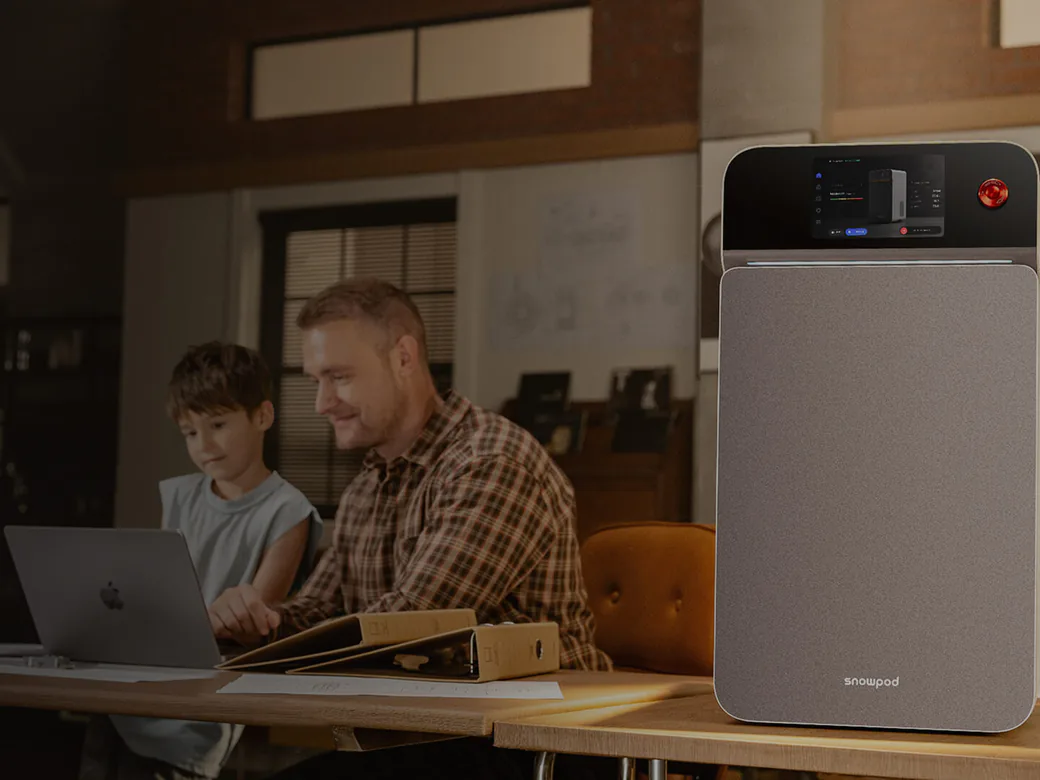
SnowPod isn’t the only sign that metal additive manufacturing is creeping toward regular people. It’s just the most direct one aimed at a desk.
Apple’s iPhone Duo, announced days before SnowPod’s details surfaced, ships with 3D printed titanium hinge covers already in mass production. Apple’s own keynote barely mentioned it. The supply chain confirmed it anyway.
That’s the pattern worth watching. Metal AM keeps showing up in products people actually buy, whether or not the company making them wants to talk about the manufacturing process.
Desktop metal printing also carries some baggage. Enthusiast forums have plenty of stories about “desktop metal” machines that underdelivered on reliability, and skepticism toward big claims in this category is earned. SnowPod is still a preorder pitch, well ahead of any shipped, independently tested unit.
It’s also not the only niche 3D printing capability chasing a crowdfunding audience this year. HeyGears’ full-color resin printer pulled in more than $13 million on Kickstarter, which says something about how much appetite there is for desktop machines that used to be industrial-only.
What’s Next for SnowPod: Kickstarter Timeline and Open Questions
The biggest unknowns here aren’t about what SnowPod can technically do. They’re about what happens after the campaign goes live.
SnowX has reportedly set a Q4 2026 target for the Kickstarter launch, without a specific date or a price attached. The company is also building out SnowX, a community platform, and says it has already signed on some artists to create content for it.
Niche 3D printers on Kickstarter don’t always ship on the timeline promised, and pricing tends to move once a campaign actually opens. Anyone interested in backing SnowPod should treat everything before launch day, including specs, as subject to change.
My Take: Should You Trust the SnowPod Pitch?
The engineering story here is more convincing than most “desktop metal” claims I’ve come across, because it’s built around the actual failure points instead of just shrinking a lab machine and calling it done.
Powder handling, support removal, and material reuse are the three things that make metal printing miserable for a solo user. SnowPod’s design decisions target all three directly. That’s a different approach than most attempts at “smaller” metal printers, which mostly just make the chamber smaller and leave the hard parts alone.
What I can’t verify yet is whether SnowPod performs as described outside of SnowX’s own materials. No independent reviewer has tested a unit. Price, real-world reliability, and delivery timelines all stay unknown until Kickstarter opens for backers.
If you’re curious, watch the campaign closely before committing money based on renders and spec sheets alone.
FAQ: SnowPod, SnowX, and Desktop Metal Printing Questions
How much does the SnowPod desktop metal 3D printer cost?
SnowX hasn’t announced pricing. Crowdfunded hardware usually reveals pricing tiers once the Kickstarter page goes live, sometimes not until the campaign actually opens.
Is Desktop Metal Inc still in business, and is it related to SnowPod?
Desktop Metal Inc is a separate, publicly traded company with no connection to SnowX or SnowPod. The shared “desktop metal” phrasing just describes the category.
What material does SnowPod print in?
ER316L stainless steel, using SLM (selective laser melting).
When can I back SnowPod on Kickstarter?
SnowX has targeted Q4 2026 for the campaign launch. No exact date has been confirmed.