

Researching FibreSeeker 3 is harder than it should be. The results are split between YouTube tests, reseller pages, Kickstarter comments, Reddit doubt, and launch-style articles.
The interesting part is not the carbon-fiber label by itself. Most desktop “carbon fiber 3D printing” means chopped carbon-fiber filament. FibreSeeker 3 is trying to bring continuous carbon and glass fiber into a personal machine, which changes the strength equation.
Table of Contents
- How This Review Was Researched
- Is FibreSeeker 3 Available to Buy Now?
- What FibreSeeker 3 Actually Is
- FibreSeeker 3 Specs
- Continuous Fiber vs Chopped Carbon Fiber Filament
- What Independent FibreSeeker 3 Reviews Found
- What the 900 MPa Claim Actually Means
- What FibreSeeker 3 Is Actually For
- The Risks Before You Put Down Money
- FibreSeeker 3 vs Markforged, PETG-CF Printers, and Normal FDM
- Verdict: Should You Buy, Wait, or Skip?
- Frequently Asked Questions
How This Review Was Researched
Disclosure: Makers101 has not tested a production FibreSeeker 3. This review uses FibreSeek’s official materials, Kickstarter records, current reseller pages, and independent reviewer coverage. The verdict may change after final retail units get longer-term testing.
The public record is still useful. The Kickstarter page shows the campaign history. Reseller pages show current pricing and lead times. Independent reviewers have shown both strength gains and early hardware friction. This follows how Makers101 handles product reviews and how Makers101 is funded.
Is FibreSeeker 3 Available to Buy Now?
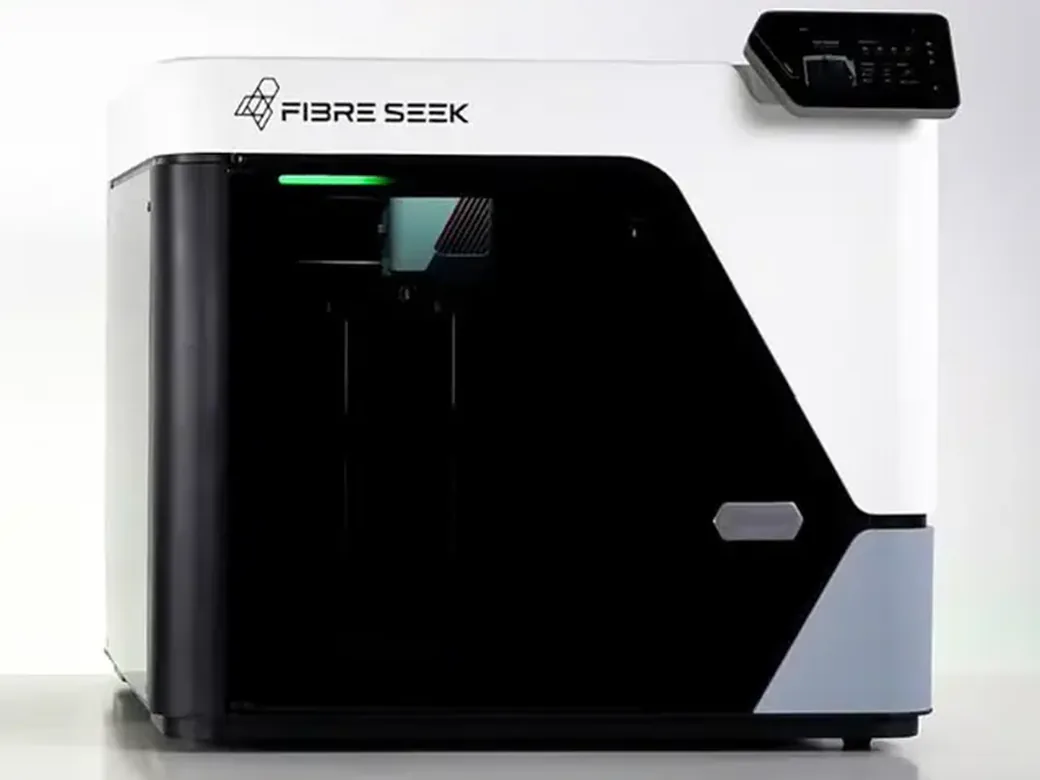
As of August 24, 2026, FibreSeeker 3 looks like a backorder or preorder product through U.S. resellers. It doesn’t look like a normal in-stock printer you can buy and receive immediately.
| Source | Price | Status or lead time | What it means |
|---|---|---|---|
| Kickstarter | Campaign ended | Funded Jan. 1, 2026 | Funding success, not retail stock |
| Additive Plus | $4,995 | Next batch 10/2026 | U.S. reseller listing |
| Fibricate | $4,999 | Expected lead time 10/2026 | U.S. reseller listing |
| FibreSeek store | No printer listing visible | Materials and accessories listed | Official store does not prove printer stock |
The Kickstarter campaign is real. FibreSeek raised $4,698,825 from 1,539 backers, against a $50,000 goal. The funding period ran from Nov. 17, 2025 to Jan. 1, 2026.
The campaign FAQ originally said shipment would start in February 2026. Treat that as old campaign information, because current reseller pages tell a later retail story. Additive Plus says the next batch ships in 10/2026. Fibricate shows the same lead-time window.
The official FibreSeek store showed materials and parts during this research, including X-CCF continuous carbon fiber filament at $49 and a CFC hotend kit, but the printer itself was not visible there.
For a buyer, FibreSeeker 3 appears buyable through resellers, but with lead-time risk.
What FibreSeeker 3 Actually Is
FibreSeeker 3 is a desktop FFF printer with an additional continuous-fiber co-extrusion system for embedding carbon or glass fiber into selected load paths.
Think of it as two jobs in one machine. The normal FFF side prints thermoplastic like a regular filament printer. The CFC side places a long fiber path into the part instead of short filler inside a filament spool.
The Kickstarter FAQ describes three modes:
| Mode | What it uses | What it is for |
|---|---|---|
| High Speed Mode | FFF nozzle only | Normal thermoplastic printing |
| High Strength Mode | CFC + FFF | Plastic prints with selected fiber reinforcement |
| Hyper Strength Mode | CFC nozzle only | High fiber-volume composite prints |
The mode split matters because you don’t need continuous fiber in every print. A spacer, cover, jig block, or decorative part can still be a normal FDM job.
FibreSeek’s FAQ says normal PLA and PETG can come from outside brands. The continuous fibers require X-Series materials. Plastic compatibility looks open in the normal FFF sense. Continuous fiber is a more controlled material path.
FibreSeeker 3 Specs
On paper, FibreSeeker 3 gives you a 300 by 300 by 245 mm build area with 350 C nozzles and a 65 C heated chamber. It also adds a continuous-fiber toolpath system.
Most core specs are consistent across reseller pages and manual mirrors. Bed temperature and slicer naming vary by source.
| Spec | FibreSeeker 3 | Confidence | Note |
|---|---|---|---|
| Technology | FFF + CFC | High | Plastic printing plus continuous fiber |
| Build volume | 300 x 300 x 245 mm | High | Repeated across sources |
| Device size | 615 x 595 x 540 mm | Medium-high | Reseller and manual sources |
| Weight | 32 kg | Medium-high | Heavy for one person |
| Max FFF speed | 500 mm/s | High | FFF mode only |
| Max CFC rate | 20 cc/h | Medium | Continuous-fiber printing is slower |
| FFF nozzle | 0.4 mm, hardened/all-metal | Medium-high | Listed on reseller specs |
| CFC nozzle | 0.7 mm with built-in cutter | Medium-high | Listed on reseller specs |
| Max nozzle temp | 350 C | Medium-high | FFF and CFC |
| Heated chamber | Up to 65 C | High | Also a V2.0 improvement |
| Heatbed | 110 to 120 C | Medium | Source discrepancy |
| Accuracy | +/-0.2 mm | Medium | Listed spec |
| Minimum layer | 50 microns | Medium | Listed spec |
| Continuous fibers | X-CCF and X-CGF | High | Carbon and glass fiber |
At 32 kg, you plan where it lives before it arrives.
Slicer naming is inconsistent. Some sources say Rocket Slicer or Rocketslicer, while others use Aura, so this article uses FibreSeek’s slicer unless the exact name matters.
Continuous Fiber vs Chopped Carbon Fiber Filament
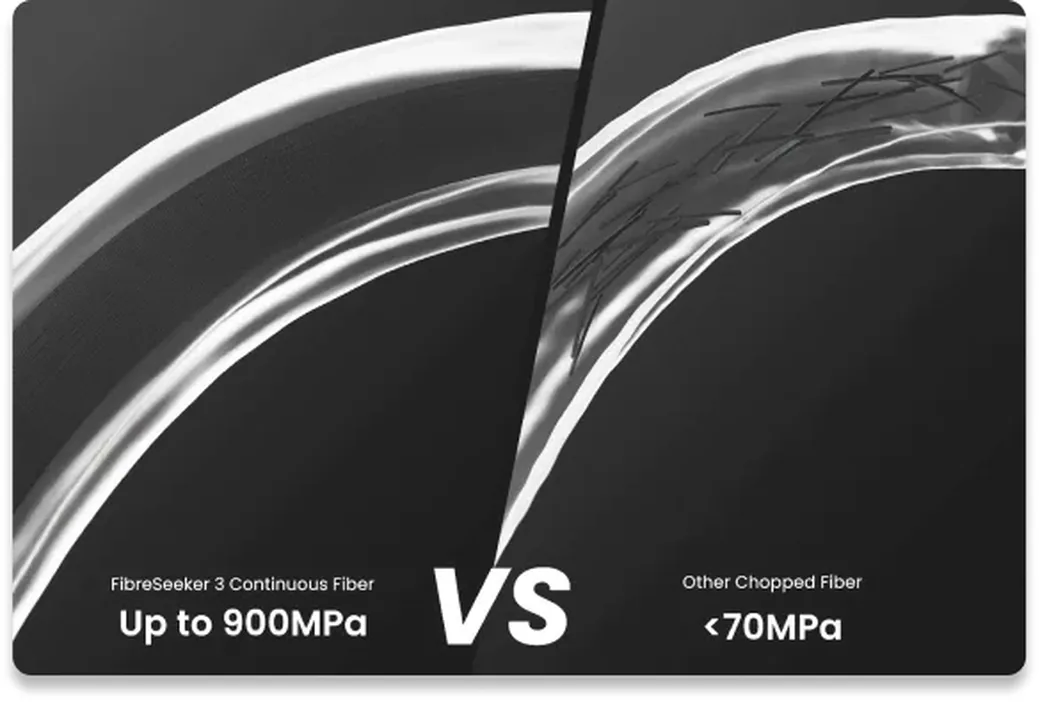
FibreSeeker 3 deserves attention because continuous fiber is structurally different from PETG-CF, PA-CF, PPA-CF, or other chopped-carbon-fiber filaments.
This is the question Reddit users keep asking: what is it for if normal printers can already run carbon-fiber-filled materials?
| Type | How it reinforces | Best use | Main limit |
|---|---|---|---|
| Chopped CF filament | Short fibers mixed into plastic | Stiffer FDM parts, nicer surface, engineering filament upgrades | No long load-bearing fiber path |
| FibreSeeker CFC | Continuous fiber placed in the printed part | Brackets, arms, fixtures, lightweight structural parts | Works best when fiber follows the load |
| Markforged-style continuous fiber | Mature continuous-fiber workflow in a closed ecosystem | Industrial jigs, fixtures, shop tooling | Higher system cost and more controlled workflow |
Chopped fiber is like adding short reinforcement pieces to the plastic. It can make a filament stiffer, cleaner-printing, or more dimensionally stable.
Continuous fiber is closer to placing a strap, cable, or rib inside the part. If the load pulls along that strap, the part can become dramatically stronger. If the load pulls across weak layer lines or through a poor geometry, the magic fades quickly.
A lot of readers should still start with a good enclosed printer and the right material. If you want practical strong prints for brackets, tool holders, clips, or shop parts, read our guide to nylon and carbon fiber printers first.
FibreSeeker 3 enters the conversation when chopped fiber stops being enough.
What Independent FibreSeeker 3 Reviews Found
Independent reviewer coverage shows real strength potential, but it also shows why FibreSeeker 3 should still be treated as early hardware.
The strongest positive results
| Reviewer | What they found | Why it matters |
|---|---|---|
| CNC Kitchen | Clear technical explainer for co-extruding continuous tow into thermoplastic | Best source for the core mechanism and the Z-strength caveat |
| The 3D Printing Zone | Compares plain PLA, PLA with one continuous carbon line, and higher-fiber prints | Shows the practical strength jump and notes prototype oozing |
| Joel Schat | Shows FPV guards, camera arms, quick-release plates, lens support, plus a rough 220 lb test | Good buyer-style use cases, with noise and software caveats |
| Tripods Garage | Reports a 40 g PETG bag holder carrying 76 lb without visible flex | Useful real-use demo, plus setup, clogging, heat, and wear notes |
| MandicReally | Reports a thicker 9 mm CCF chain reaching about 604 kg in a rough force-gauge test | Dramatic evidence, but not a controlled lab dataset |
The results that keep the hype honest
My Tech Fun is the most important skeptical source. The reviewer found continuous fiber better in impact-style tests, but it did not win every hook, bending, or tensile-style comparison against chopped-fiber PETG samples.
That result is a reason to design around continuous fiber properly. Orientation and bonding matter. So do thickness and sample prep. If the fiber path is wrong, a continuous-fiber part can disappoint you.
Across the reviewer pool, the pattern is clear: the strength upside is real, but the machine still looks early.
What the 900 MPa Claim Actually Means
Read the 900 MPa claim as a material-and-mode ceiling. It doesn’t mean every FibreSeeker 3 print will beat aluminum.
FibreSeek and reseller pages use the 900 MPa number as the headline strength claim. Fibricate describes it as tensile strength in Hyper Strength Mode, with material and geometry limits.
Load direction matters
Continuous fiber helps most when the force follows the fiber. That makes XY-plane reinforcement the natural strength zone. Pull the part in a way that stresses layer adhesion, and you are back inside a familiar 3D-printing problem.
CNC Kitchen and Joel Schat both call this out. “900 MPa” sounds simpler than “900 MPa when the material, geometry, bonding, print mode, and load direction all line up.”
Geometry matters
A bad bracket doesn’t become a good bracket because you put expensive fiber inside it. Holes and corners still matter. So do thin sections and stress concentrators.
My Tech Fun’s mixed results are the useful warning here. Continuous fiber can be much tougher in some impact-style tests, yet fail to dominate every shape and load case. That is how composites work.
“Stronger than aluminum” needs context
Reseller pages compare FibreSeeker 3’s tensile strength to 6061 aluminum. The comparison is useful as a material headline, but weak as a buying rule.
Machined aluminum and printed composite parts fail differently. Aluminum is isotropic enough for many everyday design assumptions. A fiber-reinforced printed part is much more directional. Ask whether your specific part can be designed so the fiber carries the load you care about.
If the answer is yes, FibreSeeker 3 becomes interesting fast. If the answer is no, you may be paying for a number your part cannot use.
What FibreSeeker 3 Is Actually For
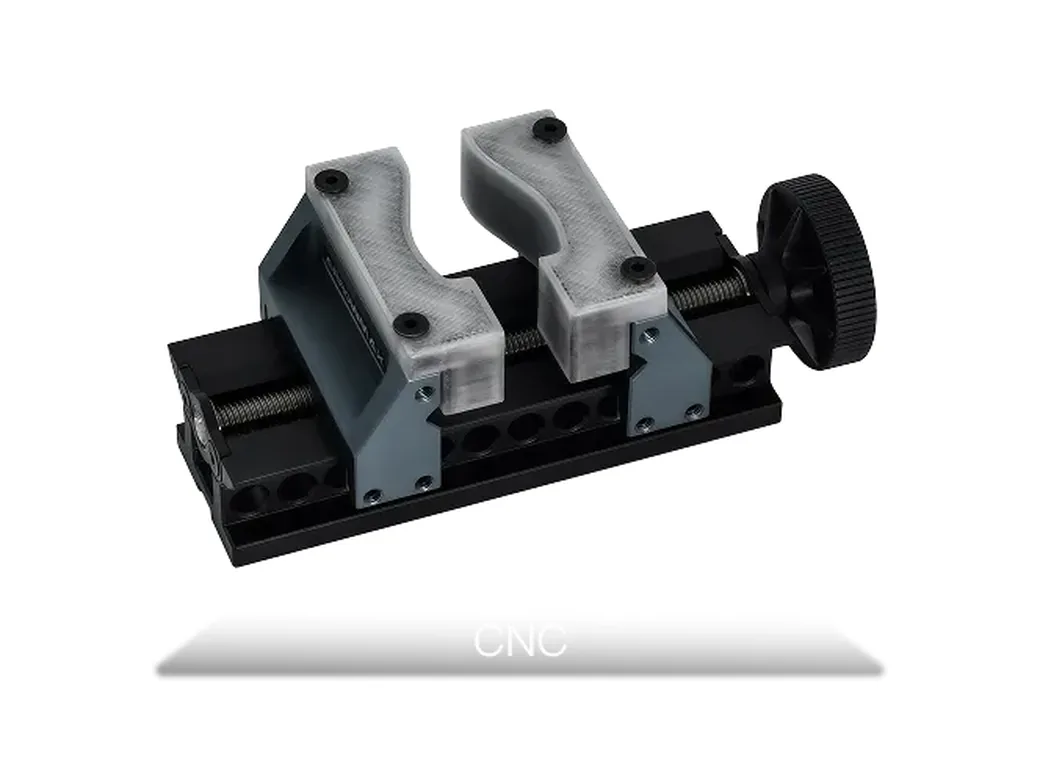
FibreSeeker 3 makes the most sense when a printed part needs stiffness, low weight, and strength along a known load path.
The best examples from reviewer coverage are practical:
- FPV drone arms and guards
- Camera rigs, GoPro arms, lens supports, plus quick-release plates
- Robotics joints and lightweight mounts
- Jigs, fixtures, plus shop tooling
- Racing, bike, automotive, plus workshop brackets
- Small-batch functional prototypes where machining is too slow or expensive
That last use case is the most realistic business argument. If you regularly outsource small brackets or fixtures, a desktop continuous-fiber printer could change your turnaround time.
This is not a beginner machine. Beginners need bed adhesion, slicer basics, material handling, and repeatable prints. FibreSeeker 3 adds engineering materials, fiber routing, maintenance, plus composite design on top of all of that.
If your real problem is heat, material strength, or outdoor durability, a guide to heat-resistant 3D printing filament may solve it for far less money. If you are choosing your first serious machine, start with how to choose a 3D printer before jumping into composite hardware.
The Risks Before You Put Down Money
The biggest FibreSeeker 3 risk is reliability. Final hardware, software, supply chain, and support all have to work for normal buyers.
Availability and lead-time risk
Kickstarter funding proves demand. It doesn’t prove retail availability, spare-parts flow, or long-term support.
We’re watching the same pattern play out with SnowX’s SnowPod, a desktop metal printer still chasing its own Kickstarter date.
Current U.S. reseller listings point to October 2026 lead times. That may be fine for a small engineering shop with a planned use case, but it is harder to justify if you want a printer next week.
Before you pay, check whether the seller is taking deposits, backorders, or true stock orders.
Early hardware maturity
The reviewer complaints cluster around the parts you’d expect: nozzle switching, fiber reliability, sensors, thermal control, wear, software, plus maintenance access.
FibreSeek’s own V2.0 update video is worth noting because it says the company changed the heated chamber, noise behavior, fiber extruder, modular hotend, plus stripping mechanism after feedback from nearly 50 prototype testers. It also reminds you that many reviewer videos involved early machines.
Treat V2.0 improvements as company claims until independent final-unit testing confirms them.
Materials and consumables
The same material boundary appears in FibreSeek’s FAQ: outside-brand PLA/PETG is allowed, while continuous fibers require X-Series material. The official store lists X-CCF 1K continuous carbon fiber at $49, while reseller accessory pages can show different add-on pricing.
For a normal FDM printer, you can usually shop around for filament. For continuous fiber, you’re more tied to the supplier’s material supply. Documentation and inventory matter more.
Workflow risk
Continuous fiber asks more from the user than a normal slicer profile. You need to understand where the part is loaded. Then you orient the model around that load and make the fiber path support the job the part actually does.
The FFF side may run fast. The CFC side is slower, with some reseller specs listing up to 20 cc/h for CFC.
If you buy FibreSeeker 3 because the headline says 500 mm/s, you are buying the wrong headline.
FibreSeeker 3 vs Markforged, PETG-CF Printers, and Normal FDM
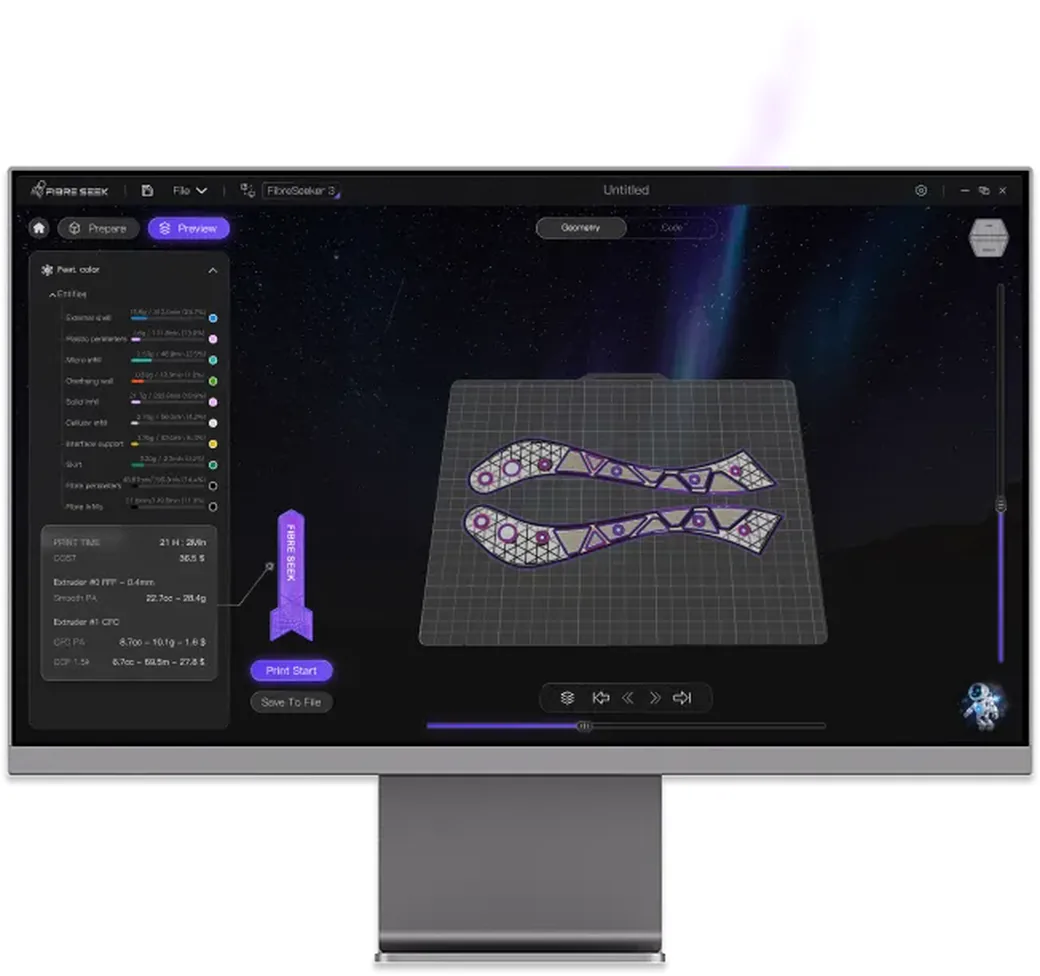
FibreSeeker 3 sits in the lower-cost, more experimental part of continuous-fiber printing. Markforged is still the proven workflow benchmark.
| Option | Best for | Strength path | Risk |
|---|---|---|---|
| FibreSeeker 3 | Advanced makers and small shops testing continuous fiber near $5,000 | CFC with carbon or glass fiber | Early ecosystem and fulfillment risk |
| Markforged Mark Two/X-series | Shops needing mature continuous-fiber workflow | Established CFF/CFR ecosystem | Higher total system cost and more controlled materials |
| Enclosed FDM + PA-CF/PETG-CF | Most hobbyists wanting stronger practical prints | Chopped-fiber filament | Less structural than continuous fiber |
| Normal fast FDM printer | Prototypes, fixtures, everyday prints | Plastic only | No composite reinforcement |
Markforged has the maturity advantage. Its ecosystem has years of shop use behind it, and its material lineup includes carbon fiber, fiberglass, Kevlar, plus HSHT fiberglass. Mark Two reseller specs list a 320 x 132 x 154 mm build volume.
FibreSeeker 3 has the cost and build-volume argument. This price class and build area are much more approachable than many industrial composite systems.
The choice is mostly about risk. Markforged asks you to pay more for workflow certainty. FibreSeeker 3 asks you to accept more early ecosystem risk in exchange for a lower entry point and more accessible continuous-fiber experimentation.
For many makers, an enclosed FDM printer with PA-CF, PETG-CF, PC, or ASA is the cleaner choice. It is easier to live with and still strong enough for a lot of shop parts.
Verdict: Should You Buy, Wait, or Skip?
FibreSeeker 3 is a specialist tool. Treat it that way.
Buy or waitlist it if you already understand FDM tuning, engineering materials, and functional part design. You should have a real use case: drone parts, robotics mounts, camera supports, jigs, fixtures, racing brackets, or machined parts you want to replace.
Wait if you need predictable delivery, stable support, final production-unit reviews, and neutral long-term reliability data. That is especially true if this is a business purchase.
Skip it if you are a beginner, if you mainly print decorative models, or if you only want the carbon-fiber surface look. You can get a lot of that practical benefit from a hardened nozzle, a heated chamber, and good CF-reinforced filament.
A cleaner rule: if your part does not need a planned load path, FibreSeeker 3 is probably more machine than you need.
Frequently Asked Questions
How much does the FibreSeeker 3 cost?
At this crawl, the two checked U.S. reseller pages show FibreSeeker 3 around $5,000. Additive Plus lists a complete system at $4,995, while Fibricate lists the printer at $4,999.
You may see older Kickstarter-era figures around $2,699 to $2,999 in early reviewer coverage. Separate those backer prices from current reseller pricing.
Is FibreSeeker 3 available to buy now?
FibreSeeker 3 appears listed through U.S. resellers, but current pages point to 10/2026 lead times. That is closer to a backorder or preorder buying situation.
Check the seller’s current stock and refund terms before paying, because availability can change quickly.
Was FibreSeeker 3 a Kickstarter project?
Yes. FibreSeeker 3 was a Kickstarter project. It ran for 45 days and raised $4,698,825 from 1,539 backers.
That’s a strong demand signal. It isn’t the same thing as mature retail availability.
Is FibreSeeker 3 a real carbon fiber 3D printer?
Yes, in the continuous-fiber composite sense. FibreSeeker 3 uses continuous carbon or glass fiber co-extrusion inside a thermoplastic part.
That is different from a normal printer running PETG-CF or PA-CF filament. Those filaments use short chopped fibers mixed into the plastic.
What is the difference between FibreSeeker 3 and PETG-CF or PA-CF filament?
PETG-CF and PA-CF use chopped fibers. They can make prints stiffer and more useful, but they don’t create a continuous load-bearing fiber path.
FibreSeeker 3 places continuous fiber along toolpaths. That can create much stronger parts when the load follows the fiber direction.
Can FibreSeeker 3 print parts stronger than aluminum?
FibreSeek and reseller pages cite up to 900 MPa tensile strength in best-case composite conditions. Real printed part strength depends on material, geometry, bonding, orientation, plus print mode.
Some parts may replace aluminum brackets or fixtures. Don’t treat every print as stronger than aluminum.
Is FibreSeeker 3 better than Markforged?
FibreSeeker 3 looks cheaper and more accessible on paper. Markforged has the more mature and proven continuous-fiber workflow.
If you want lower-cost experimentation, FibreSeeker 3 is the more accessible option. If you need workflow certainty for a shop, Markforged remains the safer benchmark.
Should beginners buy FibreSeeker 3?
Beginners should skip it as a first printer. A reliable enclosed FDM printer, good slicer profiles, plus sensible filament choices will give you more value.
FibreSeeker 3 is better for users who already understand FDM, engineering filaments, and load-bearing part design.
What should I check before ordering FibreSeeker 3?
Confirm whether the seller has stock or is taking backorders, what the refund terms are, and whether CFC consumables are available in your region.
Also check newer final-unit reviews before paying. Prototype videos are useful, but they are not the same as long-term ownership data.