
Heads up — some of the links below are affiliate links. If you buy through them, I earn a small commission (at no extra cost to you), which helps cover the gear I test. Thanks!
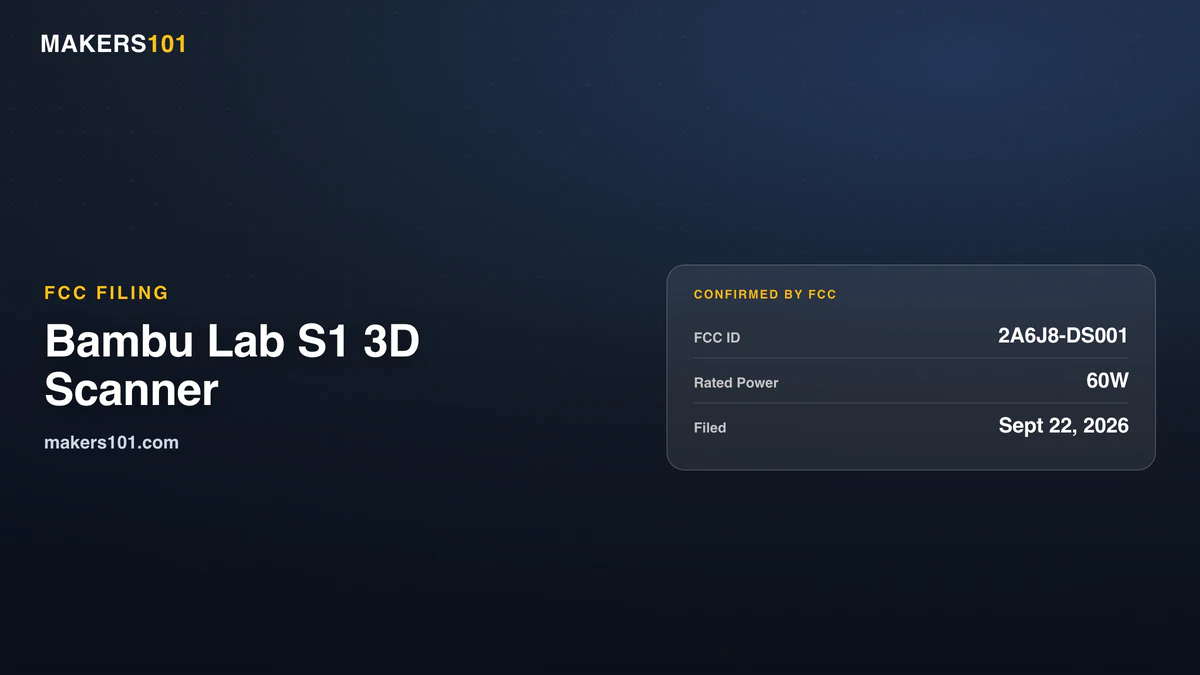
- The Bambu Lab S1 3D scanner is Bambu Lab’s first scanning device. It surfaced in an FCC filing (FCC ID 2A6J8-DS001) dated September 22, 2026, with a label that reads “3D Scanner” and a 60W power rating. Bambu Lab has not officially announced it, so nobody outside the company knows its price or launch date yet.
- A label drawing with a hand grip points to a handheld design. The filing lists no scanning technology, accuracy, price, or software.
- The S1 probably comes out of Bambu’s January 29, 2026 framework agreement with SCANTECH, a publicly listed maker of industrial 3D scanners.
- Bambu has announced nothing. Printers that cleared the FCC before the S1 (H3C, P3C, X2D Pro) had not launched at the time of writing, so treat any launch date as a guess.
- Search carefully: Creality already sells a different scanner called the Sermoon S1.
Last updated: September 24, 2026
As of September 24, 2026, everything known about the Bambu Lab S1 3D scanner comes from regulatory paperwork and community detective work.
If you saw “Bambu scanner” trending on Reddit this week and wondered whether to hold off on buying one, you’re in good company. The problem is that most coverage mixes three kinds of information: what the filing actually says, what outlets reported secondhand, and what people are guessing.
The short answer on waiting: hold off only if nothing on your bench needs scanning before winter. The details below show why the launch date is harder to call than most coverage suggests.
Table of Contents
- What the Bambu Lab S1 FCC Filing Confirms
- Bambu Lab S1 at a Glance: Confirmed, Reported, and Unknown
- SCANTECH: The Industrial Scanner Maker Behind the Bambu Lab S1
- Bambu Lab S1 Release Date: Why “FCC Means Days Away” Is Shaky This Time
- Bambu Lab S1 Price: What Competing Scanners Suggest
- Why the Bambu Lab S1 Matters for Bambu’s Scan-to-Print Ecosystem
- Bambu Lab S1 vs Creality Sermoon S1: Same Name, Different Scanners
- My Take: The Bambu Lab S1 Will Be Judged on Software More Than Accuracy
- Should You Wait for the Bambu Lab S1 or Buy a 3D Scanner Now?
- FAQ: Bambu Lab S1 3D Scanner
What the Bambu Lab S1 FCC Filing Confirms
The FCC filing confirms four things: a device called “Bambu Lab S1,” registered under FCC ID 2A6J8-DS001, labeled as a “3D Scanner,” and rated at 60W. Everything else about the S1 is still unannounced.
A user on the official Bambu Lab forum spotted the records on September 22 and posted that the device tag “also shows 60W power.” The applicant is Bambu Lab’s own legal entity. Industry trade outlets, including 3DPCC, picked it up within two days.
3DPCC noted one useful detail. The label-location drawing places the tag on a body with a hand grip, which suggests a handheld scanner. A turntable or desktop unit looks less likely. The same report is careful to add that the filing “offers no details about the scanning technology, accuracy or software.”
Treat the 60W figure with care. It’s the rated power on the device label. Nothing in the public documents tells you what light source it uses or how much of that power goes to scanning.
The Rest of Bambu’s September 22 FCC Batch
The S1 arrived in a crowded week. FCC records also show two new material systems (AMS 3H and AMS 3P), and earlier filings revealed three printers (H3C, P3C, X2D Pro).
On the same day the S1 filing surfaced, Bambu launched its first dedicated laser cutter. The Bambu Lab R1 laser cutter is a 55W CO2 machine. Its r/BambuLab launch thread drew far more engagement than the scanner thread (625 upvotes vs 363).
Bambu Lab S1 at a Glance: Confirmed, Reported, and Unknown
Four facts about the Bambu Lab S1 3D scanner come straight from the FCC label. Everything else is reported secondhand or still unknown.
| Item | Status | Detail | Source |
|---|---|---|---|
| FCC ID | Confirmed | 2A6J8-DS001 | FCC filing |
| Filing date | Confirmed | September 22, 2026 | FCC filing |
| Product type | Confirmed | Label reads “3D Scanner” | FCC label |
| Rated power | Confirmed | 60W | FCC label |
| Form factor | Likely | Handheld (label drawing shows a grip) | 3DPCC |
| Development partner | Reported | SCANTECH (publicly listed) | Jan 2026 agreement |
| Light source / accuracy | Unknown | Not in public filing | None |
| Price | Unknown | Not announced | None |
| Release date | Unknown | Not announced | None |
| Software | Unknown | Not announced | None |
SCANTECH: The Industrial Scanner Maker Behind the Bambu Lab S1
The S1 is most likely the first product of Bambu Lab’s partnership with SCANTECH (sold internationally as SCANOLOGY). On January 29, 2026, the two companies signed a framework agreement to jointly design and develop a consumer-grade 3D scanner.
SCANTECH is a serious industrial player. It went public in January 2025, and its shares hit the daily trading limit the morning after the deal became public. Its industrial scanners are rated at about 0.02 mm accuracy.
Reports on the deal describe a clear split. SCANTECH handles manufacturing and Bambu handles sales. A Reddit commenter in r/BambuLab summed it up as Bambu branding with “Scantech technology under the hood.”
One detail other coverage skips: a July 2026 LinkedIn post from an industry trade outlet said the first product was “expected to begin deliveries in August 2026.” August came and went with no scanner. That tells you the schedule has already slipped at least once.
The deal also fits a pattern among the big four consumer printer brands. Creality and Anycubic build scanners in-house, Elegoo works with Revopoint, and Bambu chose SCANTECH.
Bambu Lab S1 Release Date: Why “FCC Means Days Away” Is Shaky This Time
Bambu Lab has not given the S1 a release date, and the FCC filing does not reliably predict one. A Q4 2026 launch is possible. Nothing public confirms it.
The optimistic case comes from habit. One forum user wrote that Bambu’s FCC filings “usually drop at most 3-4 days before the actual release.” Some trade press went further and predicted a mid-November launch. Both are guesses.
Three points complicate the “days away” rule:
- Earlier filings are still waiting. The H3C, P3C, and X2D Pro all reached the FCC first. None had launched when this article went live.
- The FCC date tracks paperwork. A forum member pointed out that the column is labelled “Application date.” It records when the filing happened and says nothing about a release plan.
- The March 2027 date is a confidentiality deadline. One Redditor read March 21, 2027 as a launch date. That is exactly 180 days after September 22, the date on the FCC record, which matches the FCC’s standard short-term confidentiality window. Another commenter noted that confidentiality is normally revisited once a product is announced, so the date marks a paperwork deadline.
My read: the S1 is real and fairly far along, since companies rarely certify hardware they plan to shelve. The missed August target and the stalled printer filings suggest a wider launch window than the forum rule implies.
The same caution applies to Bambu’s other rumored hardware. The Bambu Lab H3C appeared in patents long before it showed up at the FCC.
Bambu Lab S1 Price: What Competing Scanners Suggest
Bambu has not announced a price for the S1, and nothing in the filing hints at one. Your best guide right now is what comparable scanners cost in September 2026.
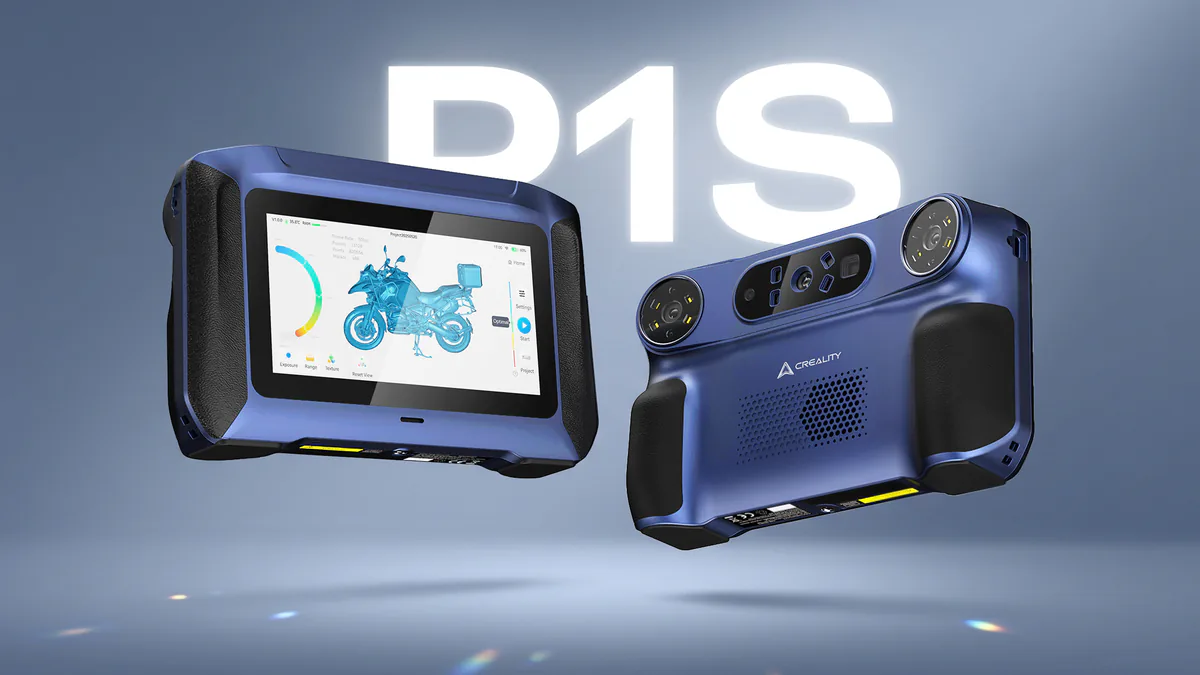
The most direct reference launched the same day. Creality put its all-in-one blue-laser Creality Sermoon P1S on sale on September 22 at a list price of $2,299, with an early-bird price of $2,099 through October 12. It targets reverse engineering and automotive work first.

- 34 cross + 7 parallel + 1 single blue laser lines, plus NIR with MASK
- Scans and processes onboard with a 6-inch touchscreen, no PC required
- Claimed accuracy up to 0.02 mm (volumetric 0.02 mm + 0.08 mm/m)
- 807 g with two swappable 3,300 mAh batteries, Wi-Fi 7 and USB 3.0
Pocket-sized scanners sit much lower. Creality’s Pika lists at $699 and weighs 260 g with a claimed 0.03 mm accuracy. In a sphere-calibration test by YouTuber Andy’s Shed, the Revopoint POP 4 measured a 0.02 mm center-distance error against 0.038 mm for the pricier Einstar Rockit (the POP 4 was a free unit from the maker and ran beta software).

- 【Industrial-Grade Accuracy】Achieve single-frame accuracy up to 0.03 mm and volumetric accuracy of 0.03 mm + 0.05 mm x L(m), faithfully reproducing…
- 【Ultra-Fast Scanning & Robust Frame Rate】Multi-line Laser mode delivers up to 105 fps with NVIDIA GPU acceleration. Full-Field Structured Light…
- 【AI-Powered & Photo-Grade Retopology】 AI object segmentation (Windows only) identifies your target in one click, tracks it throughout the scan…
- 【All-Weather Outdoor Scanning】Multi-line Laser mode operates reliably up to 50,000 lux; with an outdoor filter attached, scanning remains stable…
- 【5 Scanning Modes】NIR band supports Full-Field HD Scanning (markerless, fine structured light), Hybrid HD Scanning (dual projectors, fast…
| Scanner | Type | Price (USD, Sept 2026) | Claimed accuracy |
|---|---|---|---|
| Bambu Lab S1 | Handheld (likely) | Not announced | Not announced |
| Creality Sermoon P1S | All-in-one blue laser | $2,299 list | Up to 0.02 mm |
| Creality Pika | Pocket, phone-first | $699 list | 0.03 mm |
One forum user put typical pricing for scanners in this class at $1,500 to $4,000. That describes the market and reveals nothing about the S1.
Bambu’s history points the other way: the P1S printer brought near-professional performance to a mainstream price. If the S1 follows that playbook, expect it to aim below the Sermoon P1S. That is speculation until Bambu speaks.
Why the Bambu Lab S1 Matters for Bambu’s Scan-to-Print Ecosystem
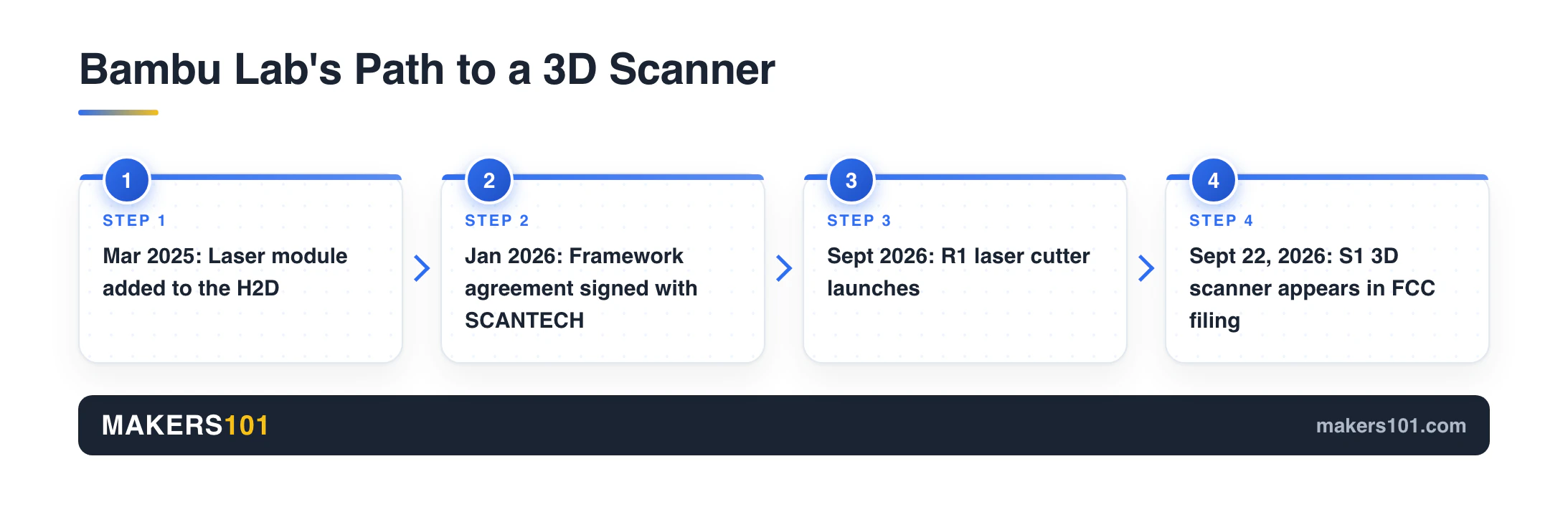
The S1 matters because it gives Bambu a way to turn physical objects into print files without leaving its own hardware. Trade coverage called it the missing piece of a “scan, edit, print” loop.
Look at the timeline. Bambu added a laser module to the H2D in March 2025, signed with SCANTECH in January 2026, and launched the R1 laser cutter in September. It has also been working on a Bambu Lab UV printer. The company is moving from 3D printers toward a full desktop fabrication lineup.
Bambu is late to this particular idea. Creality already markets the Sermoon P1S as part of a “scan-to-model-to-print workflow,” and its Pika sells on one-tap export to common mesh formats (STL, OBJ, PLY, ASC). A popular reply in the same Reddit thread (91 upvotes) noted it has “been kinda strange that only Creality has really pushed into the scanner market.”

- Pocket-sized at 260 g with a 3-inch touchscreen for standalone scanning
- Dual light source: 7-line blue laser plus IR structured light, up to 0.03 mm
- Scans straight from your phone over Wi-Fi 6, no laptop required
- One-click export to STL, OBJ and PLY for 3D printing
Bambu’s advantage is reach. Industry reports put its printer user base at more than a million, which gives the S1 a large pool of potential buyers who already use Bambu Studio. Standalone scanner brands can’t match that.
Bambu has tested scanning before. MakerLab added an experimental “AI Scanner” in 2024 that ran slowly when servers were busy and produced rough detail. One H2D owner on the Bambu forum said the laser module can do some scanning, but at very rough resolution. The S1 is Bambu’s first attempt with dedicated scanning hardware.
Bambu Lab S1 vs Creality Sermoon S1: Same Name, Different Scanners
The Bambu Lab S1 and the Creality Sermoon S1 are unrelated products from competing companies. The Sermoon S1 has been on sale for a while. The Bambu S1 exists only as an FCC filing.
That overlap will muddy search results for months. If you find specs, prices, or reviews for an “S1 scanner,” check the brand first. Our Creality Sermoon S1 review covers the Creality version.
My Take: The Bambu Lab S1 Will Be Judged on Software More Than Accuracy
The S1 will succeed or fail on ease of use. Consumer scanners already reach impressive accuracy on paper. What they still lack is a beginner experience as smooth as a modern 3D printer.
The community said it plainly. The most-upvoted comment in r/BambuLab’s S1 thread (338 upvotes) hoped Bambu would make it “easy to use for non-pros with high quality results that work ootb.” Another user warned that moving a scanner well “still requires some learning and experience.”
Most first-time buyers expect a scanner to produce a printable part. What it actually produces is a mesh. Hobbyist YouTube channel Making for Motorsport calls a scanner “just a really fancy tape measure.” You still need CAD skills to turn that mesh into a clean functional part. Dark and transparent objects usually need a scanning spray, and processing big scans calls for a strong GPU and plenty of RAM.
Accuracy is the least of the S1’s problems. The same creator notes that ultra-fine accuracy claims are unnecessary for most hobby projects. A car panel doesn’t need them. Where Bambu can actually win is tracking stability, automatic mesh cleanup, and a one-click path from scan to Bambu Studio.
There is also a trust question worth asking at launch. In May 2026, Bambu drew heavy criticism for sending a legal notice over an OrcaSlicer fork that bypassed its cloud features. Before you buy an S1, check whether scan processing runs locally or requires Bambu’s cloud.
Should You Wait for the Bambu Lab S1 or Buy a 3D Scanner Now?
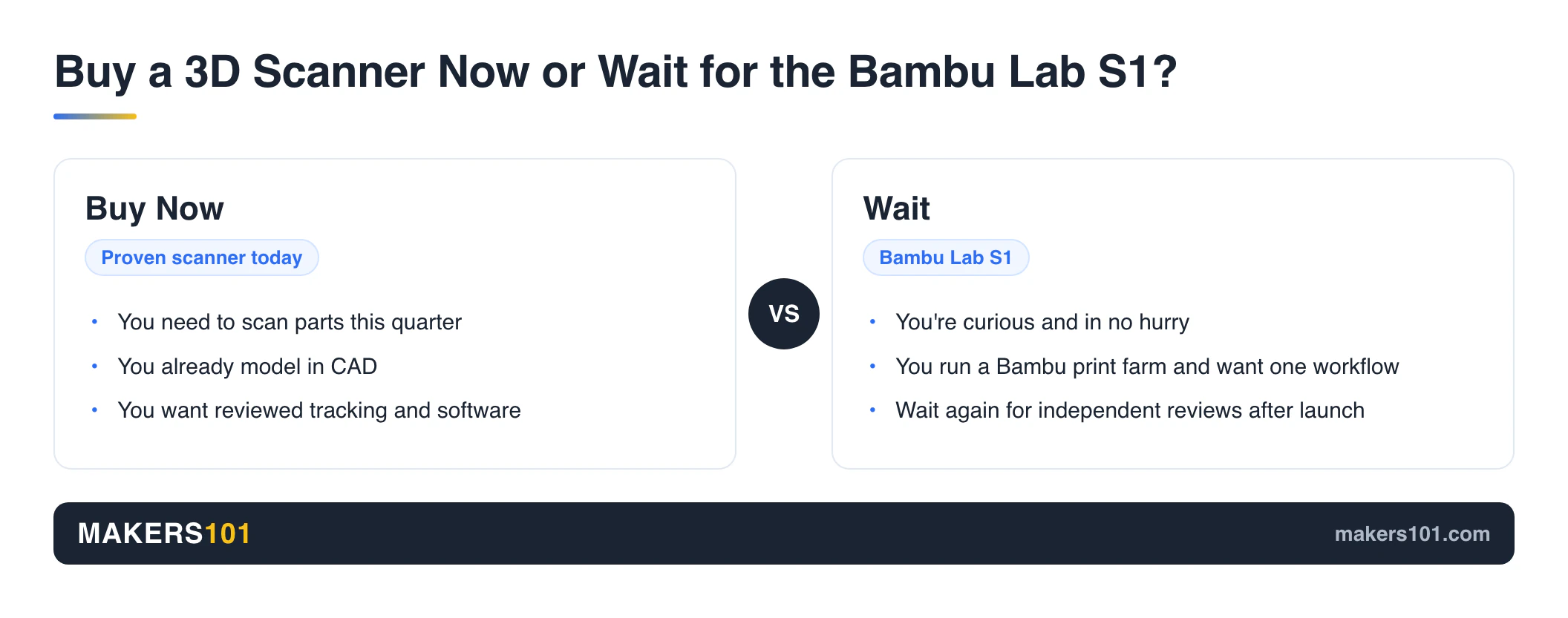
Buy now if you have a real project in the next few months. Wait if you’re curious, in no hurry, and fully invested in Bambu hardware.
- You need to scan parts this quarter: buy a proven scanner today. Our guide to the best 3D scanners for makers ranks options by what actually works for 3D printing.
- You scan once or twice a year: skip dedicated hardware. Phone photogrammetry or a rental covers occasional jobs for far less money.
- You run a Bambu print farm and want one workflow: wait for the launch, then wait again for independent reviews of tracking and software.
- You can’t model in CAD yet: learn that first. A scanner speeds up modeling for people who already know how.

- 【Blue Laser Mode】38 laser lines (19 + 19 crossed laser lines) for fast, large-area capture, 7 parallel laser lines for fine features, support…
- 【Marker-free Laser 3d Scanning】EINSTAR Rockit provides marker-free function, skip the markers — scan feature-rich objects effortlessly. Quick to…
- 【True Wireless 3D Scanning】Built-in Wi-Fi module, without extra hub or adapter setup, true wireless without messy cables, stable real-time sync to…
- 【VCSEL Infrared Scanning】Infrared Scanning Mode provides high efficiency for medium to large objects, from face to feet, scan safely and fast…
- 【Pocket Size, Rocket Speed】Sleek and solid build with a refined finish — fits comfortably in your hand or pocket, Up to 90 fps with marker…
FAQ: Bambu Lab S1 3D Scanner
How much will the Bambu Lab S1 3D scanner cost?
No price yet. Comparable scanners range from $699 (Creality Pika) to $2,299 (Creality Sermoon P1S) in September 2026. Bambu’s history of undercutting professional gear suggests it will aim at the lower-middle of that range, but that is unconfirmed.
When will the Bambu Lab S1 be released?
There is no official date. The FCC filing appeared on September 22, 2026. Community guesses point to Q4 2026, but several Bambu printers filed with the FCC before it remained unreleased when this was published.
What software will the Bambu Lab S1 use?
Bambu has not said. Given its ecosystem, integration with Bambu Studio or Bambu Suite is likely. Whether scans are processed locally or in the cloud is an open question to check at launch.
What 3D printer scanner is recommended for Bambu Lab?
Any scanner that exports STL, OBJ, or 3MF works with Bambu Studio, because the slicer only needs a mesh. Until the S1 ships, pick by object size and budget. Pocket scanners suit small parts, and blue-laser models handle fine mechanical detail.
Is a 3D scanner worth it for 3D printing?
A scanner is worth it if you regularly reproduce, repair, or design around existing objects and can already work in CAD. For occasional use, phone photogrammetry or outsourcing is usually cheaper. A scanner captures shape, and you still do the modeling.
Can I use my phone as a LIDAR scanner?
Yes, on phones with a LiDAR sensor, but the depth resolution is coarse. It works for room-scale objects and rough reference shapes. For small mechanical parts, photogrammetry apps or a dedicated scanner give much better detail.
Is the Bambu Lab S1 the same as the Creality Sermoon S1?
No. They are different scanners from different companies. The Creality Sermoon S1 is already on sale, while the Bambu Lab S1 has only appeared in an FCC filing.