
Heads up — some of the links below are affiliate links. If you buy through them, I earn a small commission (at no extra cost to you), which helps cover the gear I test. Thanks!
- The Bambu Lab A2L is a large-format, single-nozzle bed slinger with a 330 x 320 x 325 mm print area, roughly double the A1.
- It’s not just a scaled-up A1. The servo extruder and adaptive vibration system are real hardware upgrades, not just a bigger frame.
- The biggest weakness is physics: the large moving bed shakes the table at speed, and tall, skinny prints need tuning.
- The 80°C bed caps you at PLA, PETG, and TPU, so engineering materials are off the table.
- Best for cosplay builds and oversized PLA prints. Skip it if you want multicolor efficiency or a true next-generation flagship.
The Bambu Lab A2L is one of those printers that splits the room. Scroll any review and the comments fall into two camps. One side cheered that Bambu finally built a big A-series machine. The other side rolled its eyes and asked if this is just an A1 with a bigger bed.
Most reviews pick a side. Few show you the evidence. The price doesn’t help either, since the A2L sits in the awkward gap between the cheap A-series and the premium H-series.
So here’s what this Bambu Lab A2L review does differently. I’ve had hands-on time with the A2L, then weighed it against more than 400 hours of testing from six experienced reviewers. I added the full official spec sheet and the details owners surfaced on Reddit. Between my own runs and a year on the A1 Mini and AMS lite, I’ll tell you where this machine earns its keep and where it doesn’t.
What Is the Bambu Lab A2L?
The A2L is Bambu’s large-format, open-frame bed slinger aimed at PLA and PETG makers who want room to print big. Think of it as the A1 grown up, with a side job as a craft cutter. We ran the two side by side to see if the bigger bed is worth it.
The headline is size. You get a print area of 330 x 320 x 325 mm, about 105% larger than the A1. Big models print in one piece, which means fewer seams and less gluing. It keeps the single-nozzle design, adds an optional cutting and drawing module, and runs the same friendly Bambu software stack.
A2L at a glance
| Spec | Bambu Lab A2L |
|---|---|
| Build volume | 330 x 320 x 325 mm (105% larger than A1) |
| Motion type | Single-nozzle bed slinger (open frame) |
| Extruder | PMSM closed-loop servo |
| Max nozzle temp | 300°C (hardened steel, 0.2 to 0.8 mm) |
| Max bed temp | 80°C (textured PEI) |
| Max speed / accel | 500 mm/s / 10,000 mm/s² |
| Max flow | 28 mm³/s |
| Noise (quiet mode) | As low as 49 dB |
| Power | 1000 W |
| Weight | 12.8 kg |
| Colors (with AMS) | Up to 19 |
| Materials | PLA, PETG, TPU (PLA-CF/PETG-CF with hardened nozzle) |
| Price (as of June 2026) | $469 standalone / $569 AMS lite Combo |
| Released | June 2026 |
You can buy the A2L in four flavors: the standalone printer, an AMS lite Combo for multicolor, a Combo that adds the cutting and pen module, and a version bundled with the AMS 2 Pro for filament drying. Pick the bundle that matches what you actually plan to make. The cutting kit is the one option you can’t easily add later on the cheap.
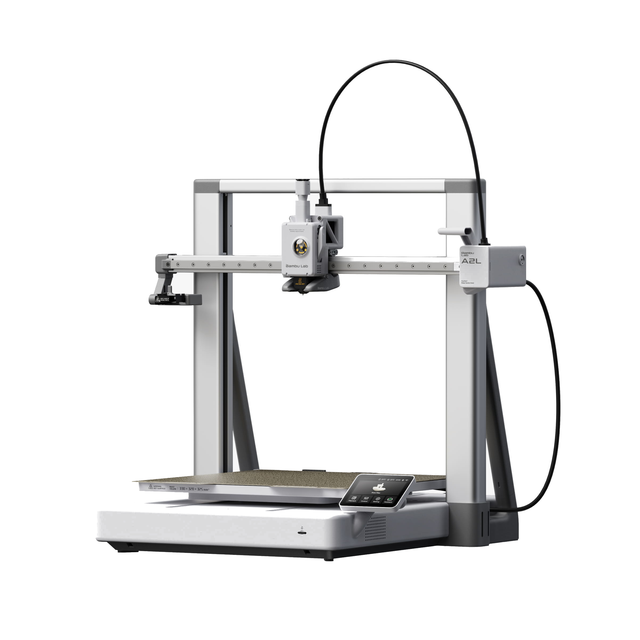
- Large 330 x 320 x 325 mm build volume, about 2x the A1
- PMSM servo extruder with adaptive vibration compensation
- Optional cutting and drawing module for vinyl and papercraft
- Up to 19 colors with AMS, quiet 49 dB operation
Funny side note. We first traced an “A2” rumor back to a 2025 Bambu patent, expecting a dual-nozzle machine. The real A2L took a very different road.
Unboxing and Setup: The First 30 Minutes
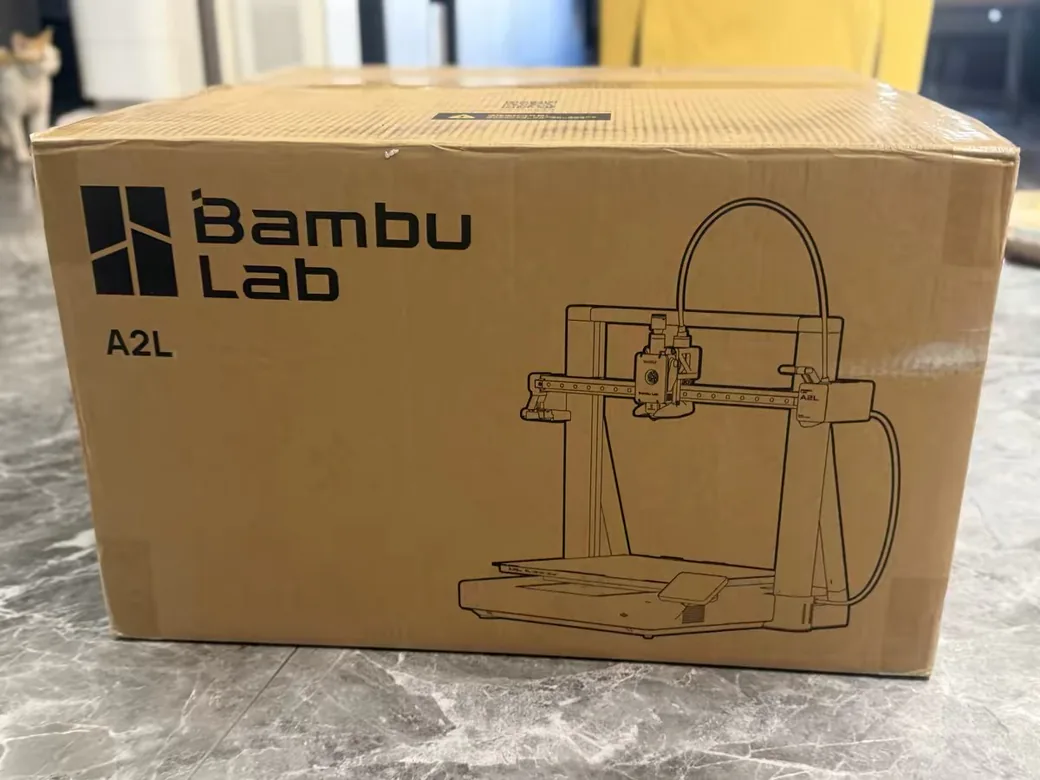
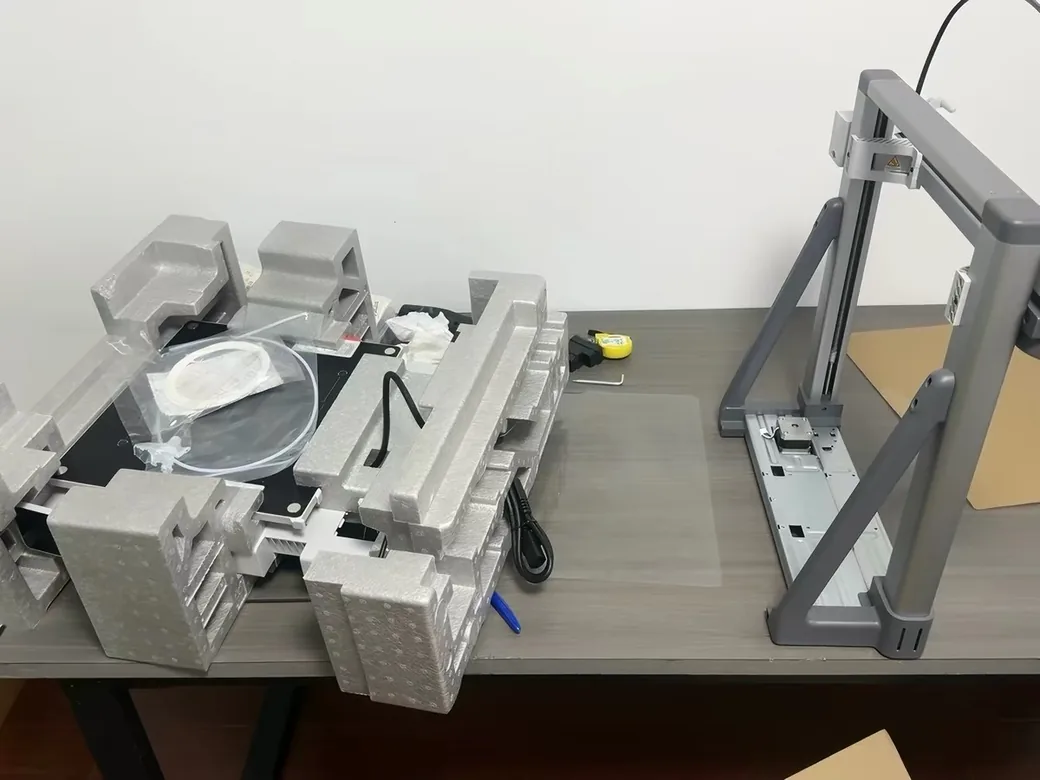
Setup is classic Bambu: mostly painless, done in about half an hour. We walk through every step in our full A2L setup guide. The box holds the base and gantry, a pre-installed 0.4 mm nozzle, a textured PEI plate, the spool holder, and the AMS lite if you bought a Combo.
Assembly follows the usual rhythm. You bolt the gantry to the base, connect a few cables, then wipe the rails with the included lubricant and run the auto-calibration. Owners on Reddit describe the same smooth first-print experience. One even raced to set it up before their spouse noticed the new box.
Two first impressions matter for buyers. This is a big machine, so clear a deep shelf before it arrives. The footprint runs 544 x 529 x 505 mm, and it’s tall once the AMS lite sits on top. A couple of reviewers also flagged small annoyances. The power cable is short at roughly 3.5 feet, and the 3.5-inch screen offers limited color choices. Neither is a dealbreaker, but both shape where the printer can live.
Is the A2L Just a Bigger A1?
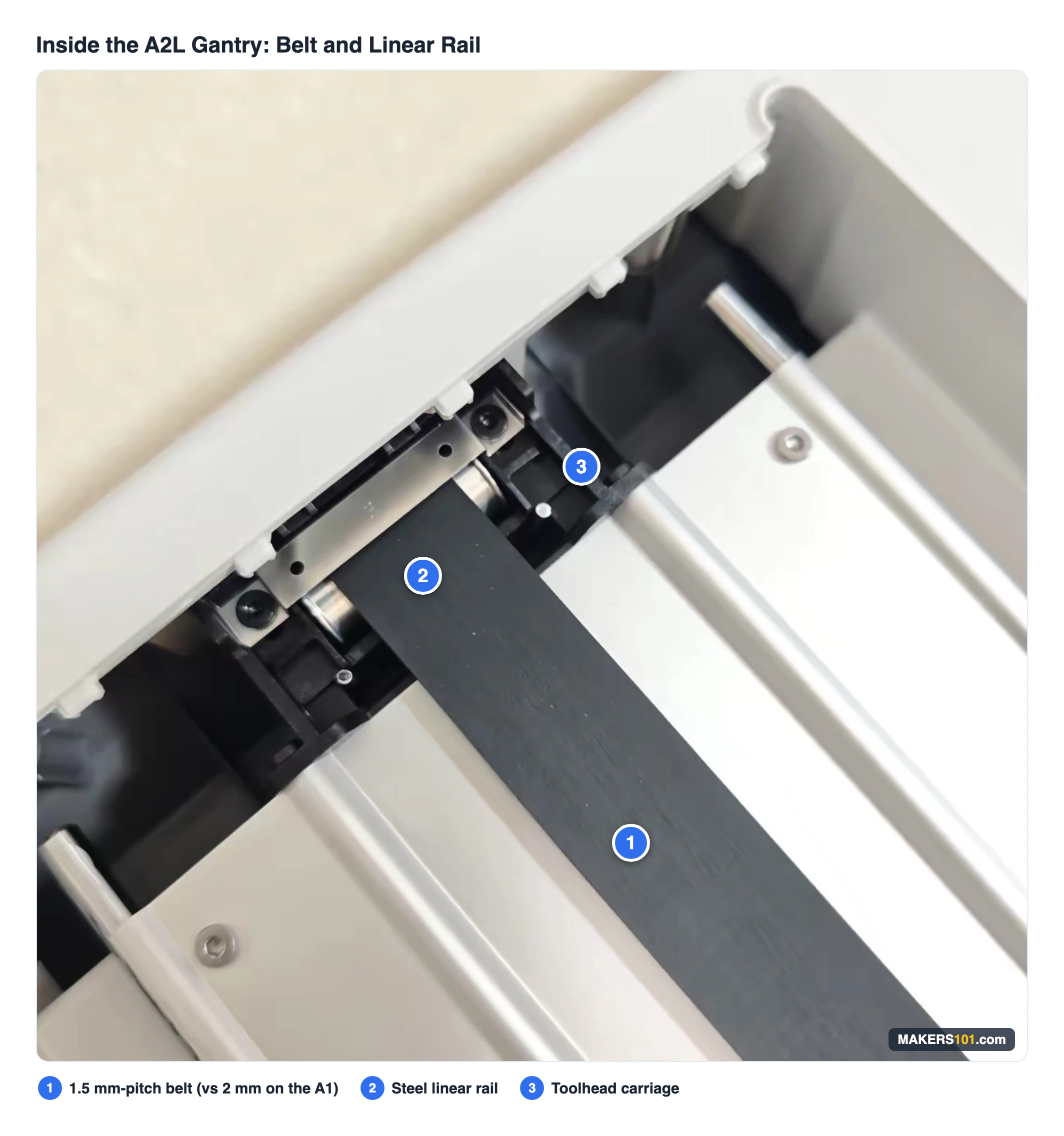
Short answer: yes and no. The chassis looks like a stretched A1, but the parts underneath are different in ways that matter.
This is the question everyone argues about, so let me give you the hardware evidence instead of an opinion. Bambu changed several core components, not just the frame size.
- Servo extruder. The A2L uses a PMSM closed-loop servo motor, while the A1 uses a standard stepper. That means steadier torque at high flow and active monitoring for extrusion problems.
- Adaptive vibration compensation. The A2L maps the bed and toolhead position into a calibration matrix and corrects for resonance during the print. Bambu calls it a desktop first.
- Particle dampers. Two dampers filled with iron sand sit inside the frame and physically absorb vibration.
- Clog detection. A dedicated physical switch watches for filament buildup around the nozzle.
Owners dug up the proof that this is more than marketing. On Reddit, one A2L buyer noted the belts use a 1.5 mm pitch, the same as the H-series and X2D, while the A1 uses a 2 mm pitch. Tighter belts reduce vertical fine artifacts. The same owner found a more powerful controller board with 4 MB of ROM, against 512 kB on the A1 series. That extra headroom is what lets the new vibration algorithms run.
So the “A1L” nickname is fair on the outside and unfair on the inside. You’re getting a genuinely upgraded engine in a familiar body. If you want a refresher on where the small A-series sits, our honest A1 Mini review breaks down that end of the lineup.
A2L vs A1: the short version
| A2L | A1 | |
|---|---|---|
| Build volume | 330 x 320 x 325 mm | 256 x 256 x 256 mm |
| Extruder | Servo (closed-loop) | Stepper |
| Bed temp | 80°C | 100°C |
| Vibration compensation | Yes (adaptive) | No |
| Clog detection | Yes | No |
| Cutting module | Optional | No |
One more practical gap shows up in multicolor. In a head-to-head test, a multicolor job finished in about 1 hour 45 minutes on the A2L versus 3 hours 12 minutes on the A1, with roughly 18% less waste thanks to faster purging.
Print Quality After 400 Hours
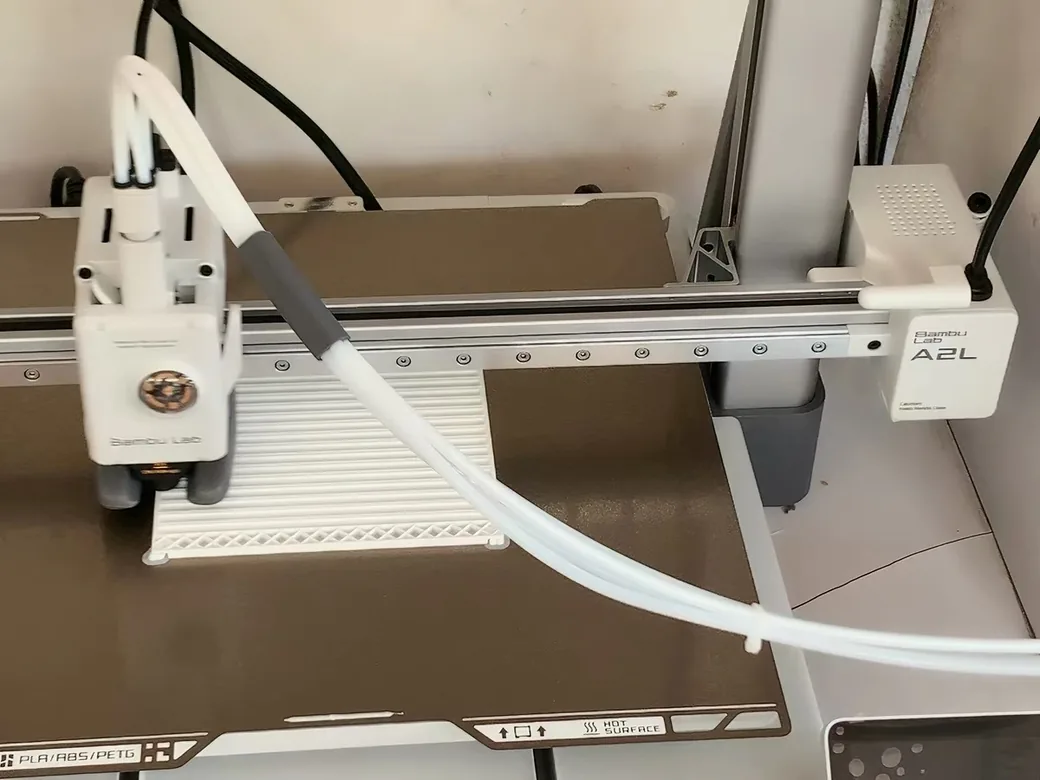
The verdict here is clear: print quality is excellent, especially on large models and cosplay pieces. This is the part nobody really disputes.
Across the reviews, the sample prints speak for themselves. One reviewer ran a 26-hour Notre-Dame model that held crisp detail. A near-full-height Eiffel Tower came out with no layer shifting. A four-piece Darth Vader helmet fit together cleanly, and stormtrooper and Wolf helmets came off the plate ready for paint. Smaller test prints showed almost no vertical artifacts or ringing.
It wasn’t flawless out of the gate. CNC Kitchen hit two early firmware bugs over a long testing window: a random pause mid-print and a failed resume after an AMS lite runout. Both were fixed in later firmware updates, which is the normal Bambu pattern. Worth knowing if you buy at launch and expect day-one perfection.
The Bed Slinger Trade-Off
Here’s the catch a big moving bed can’t escape. When you fling a heavy bed back and forth at speed, two problems follow, and the A2L feels both more than its smaller siblings.
First, tall and skinny prints. The bed motion induces resonance that shows up as surface artifacts on high, narrow parts. The fix is real but manual: turn on “Slow Down at Height,” then mind your part orientation before you slice. Reviewers got great tall prints, but they had to tune for them.
Second, the shaking travels. Multiple reviewers watched the whole desk vibrate during fast moves, and more than one saw the AMS lite creep toward the edge of the table. One reviewer’s AMS lite nearly slid off. The practical fix is a silicone mat or a sturdier stand, but you should plan for it rather than discover it. This is the most consistent complaint across every review, which makes it the one to take seriously.
The Cutting and Drawing Module
This is the A2L’s most interesting trick, and it makes more sense here than on any pricier Bambu. Swap the print head for the optional module and the A2L becomes a vinyl cutter and pen plotter.
The numbers are practical for home crafting. You get a 300 x 300 mm cutting area, a 45-degree blade, and up to 0.5 mm cutting depth. It handles paper, vinyl, stickers, even leather. Drawing covers a 300 x 255 mm area. For a cosplay maker, the workflow is genuinely clever: print a helmet, then cut the vinyl decals to dress it, all on one machine.
A few limits keep it grounded. There’s no top-down camera, so alignment relies on photographing the sheet with the Bambu Handy app. A “print then cut” mode is still in development and promised through a firmware update. And the cutting kit costs extra, around $60 to $70, so Reddit veterans tell new buyers to add it to the order up front.
- Large 330 x 320 x 325 mm build volume, about 2x the A1
- PMSM servo extruder with adaptive vibration compensation
- Optional cutting and drawing module for vinyl and papercraft
- Up to 19 colors with AMS, quiet 49 dB operation
Multicolor, Materials, and the Heat Ceiling
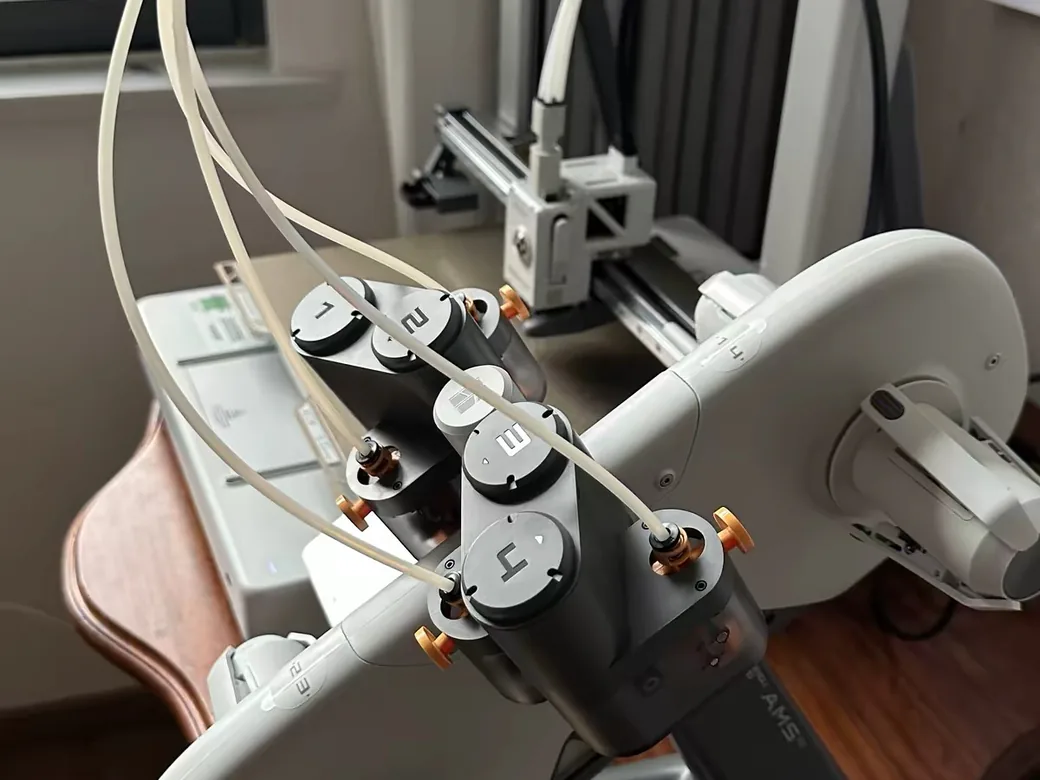
Two limits define what the A2L can and can’t do, and both come straight from its open-frame, single-nozzle design. Understand these and the rest of the buying decision gets easy.
Multicolor works, with a catch you already know from other Bambu machines. Pair it with AMS units and the A2L prints up to 19 colors. But it’s a single nozzle, so every color change purges filament, and the waste adds up on busy multicolor jobs. If you go this route, it helps to plan for the leftovers. We covered what to do with all that AMS filament poo in a separate guide.
Materials are the harder line. The bed runs cooler than the A1’s, as the spec table shows, and that one number decides what you can print. Bambu’s own explanation is energy and safety: a large open bed drawing enough power to hold a high temperature would strain a home circuit, so they capped it. The result is a comfortable zone for PLA and PETG, with TPU in the mix. ABS and the other engineering plastics aren’t its job. If that’s what you need, this is the wrong printer.
A few filament staples and basics most A2L owners grab first:


What I Like and What I Don’t
After weighing every review against the spec sheet, the trade-offs line up cleanly.
- Huge build volume prints big models in one piece
- Top-tier print quality, especially on large and cosplay parts
- Real engine upgrades: servo extruder, vibration compensation, particle dampers
- Optional cutting and pen module adds genuine versatility
- AMS lite makes long multicolor prints practical
- Quiet at 49 dB and UL GREENGUARD certified for home use
- The large bed shakes the desk and can walk the AMS lite around
- Tall, skinny prints need manual tuning to look their best
- The low bed ceiling locks you out of engineering materials
- Single nozzle still wastes filament on multicolor
- Camera remains low quality and laggy
- Short power cable, and the “2” feels more like a polished A1
Who Should Buy the A2L (and Who Should Skip)
Buy the A2L if you print big and you live in PLA and PETG. Cosplayers, prop makers, and anyone who wants large one-piece prints will love the volume. If you also want a cutter for decals and papercraft, the module seals the deal. And if you value Bambu’s hands-off ecosystem more than open tinkering, it fits.
Skip it if your needs pull the other way. Engineering materials, an enclosed chamber, and true multicolor efficiency all point elsewhere. If color throughput is your goal, a dual-nozzle machine wastes far less. And if you’re chasing genuine next-generation flagship features, the A2L is a refinement, not a revolution. Tight on desk space? This is a big, deep machine.
How the A2L Compares: A1, X2D, and P2S

- A1 Combo + LED Lamp Kit for Functional Light Projects: Bambu Lab A1 Combo + LED Lamp Kit lets you create illuminated models. Simply print compatible…
- High-Speed Precision: Experience unparalleled speed and precision with the Bambu Lab A1 3D Printer. With an impressive acceleration of 10,000 mm/s…
- Multi-Color Printing with AMS lite: Unlock your creativity with vibrant and multi-colored 3D prints. The Bambu Lab A1 3D printers make multi-color…
- Full-Auto Calibration: Say goodbye to manual calibration hassles. The A1 3D printer takes care of all the calibration processes automatically…
- Active Flow Rate Compensation: Achieve consistently smooth prints with active flow rate compensation. The algorithm actively compensates the flow rate…
A quick map of where the A2L lands against its siblings:
- vs A1: The A2L is bigger with a newer engine, but the A1 is cheaper and runs a hotter 100°C bed. If you don’t need the size, the A1 still holds up.
- vs X2D: Want real dual-nozzle multicolor or engineering materials? The X2D is the answer. See the X2D and its dual-nozzle system for the full picture.
- vs P2S: The P2S sits at a similar price but takes the opposite approach, an enclosed CoreXY built for speed and tougher materials. Our breakdown of how the P2S and X2D stack up shows that side of the lineup.
The pattern is simple. The A2L trades enclosure and multi-tool ambition for a large open bed plus a cutting module.
The Bambu Ecosystem Question
You’ve probably seen the debates, so let me address them head on rather than pretend they don’t exist. Bambu has drawn real criticism over its closed ecosystem and recent limits on third-party developer access to cloud features. Those concerns are legitimate, and every serious reviewer mentioned them.
Here’s the balanced way to hold it. If you’re happy with a polished, hands-off ecosystem and mostly print PLA and PETG, the A2L is a strong tool that mostly stays out of your way. If open-source freedom and data control sit high on your list, weigh that before buying. Both positions are reasonable. The machine itself doesn’t resolve the argument.
Final Verdict
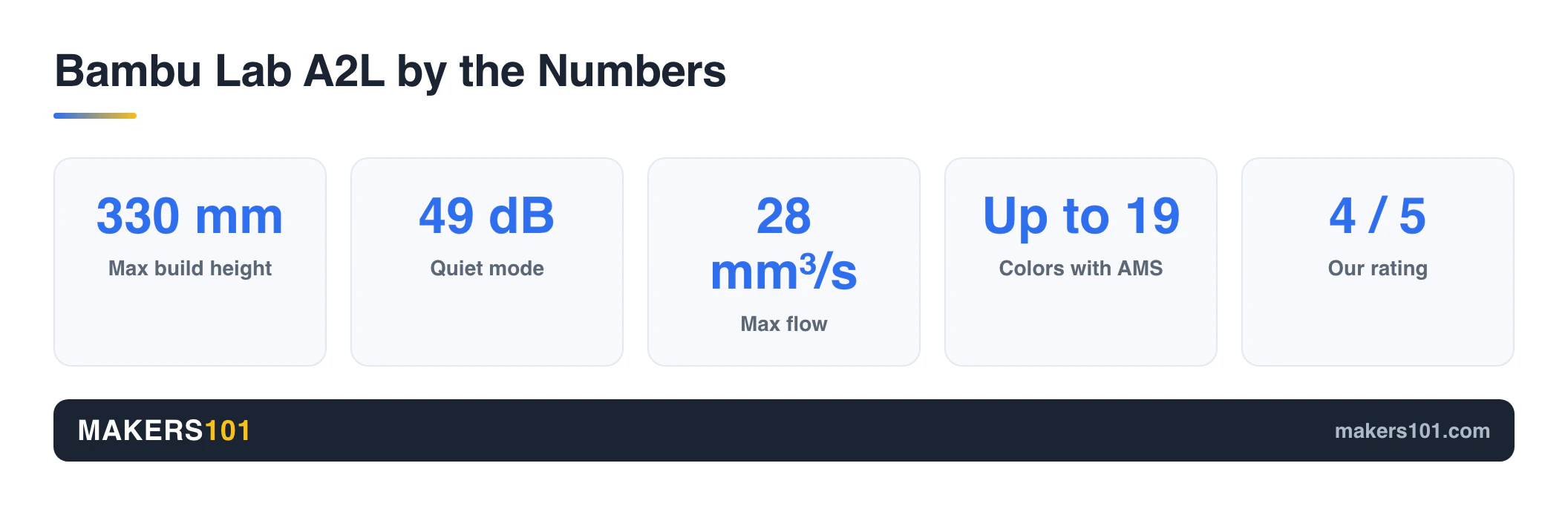
The Bambu Lab A2L earns a solid 4 out of 5. It delivers excellent print quality at a large size, the optional cutting module is a real bonus, and the upgraded extruder and vibration system run deeper than the frame.
It loses a point for physics and positioning. The bed slinger design shakes at speed, the 80°C bed fences you into a few materials, and the “2” oversells what’s really a polished, larger A1. Buy it because you want a big open bed and a clever modular cutter, not because you expect a new generation. For the right maker, it’s a lot of capable printing for the money, as of June 2026.
FAQ
Is the Bambu Lab A2L just a bigger A1? Not quite. It shares the A1’s bed slinger layout, but the internals changed. It adds a servo extruder, adaptive vibration compensation, and particle dampers. The belts are tighter at 1.5 mm and the controller board is more powerful. So it’s a bigger A1 on the outside and a real upgrade underneath.
How much does the Bambu Lab A2L cost? As of June 2026, the standalone printer is $469 and the AMS lite Combo is $569. The cutting and drawing module costs extra, roughly $60 to $70. Bundles with the cutting kit or AMS 2 Pro dryer cost more.
Why is the A2L’s bed temperature lower than the A1’s? Bambu capped it on purpose, as the spec table above shows. The A2L has a large open bed, and holding a very high temperature across that area would draw heavy power and strain home circuits. The trade-off keeps PLA and PETG comfortable while staying energy efficient.
Does the A2L do multicolor, and how many colors? Yes, with AMS units attached. You can run up to 19 colors using four AMS units plus one AMS lite. It’s still a single nozzle, so color changes purge filament and create waste on heavy multicolor jobs.
Do I need to buy the cutting module separately? In most cases, yes. Only the cutting Combo bundle includes it. If you want vinyl cutting and pen plotting, add the cutting upgrade kit to your order, since it bundles the blade and pen modules with the mats.
Is the A2L good for tall, skinny prints? It can be, with tuning. The moving bed causes resonance on high, narrow parts, so enable “Slow Down at Height” before you slice and watch your orientation. Reviewers pulled clean tall prints once they moved off the default settings.