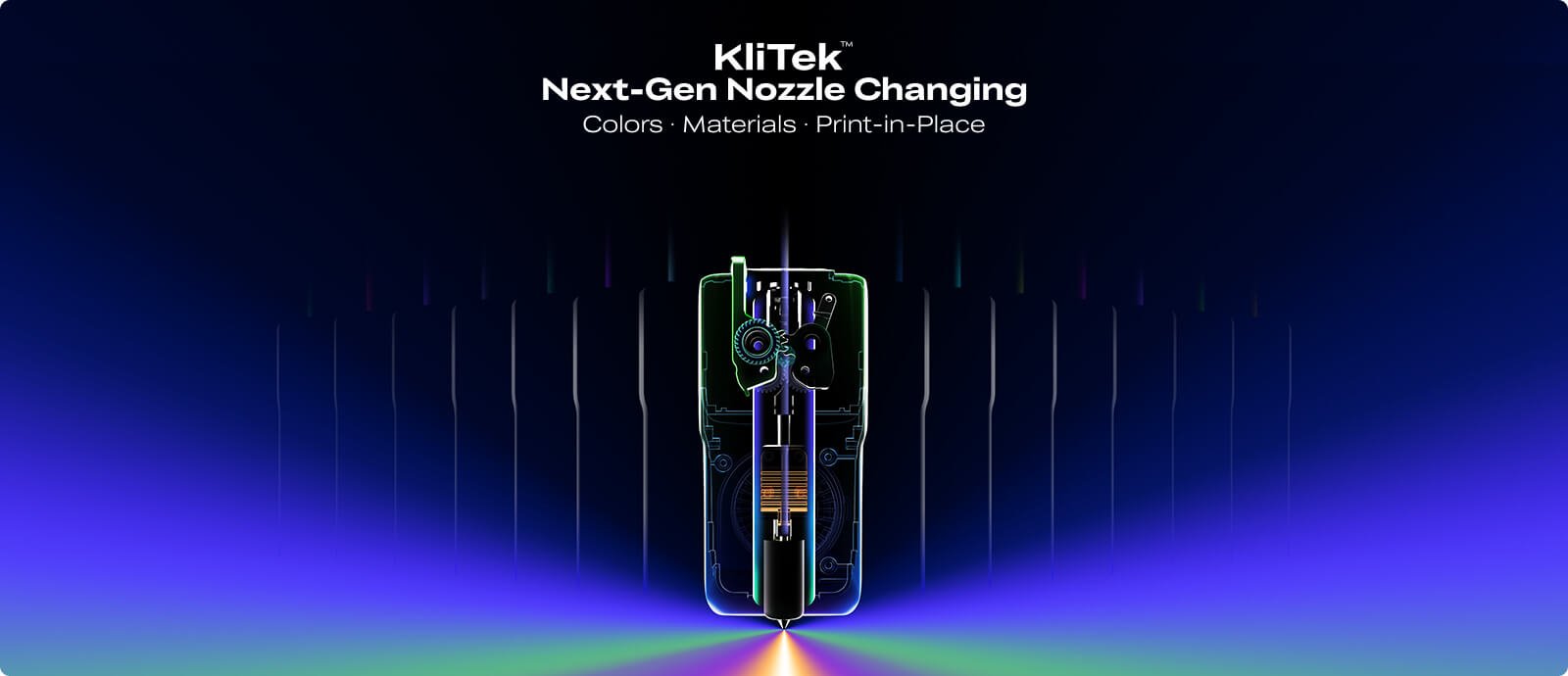

When Creality first teased the word “KliTek,” nobody could say what it actually was. A banner, a slogan, and a strange name. That was it. If you’re shopping rather than upgrading, here’s which Creality to buy.
That changed on May 30. Creality dropped a full launch video, and the guesswork turned into a spec sheet. KliTek is real. It works on camera, and the headline trick is one makers have wanted for years.
Here’s what the video confirmed, how KliTek stacks up against Bambu Vortek and Bondtech INDX, and why the comment section is far more divided than the spec sheet alone would suggest.
Table of Contents
- What Is Creality KliTek?
- What the Official Video Confirmed
- Creality K3: The Printer Behind KliTek
- KliTek vs Vortek vs Bondtech INDX
- My Take: Cautiously Excited, Realistically Patient
- How the 3D Printing Community Reacted
- Why This Matters: The Multi-Material Race in 2026
- What We Still Don’t Know
- What’s Next: Watch List
- The Teaser: What Creality Has Actually Said
- What “Coreshift” Might Be (and Why the Naming Matters)
- KliTek At a Glance
- FAQ
What Is Creality KliTek?
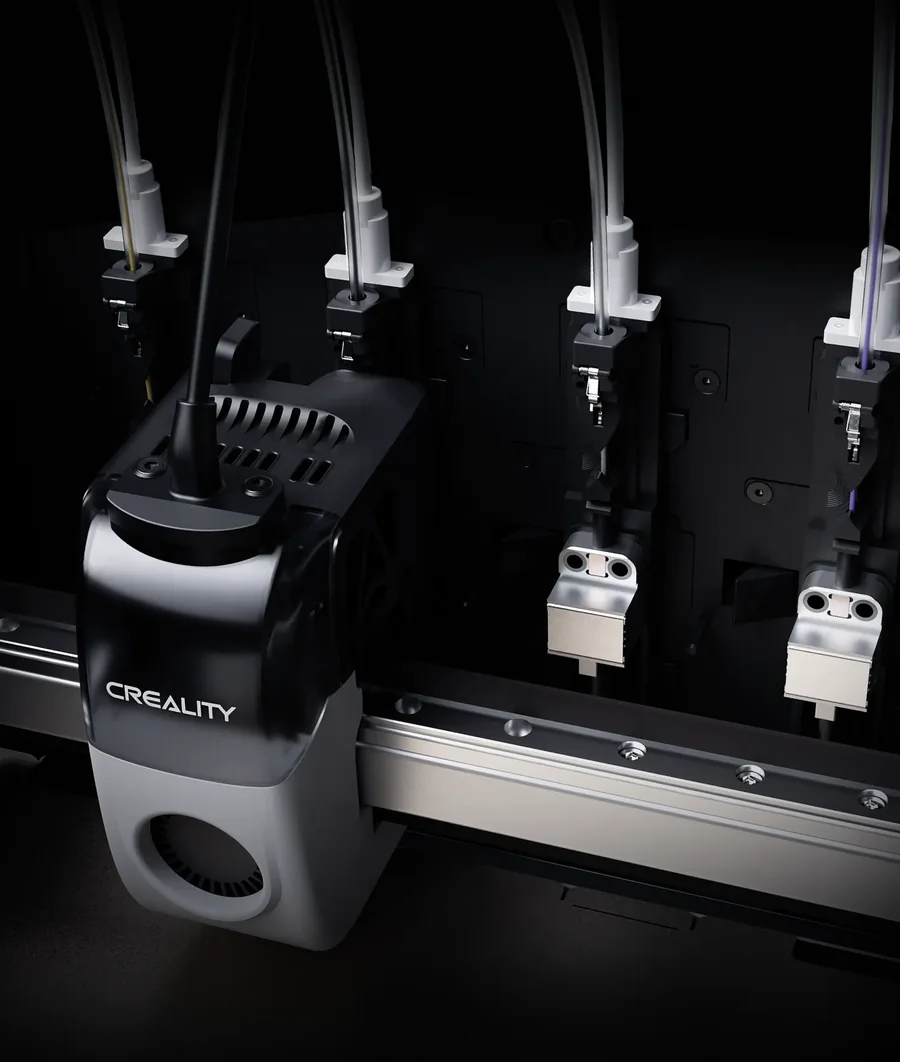
KliTek is Creality’s tool-head changing system. The name is Creality’s own. It showed up first in the 12th-anniversary teaser, then in a dedicated launch video on May 30.
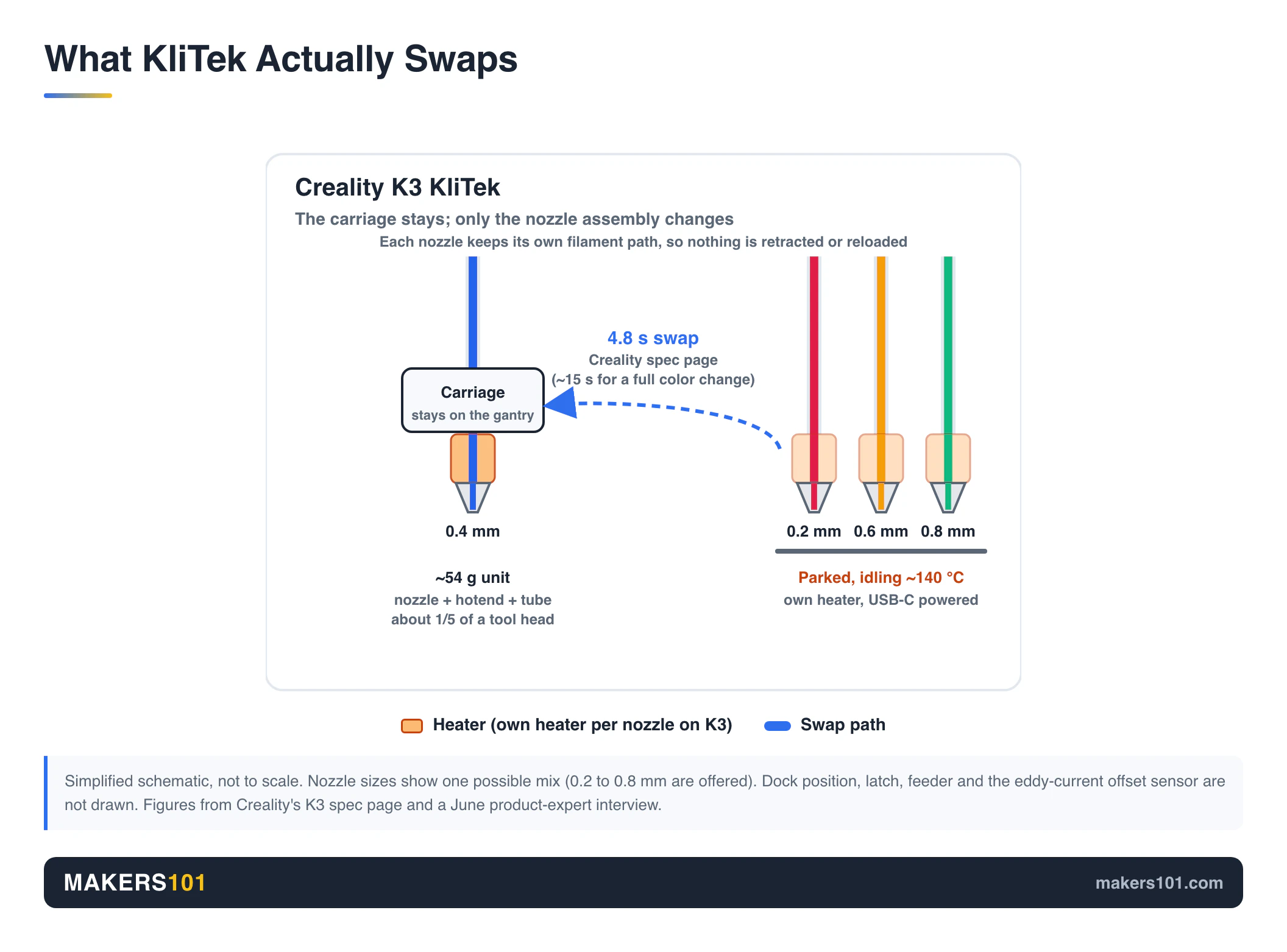
The pitch stayed the same: Colors, Materials, Print-in-Place. What’s new is that you can now watch it run. Here’s the part the early coverage got wrong: KliTek doesn’t swap a whole tool head. It swaps only the nozzle assembly (the nozzle, hotend, and filament tube), which weighs about a fifth of a full head and preheats before it drops in. Creality named it for the sharp “click” when that assembly locks home.
What the slogan tells us
The three words are not interchangeable marketing fluff. They map to three different jobs.
- Colors → multi-color printing without filament flushing.
- Materials → serious multi-material: rigid, flexible, and soluble support in one print.
- Print-in-Place → assembled mechanisms, functional parts, in-print property switching.
Why this matters more than “just a nozzle changer”
Most multi-color systems still push every filament through one nozzle. That means purge towers, color contamination, slow swaps, and real limits when materials behave nothing like each other.
An in-process nozzle or hotend swap is different physics. Different waste profile. Different print times. It belongs in the same conversation as the rest of consumer FDM’s multi-material era, not in the “easier hand swap” bucket.
What the Official Video Confirmed
The May 30 video answered most of the questions the teaser left open. Creality’s official KliTek page has since filled in the rest. Here’s what’s now confirmed.
- Mechanism: it swaps the nozzle assembly (nozzle, hotend, and filament tube), about a fifth the weight of a full tool head. Each one packs its own PTC heater, so it can preheat before it slots in. That’s a different approach from Bambu’s induction heating.
- Swap speed: 4.8 seconds to change a nozzle, per Creality’s official spec page (refining the earlier “about 5 seconds” wording). A full color or material change stays under 15.
- Mixed nozzle sizes, one job: run a 0.8 mm nozzle for infill and speed, then a 0.4 mm for fine surfaces, without stopping the print. Creality’s spec sheet now lists four sizes: 0.2, 0.4, 0.6, and 0.8 mm. This was the single most requested feature in the comments.
- Better flexibles: an S-Drive dual-drive feeder aimed at TPU. The base K3 ships with TPU 95A support; the optional Multi-Material Kit adds softer TPU down to 80A. Creality claims up to 7x the TPU speed of a conventional printer (15 mm³/s versus 2 to 3).
- Color: Creality’s page lists 4 tool heads for CMYK.
- The chassis under it all: Creality puts the K3 frame at 30% stiffer than its previous generation, running closed-loop step servos and about 7 dB quieter. Each swappable nozzle assembly weighs roughly 54 g and tops out at 300°C. A swap system lives or dies on frame rigidity, so that 30% claim is the one to check once reviewers get a machine.
- Per-head power and heating: in a June interview, a Creality product expert said each head draws its own USB-C power, idles near 140°C, and heats on demand. There are no cooling fans, a PTC-style route rather than Bambu’s induction.
- Calibration: an eddy-current sensor finds each nozzle’s center to set the offset, so there’s no mechanical probing. Creality counts 37 sensors across the machine, 12 of them working only on nozzle changes, and puts repositioning accuracy under 25 microns on an XYZ three-axis system.
The specs exist now. The question shifts from “what is it” to “does it hold up.” Creality answered a lot more of that question when the K3’s official product page replaced the campaign teaser with a full spec sheet. That page is the source for most of what follows.
Creality K3: The Printer Behind KliTek
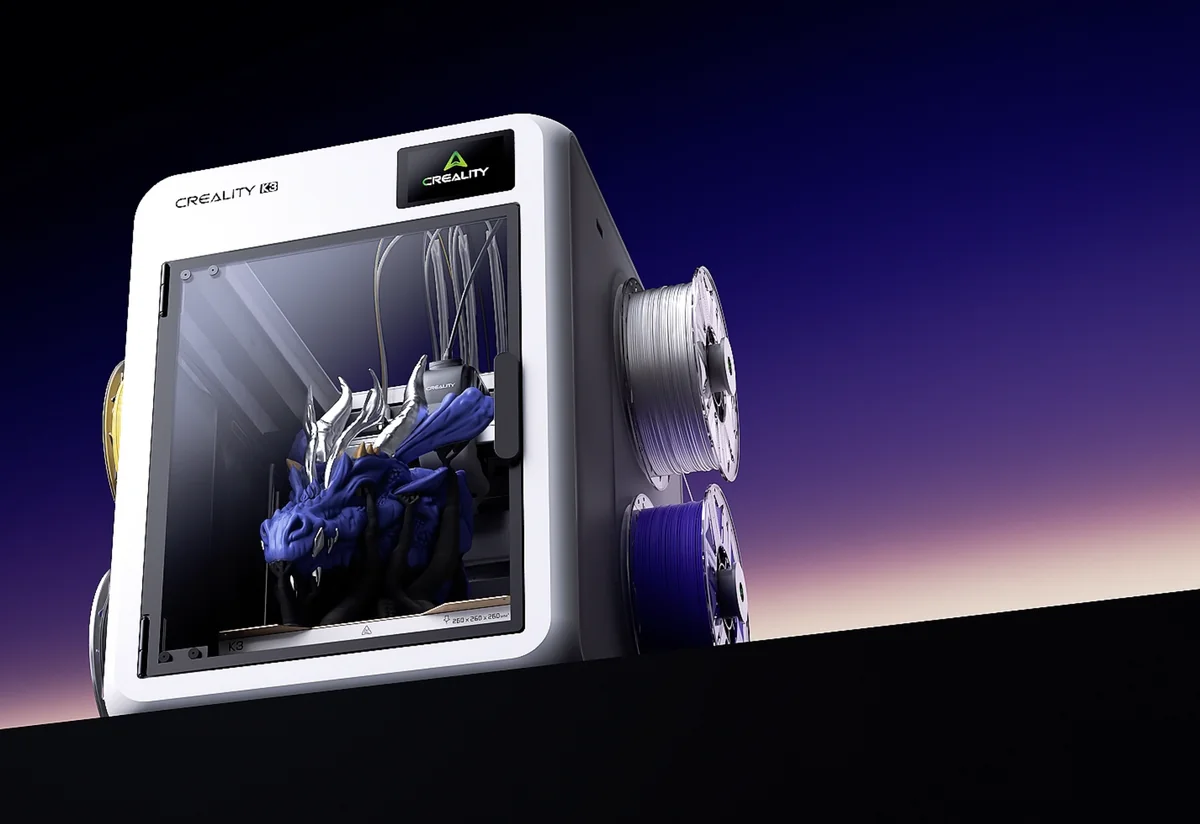
KliTek doesn’t ship on its own. It ships on the Creality K3, the next flagship, due in Q3 2026. If you came here searching for the Creality K3 3D printer rather than the swap tech, here’s the machine itself.
The base K3 is a CoreXY printer with a 260 by 260 by 260 mm build volume. A June interview with a Creality product expert filled in the parts the launch video skipped. Filament runs through a new S-Drive dual-drive feeder, and that same June interview paired it with a smaller CFS Nano unit, the one that also feeds the SparkX i7. The September spec page doesn’t repeat the CFS Nano name; it lists CFS Flex and CFS Hub instead, with no prices and no explanation of how either attaches. Whether that’s a rename or an added option isn’t clear yet. A cutter built into the print head trims filament between swaps, so the system skips long retractions. That June interview also said firmware stays on Klipper, matching the rest of the K series, though the K3’s own spec page doesn’t repeat that detail either (more on that below). KliTek isn’t the only multicolor answer Creality is working on. Three months later it showed the SPARKX i8 and its QuarTeks printhead. The i8 is on Indiegogo until October 31, and we looked at whether it’s safe to back.
Two choices stand out. The base model has no heated chamber, which caps it on high-warp materials like ABS unless you add the optional top cover, a separate purchase per the September spec page. And the four heads are a deliberate call: Creality framed KliTek around material freedom over raw nozzle count, even as commenters asked for five or six. The same interview suggested larger K3 Pro and Plus versions later, possibly with more heads and a heated chamber, though Creality hasn’t confirmed those specs, and its September spec page still doesn’t name them.
The September 4 Spec Sheet: What’s New, What’s Still a Claim
Creality’s K3 page moved from a teaser to a full product listing on September 4, the same day IFA Berlin opened. That timing isn’t new for Creality. It announced the K2 Pro on IFA’s opening day in 2025.
The page fills in hardware the June interview skipped:
- Dimensions: 420 x 482 x 536 mm, net weight 22 kg.
- Speed: 500 mm/s max, 20,000 mm/s² max acceleration.
- Bed and chamber: heated bed to 100°C. Still no heated chamber on the base model.
- Screen and camera: 3.97-inch touchscreen, 720p camera that checks for a missing build plate before printing and watches for spaghetti during one.
- Storage and connectivity: 8 GB onboard, Wi-Fi, and Creality Cloud.
- Power: 480 W at 100 to 127 V, or 950 W at 200 to 240 V.
- Slicer: needs Creality Print 7.0 or newer.
Creality also published its own benchmark data: four print jobs from the model site STLFLIX, each measured against a single-nozzle printer. The headline claims are up to 80% less print time and up to 85% less filament. Run the numbers Creality itself posted for those four jobs, and the picture is more mixed than the headline.
| Model (Creality’s own test) | Print time saved | Filament saved |
|---|---|---|
| Chivalry Thirst Quencher | 72% | 92% |
| Titan Dragon Trophy | 75% | 90% |
| Naja Incense Holder | 57% | 68% |
| Gargoyle’s Roost Dice Tower | 31% | 82% |
None of the four jobs actually clear the 80% print-time headline. Two come close, at 72% and 75%. Two land well short, down to 31% on the dice tower. Filament savings hold up better: every job clears at least 68%, and two beat the 85% headline. Creality does say “up to,” which keeps the claim technically honest. What decides your result is the model itself: how many colors it uses, and how much printing happens between each nozzle change.
KliTek vs Vortek vs Bondtech INDX
The teaser drew Vortek comparisons. The launch video drew a different one: Bondtech INDX. That’s the name the comment section keeps coming back to, and it matters more than the Vortek angle.
Both replace “one nozzle, many filaments” with “swap the hot end itself.” Both target multi-material printing without the purge-tower tax. KliTek’s twist is the mix of nozzle sizes in a single print, which neither rival leads with.
| Parameter | Bambu Vortek | Bondtech INDX | Creality KliTek |
|---|---|---|---|
| Status (September 2026) | Shipping (H2C) | Founders Edition shipping; parts and dev kit on sale at Bondtech | Still pre-launch; official K3 spec page live since Sept 4, price still unannounced |
| Mechanism | Induction-heated hotend swap | Induction-heated nozzle swap | Nozzle-assembly swap (nozzle, hotend, tube; ~1/5 tool-head weight), per-head PTC preheat |
| Heads | Up to 7 | Multiple (nozzle dock) | 4 tool heads (CMYK) |
| Swap / heat time | ~8 sec induction | Seconds (induction) | 4.8 sec per nozzle; under 15 sec per color/material change |
| Standout | Mature, shipping now | Compact, low per-nozzle cost | Four nozzle sizes in a single print; TPU down to 80A with the optional kit |
| Price | From £1,999 (H2C combo) | Standalone kit, price TBC | Low per-swap cost; K3 printer price still TBC, $50 deposit open |
The honest read: KliTek lands between the two. It skips induction heating, so it should cost less per head than Vortek or INDX. It still puts a heater in every head, so swaps stay fast and each tool can preheat. Our Bambu Lab H2C and Vortek system breakdown has the full picture on Vortek. KliTek’s still a way out, so if you need a Creality machine now, it’s worth checking today’s deals on Amazon.
Vortek shipped in March 2026. KliTek arrived two months later. That fits Creality’s pattern of fast competitive response: CFS chased AMS, K2 chased X1C. The gap is closing fast. The execution is what’s still unproven.
My Take: Cautiously Excited, Realistically Patient
This is Creality’s first real swing at next-gen multi-material printing, and the video makes the case better than the teaser did. The mixed-nozzle feature alone is something makers have asked for. Execution will decide the rest. Torn between waiting for it and backing the cheaper SparkX i8? We weighed the two against each other.
The interesting question isn’t whether Creality can ship KliTek fast. It’s whether the first version will be worth buying. CFS arrived rougher than AMS, then smoothed out by the time CFS-C launched. K2 had ringing issues; K2 Pro fixed them. Creality’s first-gen answer to a Bambu feature usually exposes the problems the second iteration quietly solves. Bet on KliTek v2, not v1. That fits Creality’s broader strategic positioning beyond budget printers.
What I’m watching for isn’t the spec sheet. It’s swap reliability after 500 cycles. That’s where most clever mechanisms quietly fail.
One thing from that June interview needed a correction. A Creality source said then that the K3 would drop the Klipper root access older K-series tinkerers leaned on, and I flagged it here as a real trust flashpoint. Creality’s own September spec page settles it: the K3 listing states native Root access integration, alongside a link to Creality’s GitHub. Given Creality’s bumpy root-access history, take that as Creality’s current official position. How open production units actually end up is still an open question.
If KliTek delivers, it could move multi-material printing past purge towers and filament flushing. It could bring toolchanger-like printing to a Creality price point. Big if.
How the 3D Printing Community Reacted
The launch video passed 80,000 views in two days and pulled nearly 400 comments. I read through all of them. The mood splits hard, and it tells you more than the spec sheet does.
The most-liked comment was simple: “Finally the different sized nozzles are here.” Mixed nozzle sizes, not color, is what got people excited. That tracks with what I’d reach for it too.
The copy debate
The loudest thread accuses Creality of cloning Bondtech INDX. “Copycat” shows up a lot. The fairer voices pointed out the real difference: KliTek heats each head with a PTC element, while INDX uses induction. And INDX still isn’t on sale, so the “clone” may reach buyers first.
Trust is the real problem
This is the wall Creality keeps hitting. Comment after comment raised the same fears: weak after-sales support, quality-control misses, and a habit of dropping older models fast. Plenty of owners want this to work and still won’t pre-order.
That skepticism hasn’t faded. A September thread on r/Creality, reacting to the new spec page, pulled the same complaints forward. One commenter described reserving a unit on Creality’s livestream with a $50 deposit, then pointed out that Creality still hadn’t named a price or a release date outside China after roughly two months of teasing. Another questioned why every K3 demo prints multicolor PLA and never TPU on camera, calling the TPU claims unproven until Creality shows it live. Neither complaint is new to 3D printing crowdfunding cycles. Both are getting louder as the Q3 window runs out.
What buyers are asking for
- More heads: many want 5 or 6 for true CMYK plus white, not just 4.
- A K2 Plus upgrade kit: one of the most-liked requests. Owners don’t want to buy a whole new machine.
- A fair price: the second most-liked comment just asked for it to stay affordable. The bar everyone names is the Snapmaker U1.
- A bigger bed: 260 mm feels small to anyone who has printed on 300 mm or more.
One quieter note: a lot of viewers disliked the AI voiceover. On a flagship launch, that reads as cheap. Small thing, real signal.
Why This Matters: The Multi-Material Race in 2026
Consumer FDM stopped being “one printer, one nozzle, occasional ABS” back in 2025. By mid-2026, every flagship brand is fighting over multi-material workflow. Creality launching KliTek is the clearest sign it doesn’t want to stay the budget-only player.
Where the industry sits in mid-2026
- Bambu is shipping Vortek on the H2C. Up to 7 hotends, ~8-second induction heat-up per swap, with documented performance gains (see comparison table above).
- Bambu X2D brought dual-nozzle below $900, but its AMS still feeds only one of those nozzles automatically.
- Snapmaker U1 still owns the budget tool-changer slot. Our dual nozzle vs tool changer trade-offs piece explains the split.
- Creality confirmed KliTek on the new K3: 4.8-second nozzle swaps, 0.2/0.4/0.6/0.8 mm sizes in one print, and TPU down to 80A with the optional kit. Spec page live, price still due.
The legal angle nobody can ignore
Tool-change patents still hover over the category. The Stratasys ruling against Bambu’s H2C in Europe failed to block the printer in early 2026, but the legal pressure is real. With KliTek, the community is pointing at a different name: Bondtech INDX. Whatever the exact mechanism, KliTek has to clear the same minefield.
What We Still Don’t Know
The video answered the big mechanical questions. The K3 page answered a few more. A shorter list is still open.
- The K3 printer’s own price. Only the nozzle assembly (~$14) has a number so far. The machine doesn’t, even with the full spec page live and a $50 deposit open on Creality’s livestream.
- A firm on-sale date. Creality’s page still says Q3 2026, but that’s a window, not a day, and there’s still no order date or ship date outside China.
- Independent, hands-on reviews. Every write-up so far, ours included, leans on Creality’s own materials, not bench testing.
- Independent reliability. The 80,000-cycle swap figure Creality cited in June no longer appears on the September spec page, and no outside lab or long-term owner has confirmed it either way. This is where clever mechanisms quietly fail.
- Whether older machines like the K2 Plus get an upgrade path, or none at all.
- Whether a larger bed option arrives, since 260 mm is small for some users.
The $50 Deposit and the Price Question
A deposit isn’t a price. Creality’s livestream let early viewers put down $50 to reserve a K3, and more than one commenter online treated that as a sign a price announcement was close. It isn’t the same thing. The official spec page still carries no currency, no per-kit pricing, and no ship date.
Numbers are circulating anyway. A handful of posts online cite early-bird figures in the $379 to $449 range, or a flat $599, sourced to Reddit threads and comment sections rather than Creality itself. None of them trace back to an official page, a press release, or a retailer listing. Treat every one of them as a guess until Creality publishes a number.
For a release date, the closest thing to precedent is Creality’s own history. The SparkX i7 went on sale about two weeks after Creality announced it. If the K3 follows that pattern, a firm date could land before the Q3 2026 window closes. That’s a guess built on past behavior, worth watching but nothing Creality has confirmed.
Is There a K3 Plus or K3 Pro?
The official KliTek FAQ says the system debuts on the “K3 Series.” That word is plural, and a company picks it on purpose. A series means more than one machine.
What you can actually bank on stays thin. The K3 in the video has a 260 mm bed and no heated chamber on the base model. Past that, Creality has named no K3 Plus, published no spec for one, and given it no window. Even Creality’s most detailed K3 listing yet says nothing beyond the base model.
So if you’re searching for K3 Plus specs and finding confident answers, be careful with them. A larger variant is a reasonable bet given how K2 rolled out, and a bigger bed with a heated chamber is the obvious gap to fill. That reading comes from Creality’s naming and its past releases. Nobody has leaked a spec sheet. We’ll put real numbers here the day Creality publishes them.
That’s the entire honest list. Anyone claiming more right now is guessing.
What’s Next: Watch List
KliTek is confirmed real. Now three things will tell you whether it’s worth buying: an official price, a firm ship date, and independent reviews that run it past the demo. Until all three land, the U1 is the only machine of this type you can actually order. Here’s how the two stack up today.
Realistic timeline
Creality showed the video at the end of May, then replaced the teaser page with a full spec sheet on September 4. That Q3 2026 window is now official, printed on Creality’s own page. Independent coverage has followed (all3dp, domechy, plus the usual launch-reaction videos), all working from Creality’s own materials. Nobody has run a K3 in person yet.
How to track without watching every YouTube channel
- Creality’s blog and 12-anniversary page.
- The r/Creality community thread already pinned to the teaser image.
- Creality’s Indiegogo and Kickstarter accounts. Past launches like the M1 filament maker debuted there before the official store.
- Bambu Lab community reactions on r/BambuLab and the Bambu forum, which tend to surface the technical critique mainstream coverage misses.
- This post. It’ll be updated as new specs land.
The Teaser: What Creality Has Actually Said
Everything you need to know is above: confirmed specs, the September spec sheet, the comparison, the community reaction. What follows is the backstory, kept for context and because it’s still the honest record of how little anyone actually knew back in May.
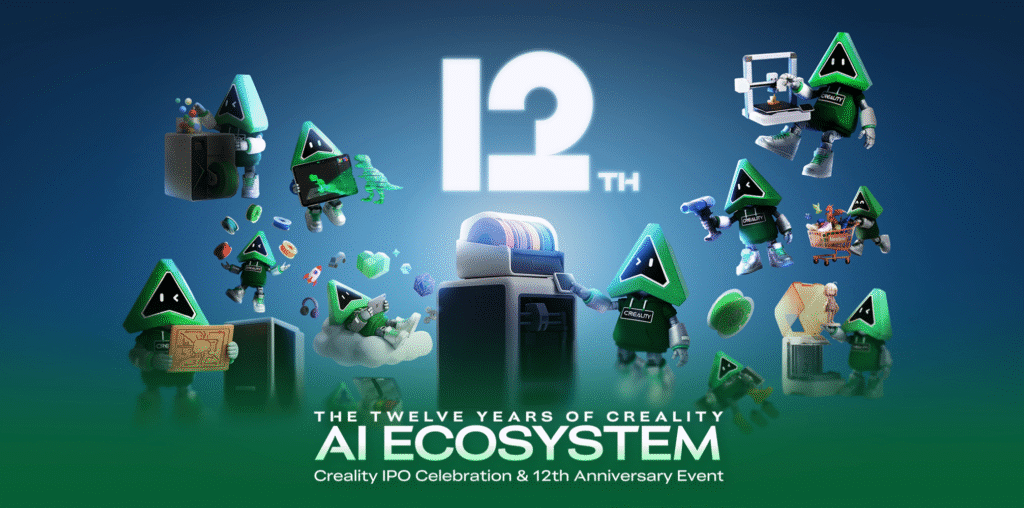
This is where it all started: one banner, two slogan words, one codename. At the time, everything below was community reading. The May 30 video, and Creality’s own spec page since, have confirmed the big questions this section could only guess at.
What’s on the anniversary page
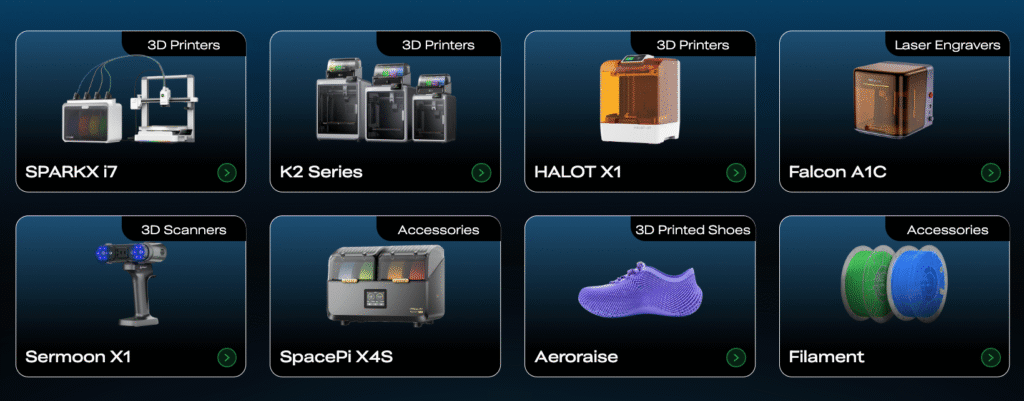
The page lists 11 new products: SparkX i7, K2 SE, K2, Ender-3 V4, HALOT-X1, Sermoon P1, Falcon T1, CFS-C, SpacePi X4L, and two laser engravers. The K2 SE on that list turned out to be the cheapest way into Creality’s color system. We pulled its spec sheet apart here. KliTek wasn’t on that SKU grid back in May, which correctly read as a sign it was still pre-launch. It has its own full product page now.
What’s on the teaser image
The teaser graphic showed something that didn’t look like a normal filament changer. That was the most widely circulated independent reading at the time. The visual implied a physical nozzle, hotend, or tool-module swap, not AMS-style filament push through a single nozzle, and the September spec page confirmed that reading was right.
Where “Coreshift” fits
The teaser also surfaced a second codename, Coreshift, covered in the next section.
What “Coreshift” Might Be (and Why the Naming Matters)
KliTek launched on its own on May 30, and Coreshift was nowhere in the video. It’s still nowhere on the September spec page either. The relationship between the two names remains unconfirmed. The name itself hints at a shift in the core: printer architecture or motion path, rather than the nozzle.
Two plausible interpretations
Both are unconfirmed:
- Coreshift = the motion or architecture layer that carries the swap mechanism (the rails and toolhead path that route a hotend in and out mid-print).
- Coreshift = a separate product: possibly a CoreXY platform refresh, or a firmware/path-planning module that schedules swaps without operator input.
How we’ll know which is right
If KliTek and Coreshift surface together on the same SKU or video, hypothesis 1 holds: paired layers of one platform. If Coreshift launches on a printer without KliTek (or vice versa), hypothesis 2 holds: separate product lines, shared teaser cycle.
Why two names is interesting
Bambu sells Vortek as one feature on one machine. Creality launching two codenames in the same teaser cycle suggests a bigger architecture move, possibly across a whole 2026 to 2027 printer line, not a single SKU. Bambu is not standing still either. Its newest patents describe a nine-dock rack well beyond Vortek’s six.
KliTek At a Glance
| Field | Value (as of September 10, 2026) |
|---|---|
| Status | Unveiled May 30, 2026; full spec page live since September 4 |
| Type | Automatic nozzle-assembly changer (nozzle, hotend, tube); per-head PTC preheat, no induction |
| Heads | Four heads, one each for CMYK |
| Swap time | 4.8 sec per nozzle. About 15 sec to change color or material. |
| Headline feature | Mixed nozzle sizes in one job (0.2 / 0.4 / 0.6 / 0.8 mm) |
| Flexibles | S-Drive dual-drive; base K3 ships with TPU 95A, optional Multi-Material Kit adds down to 80A |
| Bed | 260 mm cube (confirmed on the official spec page) |
| Machine | Creality K3 (officially confirmed) |
| Sibling codename | Coreshift (not yet shown) |
| Price | Nozzle assembly ≈ $14 (vs ~$67 rivals); K3 printer price still TBC, $50 deposit open |
| On sale | Q3 2026 (on Creality’s official K3 page); no order date or ship date outside China yet |
| Closest rivals | Bondtech INDX and Bambu Vortek (hotend swap), Snapmaker U1 (budget toolchanger) |
| Build volume | 260 x 260 x 260 mm; no heated chamber on the base K3, optional top cover unlocks ABS/ASA |
| Calibration | Eddy-current offset, no probe (~25 µm; 12 of the machine’s 37 sensors serve nozzle changes) |
| Durability | 80,000 swap cycles claimed in June; no longer listed on the September spec page, unconfirmed |
| Firmware | Klipper-based per the June interview; September spec page confirms native Root access |
| Source | Creality’s official K3 product page (live since Sept 4) and KliTek FAQ; June product-expert interview |
FAQ
What is Creality KliTek?
It’s Creality’s take on automatic nozzle swapping, revealed in a May 30 launch video. Every head heats itself and clicks into place mid-print, with no operator input. Think toolchanger printing at a Creality price.
When will KliTek launch?
Creality’s own K3 page now lists a Q3 2026 window, so it’s no longer just a community guess. There’s still no exact day. Treat it as a window, not a promise.
Is KliTek compatible with my Creality K1, K2 Pro, or Ender-3 V4?
KliTek debuts on the new K3, and no upgrade path for older machines has been announced. Owners are asking loudly for one (a K2 Plus kit was among the most-liked requests). A swap system needs firmware, motion control, and toolhead hardware most older machines lack. Don’t count on a retrofit. If you’re weighing the K2 Pro against new options, see our Bambu X2D vs Creality K2 Pro comparison.
How does KliTek compare to Bambu Lab Vortek?
Both swap the hot end instead of pushing many filaments through one nozzle. The difference: Vortek uses induction heating, KliTek puts a PTC heater in each head. Vortek ships today on the H2C; KliTek isn’t on sale yet. For what Vortek can actually do, the Bambu Lab H2C Vortek review has the details.
Does KliTek eliminate purge waste?
Almost certainly it reduces purge waste, not eliminates it. Even Vortek claims “up to 58% less,” not zero. Same physics: any nozzle swap mid-print leaves some material in transition.
Is “Coreshift” the same as KliTek?
Still unconfirmed. KliTek launched without Coreshift in the video, so the most plausible read is that they’re separate but related: Coreshift naming a motion or architecture layer, KliTek naming the swap mechanism.
How much will KliTek cost?
No full system price yet, even with the K3’s official spec page live. Creality has shown one number, and it’s the consumable: each nozzle assembly costs around $14, where rival tool heads run closer to $67. The K3 machine itself stays unpriced, though Creality is taking $50 deposits on its livestream. Figures like $379 to $449 or $599 are circulating online, but none trace back to Creality itself, so treat them as guesses. The community’s reference point is the Snapmaker U1, and the most-liked hope in the comments was simply that it stays affordable.
Is KliTek a copy of Bondtech INDX?
It’s the most common accusation in the comments, and the two systems do aim at the same goal. But the mechanics differ: KliTek heats each head with a PTC element, while INDX uses induction. INDX also isn’t on sale yet, so KliTek may reach buyers first. Similar idea, different execution.
Why is it called KliTek?
It’s named for the sound. When a nozzle assembly locks into place, it makes a sharp “click.” Creality built the name around that snap-in moment.
What are the Creality K3 specs?
The Creality K3 prints in a 260 mm cube on a CoreXY frame (420 x 482 x 536 mm overall, 22 kg), with four KliTek tool heads for CMYK color and nozzle changes in 4.8 seconds. Top speed is 500 mm/s with 20,000 mm/s² acceleration. It pairs an S-Drive feeder (TPU 95A standard, down to 80A with the optional kit) with a print-head filament cutter, and confirms native Root access. Expect it in Q3 2026. Pricing is still unannounced.
When is the Creality K3 release date?
Creality’s own K3 product page still lists a Q3 2026 window, and as of this writing there’s no order date or ship date confirmed outside China. There’s a loose precedent worth watching: the SparkX i7 went on sale about two weeks after Creality announced it, so a firm date could still land before Q3 closes. Treat the quarter as a target Creality hasn’t yet promised to hit.
Does the Creality K3 have a heated chamber?
Not on the base model. Creality’s September spec page confirms that, and limits the entry K3 to PLA, PETG, PLA-CF/GF, PETG-CF/GF, PCTG, TPU 95A out of the box. An optional top cover unlocks ABS, ASA, plus other engineering materials. A separate Multi-Material Kit adds softer TPU. A larger K3 Pro or Plus is expected to add a heated chamber later, though Creality hasn’t confirmed those specs.
Does the Creality K3 keep root access or Klipper firmware?
Yes, on root access. Creality’s June interview had suggested the K3 would drop the root access older K-series printers allowed, which read as a real trust problem given the brand’s history there. The official spec page that went live September 4 reverses that: it states native Root access integration and links to Creality’s GitHub. Klipper itself came up in the June interview. The new page stays silent on it, so treat that detail as likely, pending confirmation once a production unit ships.