
Heads up — some of the links below are affiliate links. If you buy through them, I earn a small commission (at no extra cost to you), which helps cover the gear I test. Thanks!
- PLA is the best 3D printer filament for most people. It’s cheap, easy, and prints great parts without a heated enclosure.
- PETG is the upgrade for functional parts that need to flex or take heat. ASA beats it for anything left outdoors.
- TPU handles flexible parts. Nylon and carbon fiber blends are for strength, but they fight back.
- Brand matters less than you think. Consistent diameter and dry filament beat a fancy logo every time.
- Cheap filament rarely ruins a printer on its own. Wet filament does.
What Actually Makes a Filament “Best”
There’s no single best 3D printer filament. There’s the best one for your printer, your project, and your patience. You opened three tabs trying to pick, and every list says something different, so let’s settle it with what actually matters.
So let’s skip the hype. Here’s what actually separates good filament from a frustrating spool.
Diameter consistency. Your printer expects 1.75 mm, every millimeter of the way. When the thickness wanders, extrusion wanders with it. You get blobs, gaps, and weak layers. This is the single biggest thing you pay for when you buy a “premium” brand. Prusament guarantees a tolerance of ±0.02 mm and ships every spool with a QR code showing that exact spool’s measured diameter. That’s what real quality control looks like.
Dryness. Filament drinks moisture from the air. Wet filament prints poorly. It pops, it strings, and it makes weak parts. Some materials, like nylon and TPU, are so thirsty they need a sealed box from day one.
Temperature and printer match. PLA runs cool, around 190–220°C, on any machine. ABS needs 220–250°C and an enclosure. Buy filament your printer can actually handle.
Strength versus heat versus ease. No filament wins all three. You trade one for another. The rest of this guide is really about that trade.
Ease of printing. A “stronger” material you can’t print cleanly isn’t stronger in practice. For most people, a reliable PLA beats a finicky nylon every time.
One more honest note before the picks. If you want filament matched to a specific machine, we cover that in our guide to the best filament for Bambu Lab, Creality, and Prusa. This page is the bigger map: every type, and when to reach for it.
Best 3D Printer Filament at a Glance
Here’s the short version. Skim it, find your use case, then read the section that matters to you.
| Type | Best For | Top Pick | Price | Watch Out For |
|---|---|---|---|---|
| PLA / PLA+ | Beginners, everyday prints | Sunlu PLA Plus | $ | Softens near 60°C |
| PETG | Functional parts, mild heat | Bambu Lab PETG HF | $$ | Strings when wet |
| ABS / ASA | Outdoor, high heat | ASA (any major brand) | $$ | Warps without an enclosure |
| TPU | Flexible, shock-absorbing | TPU 95A | $$ | Prints slow |
| Nylon (PA) | Tough, wear-resistant gears | PA-CF blends | $$$ | Extremely thirsty |
| Carbon fiber | Stiff, dimensionally stable | PET-CF | $$$ | Needs a hardened nozzle |
| Premium / consistency | Multi-spool, color-critical work | Prusament PLA | $$$ | Costs more |
The Main Filament Types, and When to Use Each
Before the details, here are the print settings at a glance. Match the material to what your printer can actually do.
| Material | Nozzle Temp | Enclosure | Heat Resistance | Ease |
|---|---|---|---|---|
| PLA / PLA+ | 190–220°C | No | Low (~60°C) | Easiest |
| PETG | 230–250°C | Helpful | Medium | Moderate |
| ABS / ASA | 220–250°C | Yes | High | Harder |
| TPU | 220–235°C | No | Low–Medium | Slow, fiddly |
| Nylon (PA) | 250–270°C | Yes | High | Hard, very thirsty |
| Carbon fiber | Per base resin | Per base | Per base | Hard, abrasive |
PLA, PLA+, and PLA Pro
PLA is where almost everyone should start. It runs at low temperatures, sticks well, and forgives mistakes. It also comes in more colors than any other material. Want the full rundown on how it compares to PETG, ABS, ASA and TPU? We cover each material here.
Here’s the part most guides get wrong. People treat PLA as the weak option you “graduate” from. The data says otherwise. In one destruction test, four identical helmets were printed in PLA, PLA Pro, PETG, and ABS, then hit with a torch and a 10-pound weight dropped from four feet. PLA Pro won both rounds. It resisted heat the longest and only dented on impact, while PETG shattered and basic PLA cracked apart.
So “PLA Pro” and “PLA+” aren’t just marketing. They’re tougher recipes worth the small upcharge.
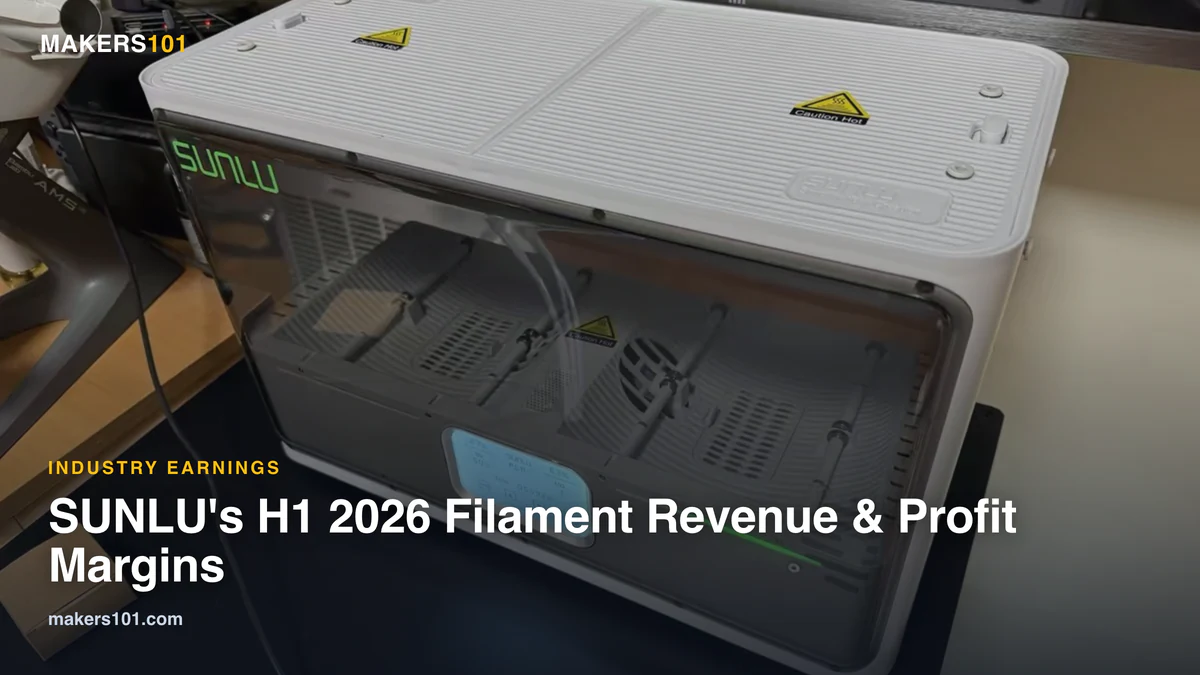
For value, Sunlu PLA Plus is the one I’d hand a friend. In a head-to-head against Bambu and Polymaker, it survived being stomped and hammered without cracking, and it costs the least. That pricing isn’t hurting the company either — its H1 2026 filings show fatter margins than most printer makers post. The trade-off is a bit more stringing, which drying and a quick retraction tune fix. Bambu Lab PLA Basic prints the cleanest of the three and carries an RFID tag your AMS reads automatically, but its matte version is brittle enough to shatter underfoot.
One catch applies to all PLA: it goes soft around 60°C. Leave a print in a hot car and you’ll learn this the hard way.

- 【SUNLU PLA PLUS 3D Filament】- PLA PLUS filament is 3 times stronger than PLA Filament, the color is brighter, it has many advantages…
- 【Neatly Wound 3D Filament Spool】- SUNLU R&D team has mastered advanced technology and produced Neatly Wound PLA Plus Filament, which is impossible…
- 【PLA Plus Filament 1.75mm】- Dimensional Accuracy +/- 0.02mm. SUNLU filament has wide compatibility due to the small diameter error, it’s suitable…
- 【Filament Spool Diameter】- Spool Diameter: 8.00″, Spool Width: 2.50″, Spool Hub Hole Diameter: 2.20″. The size of the SUNLU filament spool is…
- 【Recommend Settings】- We recommend printing at a Nozzle/Extrusion temperature of 210°C – 235°C (410°F – 455°F) and Bed/Platform temperature of…

- User-Friendly Printing: Ideal for beginners.
- Smooth Print Results.
- Filament Diameter: 1.75mm 0.03mm.
PETG, PETG-HF, PCTG
PETG is the natural next step. It keeps much of PLA’s easy printing but adds toughness and a little flex, so parts bend instead of snapping. It handles mild heat and outdoor light far better than PLA. That makes it the default for brackets, clips, and anything that takes stress. Dialing it in is the fiddly part, and the right PETG print temp depends more on your spool than on any chart.
It has quirks. PETG strings when it’s even slightly wet, so dry it. And the popular high-speed versions, like Bambu Lab PETG HF, trade a little strength for that speed. Testing of several high-speed PETGs found they print fast and look great, but come out less rigid than standard PETG. Worth knowing before you print a load-bearing part. We broke down the best PETG for each use case in a dedicated guide.
If you fight stringing or print in a humid room, look at PCTG. One tested spool sat in 50% humidity for three weeks and still printed nearly string-free, while a PETG-HF spool failed badly in the same conditions. PCTG is the quiet upgrade most people have never tried.

- PREMIUM PETG FILAMENT – STRONG & DURABLE: PETG offers enhanced strength, flexibility, and impact resistance compared to PLA, making it ideal for…
- CONSISTENT DIAMETER FOR RELIABLE PRINTS: Precisely manufactured with a 1.75mm diameter and ±0.03mm tolerance to ensure smooth feeding, reduced clogs…
- SMOOTH FINISH WITH EXCELLENT CLARITY: PETG provides a clean, glossy surface with strong color saturation or natural translucency depending on the…
- HIGH TEMPERATURE & CHEMICAL RESISTANCE: Designed to withstand higher temperatures and increased durability compared to PLA. PETG resists moisture…
- COMPATIBLE WITH BAMBU LAB & MOST FDM 3D PRINTERS: Optimized for Bambu Lab printers and works seamlessly with most FDM printers on the market. Each 1kg…
ABS and ASA
ABS is the classic engineering plastic. It stays usable well past where PLA goes soft, takes impacts, and machines cleanly. You can also vapor-smooth it with acetone for an injection-molded look no other filament matches. That heat tolerance is why it shows up in car interiors and tool housings. PLA is a different story; brush-on XTC-3D is the more beginner-friendly route when you want a smoother painted surface.
The catch is shrinkage. ABS contracts as it cools, so corners lift and tall prints split between layers unless the whole chamber stays warm. It needs an enclosure, not a suggestion of one, plus ventilation for the styrene fumes. In the helmet destruction test, ABS shrugged off the impact drop but lit into a dramatic fireball under the torch, a fair reminder that “heat resistant” means holding shape, not surviving open flame. If you don’t have an enclosure yet, see our picks for the best enclosed high-temperature 3D printers before committing to ABS.
ASA is ABS with a sunscreen. It prints almost identically and shares the warping, but it resists UV and weather instead of yellowing and turning brittle. That one change makes it the go-to for anything outdoors: garden brackets, mailbox parts, sensor housings, car trim. If a part lives in sunlight, skip ABS and reach for ASA. We put the top brands head to head in our ASA filament buying guide.
TPU and Flexible Filaments
TPU is rubber for your printer. It’s the go-to for phone cases, gaskets, watch bands, drone bumpers, and anything that needs to squish and bounce back. Hardness is measured on the Shore A scale: 95A is firm and the easiest to print, while softer 85A stretches more but fights you the whole way.
Flexible filament demands a direct-drive extruder. On a Bowden setup the long tube lets the soft filament buckle and jam. Slow down too, often to 15–30 mm/s, and dry the spool, because TPU drinks moisture as eagerly as nylon. Get those three right and it prints reliably.
Want more performance? PEBA is the high-end cousin. In testing, a 95A PEBA outbounced and outgripped the same-hardness TPU, with a softening temperature of 133°C against TPU’s 99°C and 24% less weight. A printed RC tire in PEBA gripped harder and ran lighter. The catch is it bonds to the plate so hard that large parts deform when you pry them off, so a PLA raft or a tool changer helps. For most people, good TPU is plenty. PEBA earns its place when you need rebound, grip, or heat that ordinary flexibles can’t give.
Nylon (PA)
Nylon is genuinely tough. It resists wear, flexes without snapping, and self-lubricates, which is why it’s the material for gears, living hinges, and tool mounts that take a beating. Most spools you’ll see are reinforced grades like PA-CF or glass-filled PA, since plain nylon is bendy and harder to print flat.
Two things make it demanding. First, it warps like ABS, so it wants an enclosure and a high nozzle temperature, usually 250–270°C. Second, it’s the thirstiest filament here by a wide margin. Leave nylon out for a few hours and it absorbs enough moisture to pop, string, and print weak. Dry it at 70–80°C before every print and feed it from a sealed box. With nylon, a desiccant box isn’t storage advice, it’s part of the print process.
Carbon Fiber Blends
Carbon fiber filament sounds like the obvious strength upgrade. It isn’t always. Adding carbon fiber boosts stiffness and gives a nice matte finish, but it doesn’t automatically make a part stronger, and in some base plastics it can make things worse. The machine matters as much as the spool. Here’s what to look for in a carbon fiber and nylon printer.
A factory manager who tests this for a living put it plainly: CF-PETG only gains a little rigidity, CF-ABS is really about anti-static properties and less warping, and CF-nylon just drinks even more water. The real all-rounder is CF-PC/PBT, which stays stiff and takes impacts.
Where carbon fiber clearly earns its price is stiffness and dimensional stability. PPA-CF topped a torque test of common materials at 4.3 Nm, against 2.5 Nm for plain PLA, though a steel wrench still held 13.7 Nm, so manage expectations. There’s also a trick worth knowing: annealing CF parts barely changes their strength but sharply raises their heat tolerance. One tested sample held its shape at 226°C after annealing.
If you want raw tensile strength, PET-CF is the smart buy. Across five tested brands, Fiberlogy’s came out strongest while Bambu’s lost grip on an open-frame printer. Whatever you pick, carbon fiber is abrasive and will chew through a brass nozzle in hours. Install a hardened steel nozzle first. Not sure which blend fits your project? Our filament picker tool narrows it down by use case.
Support Filaments (PVA, HIPS, Breakaway)
For complex models, a second material handles the supports so the main part comes out clean. You need a dual-extruder or multi-material setup to use them, but the payoff is real.
PVA dissolves in plain water, so you drop the print in a tub and the supports vanish, leaving a smooth surface even under deep overhangs. HIPS dissolves in limonene and pairs naturally with ABS. Breakaway just snaps off. Even on a single material, printing a support-PLA interface layer between the part and its PLA supports makes the underside noticeably cleaner and the supports far easier to peel. One catch: PVA is extremely moisture-hungry, so keep it sealed or it turns to mush. If you print figurines or intricate mechanical parts, a support material is the upgrade that ends scarred bottoms and hours of cleanup.
Best Filament by Use Case
Short answers, so you can buy and move on.
| If you are printing… | Reach for | Why |
|---|---|---|
| Toys, models, desk décor | PLA / PLA+ | Easy, cheap, great detail |
| Phone case, gasket, drone bumper | TPU | Flexes and bounces back |
| Bracket, clip, RC part | PETG | Tough, slight flex, mild heat |
| Mailbox part, garden hook, car trim | ASA | UV and weather proof |
| Gears, living hinges, tool mounts | Nylon / PA-CF | Wear-resistant and tough |
| Enclosure, high-heat housing | ABS | Heat-resistant (needs an enclosure) |
Best overall and best for beginners: PLA. Start with Sunlu PLA Plus or Bambu Lab PLA Basic and you won’t look back.
Best budget: Elegoo or Sunlu. In a direct test, Elegoo PLA Basic printed nearly identical parts to Bambu’s PLA on the same machine, for noticeably less per spool. You’re paying Bambu for the RFID convenience, not better plastic.

- SUPERIOR COMPATIBILITY – ELEGOO PLA Basic filaments are fully compatible with reusable spool of ELEGOO, Bambu Lab, eSun and more. You can also print…
- REDUCE WASTE WITH REFILL DESIGN – ELEGOO PLA Basic Refill offers a more sustainable alternative to traditional spooled filament. By eliminating the…
- EASY TO PRINT & BEGINNER-FRIENDLY – Made of pure premium PLA, lower melting temperature, low warping and strong layer adhesion. PLA Basic filament…
- PRECISION DIAMETER, LESS TANGLE – 1.75mm diameter with ±0.02mm accuracy, outstanding tolerance and consistency, neatly wound and less tangle, ensures…
- NO BUBBLE & NO CLOGGING – Complete dried before packing, well vacuum sealed, protect 3d printer filaments from moisture and dust,significantly…
Best for strength and functional parts: PETG for everyday loads, PA-CF or PPA-CF when you need maximum toughness. And remember the wrench test: a thicker redesign in plain PLA out-muscled the original in fancier material. Design matters as much as the spool.
| Material | Torque to failure | vs plain PLA | Notes |
|---|---|---|---|
| PETG | 1.7 Nm | 0.7× | Tough but not stiff |
| ABS | 2.0 Nm | 0.8× | — |
| PLA (basic) | 2.5 Nm | 1.0× (baseline) | — |
| PA-CF | 2.2 Nm | 0.9× | Carbon fiber is not automatically stronger |
| PPA-CF | 4.3 Nm | 1.7× | Strongest plastic tested |
| Steel (reference) | 13.7 Nm | 5.5× | Plastic still loses to metal |
The takeaway: PPA-CF leads the plastics, but a thicker redesign in plain PLA out-muscled the original part. Design matters as much as material.
Best for outdoor use: ASA. Nothing else here shrugs off UV as well.
Best premium and most consistent: Prusament PLA. The tight tolerance and per-spool birth certificate are worth it for multi-spool projects and color-critical work.
Are Premium Brands Worth It? (And Will Cheap Filament Wreck Your Printer?)
Premium brands buy you consistency, not stronger plastic. You’ve seen the Reddit threads: half the hobby swears by Bambu, the other half prints happily on the cheapest spool they can find. Both camps are right, and here’s the part that reconciles them.
Premium brands sell you consistency, not magic plastic. When Elegoo and Bambu PLA print nearly the same part side by side, you’re paying the difference for the RFID tag and tighter quality control, not for a stronger model. If you run a Bambu AMS and love that it auto-detects every spool, that convenience is real and worth something. If you don’t, a good budget brand prints just as well.
This matters more right now because Bambu’s own PLA and PETG keep selling out. A lot of people are hunting for reliable alternatives, and the good news is they exist. We tested several in our Bambu Lab filament alternatives guide, and several budget brands held their own.
Now the scary question: can cheap filament damage your printer? Mostly, no. The horror stories, the clogs and the gunked-up hotends, almost always trace back to wet or poorly wound filament, not a low price. A cheap spool kept dry and feeding cleanly is fine. An expensive spool that sat open in a humid garage will jam your nozzle and string all over your bed. Moisture is the villain, not the price tag. Buy reasonably, store it well, and your printer will be fine.
How to Store and Dry Filament So Your “Best” Stays Best
The best filament in the world prints badly once it’s wet. So storage isn’t an afterthought. It’s half the battle. Here’s how to dry and store your filament so it stays print-ready.
Every material absorbs moisture, but nylon, PETG, and TPU are the worst offenders. Keep spools in sealed boxes or bags with desiccant. If prints suddenly turn stringy and rough, water is usually why, and drying the spool fixes it. When the shelf gets crowded, these six storage setups sort out capacity and cost.
How dry is dry enough? A DIY drying cabinet test is telling. An empty cabinet with circulating desiccant pulled humidity from 58% down to about 18–22%. But once damp filament went in, humidity climbed back to the mid-30s. The lesson: a dry box keeps good filament good, but it can’t quickly rescue a spool that already soaked up water. Dry it actively first. Our filament drying guide walks through the temperatures and times for each material.
One last thing. Even perfect filament needs a calibrated printer. A quick filament calibration, temperature, flow, and retraction, can clean up your layers and let you print faster on the exact same spool. Good plastic and a tuned machine are a team.
Frequently Asked Questions
Is PLA better than PLA+ or PETG? It depends on the job. PLA+ is a tougher PLA that prints almost identically, so it’s an easy upgrade for everyday parts. If heat is your actual constraint, how far each filament goes before it softens is the chart you want. PETG is better when you need flex, durability, or mild heat resistance, though it’s slightly harder to print clean. For learning and for looks, PLA or PLA+ wins. For functional parts, lean PETG.
What’s the best filament for beginners? PLA, without question. It runs cool, needs no enclosure, and forgives mistakes. A budget PLA+ like Sunlu’s gives you extra toughness for almost no added cost or hassle.
Which filament is the strongest? For most functional parts, PETG. For maximum toughness, a carbon-fiber-reinforced engineering material like PA-CF or PPA-CF. But don’t ignore design. In testing, simply making a part thicker in plain PLA beat a thinner version in stronger material.
What holds up best outdoors? ASA. It shrugs off sun and weather far better than PLA or PETG, so it lasts for years outside. PETG is a passable second choice for light exposure.
Can cheap filament damage my printer? Rarely on its own. Most clogs and jams blamed on cheap filament are actually caused by moisture. Keep any spool dry and feeding smoothly, and a budget brand will print fine.
Are recycled or eco-friendly filaments worth it? PLA is already plant-based and the greenest mainstream option. Home recycling is improving but still finicky, and the machines are pricey. We break down the math in whether a filament recycler is worth it.