
Heads up — some of the links below are affiliate links. If you buy through them, I earn a small commission (at no extra cost to you), which helps cover the gear I test. Thanks!
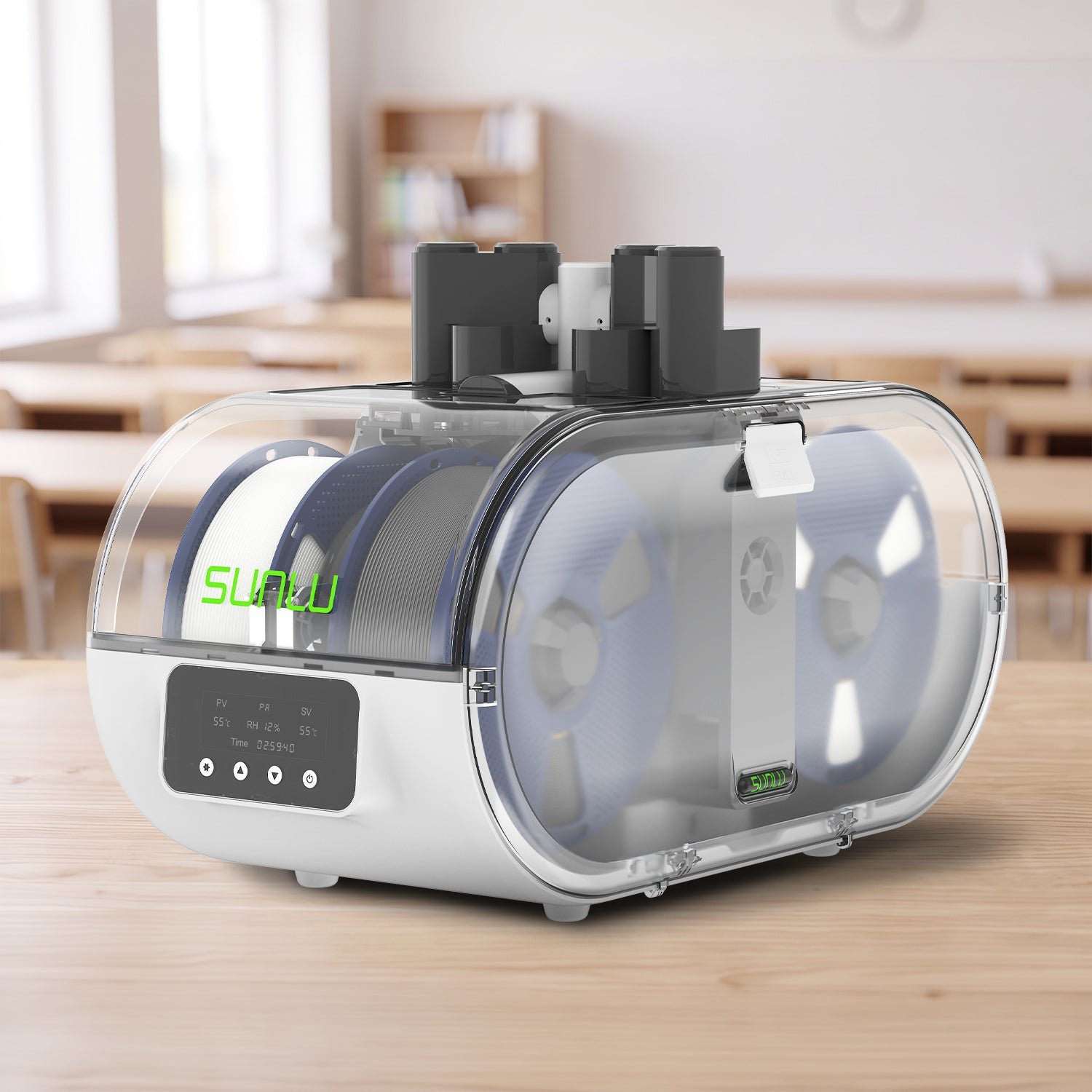
- The SUNLU AMS Lite Heater adds heated drying around an existing AMS Lite. You need to own the feeder separately.
- SUNLU lists the heater at about $119.99 in the US store. An earlier official launch promotion advertised $99.99 for the first 200 units, but that limited offer is not the normal price to budget for.
- SUNLU specifies active heating, automatic moisture exhaust, and drying during printing. Material settings still need to suit every loaded spool.
- Frequent PETG printing in humid conditions makes a stronger case for this upgrade than trouble-free PLA printing. Installation and door clearance deserve attention before ordering.
Leaving four spools on an open AMS Lite is convenient until you start wondering how long they’ve been absorbing moisture. Moving them to a separate dryer adds another job, particularly when you want those colors ready for your next print.
SUNLU’s enclosure brings drying into that setup. For a US buyer, the useful question is whether its roughly $120 price improves your workflow enough to justify another purchase, and whether the store is taking orders yet.
This is a researched product analysis. Makers101 has not tested this heater. The US price and availability below reflect checks made on September 25, 2026.
Table of Contents
- SUNLU AMS Lite Heater Facts at a Glance
- SUNLU AMS Lite Heater Price and Availability in the US
- How SUNLU Adds Drying to the Existing AMS Lite
- AMS Lite Heater Installation and Desk Space
- What the Heater Can Fix, and Where 70°C Has Limits
- Who Should Consider the SUNLU AMS Lite Heater?
- What Future AMS Lite Heater Tests Should Measure
- FAQ: SUNLU AMS Lite Heater
SUNLU AMS Lite Heater Facts at a Glance
The heater houses your existing Bambu Lab AMS Lite and adds temperature and humidity controls. SUNLU lists compatibility with A1, A1 mini, and A2L setups using that feeder. The company’s specification covers simultaneous printing and drying while retaining the original feeding functions. SUNLU product page
| Feature | Published detail | What to check |
|---|---|---|
| Required hardware | Existing Bambu Lab AMS Lite | Feeder sold separately |
| Maximum temperature | 70°C | Follow your filament and spool limits |
| Listed drying materials | PLA, PETG, ABS, ASA, PA, PC | Drying compatibility and printing suitability differ |
| Air movement | Dual airflow and automatic moisture exhaust | Keep the installation clear of obstructions |
| Humidity control | Monitoring with threshold-triggered drying | Air humidity alone doesn’t establish spool dryness |
| US store snapshot | About $119.99; listing may show coming soon or sold out | Recheck stock, tax, shipping, and the estimated dispatch date |
These are published specifications. They establish what SUNLU offers, but they don’t measure drying speed, temperature uniformity, or long-term reliability in your room.
SUNLU AMS Lite Heater Price and Availability in the US
SUNLU’s launch material advertised a $99.99 super-early-bird price for the first 200 units. The same announcement gives July 20, 2026, at 07:00 UTC as the launch time. That offer was limited, so it should not be treated as the standing US price for every later order. SUNLU’s launch announcement
The official US-facing product page has shown the heater at around $119.99, with the listing marked “Coming soon” or a selected option shown sold out at different checks. That is the number US buyers should use for a realistic budget, before sales tax and shipping. SUNLU US store
Before paying, check four things on the US listing: the current price, whether the page is accepting orders rather than collecting interest, the estimated dispatch date, and the shipping charge. A launch price or an old preorder window is not a delivery guarantee for a new order.
How SUNLU Adds Drying to the Existing AMS Lite
SUNLU combines heated airflow with moisture exhaust around the loaded spools. Its stated advantage is that you can continue printing while the enclosure dries the material, keeping the existing color-changing system in use. Official explanation
Heating, airflow, and automatic venting
The published design uses airflow from both sides and an automatic vent to release humid air. SUNLU also describes a humidity threshold that can trigger drying when chamber conditions exceed your setting.
These functions address different parts of the problem. Heating helps moisture leave the material, circulation moves air around the spools, and venting provides an exit. A sealed container with desiccant is useful for storage, but recovering a wet spool requires attention to the drying process too. Our guide to drying and storing filament explains how the two jobs fit together.
Your AMS Lite still supplies the filament
The enclosure depends on the feeder you already own. Buying the heater alone won’t give you automatic color changes. Check the full product name carefully: SUNLU also sells an AMS Heater for the original enclosed AMS, and instructions or discounts for that product may concern different hardware.
That distinction also matters when reading community posts. Some search results discuss replacing an AMS lid, while the Lite enclosure involves fitting the open feeder into a larger assembly.
AMS Lite Heater Installation and Desk Space
Allow time for partial disassembly of your AMS Lite. In its hands-on report, Fabbaloo describes removing components, securing brackets, and connecting wiring. This is worth reviewing before you place an order if you’re uncomfortable opening equipment.
Read the installation sequence first
Use the SUNLU installation manual and the installation video linked from its store. Disconnect power before working on the assembly, and follow the supplied sequence for cables and mounting hardware.
The useful purchasing test is simple: watch the installation from beginning to end. If it involves work you’d rather avoid, a separate dryer may fit your needs better.
Measure room for opening both doors
Fabbaloo also found that opening the side doors consumed substantial desk space. Check access to the rear spool positions as well as whether the closed enclosure fits. A shelf can accommodate the box while still making every spool change awkward.
PTFE routing affects placement too. Check the supplied tube lengths against your planned layout, allowing gentle bends and clear door access.
Noise deserves the same attention. Fabbaloo reported approximately 50-plus dB at one meter from its sample. Treat that as one reviewer’s measurement, with its own room and measuring conditions. It is enough reason to consider placement carefully if your printer sits beside your desk.
What the Heater Can Fix, and Where 70°C Has Limits
Drying can improve prints when absorbed moisture is the cause of the defect. You still need to identify that cause: stringing alone can also point to printing settings. Buying a dryer doesn’t remove the need to diagnose your prints.
The LayerLab drying guide discusses popping during extrusion, bubbles, brittle filament, and surface defects as clues. Its comparisons include a wet-sponge experiment, which should not be read as a measured drying rate for real filament or this SUNLU model.
Give a wet spool time before printing
The ability to run the heater during printing is useful for continued conditioning. A badly wet spool may still need a drying cycle before you start. Material entering the hotend immediately after switch-on has had little time to dry.
Likewise, the displayed relative humidity describes the air around the sensor. It doesn’t directly measure water throughout the filament. Use the material supplier’s recommended temperature and duration, then judge the resulting extrusion and print quality.
Match the temperature to the exact material
SUNLU lists PA and PC among its supported materials, but formulations vary. Bambu’s published PC guidance, for example, specifies an 80°C, eight-hour blast-oven drying cycle. A heater capped at 70°C cannot reproduce that prescribed cycle. Bambu PC guidance
Check each spool manufacturer’s instructions before relying on a generic material preset. Every loaded material and spool must tolerate the selected chamber temperature; remove anything that needs a lower limit. The filament drying guide can help organize your settings, with the supplier’s instructions taking priority.
Also keep drying and printing requirements separate. Putting an engineering material in this box doesn’t change your printer’s bed, hotend, or chamber capabilities. Bambu’s A1 mini guidance discourages materials such as ABS, ASA, PC, and PA that require more demanding thermal conditions. A1 mini material guidance
Who Should Consider the SUNLU AMS Lite Heater?
The strongest case is an existing AMS Lite owner who frequently dries compatible filament and wants several spools ready for long prints. PETG in a humid room is a more relevant example for many A1 owners than an ambition to print engineering polymers.
| Your situation | Purchasing implication |
|---|---|
| Several spools remain loaded between frequent jobs | Integrated drying could reduce spool transfers |
| Repeated moisture symptoms improve after drying | You have evidence of a problem it could address |
| Mostly PLA, with consistently clean prints | You have less reason to buy immediately |
| Only one spool occasionally needs recovery | A smaller dryer may be sufficient |
| You already own a capable multi-spool dryer | Compare convenience gains with the additional cost |
| Limited space beside the printer | Check open-door access before ordering |
An external dryer also remains usable if you later change printers or feeding systems. Our SUNLU S4 review covers one such four-spool arrangement. If your bigger goal is changing the feeding system itself, start with the AMS alternatives guide.

- 4 Spool Capacity: SUNLU 3D printer filament dryer S4 can dry up to four 1kg 3D printer filaments, enhancing drying efficiency and printing quality…
- Large Dimensions: SUNLU filament dryer S4 is notably large in size with external dimensions of 460(L) * 220(W) * 310(H)mm, internal dimensions of…
- 8 Filament Exit Holes: SUNLU filament dryer S4 features eight filament outlets for multiple printers and various filament loading angles, ensuring…
- 350W PTC Heater: SUNLU filament dryer S4 is equipped with a 350W PTC heater, offering safety and higher heating efficiency (50% higher than the…
- 3 Circulation Fans: Three high-quality fans circulate air inside, ensuring consistent temperature across the entire area for more even drying with…
My purchasing priority would be the problem you can already observe. If drying repeatedly fixes your PETG prints and transferring spools is tiresome, the enclosure has a clear purpose. If prints are already reliable, measure the desk space and keep using your current storage routine before spending more.
What Future AMS Lite Heater Tests Should Measure
The most useful follow-up evidence would quantify drying performance and ownership costs. Product specifications alone leave those questions open.
A convincing test would use the same filament before and after drying, record the cycle conditions, and compare extrusion quality. Temperature readings at several spool positions would help assess uniformity. Power consumption, repeatable noise measurements, and photographs of door clearance would make the buying decision more practical.
Independent long-duration use would also help establish reliability. A brief successful print gives you limited evidence about months of repeated heating cycles.
As of September 25, 2026, the product has a defined role: adding active drying to a feeder you already use. Whether that role earns a roughly $120 place on your desk depends on your material, humidity, and existing drying routine.
FAQ: SUNLU AMS Lite Heater
Does SUNLU work with AMS Lite?
SUNLU lists compatibility with AMS Lite setups used by the A1, A1 mini, and A2L. Check that you are buying the Lite version, since the company also sells an accessory for the original AMS.
Is the SUNLU AMS Lite Heater worth it?
It is most relevant when you regularly need to dry several loaded spools. If you rarely encounter moisture problems or already have a suitable dryer, the benefit is smaller.
How do you install the SUNLU AMS Lite Heater?
Installation involves partially disassembling the feeder and securing it inside the enclosure. Review the official instructions before buying so you know whether you’re comfortable with that work.
Can it dry filament while printing?
SUNLU specifies simultaneous operation. Start with adequately dried material when moisture is already affecting extrusion; switching the heater on doesn’t immediately restore a wet spool.
Is an AMS Lite included?
No. SUNLU’s store explicitly says the feeder is excluded. The enclosure upgrades an AMS Lite you supply separately.
Should the vent be open or closed?
The Lite model has automatic moisture venting according to SUNLU. Follow its model-specific manual, since advice about manually positioning the original AMS Heater’s vent may concern different hardware.