
Heads up — some of the links below are affiliate links. If you buy through them, I earn a small commission (at no extra cost to you), which helps cover the gear I test. Thanks!
- SUNLU’s H1 2026 3D printing filament revenue and profit margins: $158.4M (RMB 1.065 billion) in revenue, more than double what SUNLU made in the same six months last year, at a 41.45% gross margin and roughly 15.5% net margin once you account for costs beyond raw materials.
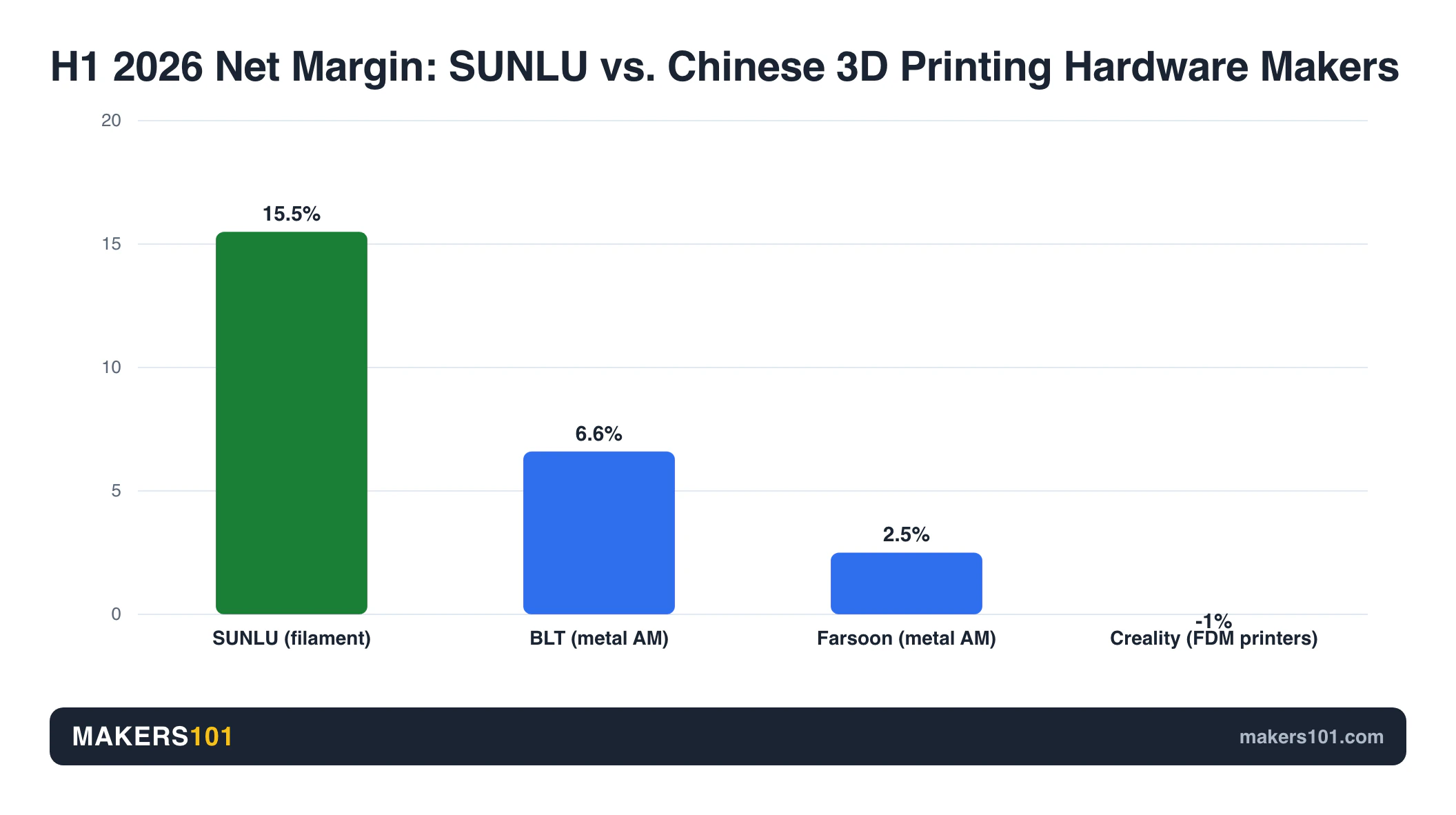
- Every China-based hardware maker we could find H1 2026 results for (BLT, Farsoon, and Creality) comes in behind that margin. Several posted thin profits or outright losses.
- SUNLU (parent of the SUNLU, JAYO, and INSLOGIC brands) now ships more consumer FDM filament than anyone else in the world, with roughly 19.57% of Amazon’s filament sales.
- The company is fast-tracking a Shenzhen ChiNext IPO to fund new plant capacity in Zhongshan and Wuhu.
- The catch: about 88% of revenue comes from exports and about 51% from Amazon alone. Regulators have already flagged that concentration.
SUNLU, the company behind the filament spool sitting next to half the 3D printers on Amazon, just posted numbers that most printer makers can only envy.
If you’ve ever spent more time picking a printer than picking what goes into it, you’re not alone. Most buyers obsess over nozzle speed and build volume and barely think about who makes the spool. But SUNLU’s newly released half-year report makes an uncomfortable case: the company selling you plastic on a spool is making more money, more reliably, than most of the companies selling you the machine.
Here’s what the numbers actually show, why the comparison holds up even across very different corners of the 3D printing industry, and what it means if you’re the one buying (or selling) filament.
Table of Contents
- SUNLU’s H1 2026 3D Printing Filament Revenue and Profit Margins, Explained
- Gross Margin vs. Net Margin: What SUNLU’s 41.45% Actually Means
- Why SUNLU Beats China’s 3D Printing Hardware Makers on Profitability
- The Business Logic: Consumables Beat One-Time Hardware Sales
- Why You Don’t Switch Filament Brands When You Switch Printers
- The Risk SUNLU Can’t Avoid: Amazon and Export Concentration
- SUNLU’s IPO: What $272M in New Capacity Means Next
- My Take: What SUNLU’s Earnings Mean If You Buy (or Sell) Filament
- FAQ: SUNLU and 3D Printing Filament Profit Margins, Answered
SUNLU’s H1 2026 3D Printing Filament Revenue and Profit Margins, Explained
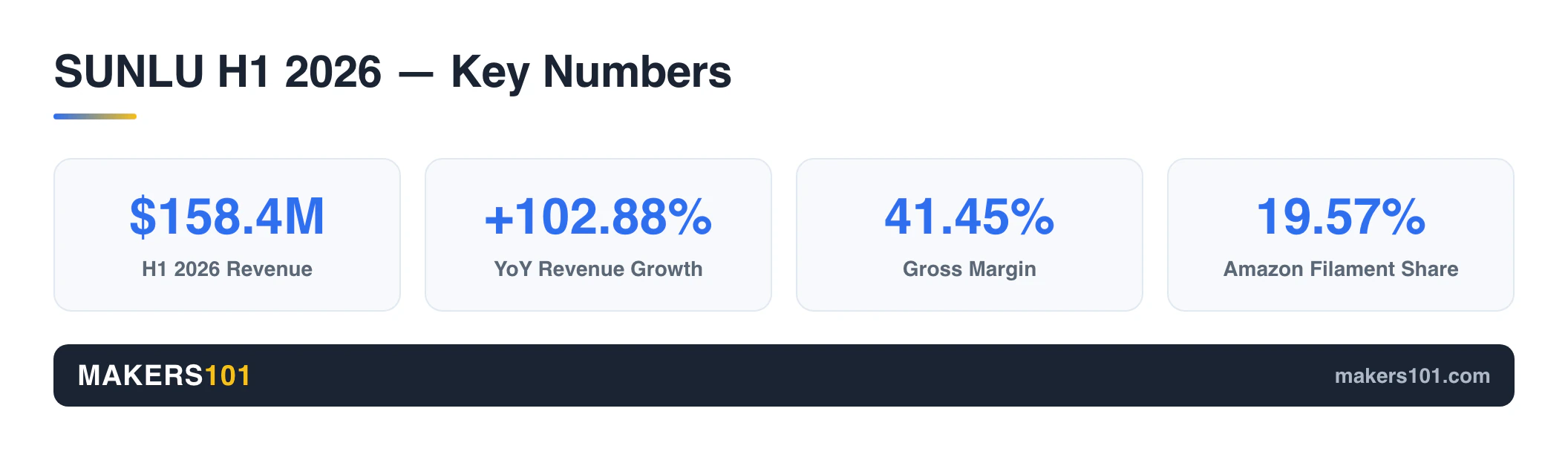
SUNLU (三绿科技), currently pushing through a ChiNext IPO application, posted RMB 1.065 billion in revenue for the first half of 2026. That’s about $158.4M at the September 2026 exchange rate of roughly ¥6.73 to the dollar, and it’s up 102.88% from the same period last year. Net profit came in at RMB 165 million (about $24.5M), up 133.14% year over year. Gross margin held at 41.45%, essentially flat with the 40.48% it posted a year earlier.
SUNLU is the flagship consumer brand of a company that also owns JAYO (mid-range FDM and resin filament) and INSLOGIC (printing accessories), selling into more than 100 countries. According to Frost & Sullivan data cited in the company’s own filings, SUNLU held the world’s largest FDM filament shipment volume in 2025, plus the top market share on Amazon among filament sellers.
The growth curve isn’t a one-quarter fluke. Revenue went from RMB 468 million in 2023 to RMB 1.283 billion in 2025, a 65.5% compound annual growth rate. Then H1 2026 alone did 83% of all of 2025’s revenue.
| Period | Revenue | Net Profit | Gross Margin |
|---|---|---|---|
| 2023 | RMB 468M (~$69.6M) | RMB 43.9M | — |
| 2024 | RMB 763M (~$113.5M) | — | 37.83% |
| 2025 | RMB 1.283B (~$190.8M) | RMB 163M (~$24.2M) | 40.79% |
| H1 2026 | RMB 1.065B (~$158.4M) | RMB 165M (~$24.5M) | 41.45% |
Source: SUNLU’s 2026 半年度报告 (H1 2026 report) and IPO filing disclosures, converted at the ~¥6.73/$1 rate in effect as of September 2026.
An independent English-language report from 3dprintingjournal.com, published September 3, 2026, corroborates the revenue figure and adds two precision numbers worth citing directly: exports account for 87.7% of SUNLU’s revenue, and Amazon alone represents 51.28% of it. Its Amazon filament market share works out to 19.57%. We’re using its export and Amazon percentages here because they’re more precise than the “near 90%” and “about half” language in SUNLU’s own summary materials.
We are not using that source’s net profit figure, which appears to conflate SUNLU’s H1 2026 and full-year 2025 numbers. The net profit figures above come from SUNLU’s own half-year filing.
Gross Margin vs. Net Margin: What SUNLU’s 41.45% Actually Means
That 41.45% is a gross margin. It’s a different number from net margin, and the gap matters more than most coverage of this report has bothered to explain.
Gross margin is what’s left after subtracting the cost of raw plastic, packaging, and manufacturing. It doesn’t touch R&D, marketing, Amazon’s referral fees, warehousing, or the IPO process itself.
SUNLU’s actual net margin for H1 2026 works out to about 15.5% (RMB 165M net profit on RMB 1.065B revenue). Still healthy. Just not the headline number.
For context, someone running a small 3D-printing storefront on Etsy targets a 30-40% net margin after materials, platform fees, and their own labor, according to one documented four-month case study. A $30 item nets $9 to $12. That’s a higher net margin percentage than SUNLU’s, on paper.
The difference is what that margin buys you. SUNLU’s 15.5% net margin sits on top of $158M in six-month revenue that grew 103% year over year.
The Etsy example generated $3,855 in revenue over four months, with sales swinging from $1,611 one month to $86 the next. One business is a manufacturing operation with pricing power and a growing export base. The other is a single person’s labor sold one piece at a time. Same industry, completely different risk profile.
Why SUNLU Beats China’s 3D Printing Hardware Makers on Profitability
Compare SUNLU’s H1 2026 report against the three other China-based printer or hardware companies with published H1 2026 results, and the gap is stark. Every one of them made less money, in absolute and percentage terms, than the company selling plastic on a spool.
SUNLU vs. BLT, Farsoon, and Creality: H1 2026 Financials Side by Side
| Company | What They Sell | H1 2026 Revenue | H1 2026 Net Profit | Net Margin |
|---|---|---|---|---|
| SUNLU | Consumer FDM/resin filament | RMB 1.065B | RMB 165M | ~15.5% |
| BLT (铂力特) | Industrial metal AM systems | RMB 770M | RMB 51.1M (RMB 16.2M excl. non-recurring items) | ~6.6% |
| Farsoon (华曙高科) | Industrial metal AM systems | RMB 341M | RMB 8.4M | ~2.5% |
| Creality (创想三维) | Consumer FDM printers | RMB 1.626B | Adjusted net loss of RMB 15.7M | Negative |
Source: each company’s own H1 2026 filings, as summarized in the source materials for this article.
Why Comparing SUNLU to Metal 3D Printing Makers Isn’t Apples-to-Apples
BLT and Farsoon build industrial metal 3D printing systems. Creality builds consumer FDM printers. SUNLU makes the plastic that feeds machines like Creality’s.
These are three different businesses in three different segments of one industry. They aren’t direct competitors.
That’s exactly why the pattern is worth noticing. SUNLU didn’t simply out-execute companies in its own category. A materials company outperformed hardware companies in two entirely separate categories (industrial and consumer) during the same six months.
Whoever sells the machine is fighting for margin. Whoever sells what the machine consumes is not, at least not this year.
Part of the answer is pricing discipline. Market timing alone doesn’t explain it.
An independent third-party test comparing SUNLU PLA Plus against Bambu Lab’s matte PLA and Polymaker’s PLA Pro found SUNLU priced at $14/kg, the cheapest of the three (Polymaker ran $25/kg, Bambu Lab’s official price was $23/kg though it’s often discounted to $11). SUNLU’s spool also held up better than Polymaker’s under a hammer-and-drop-test, even though it wasn’t the prettiest print of the three: it had the most visible stringing. Cheap and tough enough beats pretty and pricier when you’re trying to sell volume instead of chasing premium positioning.


The Business Logic: Consumables Beat One-Time Hardware Sales
A 3D printer is a one-time sale. Filament isn’t.
You buy a printer once, maybe twice if you upgrade. You buy filament every few weeks for as long as you keep printing. A single FDM printer can chew through anywhere from a few kilograms to several dozen kilograms of PLA a year, depending on how much you print. That difference between a one-time purchase and a recurring one is the entire logic behind why materials businesses tend to outlast and outearn hardware businesses.
Printer makers earn what amounts to a cover charge. Filament makers earn a tab that never closes. If you want to see what that math looks like from a buyer’s seat instead of a manufacturer’s, our breakdown of the real economics of running a 3D printer walks through where the money actually goes once the printer itself is paid off.
The category is growing fast enough to support more than one winner, too. According to China Commerce Research (中商产业研究院) data cited in SUNLU’s own materials, the global consumer-grade 3D printing market hit $4.9B in 2025, with filament making up 26.5% of that (about $1.3B), projected to reach roughly $1.7B in 2026. That’s a narrower, consumer-only slice.
Looking at the 3D printing filament market as a whole (industrial and consumer combined), Fortune Business Insights puts 2026 at $2,879.27M, growing at a 12.81% CAGR through 2034 to reach $7,552.80M. The two figures use different scopes, so don’t add them together. Read together, they point the same direction: filament demand is climbing regardless of which slice you’re counting.
Why You Don’t Switch Filament Brands When You Switch Printers
Buy a new printer and you don’t have to buy new filament. That’s the quiet advantage every filament brand has over every printer brand, and it’s a big part of why SUNLU could grow revenue 103% without needing anyone to buy a new machine first.
An independent test running SUNLU PLA on a Bambu Lab printer, using Bambu’s own official PLA profile instead of a generic one, produced prints the tester called “absolutely identical” to genuine Bambu filament, and about 35 minutes faster than using a generic PLA profile. The only real inconvenience: SUNLU spools don’t carry Bambu’s RFID tag, so the AMS can’t auto-detect them.
You select the filament type manually. That’s a minor workflow step. It has nothing to do with print quality.
That interoperability is the whole business model. A user who’s happy with SUNLU PLA on one printer stays a SUNLU customer after switching to a different brand’s next model. Printer makers compete for a one-time decision. Filament brands compete for a habit.
It’s not a spotless record. One small-business owner documented two spools of the same SUNLU black PLA, from different production batches, coming out as visibly different shades when the AMS switched mid-print. That’s a real, reported inconsistency worth knowing about if you’re printing anything where color-matching matters across spools. It isn’t a reason to write the brand off.
The Risk SUNLU Can’t Avoid: Amazon and Export Concentration
SUNLU’s biggest strength is also its biggest exposure. Exports make up roughly 87.7% of its business, and Amazon alone accounts for about 51.28% of total revenue. Shenzhen Stock Exchange regulators flagged exactly this in their formal inquiry during SUNLU’s IPO review.
That’s a lot of eggs in two closely related baskets. A shift in US-China trade policy, an Amazon algorithm or fee change, or a sustained swing in the yuan could all hit SUNLU’s numbers in ways that have nothing to do with how good its filament is. It’s the same structural bet other Chinese 3D printing companies are making right now. Creality’s own IPO push beyond printers is built on a similar read: diversify revenue streams before a single point of failure catches up with you.
SUNLU’s IPO: What $272M in New Capacity Means Next
SUNLU isn’t raising this money to survive. The goal is more capacity for a product line it says is already selling faster than it can make it.
The company listed on the New Third Board in March 2026, moved to a formal listing on May 21, and had its ChiNext IPO application accepted by June 22. It entered the inquiry phase July 7, and its first-round inquiry response went public September 1, less than two months after acceptance. That’s a fast timeline by A-share standards.
The IPO aims to raise about RMB 1.829 billion (roughly $272M), split mostly between two projects: a Zhongshan facility (RMB 557M, about $82.8M) and a Wuhu facility (RMB 488M, about $72.6M), both focused on degradable, bio-based 3D printing materials. Combined, the plan targets annual production of 25,200 tonnes of environmentally friendly filament plus a further 28,800-tonne expansion of existing domestic capacity.
That’s a lot of new plastic hitting the market at once. If demand keeps pace, SUNLU consolidates its lead. If it doesn’t, that capacity becomes the thing that starts a price war SUNLU itself triggered. Either way, national data backs the demand side of that bet for now: China’s 3D printing equipment output grew 54.0% year over year in Q1 2026, according to the National Bureau of Statistics, which means more printers in the field consuming more filament.
My Take: What SUNLU’s Earnings Mean If You Buy (or Sell) Filament
If there’s one line to take away from SUNLU 3D printing filament revenue profit margins in H1 2026, it’s this: materials outearned machines.
What I take from this report isn’t “SUNLU is the best filament.” The independent tests cited above tell a more specific story. It isn’t the cleanest surface finish or the most refined formula out there.
It’s tough enough to survive real abuse and cheap enough to keep multiple colors in rotation without a second thought. That’s a brand built on volume and reliability instead of premium positioning, and it’s out-earning companies selling far flashier hardware.
That’s worth remembering the next time a printer’s spec sheet gets more attention than what you’re going to run through it. If you’re curious how SUNLU’s own hardware holds up, we’ve put its filament dryer through a full review here.
FAQ: SUNLU and 3D Printing Filament Profit Margins, Answered
Who actually makes SUNLU filament?
SUNLU is 三绿科技’s own in-house brand. It isn’t a reseller or a white-label operation. The company also owns JAYO and INSLOGIC, and manufactures its own FDM and LCD resin materials for sale globally, primarily through Amazon and its own website.
Is SUNLU filament as good as Bambu Lab’s own filament?
It depends what you’re optimizing for. Independent testing found SUNLU PLA Plus cheaper and tougher under impact than Bambu Lab’s matte PLA, but with more visible stringing. Separate testing found SUNLU filament, run through Bambu’s own PLA profile, produced prints indistinguishable from genuine Bambu filament. For a wider set of tested picks across filament brands, it’s worth comparing more than one option before you commit to a full spool.
What’s the most profitable corner of the 3D printing business?
Based on H1 2026 filings, materials beat hardware. Consumer filament brands like SUNLU posted double-digit net margins on fast-growing revenue, while both industrial metal AM equipment makers and consumer printer makers in the same period posted thin profits or losses. Print-on-demand and small-batch selling can hit similar or higher percentage margins, but on far smaller, far less stable revenue.
Do people actually like using SUNLU filament?
Community sentiment leans neutral to positive. In one Bambu Lab forum thread where a user reported rough surfaces and blobs across several SUNLU filament types, other users traced the problem back to moisture and slicer settings instead of the filament, with one commenter summing it up as: “you can take the brand out of the equation. It’s got to be moisture or settings.”
Is SUNLU going public, and when?
It’s in the review process for a Shenzhen ChiNext listing, with regulators already through the first round of questions as of September 1, 2026 (see the full timeline above). There’s no confirmed listing date yet, but the pace so far has been faster than typical for A-share IPOs.